
KPV research guide
KPV is a short peptide name that shows up in chemistry records, research catalogs, lab reports, and search results. Those sources do not all answer the same question. A public identity record can help confirm a name, formula, sequence, or synonym. A product page explains what Purity Collective is listing. A lab report records what a submitted sample showed under a stated method, lot, and date.
This guide keeps those records separate. It is written for qualified catalog review, KPV product matching, KLOW blend comparison, and analytical-document reading only. It does not provide human-use instructions, veterinary-use instructions, preparation instructions, administration guidance, clinical recommendations, or outcome claims.
KPV identity at a glance
PubChem lists MSH (11-13), commonly associated with Lys-Pro-Val or KPV, under CID 125672, with formula C16H30N4O4 and molecular weight 342.43. Public chemistry records are useful for name matching, sequence review, formula checks, and synonym comparison. They are not lot-level product documents, and they do not replace the reports linked from a saleable catalog page.
FDA’s briefing document on KPV-related bulk drug substances also describes KPV as a tripeptide composed of lysine, proline, and valine. The same document is useful for another reason: it highlights that KPV-related naming and characterization can be inconsistent across submitted materials and public information. That makes careful source separation especially important. A reviewer should not treat a chemistry database, product page, or lab PDF as if each one automatically corrects the others.
How Purity Collective separates KPV and KLOW
Purity Collective currently has two relevant catalog records for this cluster:
- KPV 10mg: a standalone lyophilized vial listing with KPV-specific UPLC/MS and endotoxin documents linked from the product page.
- KLOW 80mg Peptide Blend: a four-component blend listing that includes BPC-157 10mg, TB-500 10mg, GHK-Cu 50mg, and KPV 10mg in its catalog formulation.
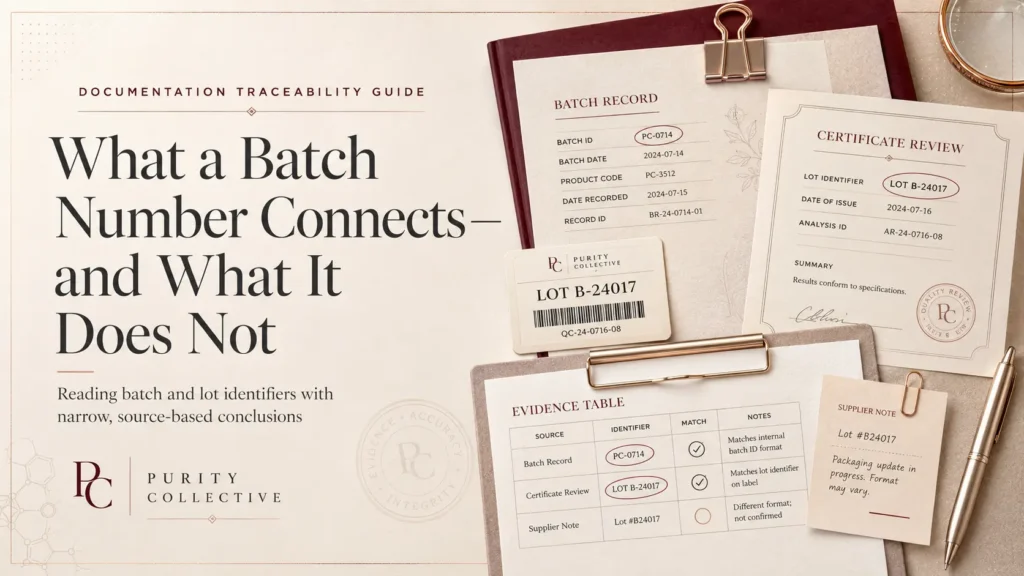
Those pages should not be collapsed into one evidence record. KPV 10mg has its own product URL, stated quantity, SKU, and linked documents. KLOW 80mg has a separate product URL, blend formulation, SKU, lot references, and linked documents. A standalone KPV report should not be used to characterize the KLOW blend, and a KLOW component panel should not be treated as a replacement for the standalone KPV page.
How to review the KPV 10mg documents
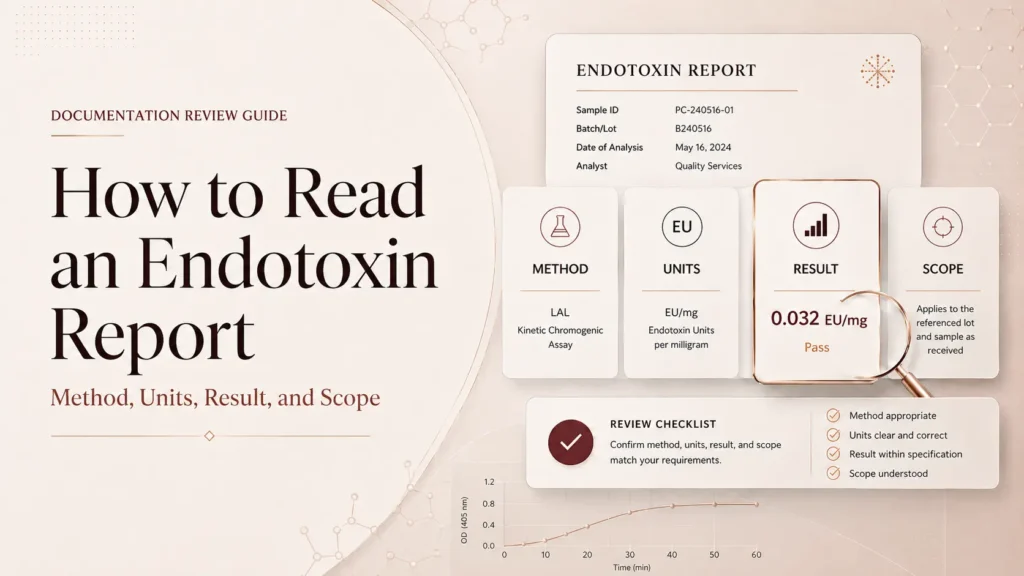
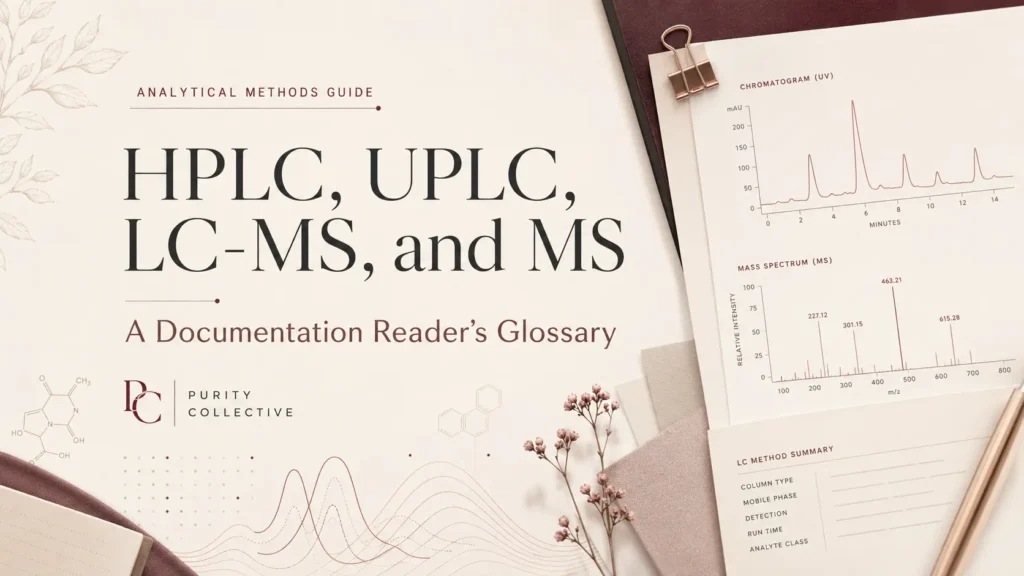
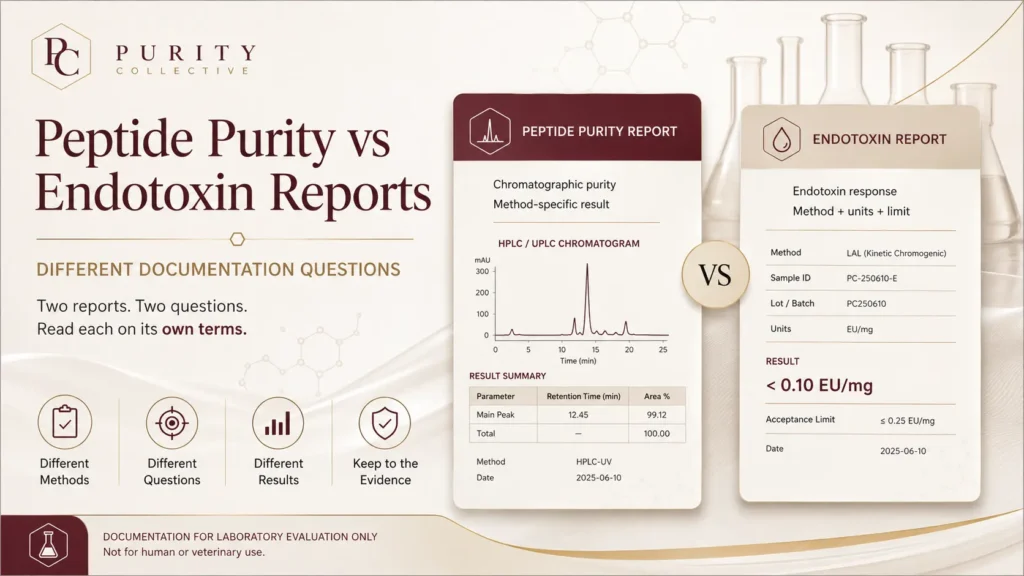
The KPV 10mg product page links a KPV 10mg UPLC/MS report and a separate KPV endotoxin report. The page states that the UPLC/MS report identifies lot PCCL-4451178, lists a 10mg specification, records a 10.15mg quantity result, and records a 99.28% purity result for the submitted sample. The separate endotoxin report records 0.075 EU/mL for the same compound and lot, while the public product page notes that no endotoxin acceptance specification is printed.
Those numbers are useful only when they stay attached to their source. A quantity result is not a universal product promise. A purity result is not a complete supplier-qualification record. An endotoxin number without a printed acceptance specification should not be converted into a pass statement. The safest review habit is to write down the product URL, report name, lot, method, date fields, specification fields, and result together.
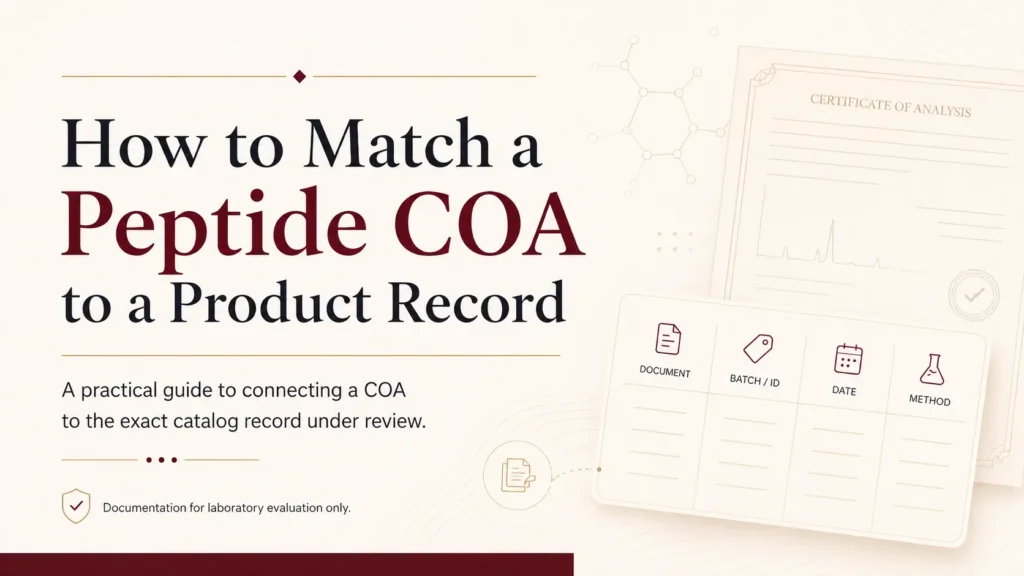
If a public chemistry source and a lab PDF present different identity fields such as CID, formula, or molecular weight, keep the difference visible instead of blending the records. Public identity pages help with external name matching. Product-linked lab documents describe the submitted sample and the fields printed by that laboratory. The COA review guide explains how to compare those fields without stretching a sample result into a broader claim.
How to review the KLOW 80mg blend
The KLOW 80mg Peptide Blend page lists four components: BPC-157 10mg, TB-500 10mg, GHK-Cu 50mg, and KPV 10mg. It links an eight-page KLOW component UPLC/MS report and a separate KLOW endotoxin document.
A blend document should be read component by component. The current KLOW page states separate reported quantity and purity results for BPC-157, TB-500, GHK-Cu, and KPV. It does not state one blend-wide purity percentage. That distinction matters for search copy and product copy: a blend can be ordered and reviewed as one catalog item, but each component result should stay tied to the component panel and submitted lot shown in the linked report.
The KLOW page also preserves date-sequence and endotoxin-document limitations. That is good catalog hygiene. If a report prints analysis and receipt dates in an unusual order, or if a document does not print an acceptance specification, the public copy should keep those details visible rather than smoothing them into a broader assurance.
KPV and KLOW product-record checklist
- Choose the exact record first: standalone KPV 10mg or KLOW 80mg Peptide Blend.
- Match the product URL, title, listed quantity, SKU, format statement, and linked documents.
- For KPV 10mg, keep the 10.15mg, 99.28%, and 0.075 EU/mL results tied to lot PCCL-4451178 and the report where each value appears.
- For KLOW 80mg, review the BPC-157, TB-500, GHK-Cu, and KPV component panels separately.
- Do not transfer standalone KPV evidence to the KLOW blend, or KLOW component evidence to the standalone KPV product.
- Use public sources such as PubChem and FDA for identity context, not as product-specific lot evidence.
KPV FAQs
What is KPV?
KPV commonly refers to Lys-Pro-Val, a three-amino-acid sequence. For Purity Collective review, the practical question is which product page, quantity, lot record, and linked analytical document are being evaluated.
Which Purity Collective page is the standalone KPV listing?
The standalone listing is KPV 10mg, supplied as a lyophilized vial for qualified laboratory research.
What documents are linked for KPV 10mg?
The current product page links a KPV 10mg UPLC/MS report and a separate KPV endotoxin report. Each file should be reviewed as its own record with its own lot, date, method, specification, and result fields.
What is KLOW 80mg?
KLOW 80mg is a Purity Collective blend listing that identifies BPC-157 10mg, TB-500 10mg, GHK-Cu 50mg, and KPV 10mg as its four listed components.
Can KPV 10mg documents support the KLOW blend?
No. The KPV 10mg documents belong to the standalone KPV product page. KLOW has its own blend documents and should be reviewed as a separate catalog record.
Is KPV intended for human use on this site?
No. Purity Collective’s KPV and KLOW listings are for qualified laboratory research only and are not for human or veterinary administration.