
Glutathione research guide
Glutathione is a compound name that appears in chemistry databases, research catalogs, and consumer-facing search results. Those search results can mix very different intents. A qualified catalog reviewer usually needs a narrower answer: which Glutathione product page is being evaluated, what quantity is listed, which documents are attached, and which statements should not be transferred from one variant to another.
This guide keeps the scope on Purity Collective’s non-nasal Glutathione vial records. It is written for identity, quantity comparison, internal linking, and analytical-document review only. It does not provide human-use instructions, veterinary-use instructions, preparation instructions, clinical language, or outcome claims.
Glutathione identity at a glance
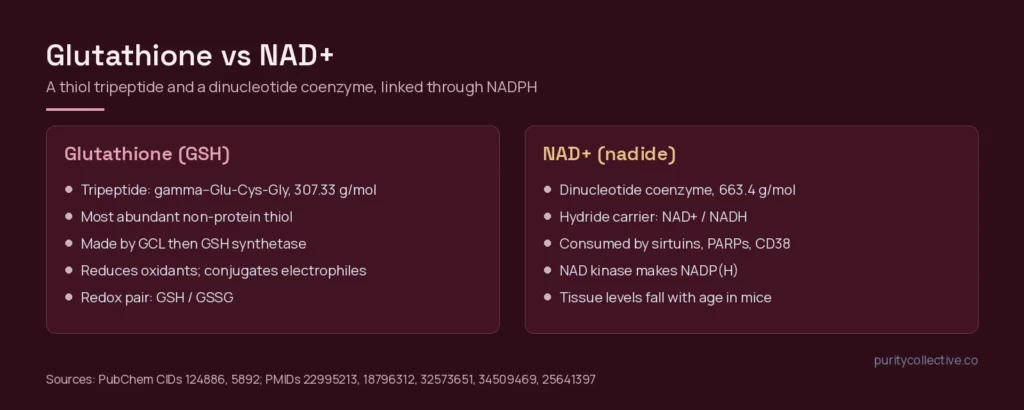
PubChem lists Glutathione under CID 124886, with formula C10H17N3O6S and molecular weight 307.33. Public identity records are useful for name matching, formula checks, and synonym review. They are not product-specific lot documents, and they do not prove that a commercial vial matches a submitted sample.
FDA’s openFDA UNII documentation explains that the Substance Registration System and Unique Ingredient Identifiers are used to support substance identification across regulated-product data. That identity infrastructure can help explain why precise names matter, but an identifier or database record should not be rewritten as product approval, suitability, or a batch-level result for a separate catalog listing.
How Purity Collective separates Glutathione vial records
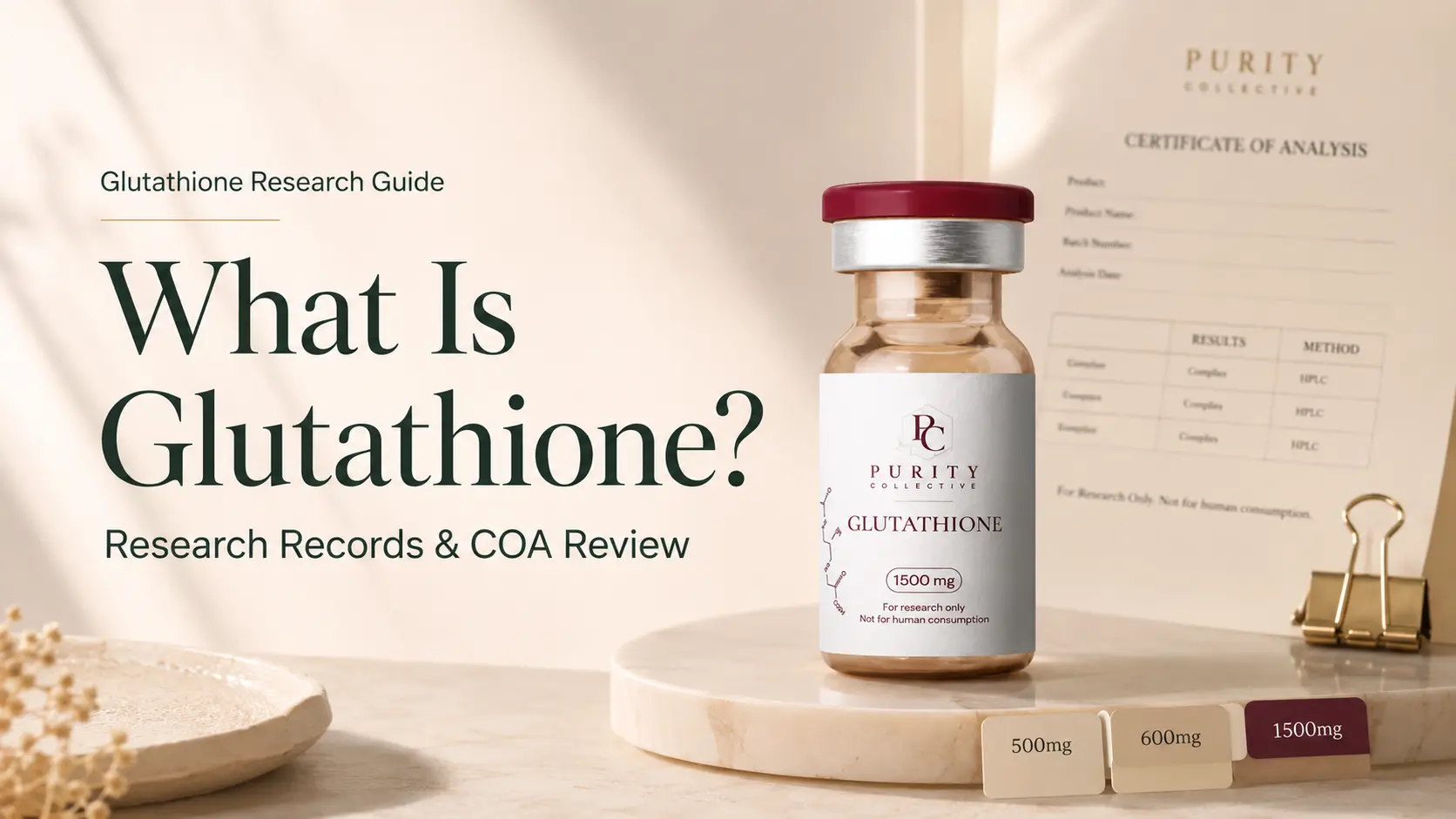
Purity Collective currently separates the non-nasal Glutathione vial records by exact quantity and product page:
- Glutathione 500mg: a lyophilized vial listing with product-level UPLC/MS and endotoxin documents linked from the product page.
- Glutathione 600mg: a separate lyophilized vial listing whose page currently states that no product-specific analytical PDF is visible.
- Glutathione 1500mg vial: a higher-quantity vial listing whose page currently states that no product-specific analytical report is linked.
That separation matters. A visitor may search “glutathione” broadly, but the review should happen at the exact product URL, exact listed quantity, and exact document package. A report from one quantity should not be used as evidence for another quantity unless the product record clearly reconciles the lot relationship.
It also helps keep commercial pages useful. The product page should answer what is being offered, what quantity is listed, what format is shown, and which documents are currently visible. The guide can explain how to compare those records, but the final evidence still belongs to the page and file being reviewed.
How to review the Glutathione 500mg documents
The 500mg page currently links a Glutathione 500mg UPLC/MS report and a separate Glutathione 500mg endotoxin report. Those documents should be reviewed beside the exact product page where they appear. Check the compound name, lot or submitted-sample reference, report type, method, date fields, specification fields, and results.
The UPLC/MS report and endotoxin report answer different analytical questions. A quantity or percentage printed in one report should stay tied to the submitted sample and method. The endotoxin report should be read as its own document, not as a substitute for identity or quantity review. A linked report is not a universal claim about every unit, a complete quality system, or proof of human suitability.
When a reviewer sees a numerical result, the safer habit is to write down the report name, lot reference, method, and date beside the result. That prevents the number from becoming detached from the document that produced it. Detached numbers are where catalog copy can accidentally sound broader than the evidence.
How to handle the 600mg and 1500mg documentation gaps
The 600mg and 1500mg vial pages are still useful catalog records, but they should not inherit the 500mg document package. Their current public pages disclose documentation status, and that disclosure should remain visible until product-specific records are attached and matched to the exact listing.
For procurement review, this means the 600mg and 1500mg pages should be evaluated by product title, visible quantity, URL, SKU where shown, price, stock status, format statement, and any current documentation supplied with the saleable lot. If a document is later supplied, match it to that product page before using its results in public copy.
This approach protects both search quality and buyer clarity. A documentation-status page can still be indexable and useful, but it should not pretend to have the same evidence as a page with current linked reports. The honest distinction is part of the page’s value.
A practical Glutathione product-record checklist
- Confirm whether the review concerns 500mg, 600mg, or 1500mg.
- Open only the documents linked from the exact product page being reviewed.
- Check compound name, listed quantity, lot reference, report type, method, dates, specifications, and results.
- Do not transfer the 500mg document package to the 600mg or 1500mg listings.
- Use the COA guide to separate document evidence from unsupported claims.
- Keep the review inside qualified laboratory research.
Glutathione FAQs
What is Glutathione?
Glutathione is a compound name listed in public chemistry records. For Purity Collective product review, the name should be matched to the exact catalog listing and document package being evaluated.
Which Glutathione vial page should I review first?
Start with the exact quantity needed for the catalog review: Glutathione 500mg, Glutathione 600mg, or Glutathione 1500mg vial.
Are the 500mg, 600mg, and 1500mg listings interchangeable?
No. They are separate catalog records with different quantities and document status. Each page should be reviewed on its own product facts.
What documents are available for Glutathione 500mg?
The current 500mg page links a UPLC/MS report and a separate endotoxin report. Those documents should be reviewed as product-page-specific records with their own scope and limitations.
Can the Glutathione 500mg documents support the 600mg or 1500mg pages?
No. The 500mg documents belong to the 500mg listing unless a current product record explicitly reconciles another quantity to the same document package.
Is Glutathione intended for human use on this site?
No. Purity Collective’s Glutathione vial listings are for qualified laboratory research only and are not for human or veterinary administration.