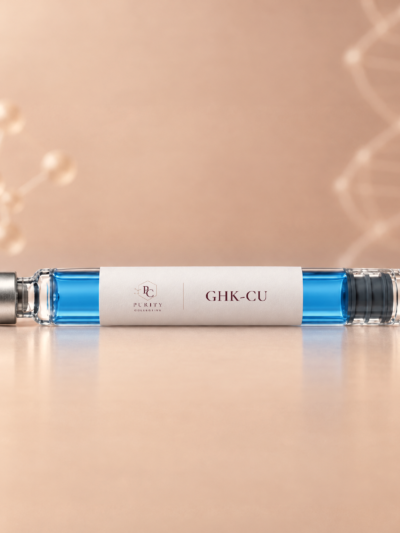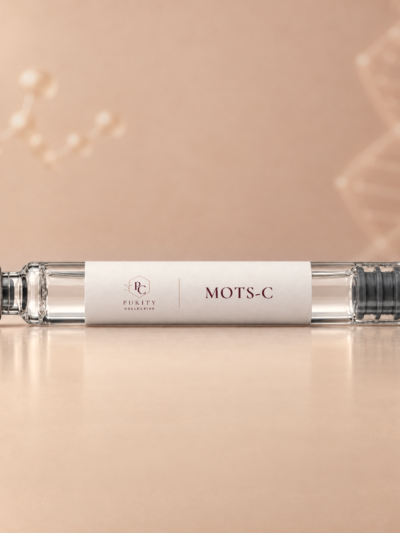

For laboratory research only. Not for human or animal use. This article gives no dosing, administration or therapeutic advice.
Short answer: a lyophilized vial and a nasal spray are not two packages of the same thing. A vial record documents a dry solid: one lot, its total peptide content, purity and identity. A spray record documents a solution, so it also needs the volume or concentration, the solvent and any buffer or preservative, and its stability depends on chemistry that runs faster in water.[1][2] Intranasal delivery itself is an active research area in animal models, with several null human trials.[3][4][5] This article compares what each format’s records can tell a lab. It gives no preparation, handling or administration instructions.
What a vial record and a spray record each describe
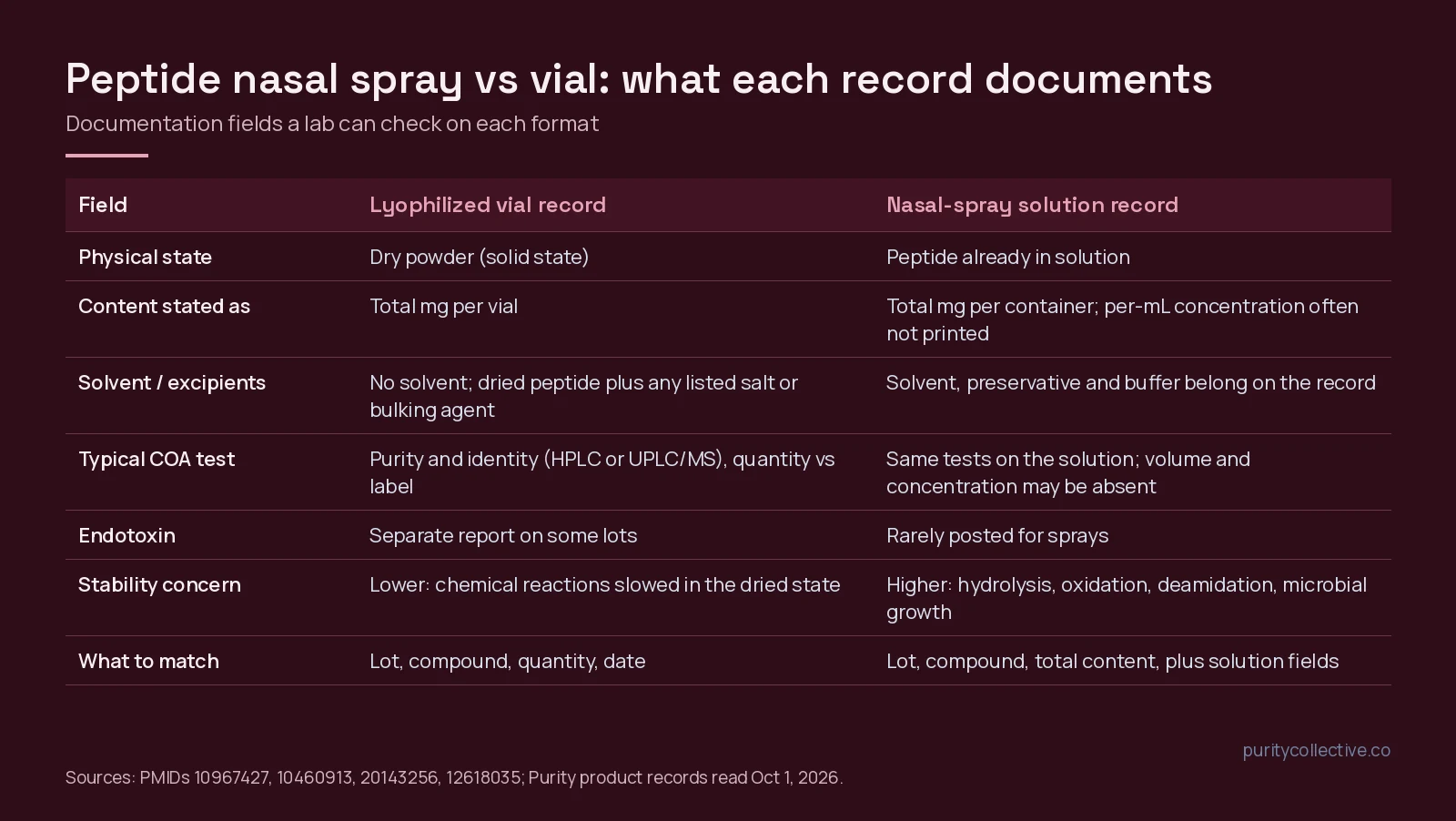
A lyophilized vial holds freeze-dried peptide. The useful numbers are absolute: the labeled amount, the measured amount, the purity by chromatography and an identity check. Nothing else is in the record because nothing else is supposed to be in the vial except any listed salt form or bulking agent.
A spray is a finished solution. To describe it fully, a record needs the peptide’s total content, the fill volume or per-mL concentration, the solvent, and any preservative, buffer or tonicity agent. Purity’s spray listings give a total content and a spray count in the size field, for example on the Selank Nasal Spray 5mg record, but they do not list the solvent or excipients. That is not unusual for research listings, and it is the first thing to ask about when you compare formats.
| Documentation field | Lyophilized vial | Nasal-spray solution |
|---|---|---|
| Physical state | Dry solid | Aqueous or mixed-solvent solution |
| Content expressed as | Total mg per vial | Total mg per container; concentration per mL needed for a complete record |
| Solvent and excipients | Usually none beyond salt form or bulking agent | Solvent, buffer, preservative, tonicity agent |
| Main chemical risks | Slowed in the dried state; stresses during freezing and drying[2] | Hydrolysis, oxidation, deamidation, aggregation in solution[1][6] |
| Microbial risk | Low while dry and sealed | Relevant for multi-use solutions; why preservatives are used |
| What a COA usually reports | Purity, identity, measured vs labeled content; endotoxin on some lots | Purity, identity, total content; volume, concentration and excipients often absent |
| Stability data to look for | Lot date and the product’s storage statement | Solution stability data for that formulation, if published |
Why peptides behave differently in solution
The formulation literature is consistent on the basic point. Proteins and peptides face physical and chemical instability, and in aqueous solution the main pathways include hydrolysis, deamidation, oxidation and aggregation; these are the reasons many protein drugs are made as solids rather than liquids.[1][6] Lyophilization trades those solution risks for freezing and drying stresses, and excipients such as sugars are used to protect the molecule in the dried state.[2] A 2010 review added that chemical and physical instability are linked: one can trigger the other.[6]
Peptide sequence matters too, because oxidation, deamidation and enzymatic cleavage act on particular residues and bonds, and short peptides are substrates for peptidases. A tritium-labeling study tracked Selank in rat brain after intranasal application and identified TKPRP, TKP, RP and GP as its main breakdown products; the same work characterized Semax degradation in the presence of nerve cells.[7] None of this sets a shelf life for a particular spray. It explains why a spray’s stability is a formulation question, answered only by data on that formulation.
What intranasal research has looked at
Intranasal delivery is studied because it may give some molecules access to the central nervous system through olfactory and trigeminal pathways, bypassing part of the blood-brain barrier.[3] The same reviews describe the limits: nasal enzymes, mucociliary clearance and the small absorptive area restrict how much of a peptide crosses the nasal membrane, and formulation strategies exist to improve it.[8][3]
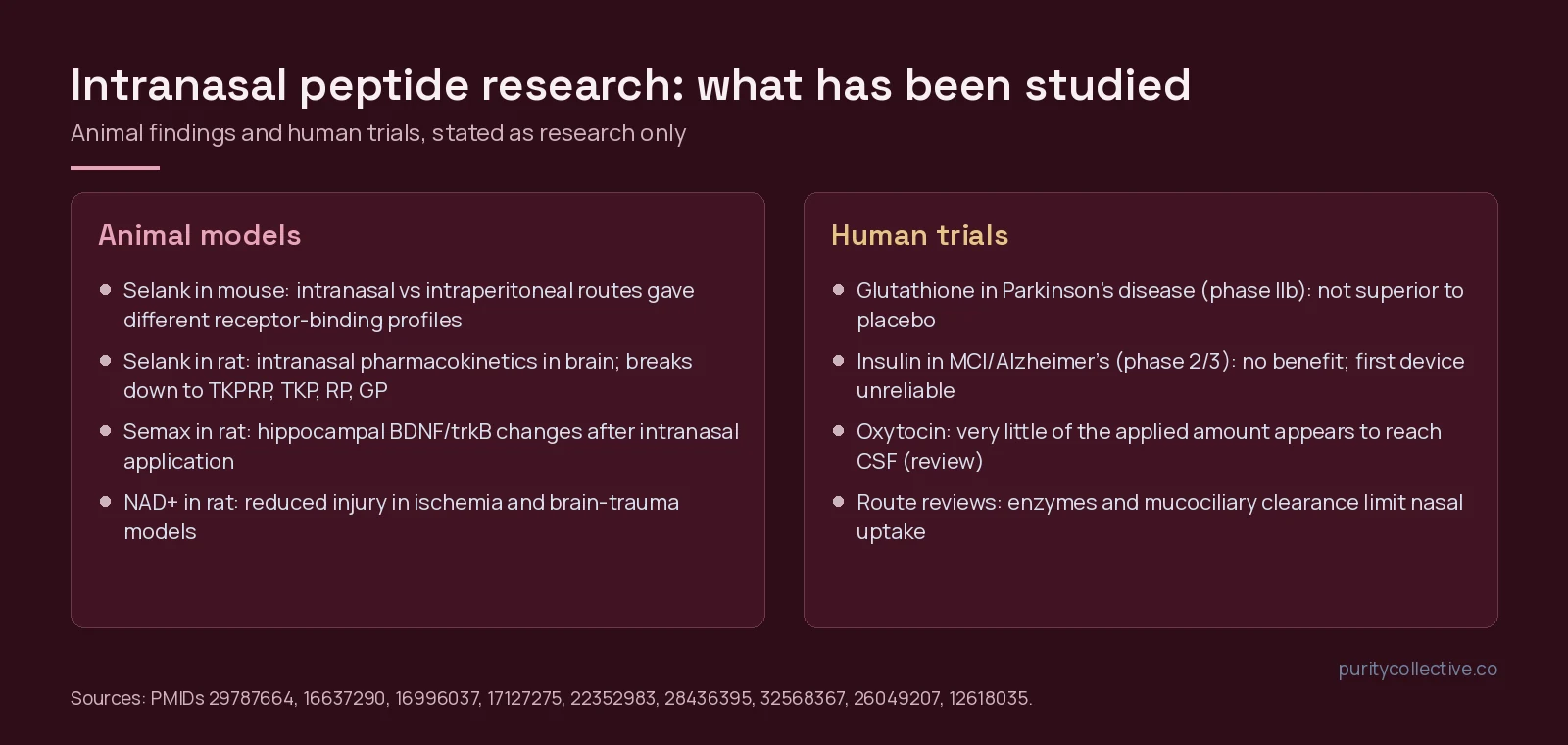
| Compound | Model | What was reported | Ref |
|---|---|---|---|
| Selank | BALB/c and C57BL/6 mice | Intranasal and intraperitoneal routes produced different behavioral and receptor-binding profiles | [9] |
| Selank, Semax | Rat brain; nerve-cell cultures | Brain pharmacokinetics after intranasal Selank; main degradation products identified | [7] |
| Semax | Rat hippocampus | Changes in BDNF and trkB expression and activation | [10] |
| NAD+ | Rat transient focal ischemia | Less ischemic brain damage; intranasal nicotinamide did not reduce damage | [11] |
| NAD+ | Rat traumatic brain injury | Less neuron death; superoxide production and PARP-1 accumulation not inhibited | [12] |
| Glutathione | Human, Parkinson’s disease, phase IIb | All groups improved, including placebo; neither active group superior to placebo | [4] |
| Insulin | Human, MCI and Alzheimer’s, phase 2/3 | No cognitive or functional benefit; first delivery device had inconsistent reliability | [5] |
| Oxytocin | Review of human and animal data | Very little of the applied amount appears to reach CSF; peripheral levels rise | [13] |
The insulin trial carries a lesson for format comparisons: its first device was unreliable, so the investigators changed devices and analyzed the later cohort as the primary population.[5] With a spray, the device and the solution are part of what is being tested.
How COAs differ by format at Purity
Here is what the product pages link for three compounds sold in both formats, read from the reports themselves on October 1, 2026:
| Listing | Posted report | What it shows |
|---|---|---|
| Selank 10mg (vial) | Horizon Analytical, lot PCCL-240644, analyzed 04/26/2026 | 10.21 mg vs 10mg spec; purity 99.37%; endotoxin <0.05 EU/mL |
| Selank Nasal Spray 5mg | None | A batch COA for this product isn’t posted yet. |
| Semax 10mg (vial) | Horizon Analytical, lot PCCL-1902514-P, analyzed 05/04/2026 | 9.8 mg vs 10mg spec; purity 99.18%; endotoxin <0.05 EU/mL |
| Semax Nasal Spray 5mg | None | A batch COA for this product isn’t posted yet. |
| NAD+ 500mg (vial) | Horizon Analytical, lot PCCL-7932744-P, analyzed 05/04/2026 | 497 mg vs 500mg spec; purity 99.39%; endotoxin <0.05 EU/mL |
| NAD+ Nasal Spray 500mg | Bioviridian COA7122, lot 80-202607-78, issued 07/17/2026 | Identity NAD+ by LC-MS/MS; content 504.27 mg by HPLC; purity 99.8% (RP-HPLC). No volume, concentration, excipient or endotoxin line. |
The pattern holds beyond these three: the Glutathione 1500mg and AOD-9604 sprays also have no spray-specific report, while their vial counterparts do. Notice, too, that the NAD+ spray report states total content in milligrams, not a concentration, so it confirms what is in the container without describing the solution. Our existing overview of nasal spray research peptides lists every spray record, every posted report is in the COA library, and the main catalog page explains how to buy research peptides online in the USA by category.
Storage considerations from the literature
The formulation reviews cited here describe the dried state as the more stable one for peptides and proteins, and freeze-thaw cycles as a stress in their own right.[2][1] Solutions add hydrolysis, oxidation and microbial growth to the list.[1][6] For any specific product, the storage statement on its own label and record is the reference; general literature cannot replace formulation-specific stability data.
What the evidence does not show
- It does not show sprays and vials are interchangeable. Different physical states carry different stability risks and different documentation needs.[1][2]
- It does not show reliable nose-to-brain delivery in people. Glutathione and insulin trials missed their primary outcomes, and oxytocin data suggest little reaches CSF.[4][5][13]
- It does not show animal intranasal results translate. The Selank, Semax and NAD+ findings above are rodent studies.[9][10][11]
- It does not give a shelf life for any spray. Stability is formulation-specific, and no spray-specific stability data were posted on the records reviewed.
- A vial COA does not qualify a spray. Each report covers one lot in one format.
Frequently asked questions
What is the main documentation difference between a peptide nasal spray and a vial?
A lyophilized vial record describes a dry solid: total peptide content, purity and identity for one lot. A nasal-spray record describes a solution, so a complete record also needs the volume or per-mL concentration and the solvent, buffer and preservative. Those solution fields are often missing from spray listings and reports.
Are peptides less stable in a spray solution than in a dried vial?
Generally, yes. Formulation reviews describe hydrolysis, oxidation, deamidation and aggregation as faster in aqueous solution, which is why many peptide and protein products are made as lyophilized solids for shelf life. Stability for a specific spray depends on its formulation and should come from that product’s own data.
Does intranasal research show that peptides reach the brain?
Animal and some human studies describe nose-to-brain transport routes, but uptake is limited by nasal enzymes and mucociliary clearance, and a review of oxytocin found very little of the applied amount appears to reach cerebrospinal fluid. Human trials of intranasal glutathione and insulin did not beat placebo on their primary outcomes.
Do Purity’s nasal sprays have their own COAs?
Of the spray and vial pairs reviewed for this article on October 1, 2026, only the NAD+ Nasal Spray 500mg has a spray-specific report posted (Bioviridian COA7122). The Selank, Semax, Glutathione and AOD-9604 sprays have no spray-specific report yet, while the matching vials do.
Can a vial COA be used to qualify a spray of the same compound?
No. A COA describes one lot in one format. A vial report shows the dry peptide’s identity and purity; it says nothing about a spray’s concentration, solvent, excipients or stability in solution.
References
- Wang W (1999). Instability, stabilization, and formulation of liquid protein pharmaceuticals. Int J Pharm. PMID: 10460913. doi: 10.1016/s0378-5173(99)00152-0.
- Wang W (2000). Lyophilization and development of solid protein pharmaceuticals. Int J Pharm. PMID: 10967427. doi: 10.1016/s0378-5173(00)00423-3.
- Lochhead JJ, Thorne RG (2012). Intranasal delivery of biologics to the central nervous system. Adv Drug Deliv Rev. PMID: 22119441. doi: 10.1016/j.addr.2011.11.002.
- Mischley LK, Lau RC, Shankland EG et al. (2017). Phase IIb Study of Intranasal Glutathione in Parkinson’s Disease. J Parkinsons Dis. PMID: 28436395. doi: 10.3233/JPD-161040.
- Craft S, Raman R, Chow TW et al. (2020). Safety, Efficacy, and Feasibility of Intranasal Insulin for the Treatment of Mild Cognitive Impairment and Alzheimer Disease Dementia: A Randomized Clinical Trial. JAMA Neurol. PMID: 32568367. doi: 10.1001/jamaneurol.2020.1840.
- Manning MC, Chou DK, Murphy BM et al. (2010). Stability of protein pharmaceuticals: an update. Pharm Res. PMID: 20143256. doi: 10.1007/s11095-009-0045-6.
- Zolotarev IuA, Dadaian AK, Dolotov OV et al. (2006). [Evenly tritium-labeled peptides and their in vivo and in vitro biodegradation]. Bioorg Khim. PMID: 16637290.
- Illum L (2003). Nasal drug delivery–possibilities, problems and solutions. J Control Release. PMID: 12618035. doi: 10.1016/s0168-3659(02)00363-2.
- Vasil’eva EV, Kondrakhin EA, Salimov RM et al. (2016). [COMPARISON OF PHARMACOLOGICAL EFFECTS OF HEPTAPEPTIDE SELANK AFTER INTRANASAL AND INTRAPERITONEAL ADMINISTRATION TO BALB/c AND C57BL/6 MICE.]. Eksp Klin Farmakol. PMID: 29787664.
- Dolotov OV, Karpenko EA, Inozemtseva LS et al. (2006). Semax, an analog of ACTH(4-10) with cognitive effects, regulates BDNF and trkB expression in the rat hippocampus. Brain Res. PMID: 16996037. doi: 10.1016/j.brainres.2006.07.108.
- Ying W, Wei G, Wang D et al. (2007). Intranasal administration with NAD+ profoundly decreases brain injury in a rat model of transient focal ischemia. Front Biosci. PMID: 17127275. doi: 10.2741/2267.
- Won SJ, Choi BY, Yoo BH et al. (2012). Prevention of traumatic brain injury-induced neuron death by intranasal delivery of nicotinamide adenine dinucleotide. J Neurotrauma. PMID: 22352983. doi: 10.1089/neu.2011.2228.
- Leng G, Ludwig M (2016). Intranasal Oxytocin: Myths and Delusions. Biol Psychiatry. PMID: 26049207. doi: 10.1016/j.biopsych.2015.05.003.