
For laboratory research only. Not for human or animal use. This article gives no dosing, administration or therapeutic advice.
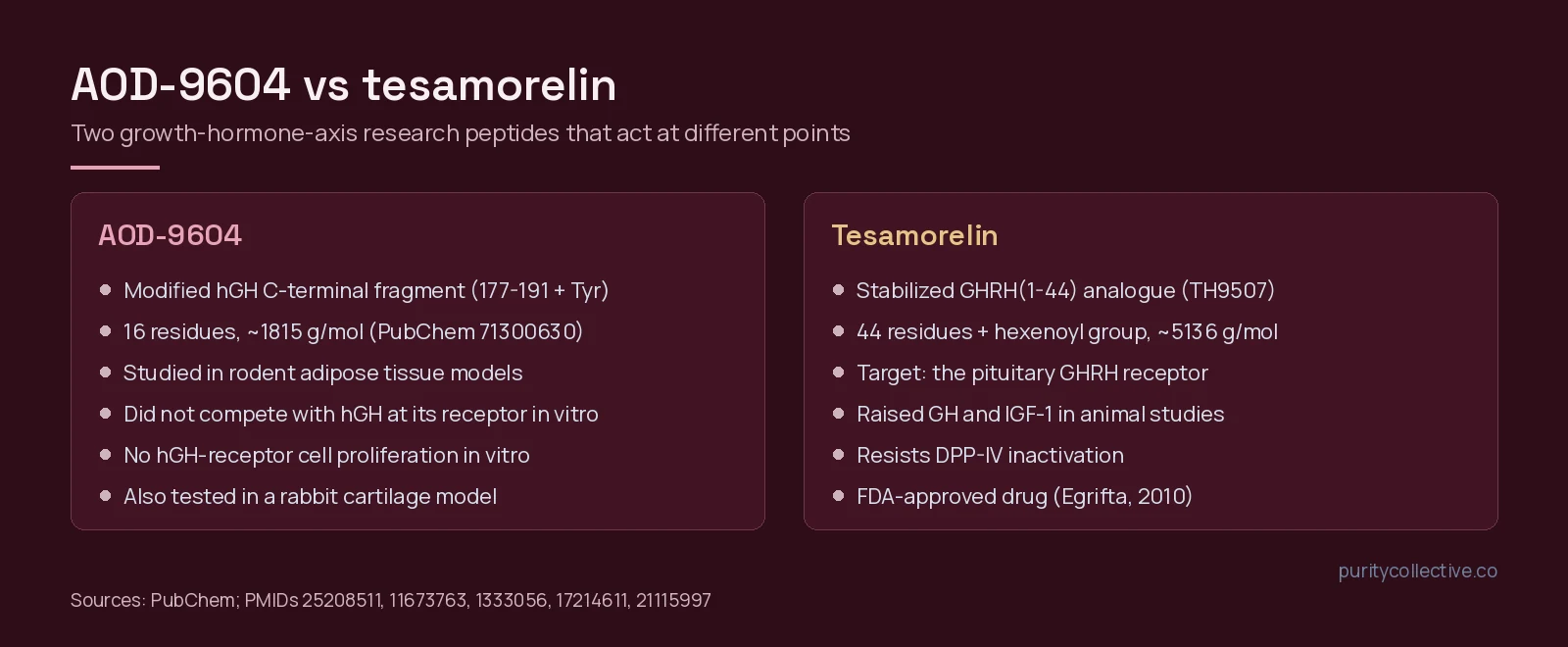
Short answer: AOD-9604 and tesamorelin both come out of growth hormone (GH) research, but they work at different points. AOD-9604 is a small piece of the GH molecule itself: residues 177–191 of human GH with an extra tyrosine added at the front [1]. In mouse and cell work it did not bind the GH receptor [2]. Tesamorelin is a stabilized copy of the hypothalamic hormone GHRH(1-44). It acts one step earlier, at the pituitary GHRH receptor, and raises GH and IGF-1 [3][4]. One is a fragment of the hormone; the other works upstream on the gland that releases it.
AOD-9604 vs tesamorelin at a glance
| Feature | AOD-9604 | Tesamorelin |
|---|---|---|
| What it is | Modified C-terminal fragment of human GH (177–191 plus an N-terminal tyrosine) [1] | GHRH(1-44) analogue with a trans-3-hexenoyl group on Tyr1 (code TH9507) [3] |
| Where it acts | Adipose tissue in the published models. Did not compete for hGH receptor binding in vitro [2] | The GHRH receptor, a G protein-coupled receptor found mainly in the anterior pituitary [5] |
| Effect on GH and IGF-1 | Not a GH secretagogue. Studied for lipolytic and antilipogenic actions of the GH C-terminus [6][7] | Raises GH and IGF-1 in pigs, rats and dogs [3], and increases basal and pulsatile GH secretion in human pharmacokinetic work [4] |
| Main research models | Rat fat pads, obese Zucker rats, ob/ob and β3-adrenergic receptor knockout mice, a rabbit knee model [6][7][8][9] | Non-clinical pharmacology and toxicology in rats and dogs [3]. Randomized human trials in adults with HIV [10][11] |
| Regulatory status (US) | Not approved as a drug. Banned in sport by WADA [1] | Approved by the FDA in 2010 as Egrifta, for an HIV-associated lipodystrophy indication [12] |
Identity of each compound
| Compound | Length | Formula | MW (g/mol) | PubChem CID |
|---|---|---|---|---|
| AOD-9604 | 16 residues | C78H123N23O23S2 | 1815.1 | 71300630 |
| Tesamorelin (free peptide) | 44 residues plus hexenoyl group | C221H366N72O67S | 5136 | 16137828 |
| Tesamorelin (acetate salt record) | Same peptide, salt form | C223H370N72O69S | 5196 | 44147413 |
The size gap matters on a lab report. AOD-9604 is about one third the mass of tesamorelin, so a mass spectrum or a printed molecular weight tells the two apart at a glance. The tesamorelin acetate record differs from the free peptide by one acetic acid unit. That is why a report can print about 5196 g/mol for the same peptide PubChem lists at 5136 g/mol.
AOD-9604: a fragment of growth hormone
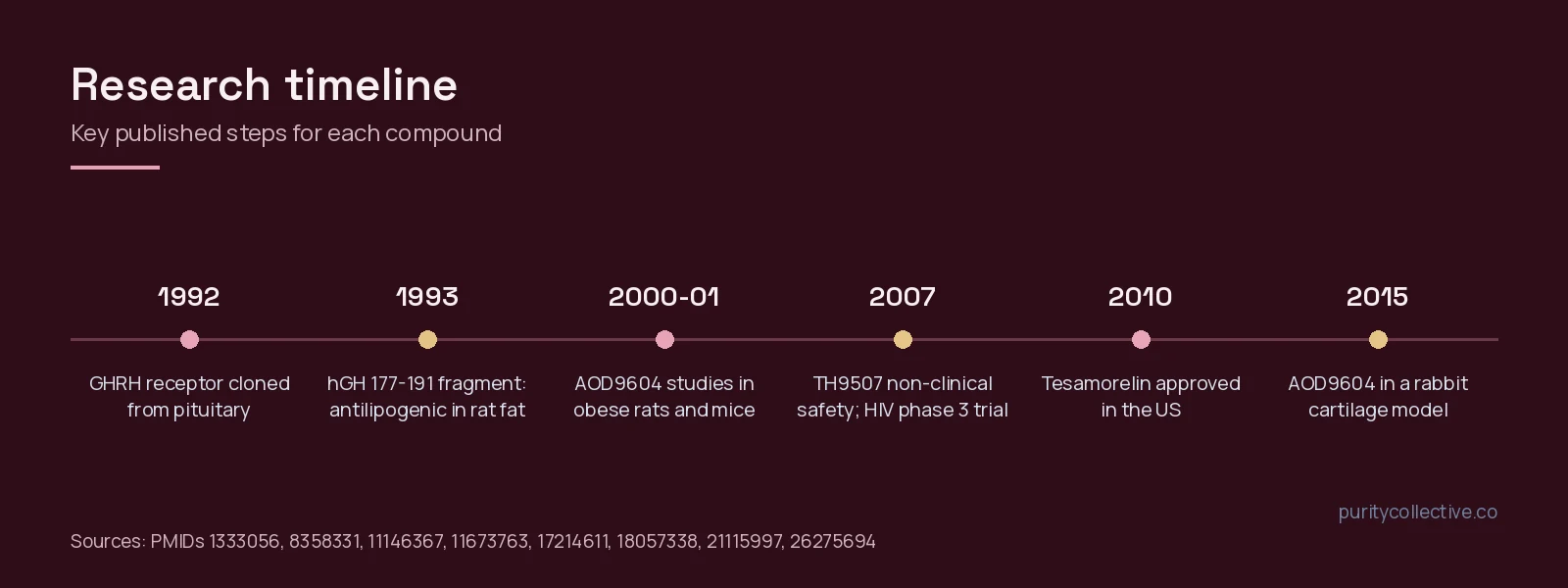
The idea behind AOD-9604 goes back to work on the C-terminal end of human GH. In 1993, a synthetic hGH 177–191 peptide showed antilipogenic activity matching intact GH in rat adipose tissue. The same study found no significant lipolytic effect from that fragment, measured as glycerol release from rat fat pads [6]. The authors read this as evidence that the region controlling GH’s effect on fat building sits near the C-terminus.
AOD-9604 adds a tyrosine to that fragment [1]. In obese Zucker rats, adipose tissue from treated animals showed higher lipolytic activity, and body-weight gain over the study was lower than in controls. Unlike chronic intact GH, the fragment did not worsen insulin sensitivity on euglycemic clamp testing [7]. In ob/ob mice, both hGH and AOD-9604 reduced body-weight gain and raised fat oxidation and plasma glycerol. AOD-9604 did not cause hyperglycemia or lower insulin secretion. In cells carrying the hGH receptor, it did not compete for receptor binding and did not drive cell proliferation, while hGH did both [2].
A follow-up asked whether the β3-adrenergic receptor carries the effect. Both compounds raised β3-receptor RNA in obese mice. In β3-receptor knockout mice, longer treatment did not reproduce the body-weight and lipolysis changes seen in wild-type mice. Even so, an acute dose still raised energy expenditure and fat oxidation in the knockouts. The authors concluded the lipolytic action is not mediated directly through that receptor [8]. So the exact target of AOD-9604 is still not settled in the papers we found.
A separate line of work moved away from fat. In a collagenase-induced knee osteoarthritis model in rabbits, injections into the joint were compared with hyaluronic acid and saline. Groups given AOD-9604, alone or with hyaluronic acid, had lower cartilage degeneration scores than saline. The combination scored better than either alone [9]. That is one animal study from one group, and we found no replication.
Because AOD-9604 is a GH fragment rather than GH, it does not register in the WADA hGH isoform immunoassay [13]. Anti-doping labs detect it with a dedicated mass spectrometry method instead. That work also found that a CRSVEGSCG metabolite is more stable in serum than the parent peptide [1].
Tesamorelin: a stabilized GHRH analogue
Tesamorelin works further up the axis. Its target, the GHRH receptor, was cloned in 1992. It is a seven-transmembrane G protein-coupled receptor that binds GHRH with high affinity, raises cAMP, and is expressed mainly in the anterior pituitary [5]. Our tesamorelin research guide covers the compound on its own; here the point is the contrast.
Natural GHRH(1-44) is cut quickly by the enzyme dipeptidyl peptidase-IV. Adding a trans-3-hexenoyl group to Tyr1 made TH9507 resistant to that enzyme. It also slowed breakdown in rat, dog and human plasma and lengthened plasma elimination compared with the natural peptide. Repeat dosing raised plasma GH and IGF-1 in pigs, rats and dogs. The same non-clinical program recorded reversible adverse findings in dogs (liver and kidney findings, anemia, organ weight effects), which the authors linked to prolonged exposure [3].
In humans, a population pharmacokinetic analysis of HIV-infected patients and healthy subjects describes tesamorelin as increasing basal and pulsatile GH secretion and, after that, IGF-1 [4]. Its randomized, placebo-controlled phase 3 trials enrolled adults with HIV and abdominal fat accumulation and used visceral adipose tissue on CT as the primary endpoint [10][11]. A 26-week extension tracked adverse events and glucose parameters [14]. The FDA approved tesamorelin in 2010 [12]. We state that approval only as regulatory status, not as an efficacy claim. If you want tesamorelin set against another GHRH analogue rather than a GH fragment, see tesamorelin vs sermorelin.
Study table
| Compound | Study | Model | What was reported | Ref |
|---|---|---|---|---|
| hGH 177–191 | Antilipogenic action of the C-terminal fragment | Rat adipose tissue | Antilipogenic activity like intact hGH; no significant lipolytic effect in fat pads | [6] |
| AOD-9604 | Metabolic studies | Obese Zucker rats | Higher adipose lipolytic activity; no adverse effect on insulin sensitivity, unlike chronic hGH | [7] |
| AOD-9604 | Chronic treatment vs hGH | ob/ob and lean mice; hGH-receptor cells | Higher fat oxidation; no hyperglycemia; no hGH-receptor binding or proliferation | [2] |
| AOD-9604 | β3-adrenergic receptor role | Obese and β3-AR knockout mice | Raised β3-AR RNA; chronic effect absent in knockouts; acute effect kept | [8] |
| AOD-9604 | Intra-articular study | Rabbit knee osteoarthritis model | Lower cartilage degeneration scores than saline; more with hyaluronic acid | [9] |
| Tesamorelin | Non-clinical pharmacology and safety | Plasma in vitro; pigs, rats, dogs | DPP-IV resistance; GH and IGF-1 increases; reversible dog findings | [3] |
| Tesamorelin | Population pharmacokinetics | Adults with HIV and healthy subjects | One-compartment model; age, body size, race and health status not related to its pharmacokinetics | [4] |
| Tesamorelin | Phase 3 trials and extension | Adults with HIV and abdominal fat accumulation | Primary endpoint: visceral adipose tissue on CT; safety and glucose tracked over 52 weeks | [10][11][14] |
What the evidence does not show
- No published human results for AOD-9604 that we could find. AOD-9604 was in phase IIa obesity trials by February 2002 [15], and it was still listed as in clinical development in a 2006 review [16]. We found no peer-reviewed report of those trials’ results on PubMed, and it never reached approval. A 2026 review of approved and unapproved peptides puts AOD-9604 in the unapproved group and notes that rigorous human safety data are scarce [17].
- No head-to-head study. No paper we found compares AOD-9604 with tesamorelin directly or tests them together. Any side-by-side here comes from separate studies with different models and endpoints.
- The rodent fat results don’t carry over by default. The AOD-9604 adipose findings come from rats and mice, plus isolated tissue. The cartilage finding is one rabbit study.
- Tesamorelin’s human data are narrow. The trials studied one population, adults with HIV and abdominal fat accumulation, under medical supervision. They say nothing about other settings.
- Reviews flag uncertain supply. A 2026 review of GH-axis peptides sold as “research compounds” lists both AOD9604 and tesamorelin. It points to uncertainty about product composition in unregulated supply chains and sorts the compounds into evidence tiers [18].
Reading the product records for each compound
Identity is the first thing to check, because these are easy compounds to mislabel. AOD-9604 has turned up in confiscated vials in the USA [1] and in seized preparations analyzed by Belgian authorities [19]. GHRH analogues including tesamorelin now have published LC-MS/MS detection methods built on reference metabolites [20]. A report that confirms identity by mass spectrometry matches the formula and molecular weight in the table above.
- AOD-9604 5mg. The posted UPLC/MS report for lot DPS-4008902 (report 1020721, Horizon Analytical, analysis date July 28, 2026) confirms AOD-9604. It prints CAS 221231-10-3, PubChem CID 71300630 and about 1815.11 g/mol, which match PubChem. Purity is 99.26% against a specification above 98%. The report also prints a separate quantity result; purity and quantity answer different questions, so read both lines. The endotoxin report for the same lot (1019799) reads <0.05 EU/mL. See the AOD-9604 5mg listing.
- AOD-9604 10mg. A batch COA for this product isn’t posted yet. Check the AOD-9604 10mg page for an added report before relying on the 5mg lot’s numbers.
- Tesamorelin 10mg. The UPLC/MS report for lot PCCL-4867057-P confirms tesamorelin at 10.13 mg against a 10 mg specification, with purity of 99.23%. The matching endotoxin report (PCCL-4867057-E) reads <0.05 EU/mL. The report cites PubChem CID 44147413, the acetate salt record (about 5196 g/mol), not the free-peptide record 16137828. See the Tesamorelin 10mg listing.
Every posted report sits in the COA library. Our guide on how to read a peptide COA goes through each field. When you’re ready to buy research peptides online in the USA, match the lot number on the vial to the lot number on the report.
Frequently asked questions
What is the difference between AOD-9604 and tesamorelin?
They act at different points on the growth hormone axis. AOD-9604 is a modified fragment of growth hormone itself (residues 177–191 plus a tyrosine) and was studied in rodent fat-tissue models. Tesamorelin is a stabilized analogue of GHRH(1-44) that acts on the pituitary GHRH receptor and raises GH and IGF-1 in published studies.
Does AOD-9604 act on the growth hormone receptor?
Not in the published work we found. In cells carrying the hGH receptor, AOD-9604 did not compete for receptor binding and did not drive cell proliferation, unlike intact hGH (PMID 11673763). A mouse study also found its lipolytic action was not mediated directly through the β3-adrenergic receptor (PMID 11713213), so its exact target is not settled.
Is tesamorelin FDA-approved? Is AOD-9604?
Tesamorelin was approved by the FDA in 2010 under the brand Egrifta, for an HIV-associated lipodystrophy indication (PMID 21115997). AOD-9604 is not an approved drug. A 2026 review lists it among unapproved peptides with scarce rigorous human safety data (PMID 41966639).
Were there human trials of AOD-9604?
AOD-9604 entered phase IIa obesity trials by February 2002 (PMID 15134286) and was still listed as in clinical development in 2006 (PMID 16625817). We found no peer-reviewed report of those trials’ results on PubMed, and it was never approved.
What should a lab check on the COA for each compound?
Check identity by mass spectrometry against the expected molecular weight (about 1815 g/mol for AOD-9604, about 5136 g/mol for free tesamorelin or about 5196 g/mol for the acetate record), then the purity percentage, the measured quantity against the label, the endotoxin result and the lot number. Purity Collective’s posted reports are in the COA library.
References
- Cox HD, Smeal SJ, Hughes CM et al. (2015). Detection and in vitro metabolism of AOD9604. Drug Test Anal. PMID: 25208511. doi: 10.1002/dta.1715.
- Heffernan MA, Thorburn AW, Fam B et al. (2001). Increase of fat oxidation and weight loss in obese mice caused by chronic treatment with human growth hormone or a modified C-terminal fragment. Int J Obes Relat Metab Disord. PMID: 11673763. doi: 10.1038/sj.ijo.0801740.
- Ferdinandi ES, Brazeau P, High K et al. (2007). Non-clinical pharmacology and safety evaluation of TH9507, a human growth hormone-releasing factor analogue. Basic Clin Pharmacol Toxicol. PMID: 17214611. doi: 10.1111/j.1742-7843.2007.00008.x.
- González-Sales M, Barrière O, Tremblay PO et al. (2015). Population pharmacokinetic analysis of tesamorelin in HIV-infected patients and healthy subjects. Clin Pharmacokinet. PMID: 25358450. doi: 10.1007/s40262-014-0202-x.
- Mayo KE (1992). Molecular cloning and expression of a pituitary-specific receptor for growth hormone-releasing hormone. Mol Endocrinol. PMID: 1333056. doi: 10.1210/mend.6.10.1333056.
- Wu Z, Ng FM (1993). Antilipogenic action of synthetic C-terminal sequence 177-191 of human growth hormone. Biochem Mol Biol Int. PMID: 8358331.
- Ng FM, Sun J, Sharma L et al. (2000). Metabolic studies of a synthetic lipolytic domain (AOD9604) of human growth hormone. Horm Res. PMID: 11146367. doi: 10.1159/000053183.
- Heffernan M, Summers RJ, Thorburn A et al. (2001). The effects of human GH and its lipolytic fragment (AOD9604) on lipid metabolism following chronic treatment in obese mice and beta(3)-AR knock-out mice. Endocrinology. PMID: 11713213. doi: 10.1210/endo.142.12.8522.
- Kwon DR, Park GY (2015). Effect of Intra-articular Injection of AOD9604 with or without Hyaluronic Acid in Rabbit Osteoarthritis Model. Ann Clin Lab Sci. PMID: 26275694.
- Falutz J, Allas S, Blot K et al. (2007). Metabolic effects of a growth hormone-releasing factor in patients with HIV. N Engl J Med. PMID: 18057338. doi: 10.1056/NEJMoa072375.
- Falutz J, Mamputu JC, Potvin D et al. (2010). Effects of tesamorelin (TH9507), a growth hormone-releasing factor analog, in human immunodeficiency virus-infected patients with excess abdominal fat: a pooled analysis of two multicenter, double-blind placebo-controlled phase 3 trials with safety extension data. J Clin Endocrinol Metab. PMID: 20554713. doi: 10.1210/jc.2010-0490.
- Traynor K (2010). FDA approves tesamorelin for HIV-related lipodystrophy. Am J Health Syst Pharm. PMID: 21115997. doi: 10.2146/news100082.
- Orlovius AK, Thomas A, Schänzer W et al. (2013). AOD-9604 does not influence the WADA hGH isoform immunoassay. Drug Test Anal. PMID: 24124033. doi: 10.1002/dta.1557.
- Falutz J, Allas S, Mamputu JC et al. (2008). Long-term safety and effects of tesamorelin, a growth hormone-releasing factor analogue, in HIV patients with abdominal fat accumulation. AIDS. PMID: 18690162. doi: 10.1097/QAD.0b013e32830a5058.
- Wilding J (2004). AOD-9604 Metabolic. Curr Opin Investig Drugs. PMID: 15134286.
- Halford JC (2006). Obesity drugs in clinical development. Curr Opin Investig Drugs. PMID: 16625817.
- Mendias CL, Awan TM (2026). Safety and Efficacy of Approved and Unapproved Peptide Therapies for Musculoskeletal Injuries and Athletic Performance. Sports Med. PMID: 41966639. doi: 10.1007/s40279-026-02437-0.
- Dominikowski A, Rękoś Z, Olejarz M et al. (2026). The emerging landscape of performance-enhancing peptides modulating GH-IGF1 axis: bridging the gap between clinical evidence and patient self-administration. Front Endocrinol (Lausanne). PMID: 42395176. doi: 10.3389/fendo.2026.1822475.
- Vanhee C, Moens G, Deconinck E et al. (2014). Identification and characterization of peptide drugs in unknown pharmaceutical preparations seized by the Belgian authorities: case report on AOD9604. Drug Test Anal. PMID: 24976118. doi: 10.1002/dta.1687.
- Memdouh S, Gavrilović I, Ng K et al. (2021). Advances in the detection of growth hormone releasing hormone synthetic analogs. Drug Test Anal. PMID: 34665524. doi: 10.1002/dta.3183.