
For laboratory research only. Not for human or animal use. This article gives no dosing, administration or therapeutic advice.
Short answer: KPV and BPC-157 both show up in gut-inflammation research, but they are very different molecules with different evidence behind them. KPV is a three-residue peptide (Lys-Pro-Val), the C-terminal end of the hormone alpha-MSH [1]. In cell and mouse work it was carried into intestinal cells by the PepT1 transporter and damped NF-κB and MAP kinase signalling [2]. BPC-157 is a 15-residue fragment of a protein first described in gastric juice [3]. Its gut data come mostly from rat lesion models (colitis, anastomosis, fistulas) run by one research group, and no single receptor has been identified for it [4]. One has a defined uptake route and a narrow mouse-colitis literature; the other has a broad, mostly single-group rat literature with a proposed vascular and nitric oxide mechanism.
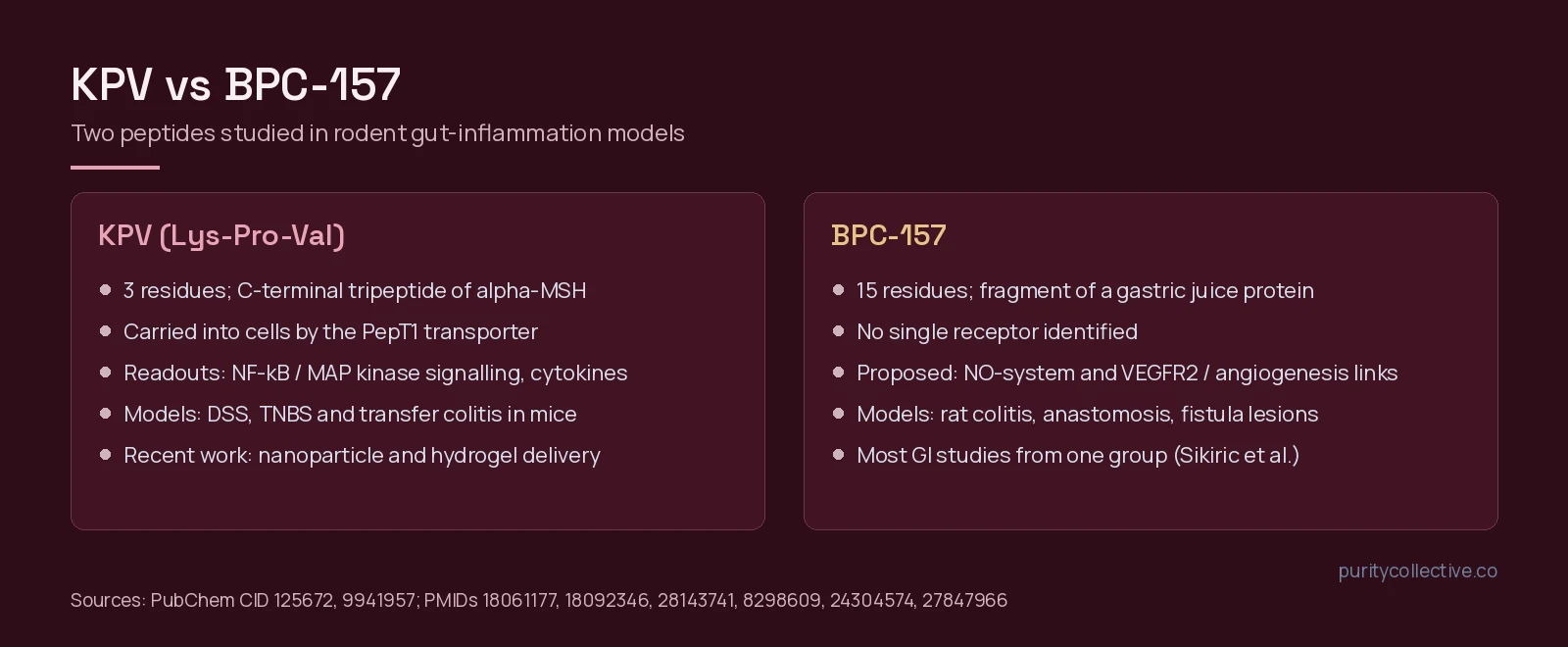
KPV vs BPC-157 at a glance
| Feature | KPV | BPC-157 |
|---|---|---|
| What it is | Tripeptide Lys-Pro-Val, residues 11–13 of alpha-MSH [1] | Pentadecapeptide GEPPPGKPADDAGLV, a fragment of a gastric juice protein [3][5] |
| Size | 3 residues, about 342 g/mol (PubChem) | 15 residues, about 1419 g/mol (PubChem) |
| Best-described entry route | PepT1 di/tripeptide transporter in intestinal epithelial and immune cells [2] | No transporter or receptor identified; described as stable in human gastric juice [4] |
| Main readouts | NF-κB and MAP kinase activation, pro-inflammatory cytokines, colon histology, MPO activity [2][6] | Lesion healing, vessel presentation, MDA and NO levels in colon tissue [7][8] |
| Typical gut models | DSS, TNBS and CD45RBhi transfer colitis in mice [2][6] | Cysteamine colitis, colon-colon anastomosis, ischemic colitis and colovesical fistula in rats [7][8][9] |
| Who did the work | Several groups with different authors (Dalmasso, Kannengiesser, Viennois, Xiao and others) | Mostly Sikirić and colleagues; mechanism and pharmacokinetic papers from other groups exist [10][11] |
| Human data | No controlled human trials found in PubMed | A two-person safety pilot [12]; no completed Phase II trial [13] |
Identity of each compound
| Field | KPV | BPC-157 |
|---|---|---|
| PubChem CID | 125672 (“MSH (11-13)”) | 9941957 |
| Molecular formula | C16H30N4O4 | C62H98N16O22 |
| Molecular weight | 342.43 g/mol | 1419.5 g/mol |
| Sequence | Lys-Pro-Val (KPV) | Gly-Glu-Pro-Pro-Pro-Gly-Lys-Pro-Ala-Asp-Asp-Ala-Gly-Leu-Val |
These are free-peptide records. A lab report may cite a salt form (for example an acetate), which carries a different molecular weight, so compare the CID on the report with the record it names.
KPV: a tripeptide that rides PepT1
KPV comes from the melanocortin literature. Alpha-MSH has broad anti-inflammatory effects in animal models, but it also drives pigmentation. Reviewers pointed to its C-terminal tripeptide, KPV, as a fragment that kept anti-inflammatory activity without the pigmentary action [1].
The gut story for KPV rests on one transporter. PepT1 carries di- and tripeptides across the intestinal lining. It is normally expressed in the small intestine and is induced in the colon during inflammatory bowel disease. In 2008, Dalmasso and colleagues showed that KPV entered human intestinal epithelial cell lines (Caco2-BBE, HT29-Cl.19A) and Jurkat T cells through PepT1. At nanomolar concentrations it inhibited NF-κB and MAP kinase activation and reduced pro-inflammatory cytokine secretion. In mice given KPV in drinking water, DSS- and TNBS-induced colitis was less frequent, with lower pro-inflammatory cytokine expression [2].
The same year, Kannengiesser and colleagues tested KPV in DSS colitis and in CD45RBhi T-cell transfer colitis. Treated mice regained body weight sooner and had fewer inflammatory infiltrates and lower colonic myeloperoxidase activity. KPV also worked in mice with a non-functional melanocortin-1 receptor, which suggests its effect is at least partly independent of MC1R [6].
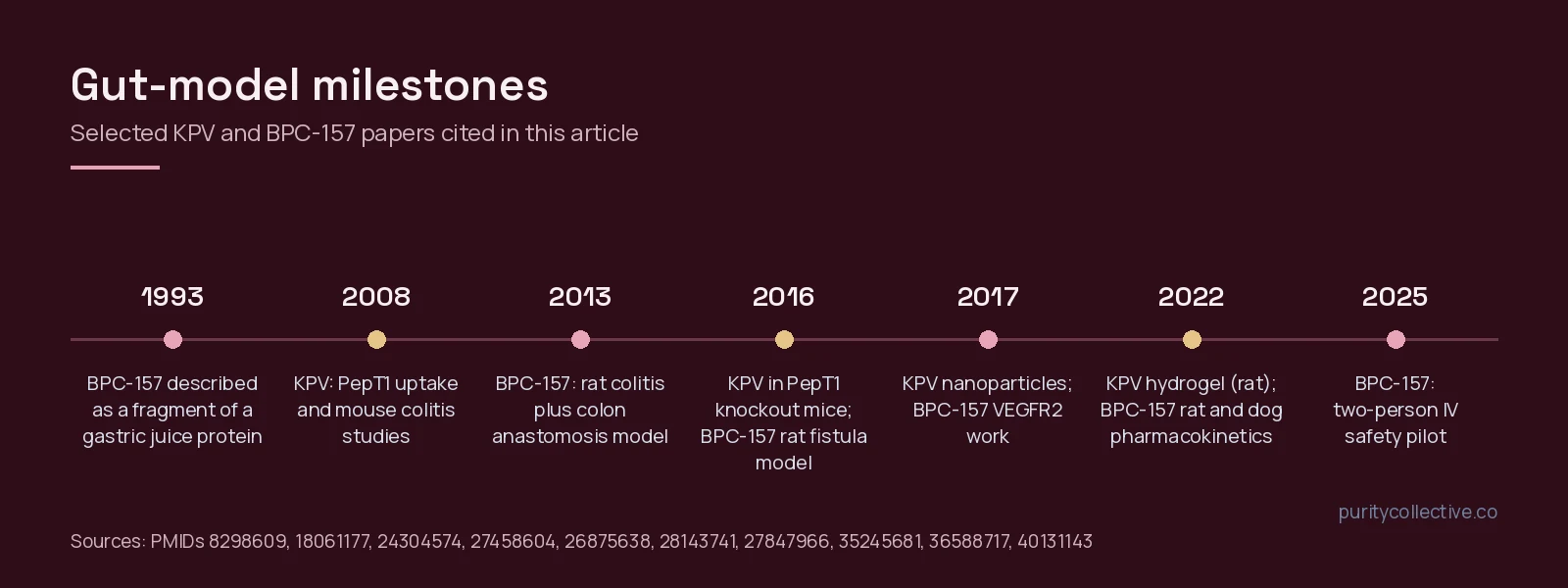
A 2016 study made the PepT1 link sharper. In an AOM/DSS model of colitis-associated cancer, KPV reduced tumorigenesis in wild-type mice but had no such effect in PepT1-knockout mice [14]. That is a useful negative control: when the transporter is gone, the effect is gone. More recent KPV papers are largely about delivery. Hyaluronic-acid-coated nanoparticles carried KPV to colonic epithelial cells and macrophages in a mouse colitis model [15], and a mucoadhesive hydrogel was used to hold KPV on inflamed colon tissue in rats with TNBS colitis [16].
BPC-157: a gastric pentadecapeptide studied in rat lesion models
BPC-157 was described in 1993 as a 15-amino-acid fragment of a larger gastric juice protein (about 40 kDa) named BPC, and was framed within a “stomach-stress-organoprotection” hypothesis [3]. Its sequence is GEPPPGKPADDAGLV, with a molecular weight of about 1419 [5]. The authors describe it as stable in human gastric juice, which is part of why it has been given orally in many rat studies [4].
The gut models are mostly surgical or chemical injuries in rats. In a 2013 study, control rats did not heal cysteamine-induced colitis or a colon-colon anastomosis over 14 days, while BPC-157-treated rats healed both, given either by injection or in drinking water [7]. In an ischemic colitis model, BPC-157 applied to the blood-deprived colon segment increased visible vessel presentation and kept tissue MDA and NO levels near normal, and the authors linked this to the NO system [8]. In a colovesical fistula model, treated rats showed closure of both the colon and bladder defects, while control fistulas kept leaking [9].
Proposed mechanisms are broad. The originating group has reviewed a relationship with the nitric oxide system, including interactions with L-NAME and L-arginine [4]. A separate group (Hsieh and colleagues) reported that BPC-157 raised vessel density in chick embryo and endothelial tube assays, sped blood-flow recovery in a rat ischemic hind limb, and increased VEGFR2 (not VEGF-A) expression in human endothelial cells [10]. None of these define a receptor.
The single-group concern is real. Most of the gastrointestinal studies above share Sikirić as an author. That does not make them wrong, but replication by unrelated labs in the same gut models is thin. Papers from this group also mention inflammatory bowel disease trials under the codes PL 10, PLD 116 and PL 14736 (Pliva, Croatia) [5]; we did not find peer-reviewed results from those trials in PubMed.
Head-to-head: what each gut study measured
| Study | Compound | Model | What was measured |
|---|---|---|---|
| Dalmasso 2008 [2] | KPV | Human epithelial and T cell lines; DSS and TNBS colitis in mice | PepT1 uptake kinetics, NF-κB/MAPK activation, cytokines, colitis histology |
| Kannengiesser 2008 [6] | KPV | DSS and transfer colitis; MC1R-deficient mice | Body weight, histology, MPO activity, survival |
| Viennois 2016 [14] | KPV | AOM/DSS colitis-associated cancer, wild-type vs PepT1-knockout mice | Tumor number and size, inflammation |
| Xiao 2017 [15] | KPV in nanoparticles | Colon cells, macrophages; mouse colitis | Cell uptake, mucosal damage, TNF-α |
| Sikirić group 2013 [7] | BPC-157 | Rat cysteamine colitis and colon-colon anastomosis | Lesion and anastomosis healing over 14 days |
| Sikirić group 2016 [9] | BPC-157 | Rat colovesical fistula | Defect closure, leakage, adhesions |
| Sikirić group 2017 [8] | BPC-157 | Rat ischemic colitis and reperfusion | Vessel presentation, MDA and NO levels |
Two things stand out. The KPV work is built on inflammation readouts in mice, with a knockout that tests the proposed mechanism. The BPC-157 work is built on healing of induced injuries in rats, with mechanism mostly inferred from interactions with NO-system drugs. The models don’t overlap, so these studies can’t tell you which peptide is “stronger”. No study we found tested KPV and BPC-157 side by side.
Delivery: the question both literatures keep returning to
For KPV, the open question is getting a small, rapidly transported peptide to inflamed colon tissue. That is why so much recent work wraps it in nanoparticles or hydrogels [15][16]. Those results describe the delivery system as much as the peptide.
For BPC-157, the issue is a mismatch between short exposure and long reported effects. In a formal rat and beagle dog study, the parent peptide had a plasma half-life under 30 minutes and was broken down into small fragments and amino acids [11]. A 2026 review called this a pharmacokinetic-pharmacodynamic disconnect and noted that BPC-157 has no approved formulation and no completed Phase II trial [13].
What the evidence does not show
- No head-to-head data. We found no study comparing KPV and BPC-157 in the same model.
- No controlled human efficacy data for either. The only BPC-157 human report we found is an uncontrolled pilot in two people who had received the peptide before; it measured blood markers and side effects only [12]. Two participants cannot establish safety.
- Thin replication for BPC-157 gut results. Most rat GI studies come from one group. Independent work so far covers mechanism and pharmacokinetics more than the gut models themselves.
- Narrow model range for KPV. The colitis data come from a handful of mouse and rat models, and the newer papers mix the peptide’s effect with the delivery system’s.
- No defined receptor for BPC-157. The NO-system and VEGFR2 links are associations, not a target.
- Regulatory status. Neither compound is an FDA-approved drug. FDA’s Pharmacy Compounding Advisory Committee discussed BPC-157- and KPV-related bulk drug substances on July 23, 2026, as candidates for the 503A bulks list (FDA meeting page). An advisory committee discussion is not an approval.
Reading the product records for each compound
If you work with either peptide in the lab, the batch documents matter more than any summary. Both Purity listings link two reports for the lot on sale: a UPLC/MS report for identity and purity, and a separate endotoxin report.
- KPV 10mg. The KPV 10mg listing links the UPLC/MS and endotoxin reports for lot PCCL-4451178. Check that the report names KPV and that the lot on your vial matches.
- BPC-157 10mg. The BPC-157 10mg listing links the UPLC/MS report and the endotoxin report for lot PCCL-9216929. Because BPC-157 is 15 residues long, the mass spectrum is the line that confirms you have the full sequence rather than a fragment.
For background on each compound, see what KPV is and what BPC-157 is. Every posted report sits in the COA library, and our guide on how to read a peptide COA explains each field. When you’re ready to buy research peptides online in the USA, match the lot number on the vial to the lot number on the report.
Frequently asked questions
What is the difference between KPV and BPC-157?
KPV is a three-residue peptide (Lys-Pro-Val) from the C-terminal end of alpha-MSH, studied mainly in mouse colitis models where it entered cells via the PepT1 transporter. BPC-157 is a 15-residue fragment of a gastric juice protein, studied mainly in rat injury models such as colitis, anastomosis and fistulas, with no identified receptor.
How does KPV get into intestinal cells?
In cell-line work, KPV was taken up by PepT1, a di- and tripeptide transporter that is induced in the colon during inflammation. In a mouse colitis-associated cancer model, KPV’s effect disappeared in PepT1-knockout mice.
Has BPC-157 been tested in humans?
PubMed holds one small pilot in which two people received BPC-157 while blood markers and side effects were recorded. A 2026 review noted there is no completed Phase II trial and no approved formulation. There are no controlled human efficacy data.
Why is BPC-157 research described as coming from one group?
Most of the gastrointestinal studies share the same senior author, Sikirić, and colleagues. Other labs have published mechanism and pharmacokinetic work, but independent replication of the gut injury models is limited.
Are KPV or BPC-157 FDA-approved?
No. Neither is an FDA-approved drug. FDA’s Pharmacy Compounding Advisory Committee discussed both as candidates for the 503A bulks list on July 23, 2026; an advisory discussion is not an approval.
References
- Brzoska T, Luger TA, Maaser C et al. (2008). Alpha-melanocyte-stimulating hormone and related tripeptides: biochemistry, antiinflammatory and protective effects in vitro and in vivo, and future perspectives for the treatment of immune-mediated inflammatory diseases. Endocr Rev. PMID: 18612139. doi: 10.1210/er.2007-0027.
- Dalmasso G, Charrier-Hisamuddin L, Nguyen HT et al. (2008). PepT1-mediated tripeptide KPV uptake reduces intestinal inflammation. Gastroenterology. PMID: 18061177. doi: 10.1053/j.gastro.2007.10.026.
- Sikirić P, Petek M, Rucman R et al. (1993). A new gastric juice peptide, BPC. An overview of the stomach-stress-organoprotection hypothesis and beneficial effects of BPC. J Physiol Paris. PMID: 8298609. doi: 10.1016/0928-4257(93)90038-u.
- Sikiric P, Seiwerth S, Rucman R et al. (2014). Stable gastric pentadecapeptide BPC 157-NO-system relation. Curr Pharm Des. PMID: 23755725. doi: 10.2174/13816128113190990411.
- Sikiric P, Seiwerth S, Brcic L et al. (2006). Stable gastric pentadecapeptide BPC 157 in trials for inflammatory bowel disease (PL-10, PLD-116, PL 14736, Pliva, Croatia). Full and distended stomach, and vascular response. Inflammopharmacology. PMID: 17186181. doi: 10.1007/s10787-006-1531-7.
- Kannengiesser K, Maaser C, Heidemann J et al. (2008). Melanocortin-derived tripeptide KPV has anti-inflammatory potential in murine models of inflammatory bowel disease. Inflamm Bowel Dis. PMID: 18092346. doi: 10.1002/ibd.20334.
- Klicek R, Kolenc D, Suran J et al. (2013). Stable gastric pentadecapeptide BPC 157 heals cysteamine-colitis and colon-colon-anastomosis and counteracts cuprizone brain injuries and motor disability. J Physiol Pharmacol. PMID: 24304574.
- Duzel A, Vlainic J, Antunovic M et al. (2017). Stable gastric pentadecapeptide BPC 157 in the treatment of colitis and ischemia and reperfusion in rats: New insights. World J Gastroenterol. PMID: 29358856. doi: 10.3748/wjg.v23.i48.8465.
- Grgic T, Grgic D, Drmic D et al. (2016). Stable gastric pentadecapeptide BPC 157 heals rat colovesical fistula. Eur J Pharmacol. PMID: 26875638. doi: 10.1016/j.ejphar.2016.02.038.
- Hsieh MJ, Liu HT, Wang CN et al. (2017). Therapeutic potential of pro-angiogenic BPC157 is associated with VEGFR2 activation and up-regulation. J Mol Med (Berl). PMID: 27847966. doi: 10.1007/s00109-016-1488-y.
- He L, Feng D, Guo H et al. (2022). Pharmacokinetics, distribution, metabolism, and excretion of body-protective compound 157, a potential drug for treating various wounds, in rats and dogs. Front Pharmacol. PMID: 36588717. doi: 10.3389/fphar.2022.1026182.
- Lee E, Burgess K (2025). Safety of Intravenous Infusion of BPC157 in Humans: A Pilot Study. Altern Ther Health Med. PMID: 40131143.
- Mateescu DM, Gavrilescu DM, Constantinescu FE et al. (2026). BPC-157 as an Investigational Peptide Therapeutic: Biopharmaceutical Challenges, Formulation Strategies, and Translational Development Barriers. Pharmaceutics. PMID: 42198317. doi: 10.3390/pharmaceutics18050625.
- Viennois E, Ingersoll SA, Ayyadurai S et al. (2016). Critical role of PepT1 in promoting colitis-associated cancer and therapeutic benefits of the anti-inflammatory PepT1-mediated tripeptide KPV in a murine model. Cell Mol Gastroenterol Hepatol. PMID: 27458604. doi: 10.1016/j.jcmgh.2016.01.006.
- Xiao B, Xu Z, Viennois E et al. (2017). Orally Targeted Delivery of Tripeptide KPV via Hyaluronic Acid-Functionalized Nanoparticles Efficiently Alleviates Ulcerative Colitis. Mol Ther. PMID: 28143741. doi: 10.1016/j.ymthe.2016.11.020.
- Zhao Y, Xue P, Lin G et al. (2022). A KPV-binding double-network hydrogel restores gut mucosal barrier in an inflamed colon. Acta Biomater. PMID: 35245681. doi: 10.1016/j.actbio.2022.02.039.