
Your cart is currently empty!.
You may check out all the available products and buy some in the shop.
Continue ShoppingCompound guide · KLOW
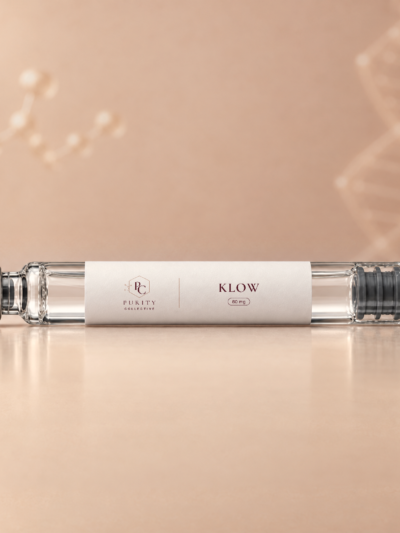
KLOW is Purity Collective’s four-component research blend: BPC-157, TB-500, GHK-Cu and KPV in one 80mg vial or pen. This guide collects what the peer-reviewed literature says about each component, the chemical identity of all four, what the evidence does not show, and what Purity’s own lot report measured.
For laboratory research only. Not for human or animal use. This guide gives no dosing, reconstitution, administration or therapeutic advice.

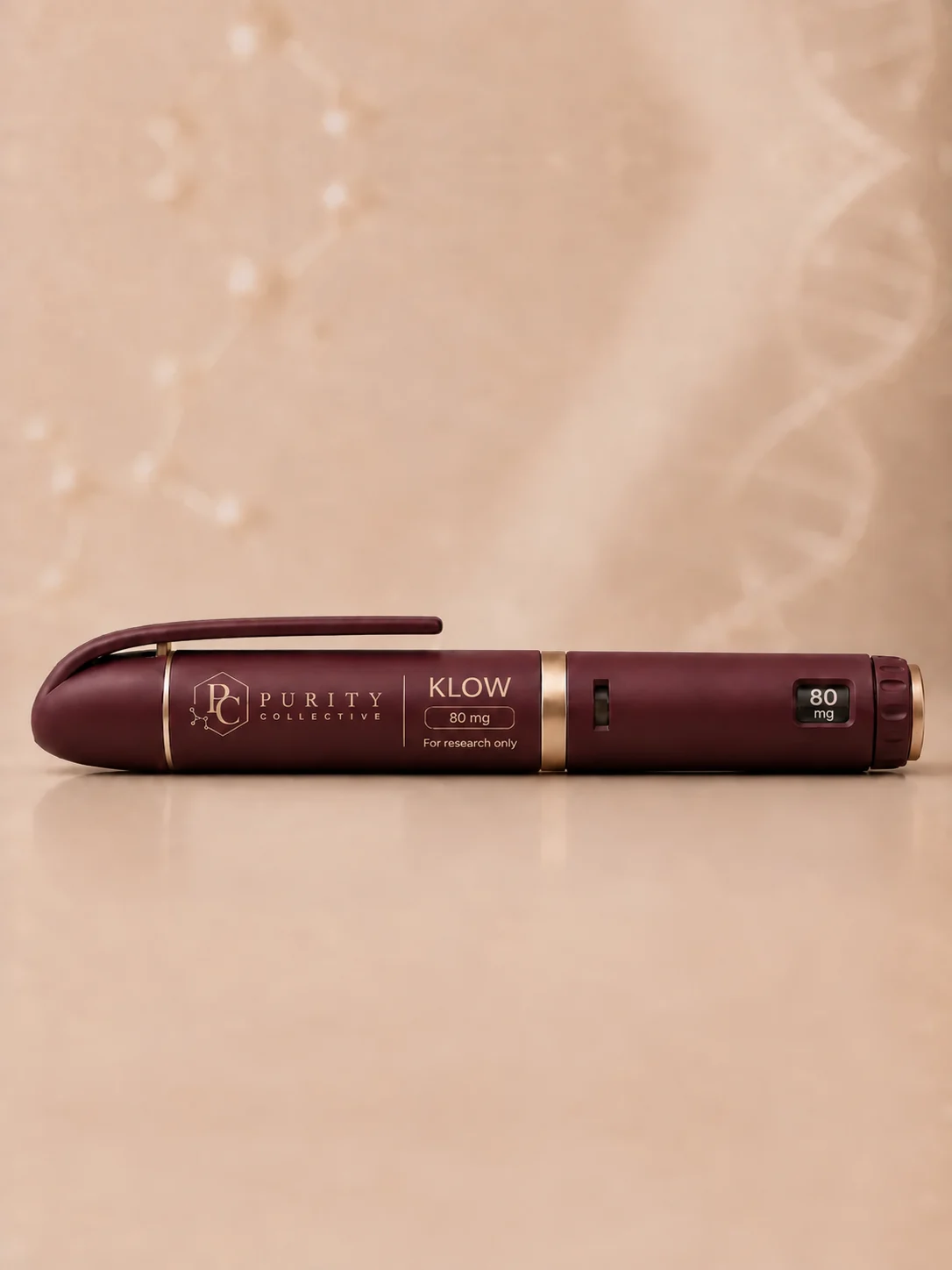
Purity Collective lists KLOW in two formats, and they share one lot report. The vial is the lyophilized 80mg blend; the pen is the same formulation supplied in a pre-filled cartridge device. Pick by how your laboratory stores and dispenses material, not by documentation, because the certificate is the same.
| Listing | Format | Catalog specification | Lot on report | Report |
|---|---|---|---|---|
| KLOW 80mg Blend | Lyophilized vial | BPC-157 10mg · TB-500 10mg · GHK-Cu 50mg · KPV 10mg | PCCL-7964352 | UPLC/MS per component + endotoxin |
| KLOW 80 mg (Pen) | Pre-filled pen | Same 80mg formulation | PCCL-7964352 | Shares the vial lot’s certificates |
Key facts. KLOW is a four-component research blend: two tissue-repair peptides studied mostly in rodents (BPC-157, TB-500), a copper-binding tripeptide first isolated from human plasma (GHK-Cu) and the C-terminal tripeptide of alpha-MSH (KPV). The blend itself has not been studied as a blend in any published trial; every finding below concerns a single component. Purity’s lot report gives a separate quantity and purity result for each component, which is what a blend certificate should do.
BPC-157 is a 15-amino-acid fragment (GEPPPGKPADDAGLV, MW 1419) described by Sikirić and colleagues as a stable gastric pentadecapeptide; its early literature is almost entirely rat work from one group in Zagreb, and it was once in clinical trials for inflammatory bowel disease under the codes PL 14736 and PLD-116[14554208]. TB-500 is the synthetic peptide marketed under that name and corresponds to the N-terminal acetylated 17-43 fragment, or in Purity’s listing the full-length sequence, of thymosin beta-4 (Tβ4), a 43-residue actin-sequestering protein found in most mammalian cells; the analytical literature on TB-500 comes from doping-control laboratories that had to characterize it[22962027]. GHK (glycyl-L-histidyl-L-lysine) was isolated from human plasma as a growth-modulating factor and shown in 1980 to co-isolate with copper and to enhance copper uptake into cultured cells[7453802]; the copper(II) complex is what the catalog sells. KPV (Lys-Pro-Val) is residues 11-13 of alpha-melanocyte-stimulating hormone, studied as a small anti-inflammatory tripeptide transported by the intestinal di/tripeptide carrier PepT1[18061177].
| Attribute | Value |
|---|---|
| Catalog name | KLOW 80mg Blend (vial) · KLOW 80 mg (Pen) |
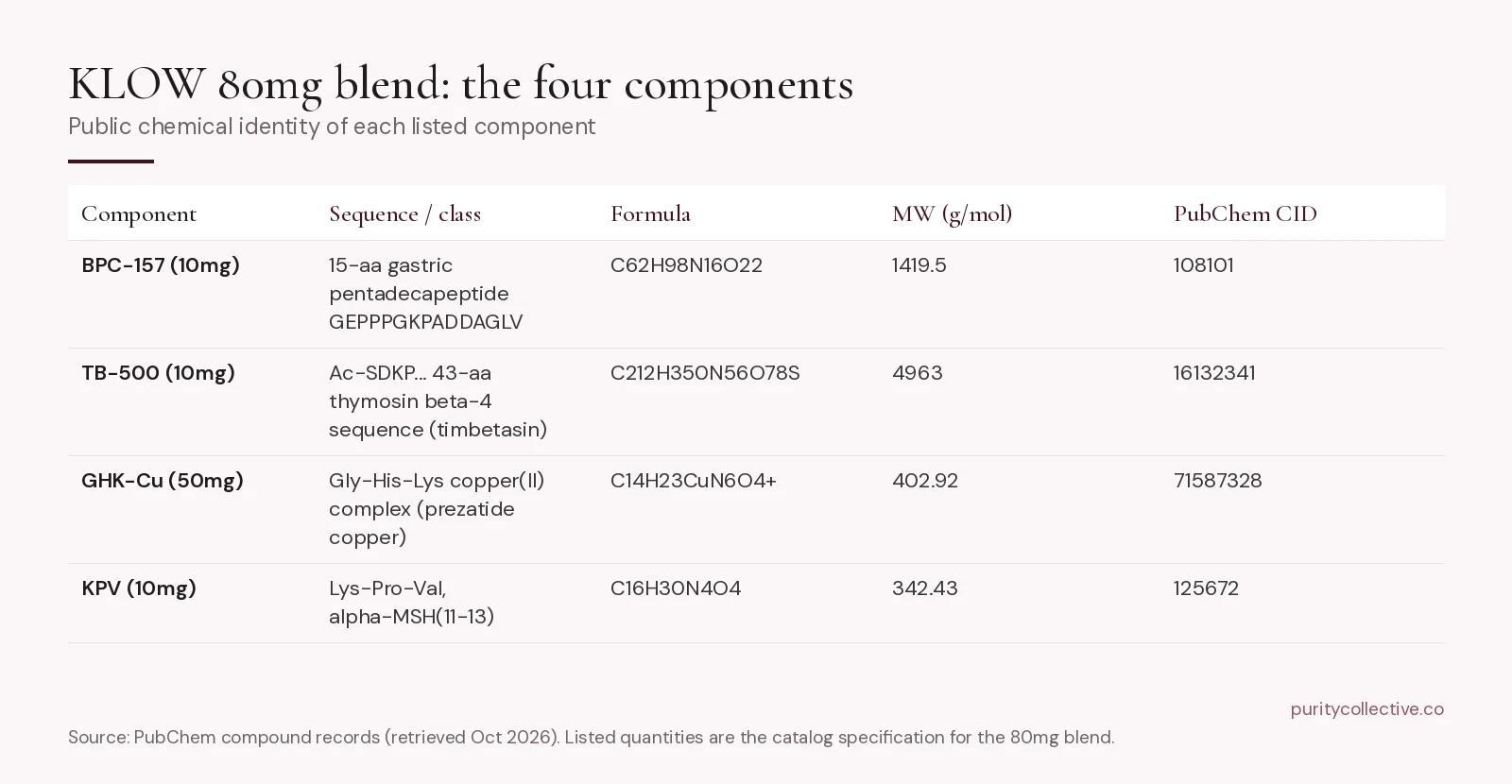
| Composition | BPC-157 10mg + TB-500 10mg + GHK-Cu 50mg + KPV 10mg = 80mg catalog total |
| BPC-157 | C62H98N16O22, MW 1419.5, PubChem CID 108101 |
| TB-500 / thymosin beta-4 | C212H350N56O78S, MW 4963, PubChem CID 16132341 (timbetasin) |
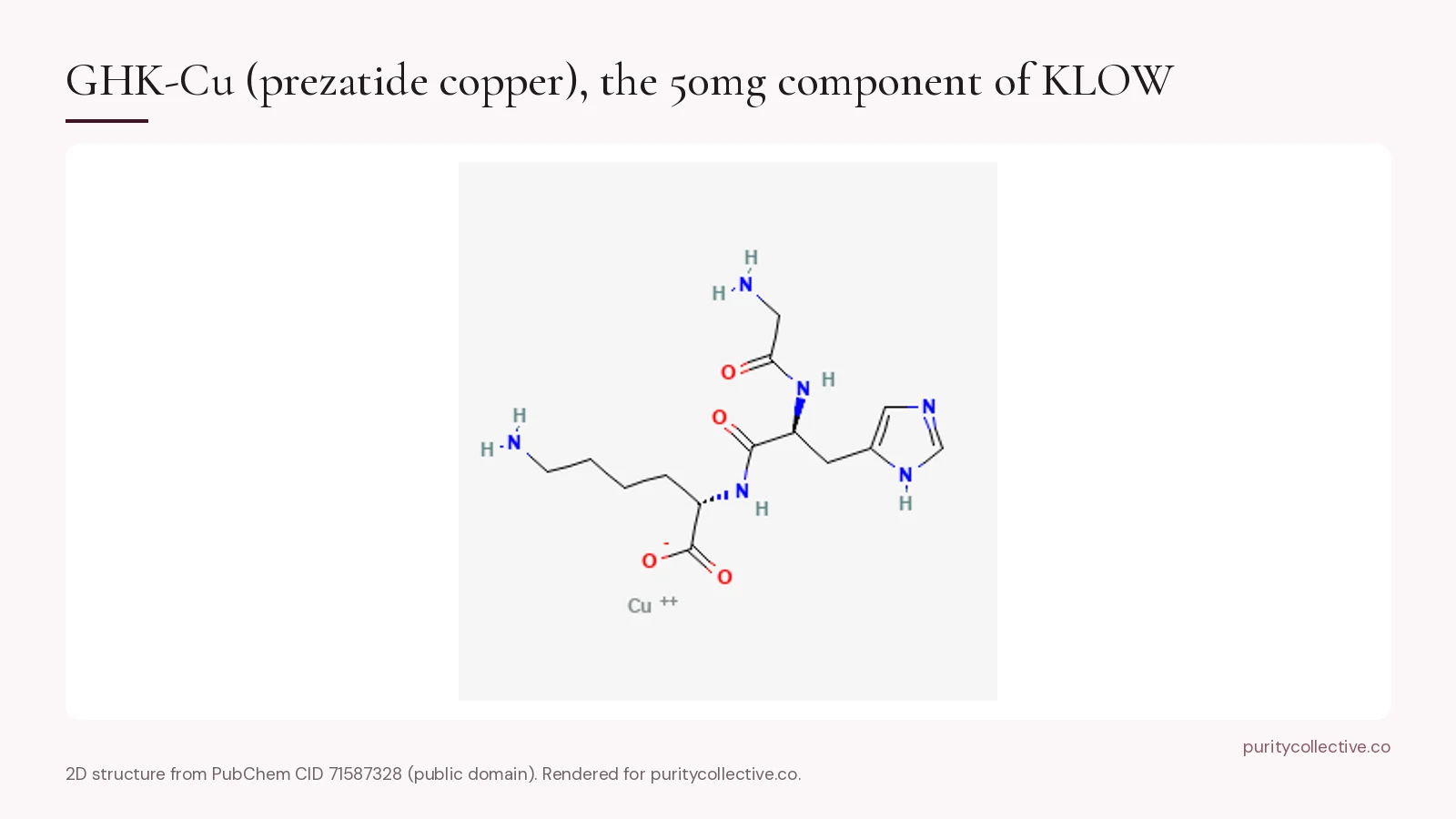
| GHK-Cu | C14H23CuN6O4+, MW 402.92, PubChem CID 71587328 (prezatide copper) |
| KPV | C16H30N4O4, MW 342.43, PubChem CID 125672 (MSH 11-13). Note: the lot certificate prints a different CID beside KPV; the PubChem record for Lys-Pro-Val is 125672. |
| Supplied as | Lyophilized powder (vial) or pre-filled pen cartridge |
| Regulatory status | Not an approved drug in any component; research reference material only |
In rats with a transected Achilles tendon, BPC-157 given systemically or locally improved the biomechanical, functional and histological markers of healing compared with saline, and the same paper reported that the peptide stimulated tendon-explant outgrowth in vitro[14554208]. Follow-up work in rat tendon fibroblasts tied the effect to the VEGFR2 pathway and to angiogenic signaling[27847966], and the Zagreb group has summarized a long series of rat experiments in which BPC-157 interacted with the nitric-oxide system, counteracting both NO-synthase blockade and NO over-stimulation[23755725]. A 2026 rat study compared BPC-157, TB-500 and the two together in Achilles tendon repair: the TB-500 group reached statistical significance on load-to-failure and histology scores, the BPC-157 group showed numerically better scores without reaching significance, and the combination did not outperform TB-500 alone[42542926].
Thymosin beta-4 accelerated dermal wound healing in rats and in aged mice, increasing re-epithelialization, collagen deposition and angiogenesis[10469335]; in mouse heart it activated integrin-linked kinase signaling and promoted cardiomyocyte survival after coronary ligation[15565145]. The one human dataset in the reference list is a phase I study of recombinant thymosin beta-4 in healthy Chinese volunteers, which reported dose-proportional exposure and no accumulation and was designed only to assess safety and pharmacokinetics[34346165]. Doping-control chemists have characterized synthetic TB-500 by LC-MS, which is why identity confirmation by mass spectrometry is meaningful for this component[22962027].
GHK-Cu stimulated collagen synthesis in cultured fibroblasts at nanomolar concentrations without changing cell number[3169264], and increased connective-tissue accumulation in rat wound chambers in vivo[8227353]. The human evidence is cautionary: a randomized, evaluator-blinded trial of two candidate wound agents in venous ulcers did not show a healing benefit[1495150]. A 2018 review reinterpreted the older data through gene-expression profiling, proposing that GHK resets a large set of genes toward a regenerative pattern, a hypothesis rather than a clinical finding[29986520].
Nanomolar KPV inhibited NF-κB and MAP-kinase inflammatory signaling in human intestinal epithelial and T-cell lines, and oral KPV reduced the severity of DSS- and TNBS-induced colitis in mice; uptake depended on the PepT1 transporter[18061177]. A second group reported earlier recovery and less histological inflammation in two mouse colitis models, with effects at least partly independent of the melanocortin-1 receptor[18092346]. KPV and related alpha-MSH fragments have also shown antimicrobial activity against Staphylococcus aureus and Candida albicans in vitro[10670585].
| Finding | Model | What was measured | Ref. |
|---|---|---|---|
| BPC-157 improved transected Achilles tendon healing | Rat | Biomechanics, function, histology; explant outgrowth in vitro | [14554208] |
| BPC-157 pro-angiogenic action linked to VEGFR2 | Rat tendon fibroblasts; rat | VEGFR2 expression and signaling | [27847966] |
| TB-500 significant, BPC-157 numerical, combination not superior | Rat Achilles tendon (2026) | Load to failure, Bonar and Movin scores, collagen I/III | [42542926] |
| Thymosin beta-4 accelerated dermal wound repair | Rat; aged mouse | Re-epithelialization, collagen, angiogenesis | [10469335] |
| Thymosin beta-4 phase I: tolerated, dose-proportional PK | Healthy volunteers (human) | Safety and pharmacokinetics only | [34346165] |
| GHK-Cu stimulated collagen synthesis | Human fibroblast culture | Collagen output at nanomolar concentrations | [3169264] |
| GHK-Cu increased connective tissue in wounds | Rat wound chamber | Collagen, glycosaminoglycans, DNA | [8227353] |
| No healing benefit in venous ulcers | Human RCT (evaluator-blinded) | Ulcer healing versus vehicle | [1495150] |
| KPV reduced colitis via PepT1 uptake | Human cell lines; mouse | NF-κB and MAPK signaling, cytokines, histology | [18061177][18092346] |
Purity Collective’s lot PCCL-7964352 was analyzed by Horizon Analytical on 29 March 2026 by UPLC/MS. The certificate gives each component its own quantity and purity result rather than a single blend-wide number; the endotoxin certificate for the matching lot (PCCL-7964352-E, 3 April 2026) reads <0.05 EU/mL. Both PDFs are in the COA library and linked from the vial and pen pages.
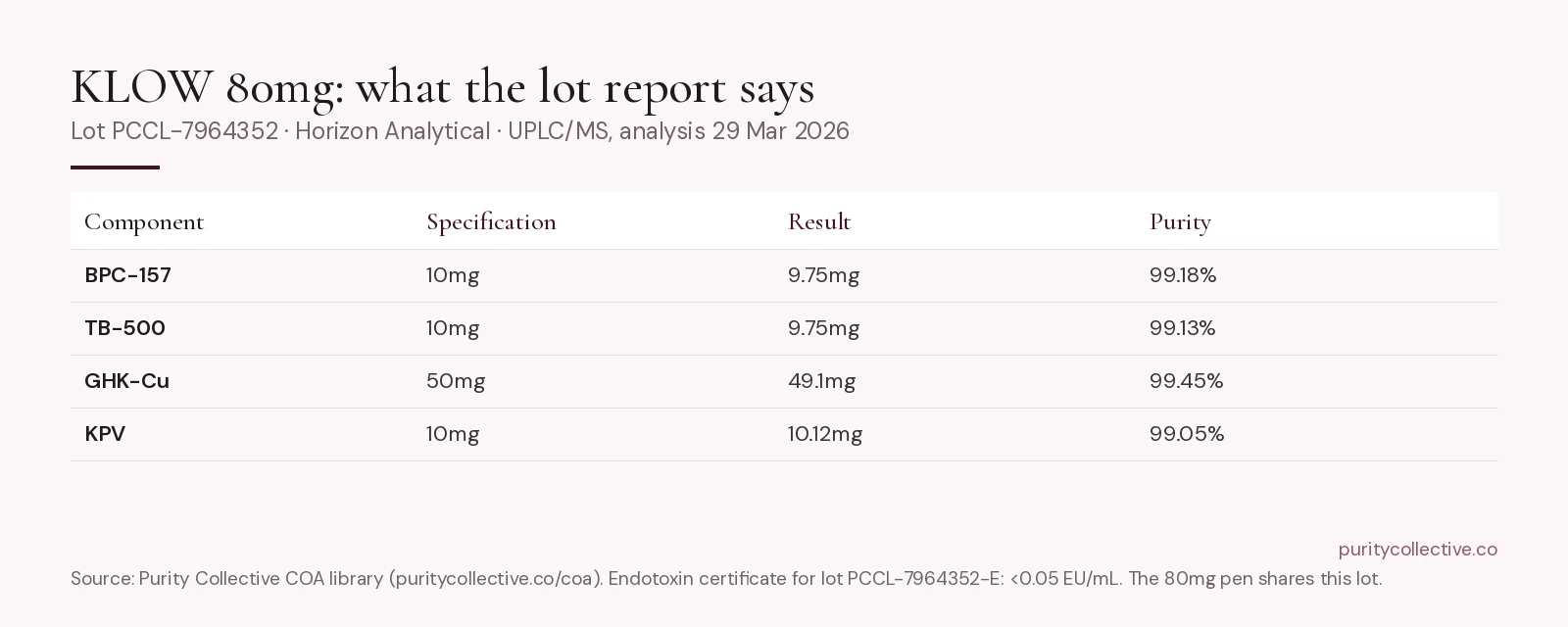
Reading it: the four quantity results sit within about 3% of specification, the purity results are all above the 98% specification, and the identity for each component is confirmed by mass spectrometry. One detail to know: the certificate prints a PubChem CID beside each component, and the CID beside KPV does not correspond to Lys-Pro-Val in PubChem; the mass result is what confirms identity, and the correct record is listed in the identity table above.
The vial is lyophilized powder and should be kept cold, dry and away from light until use; once in solution, peptides of this size are best kept refrigerated and used within the window your protocol defines. The pen is supplied as a liquid cartridge and should be refrigerated per the product page. Document the lot number with your records so a result can be traced back to the certificate. For general handling guidance read how to read a peptide COA and the KPV, BPC-157, TB-500 and GHK-Cu records in the research library.
Purity Collective lists KLOW as an 80mg lyophilized vial and an 80mg pre-filled pen, sold to qualified researchers for laboratory use with checkout in US dollars. Both listings link the same Horizon Analytical lot report.
The catalog formulation is BPC-157 10mg, TB-500 10mg, GHK-Cu 50mg and KPV 10mg, an 80mg total. The lot certificate reports each component separately: 9.75mg, 9.75mg, 49.1mg and 10.12mg for lot PCCL-7964352.
Yes. Lot PCCL-7964352 has a UPLC/MS purity and quantity certificate and a separate endotoxin certificate (<0.05 EU/mL), both in the COA library. The pen shares the vial lot.
Each component gets its own chromatographic purity: 99.18%, 99.13%, 99.45% and 99.05% on this lot. There is no single blend-wide purity figure, and quoting one would be misleading.
No. All published work concerns the individual components, almost all of it in cells or rodents. The one rat study that combined BPC-157 and TB-500 did not find the pair superior to TB-500 alone.
No. It is a research reference material for in-vitro laboratory work. Purity Collective publishes no dosing or administration information for any product.