
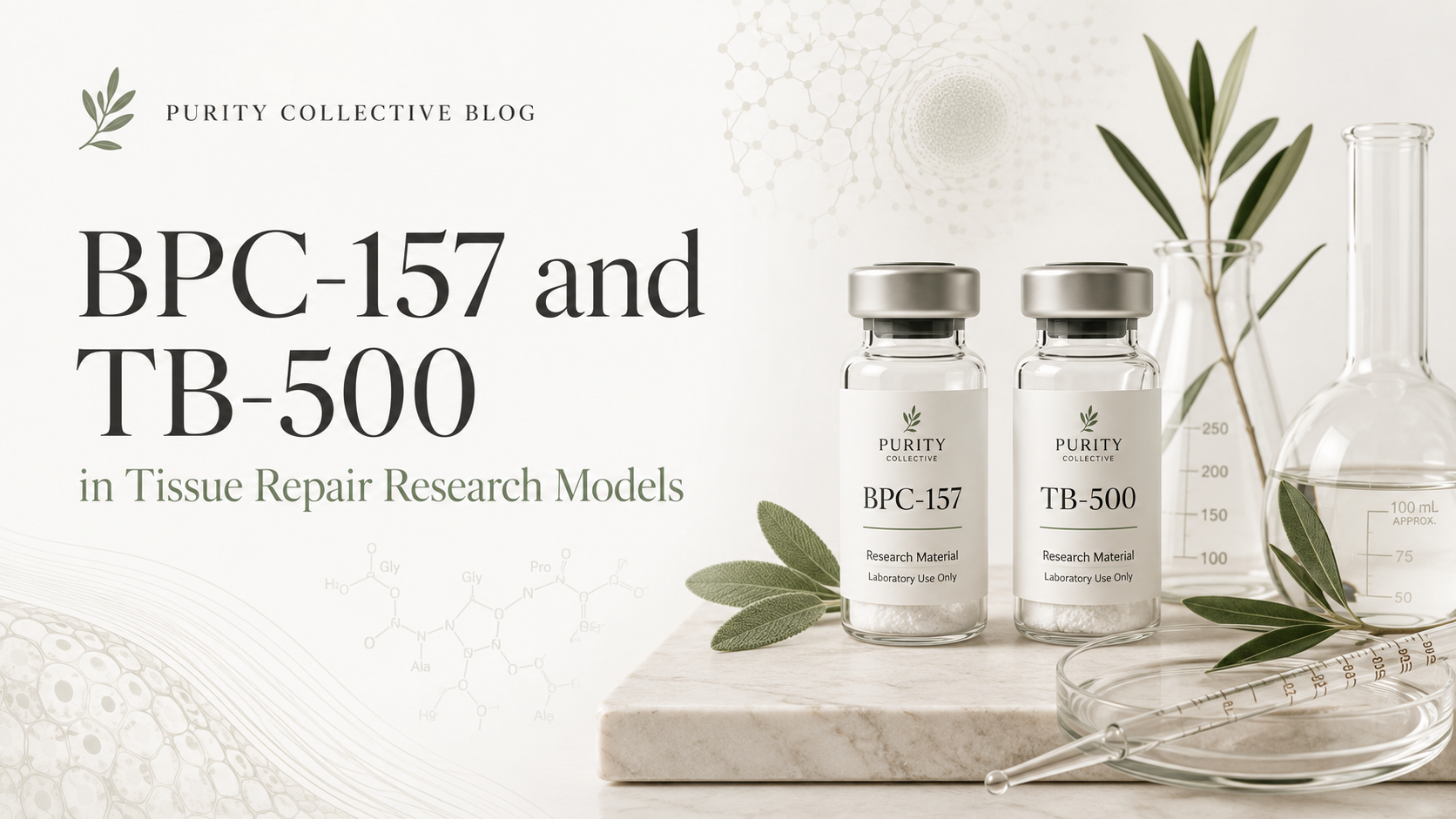
BPC-157 and TB-500 are peptide reference compounds often discussed near the same research-catalog themes. For a responsible catalog page, the useful question is not whether either compound is associated with a broad outcome phrase. The useful question is whether the product record makes identity, format, quantity and documentation clear enough for laboratory review.
This guide explains how to compare BPC-157, TB-500 and BPC-157 + TB-500 blend listings in a documentation-first way. It is written for laboratory catalog evaluation only and does not provide use instructions or medical positioning.
BPC-157 as a catalog record
BPC-157 is commonly listed as a peptide reference material. When reviewing a BPC-157 product page, start with the exact compound name, listed quantity, SKU, format and available documents. A well-structured record should make it clear whether the listing is a single-compound vial, a metered format or part of a blend.
For a single-compound product such as BPC-157 10mg, the product record should be evaluated on its own page. Do not assume that a document, lot number or result from a separate blend applies to the standalone listing unless the records explicitly connect them.
TB-500 as a catalog record
TB-500 10mg is also reviewed as a peptide reference compound. In a catalog environment, the same evaluation rules apply: confirm the product name, listed amount, format, SKU, linked analytical files and research-use boundary. The page should not rely on broad claims when product-specific documentation is the stronger evidence path.
Where TB-500 appears in a combined listing, review whether the product page identifies the TB-500 component separately from the BPC-157 component. Blends can be useful catalog formats, but they need clearer documentation because more than one material identity is involved.
How to evaluate a BPC-157 + TB-500 blend
A blend page should not hide the component record. The buyer should be able to identify the listed total amount, the amount assigned to each component where stated, the format, the SKU and any certificate or analytical documents tied to the current listing.
For example, a BPC-157 + TB-500 10mg blend should be reviewed as a blend record. If the page says the 10mg total is represented by 5mg BPC-157 and 5mg TB-500, that component relationship should be visible in the product copy and supported by the linked documentation. A component-specific purity result should not be stretched into a blend-wide purity claim unless the document actually supports that statement.
Documentation checks before comparing listings
Before choosing between standalone BPC-157, standalone TB-500 or a combined blend, review the documentation fields rather than relying on category names or shorthand product labels.
- Identity: Does the page identify each compound clearly?
- Quantity: Is the listed total amount separate from any component amount or reported sample amount?
- Format: Is the supplied format stated clearly, such as lyophilized vial?
- Documents: Are COA, UPLC/MS, HPLC, mass confirmation or endotoxin records linked where available?
- Lot relationship: Do the document identifiers connect to the product record being reviewed?
- Evidence boundary: Does the page avoid turning a sample-specific result into a blanket product claim?
If analytical PDFs are linked, read them with the peptide COA guide open. HPLC or UPLC/MS, mass confirmation and endotoxin reporting answer different questions, and none of them should be used as a shortcut for a laboratory’s own supplier qualification or acceptance criteria.
Why category context is not enough
BPC-157 and TB-500 products may appear in a category collection because of catalog navigation needs. That category context can help users browse, but it is not a product claim and it does not replace product-specific documentation.
Use categories to find potentially relevant records, then use the product page and linked documents to evaluate the actual listing. This is especially important where a product family includes standalone compounds, blends or multiple formats.
Responsible language for BPC-157 and TB-500 pages
Responsible product copy should stay close to the record. It can describe the compound identity, component structure, supplied format, available documents and research-use boundary. It should not provide non-research instructions, use-amount language, unsupported promises or non-research positioning.
That restraint is not just a compliance issue. It also makes the page more useful. Buyers comparing research materials need clear evidence, not stronger adjectives. A documentation-led page is easier to audit, easier to update and easier for search engines to understand.
Related BPC-157 and TB-500 resources
- Read the BPC-157 research and COA guide for identity, FDA-context and document-review boundaries.
- Review the BPC-157 10mg product record for listed quantity, format and available documentation.
- Read the TB-500 research records and COA guide for standalone-versus-blend boundaries.
- Review the TB-500 10mg product record for listed quantity, format and available documentation.
- Compare the BPC-157 + TB-500 10mg blend when a workflow requires a component-by-component record.
- Browse the Recovery + Repair collection as a navigation hub, then evaluate each product page on its own record.
- Read the peptide COA guide before interpreting HPLC, mass confirmation or endotoxin documents.