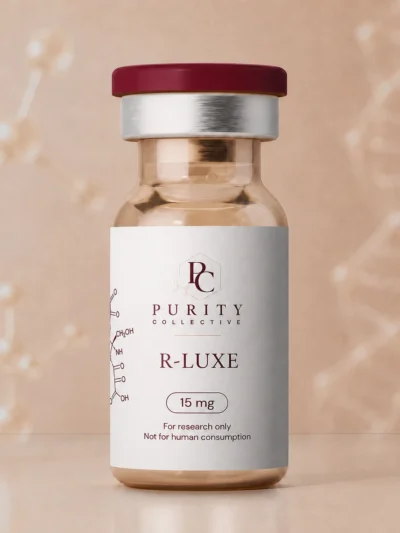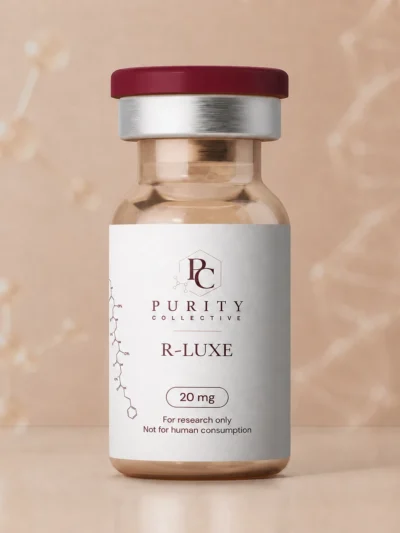

Retatrutide is the preferred substance name for LY3437943, an investigational compound listed in the FDA substance registry under UNII NOP2Y096GV and CAS 2381089-83-2. It is not an FDA-approved drug. On Purity Collective, R-Luxe identifies research-only Retatrutide listings in 10mg and 30mg lyophilized-vial formats. That shared name is a starting point for verification—not proof that a commercial vial is equivalent to any clinical-trial material.
Research-use boundary: This guide explains identity records, current U.S. research status and analytical-document review. It does not provide non-research or procedural-use guidance. Purity Collective’s Retatrutide listings are supplied only for qualified laboratory research and are restricted to qualified laboratory research contexts.
Retatrutide identity at a glance
| Preferred substance name | Retatrutide |
|---|---|
| Research code | LY3437943 / LY-3437943 |
| UNII | NOP2Y096GV |
| CAS registry number | 2381089-83-2 |
| Current U.S. status | Investigational; not a component of an FDA-approved drug |
| Purity Collective catalog formats | 10mg and 30mg lyophilized-vial research listings |
The identity fields above come from the FDA’s Global Substance Registration System. Its record also makes an important limitation explicit: receiving a UNII does not imply regulatory review or approval.1
One name can appear in three different contexts
Search results often place an official substance record, a clinical study and a commercial research listing side by side. They may share the word Retatrutide, but they do not establish the same thing.
- Substance identity. The FDA registry provides standardized names and identifiers. It answers “which substance is being named?” It does not approve a product or qualify a supplier.
- Clinical research record. ClinicalTrials.gov lists sponsor-submitted study information for LY3437943. A study record describes that research program; it does not validate a third-party commercial material.
- Commercial laboratory listing. Purity Collective uses R-Luxe as a catalog name for Retatrutide research listings. Product-level evidence begins with the SKU, stated quantity and documents linked to the specific listing.
This separation prevents a common reasoning error: recognizing the same compound name and silently assuming product equivalence. Identity, source, batch traceability and analytical scope still need to be reviewed independently.
What is Retatrutide’s current research status?
As of July 16, 2026, FDA states that Retatrutide is not a component of an FDA-approved drug, has not been found safe and effective for any condition, and cannot be used in compounding under federal law.2 ClinicalTrials.gov lists Retatrutide studies, including a completed Phase 3 record sponsored by Eli Lilly and Company.3 A completed study and a standardized substance identifier are not substitutes for FDA approval.
That distinction also affects responsible website copy. In a March 31, 2026 warning letter, FDA explained that research-use disclaimers did not control when the surrounding presentation signaled intended human use.4 Purity Collective therefore does not use this guide to discuss human outcomes, procedural-use details.
How the Purity Collective listings are organized
Purity Collective currently presents two Retatrutide research listings. The quantity, SKU and supporting documents differ, so they should be handled as separate procurement records rather than interchangeable versions of one page.
| Listing | SKU | Current documents linked on the listing |
|---|---|---|
| Retatrutide 10mg (R-Luxe) | PC-R-LUXE-10MG | UPLC/MS report and endotoxin report |
| Retatrutide 30mg (R-Luxe) | PC-R-LUXE-30MG | UPLC/MS report and endotoxin report |
The documents should be opened and reviewed directly. A link, thumbnail or certificate card is only a route to the evidence; it is not the evidence itself.
How to review a Retatrutide analytical report
Begin with traceability, not the largest percentage on the page. A practical review follows six checks:
- Confirm the compound. The report should identify Retatrutide, not only an internal catalog alias.
- Confirm the listing. Match the stated 10mg or 30mg quantity and the relevant product SKU.
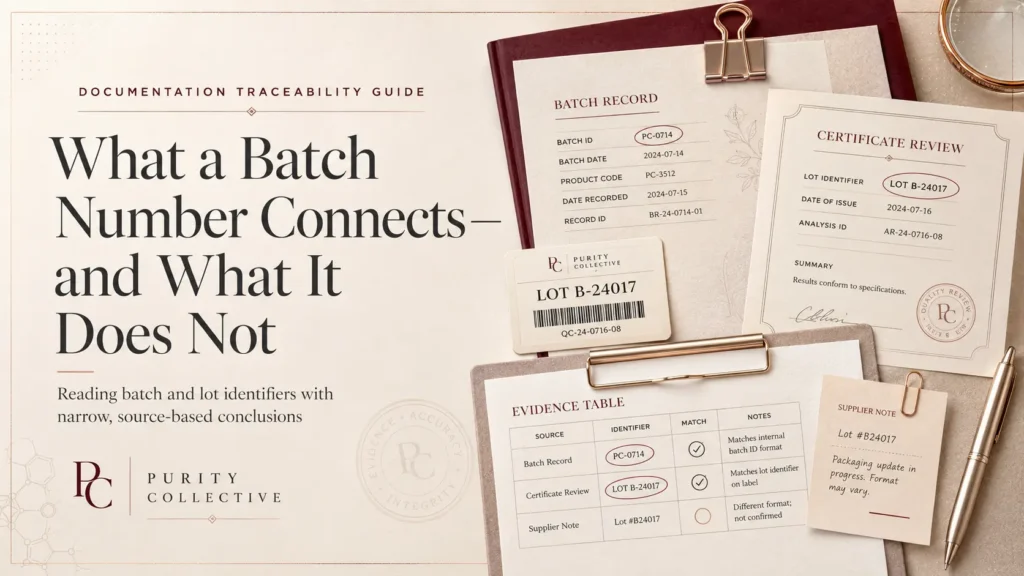
- Match the report identifiers. Compare the lot or report identifier with the certificate card and the product-level document record.
- Read the dates in order. Record received and analysis dates exactly as printed. If the chronology appears unusual, preserve and disclose it rather than guessing.
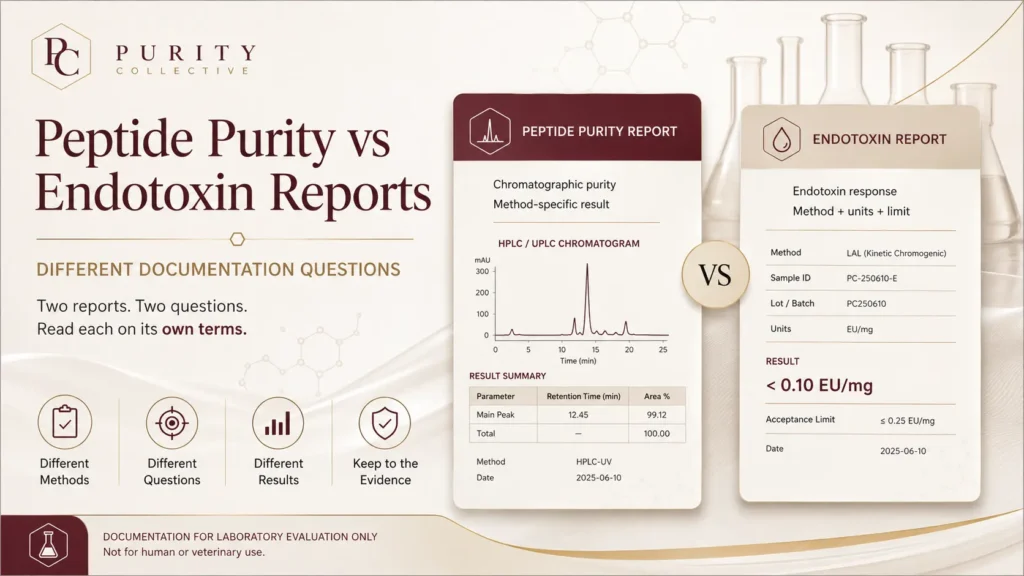
- Separate each test. Chromatographic purity, mass evidence, reported quantity and endotoxin are different analytical questions.
- Apply your own acceptance criteria. A supplier document supports review; it does not replace a laboratory’s procurement controls or fit-for-purpose evaluation.
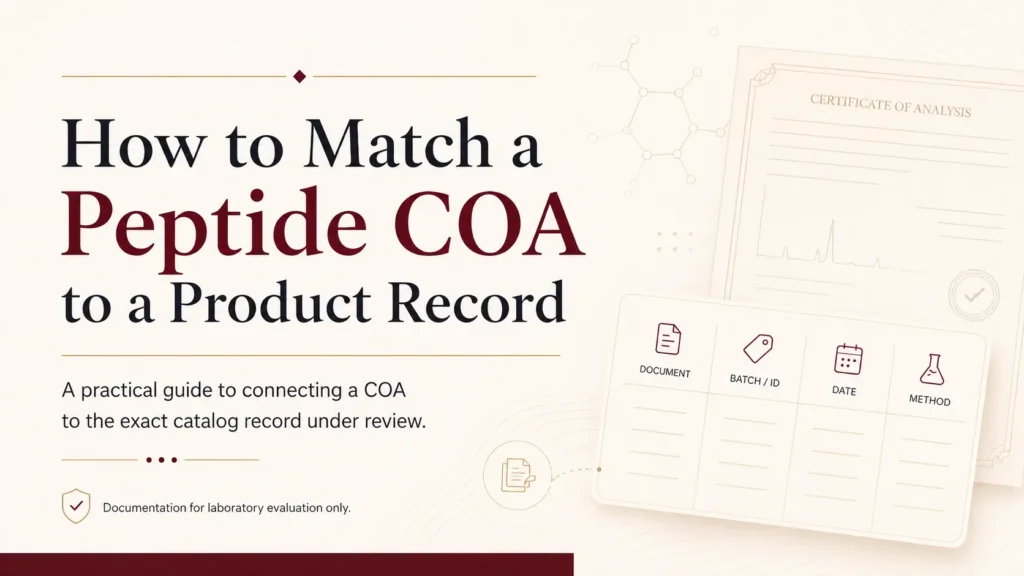
For a deeper method-by-method workflow, use the Purity Collective peptide COA guide.
What UPLC/MS documentation can—and cannot—show
UPLC separates detected components under a stated chromatographic method. A reported area percentage describes that chromatographic profile under those conditions. Mass spectrometry contributes a different kind of evidence by comparing an observed signal with the expected molecular mass.
Read together, those outputs can support a bounded identity and purity review of the submitted sample. They do not independently establish full structural characterization, filled quantity across every unit, sterility, safety, performance or equivalence to material used in a sponsor’s clinical study.
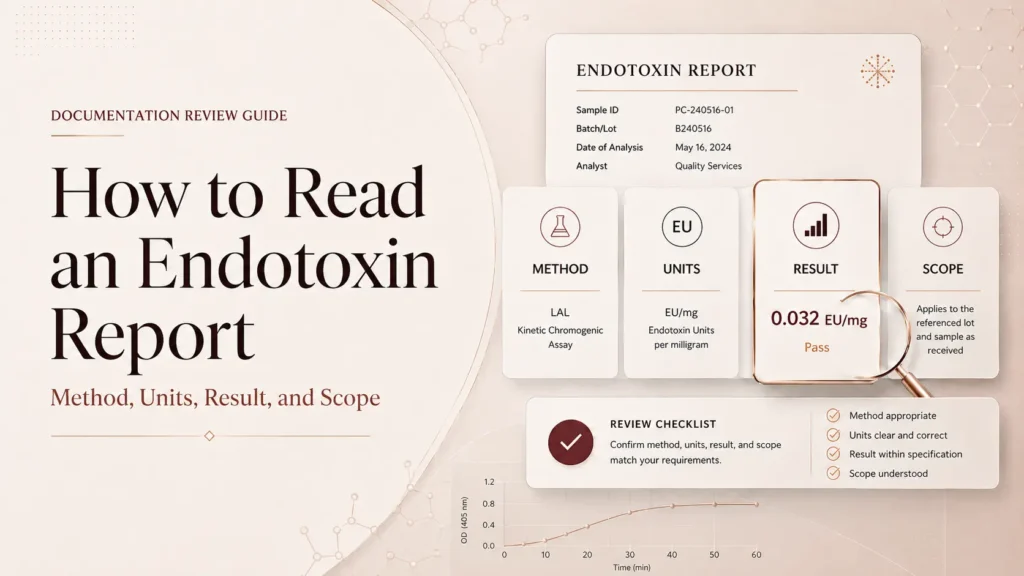
An endotoxin report is separate again. Its result should be read with the method, units and printed acceptance specification. If the document does not print an acceptance specification, do not invent one and do not convert the result into a pass claim. Endotoxin reporting is also not a sterility test.
Document limitations visible on the current listings
Transparency includes recording what is awkward, not only what is favorable.
- The 10mg endotoxin report displays an analysis date earlier than its received date and does not print an acceptance specification.
- The 30mg UPLC/MS and endotoxin reports both display an analysis date earlier than their received date.
- The 30mg endotoxin report does not print an acceptance specification.
- Any numerical result belongs to the report and sample it identifies; it should not be generalized into a permanent product promise.
These points do not prove that a report is valid or invalid. They are review conditions that a qualified laboratory should record and resolve within its own acceptance process.
A practical Retatrutide procurement checklist
- Use the preferred substance name and identifiers to confirm what material is being requested.
- Select the 10mg or 30mg listing intentionally; verify the SKU rather than relying on the R-Luxe alias alone.
- Open every linked report and match the compound, quantity, lot information and dates.
- Keep UPLC, mass, quantity and endotoxin conclusions separate.
- Record missing specifications and unusual chronology without converting them into unsupported conclusions.
- Do not assume that a commercial research vial is equivalent to any sponsor’s study material.
- Use only within a qualified laboratory workflow and outside consumer or veterinary use contexts.
Retatrutide FAQs
What is Retatrutide?
Retatrutide is the preferred substance name for LY3437943. FDA’s substance registry lists UNII NOP2Y096GV and CAS 2381089-83-2 for the identity. The substance is investigational and is not an FDA-approved drug.
Are Retatrutide and R-Luxe the same name?
R-Luxe is Purity Collective’s catalog name for its Retatrutide research listings. The product title and linked analytical reports make the Retatrutide identity explicit so the catalog alias is not mistaken for a different compound.
Is Retatrutide FDA approved?
No. As of July 16, 2026, FDA states that Retatrutide is not a component of an FDA-approved drug and has not been found safe and effective for any condition. Regulatory status can change, so verify the current FDA source rather than relying on an undated summary.
What is the difference between the 10mg and 30mg listings?
They have different stated quantities, SKUs and product-level analytical documents. The 10mg listing uses SKU PC-R-LUXE-10MG; the 30mg listing uses SKU PC-R-LUXE-30MG. Review the appropriate page and its documents before selection.
What can a Retatrutide COA show?
Its usefulness depends on the fields and methods it contains. A report may provide compound, lot, date, chromatographic, mass, quantity or endotoxin information for the submitted sample. Each result should be interpreted separately and within the report’s stated scope.
Does a high purity percentage establish safety or suitability?
No. A chromatographic area percentage is not proof of sterility, safety, filled quantity across every unit, cross-context equivalence or suitability outside a laboratory research setting.
Is Purity Collective Retatrutide positioned outside qualified laboratory research?
No. The 10mg and 30mg listings are supplied only for qualified laboratory research and are restricted to qualified laboratory research contexts.
Sources
- U.S. FDA, Retatrutide substance record, UNII NOP2Y096GV, accessed July 16, 2026.
- U.S. FDA, FDA Retatrutide compounding notice, accessed July 16, 2026.
- ClinicalTrials.gov, NCT05929066: A Study of Retatrutide (LY3437943) in Participants Who Have Obesity or Overweight, record last updated June 3, 2026; accessed July 16, 2026.
- U.S. FDA, Gram Peptides warning letter, March 31, 2026, accessed July 16, 2026.