
“99% purity” sounds like a complete quality verdict. Usually, it is not.
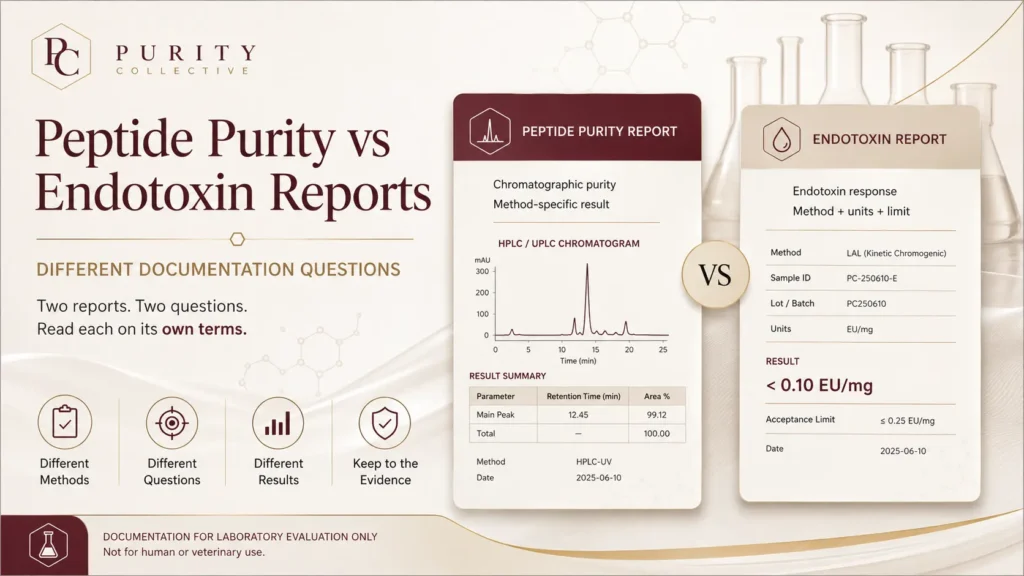
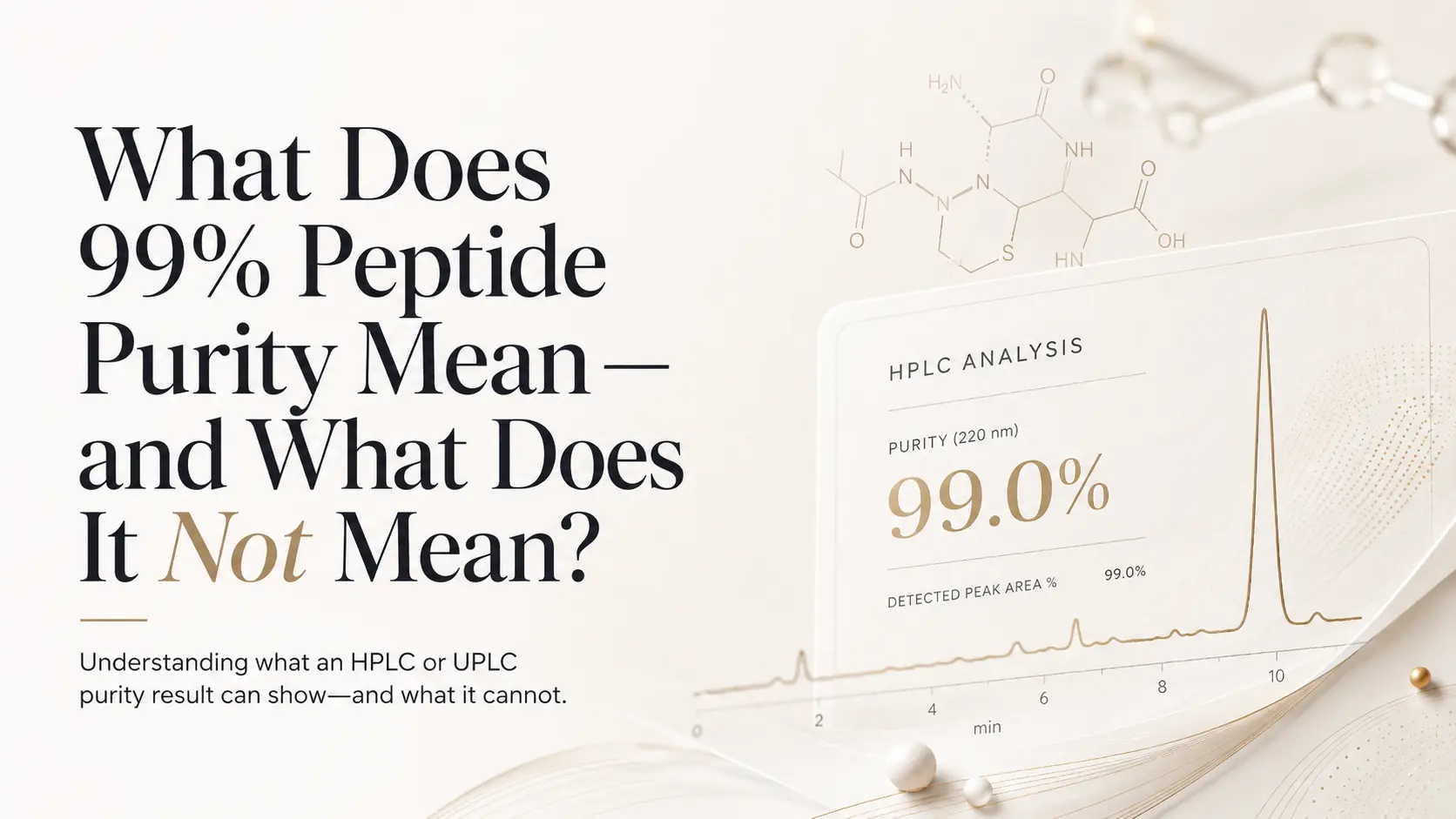
On a peptide certificate of analysis, the number commonly refers to the relative area of a designated main peak in an HPLC or UPLC chromatogram. It describes what the selected chromatographic method and detector observed in the analyzed sample. It does not automatically mean that 99% of the vial’s total mass is the intended peptide, that the molecular identity is fully established or that unrelated quality attributes have been tested.
The right way to read the claim is: 99% by which method, for which batch, against what acceptance criterion, and with what supporting evidence?
Research-use boundary: This guide concerns analytical documentation for laboratory evaluation. It does not establish suitability for human use and does not provide dosing, administration or clinical guidance.
The number needs a label
“Purity” can refer to different analytical ideas. A useful report names the test instead of leaving the percentage to carry more meaning than it can support.
| Label or claim | What it may describe | What to verify |
|---|---|---|
| 99% HPLC area purity | The designated main peak as a percentage of integrated detector response under the stated chromatographic method | Batch, detector, method, chromatogram, integration table, main-peak assignment and acceptance criterion |
| Mass consistent with expected | An observed molecular-mass or m/z result that agrees with the expected value within the method’s interpretation | Expected and observed values, charge/adduct assignment, batch and method context |
| Net peptide content | The amount or mass fraction attributable to peptide after accounting for components such as water and counterions | Quantitative method, reference standard, calculation and units |
| Labeled or filled quantity | The amount placed in or assigned to the container | Validated fill or content procedure and batch record—not an HPLC area result alone |
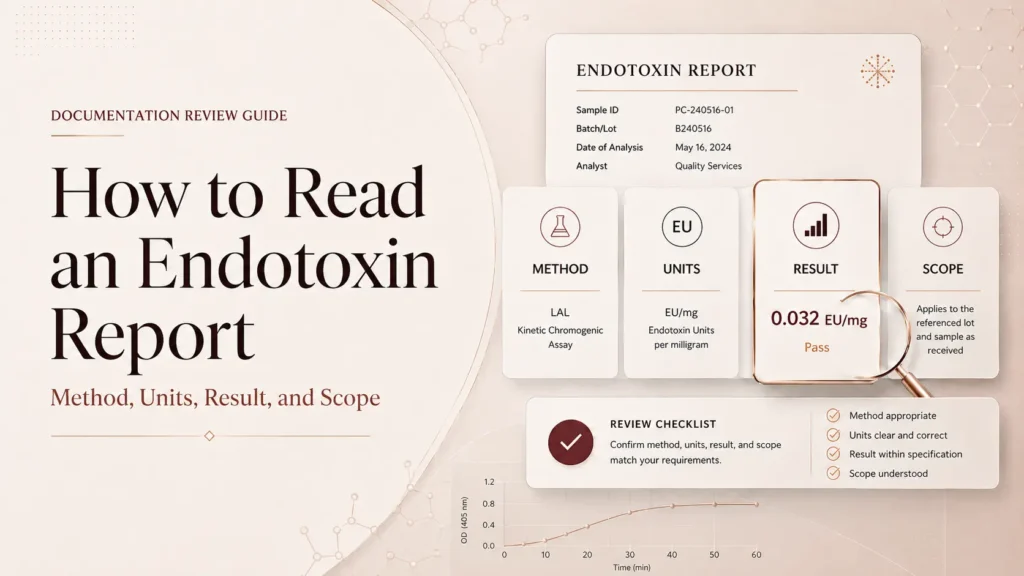
| Endotoxin result | A separate microbiological attribute reported in stated units against an applicable limit | Method, suitability, units, result and acceptance limit |
These statements may all appear in a documentation package, but they are not interchangeable. The first discipline of reading a purity claim is to preserve its exact label.
Where a 99% HPLC result usually comes from
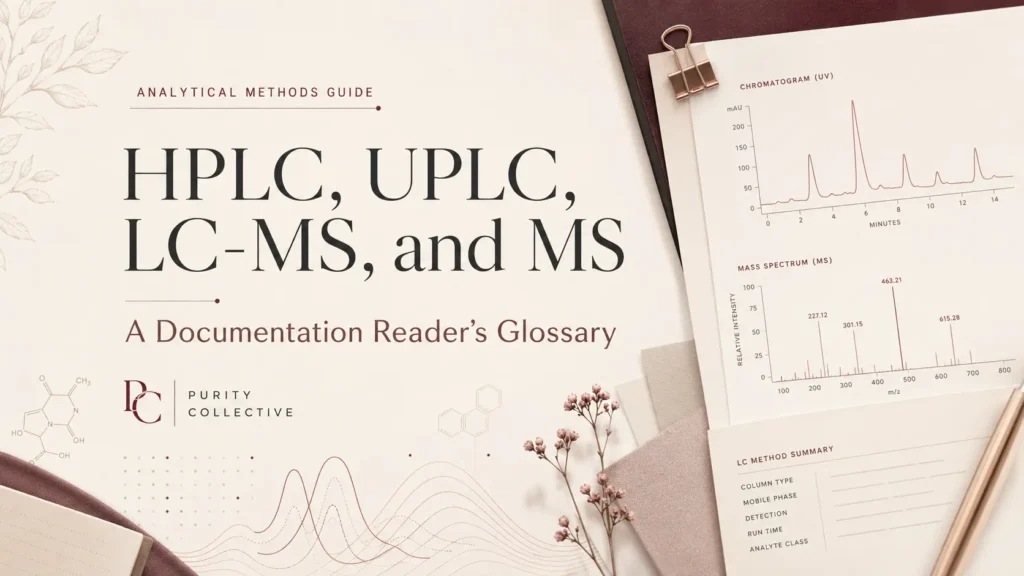
High-performance liquid chromatography separates detectable sample components as they pass through a column. UPLC uses the same core separation principle with systems designed for higher pressure and potentially faster or higher-resolution methods.
The separation system is paired with a detector. Peptide reports commonly use ultraviolet detection, producing a chromatogram in which the detector response appears as peaks over time. The laboratory integrates those peaks and designates one as the main peak associated with the target material.
A relative area calculation can be expressed simply:
main-peak area ÷ total integrated peak area × 100
If the main peak represents 99 units of integrated response and the included peaks total 100, the report may state 99% area purity. That percentage describes the chromatographic profile under the reported conditions.
It is not a universal property detached from the procedure. Column chemistry, mobile phases, gradient, flow rate, temperature, detector wavelength, sample preparation, peak integration and the method’s ability to resolve related substances can all affect the result. FDA’s Q14 guidance treats analytical development as a fit-for-purpose, scientifically justified activity, while Q2(R2) provides a framework for demonstrating that an analytical procedure performs suitably for its intended purpose.12
This does not mean a high area percentage is unimportant. It means the number is strongest when the method, chromatogram and calculation remain visible.
Why 99% area purity is not 99% peptide content
A detector does not necessarily respond equally to every component in a sample. Some components may not absorb meaningfully at the selected UV wavelength. Others may be unresolved, excluded by the integration approach or outside the method’s analytical scope.
The total mass of a lyophilized peptide material can also include water, counterions and other constituents that do not translate directly into separate UV peak area. As a result, relative chromatographic purity should not be treated as a gravimetric mass fraction.
The difference is practical:
- HPLC area purity asks how the integrated chromatographic response is distributed.
- Net peptide content asks how much of the material’s mass is attributable to peptide.
- Filled quantity asks how much material was placed in the container.
Peptide assay recommendations published in Clinical Chemistry explicitly distinguish chromatographic purity from net peptide content and discuss water and counterions as contributors to gravimetric weight.3 A report on synthetic peptide reference standards likewise treats identity, purity and strength as separate quality attributes supported by multiple analytical techniques.4
Therefore, a product page should not use “99% HPLC purity” as proof of a labeled milligram fill, net peptide content or potency unless the documentation includes a separate, appropriate quantitative procedure.
Purity and identity answer different questions
A chromatogram may contain one dominant peak. The detector signal alone does not fully establish what that peak is.
Retention time can support identification when compared under appropriate conditions, but it is method-specific and may not distinguish every possible related compound. Orthogonal evidence—often including mass spectrometry—is used because it addresses a different analytical dimension.
Mass spectrometry measures ions by their mass-to-charge ratio. A scientifically interpreted match between an expected molecular mass and an observed result can support the conclusion that the analyzed species is consistent with the expected compound. Even that wording has limits: compounds with the same mass can differ in sequence arrangement, stereochemistry or another structural feature.
The practical distinction is:
- a chromatogram can support a conclusion about relative chromatographic purity;
- a mass result can support a conclusion about molecular-mass consistency; and
- the full identity conclusion depends on the analytical purpose and the evidence used.
For a side-by-side explanation, see HPLC vs Mass Spectrometry for Peptides.
A 99% result does not answer microbiological questions
HPLC area purity does not establish endotoxin level. It does not establish sterility. Those attributes require separate methods and separately reported results.
An endotoxin document should identify the method, units, numerical result and applicable acceptance limit. “Below detection” is incomplete if the reporting or detection limit is missing. FDA’s current endotoxin guidance discussion emphasizes verifying that the selected assay is suitable for its intended purpose and for the particular material under the conditions of use.5
Sterility is also distinct from endotoxin. A sample can meet one analytical criterion without the other having been evaluated. Neither attribute should be inferred from a chromatogram or molecular-mass result.
This is one reason the broad statement “99% pure” can mislead: it invites readers to fill in quality attributes the test never measured.
What a strong 99% claim should show
Before relying on the headline number, look for the evidence directly around it.
1. The exact method label
The document should say whether the result is HPLC, UPLC, LC-UV or another procedure. “Purity: 99%” without a method is incomplete.
2. A matching batch
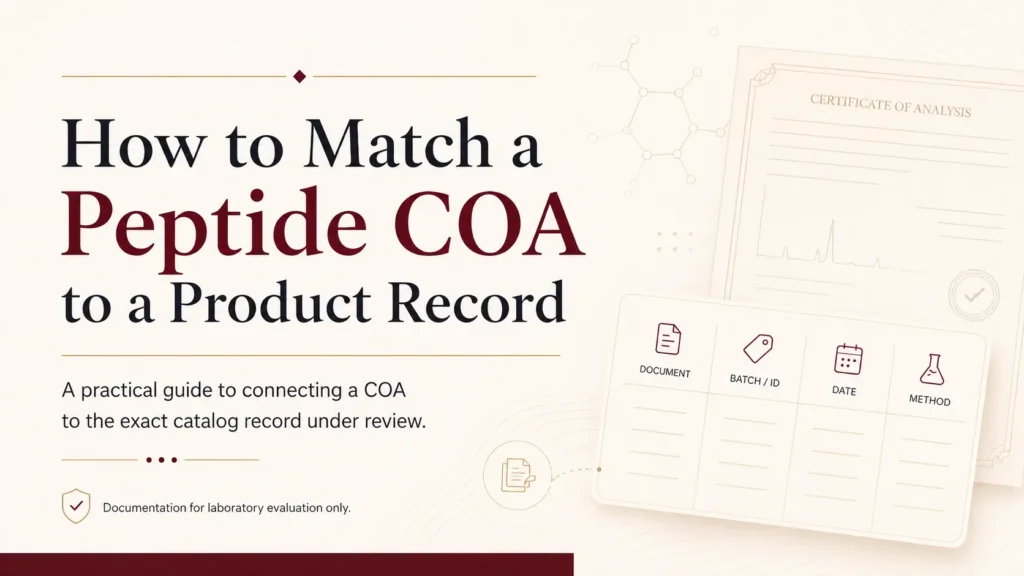
The lot or batch identifier on the product, label or batch selector should match the identifier on the chromatographic report. A 99% result for a previous batch is not batch-specific evidence for the current one.
3. The chromatogram and integration table
A numerical result is more reviewable when the underlying chromatogram, retention times, included peaks and integrated areas are visible. Cropped axes, excluded peaks or unexplained manual integration deserve clarification.
4. The acceptance criterion
The result should be read against a stated limit where one has been established. “Pass” is more useful when the specification and numerical result are both shown.
5. Supporting identity evidence
Check whether the documentation provides an expected-versus-observed mass comparison or other suitable identity evidence. Do not assume the largest UV peak must be the intended peptide.
6. Separate quantitative evidence for separate claims
If the page states a filled quantity, net content, water result, counterion result or endotoxin status, look for the method and batch-specific result supporting each statement.
For the wider document review—including issuer, dates and authorization—use How to Read a Peptide COA.
Common ways the claim gets overstated
Pause when you see language such as:
- “99% pure” with no method named;
- “99% peptide content” derived only from an HPLC area table;
- “identity confirmed” based only on a dominant chromatographic peak;
- “sterile” or “endotoxin-free” inferred from chromatographic purity;
- “exactly 10 mg” inferred from a purity percentage;
- one generic COA displayed across multiple batches;
- a testing badge with no report, issuer or batch link; or
- “independently tested” when the external laboratory is not identified.
These phrases may go beyond the displayed evidence. The remedy is not more promotional wording; it is a narrower claim and more reviewable documentation.
How Purity Collective should present purity data
Purity Collective product pages should state the analytical result with enough context to preserve its meaning. A defensible pattern is:
Reported HPLC/UPLC area purity: [result] for batch [identifier]. Review the linked chromatogram and analytical report for method context.
That sentence should appear only when the result, batch and report have been verified. If batch linkage is missing, the page should not imply that the document applies to the item currently offered.
The product specification table should keep separate rows for:
- compound identity and supplied form;
- labeled quantity;
- HPLC or UPLC area purity;
- mass documentation;
- content or water results, when actually tested; and
- endotoxin or other attribute results, when applicable and supported.
This structure is less dramatic than a giant “99%+” badge. It is also easier to audit, compare and correct.
The bottom line
A 99% peptide purity result can be useful evidence. It is not a complete certificate of quality.
When the percentage comes from HPLC or UPLC, it usually describes the relative area of the designated main peak under a stated chromatographic method. It should not be automatically translated into molecular identity, net peptide content, filled quantity, sterility, endotoxin status, safety or suitability.
Keep the conclusion as precise as the test: name the method, match the batch, review the chromatogram and verify every additional claim with its own evidence.
Sources
- U.S. Food and Drug Administration, Q14 Analytical Procedure Development, final guidance, March 2024.
- U.S. Food and Drug Administration, Q2(R2) Validation of Analytical Procedures, final guidance, March 2024.
- Hoofnagle AN, et al., Recommendations for the Generation, Quantification, Storage, and Handling of Peptides Used for Mass Spectrometry-Based Assays, Clinical Chemistry, 2016.
- McCarthy D, et al., Reference Standards to Support Quality of Synthetic Peptide Therapeutics, Pharmaceutical Research, 2023.
- U.S. Food and Drug Administration, FDA Clarifies Current Thinking on Pyrogen and Endotoxins Testing, content current March 18, 2026.
Understanding what is peptide purity is essential for evaluating the quality of peptide products.