
For laboratory research only. Not for human or animal use. This article gives no dosing, administration or therapeutic advice.
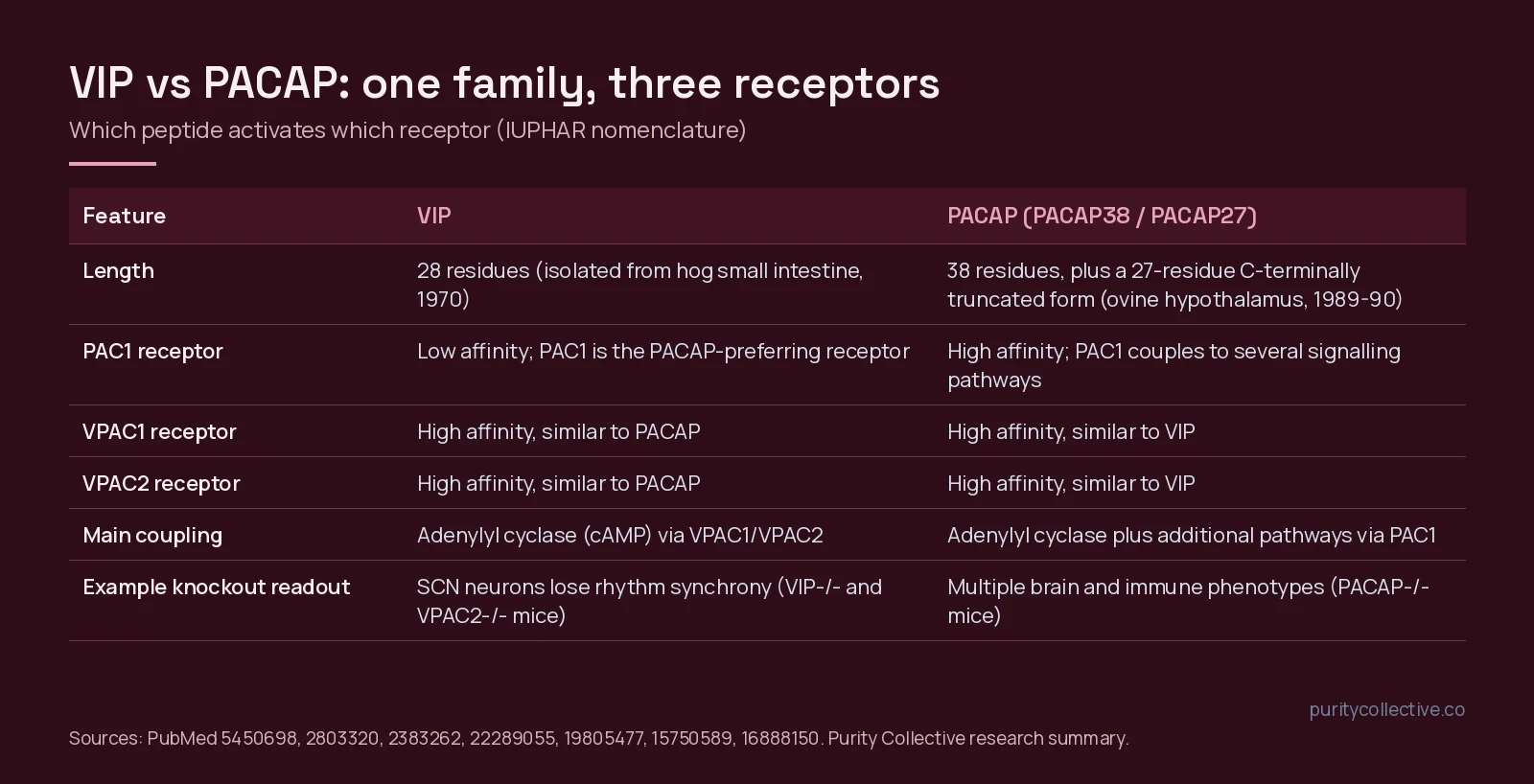
Short answer: VIP (vasoactive intestinal peptide) and PACAP (pituitary adenylate cyclase-activating polypeptide) are close relatives in the secretin/glucagon peptide superfamily, and they share two of their three receptors [1]. VPAC1 and VPAC2 respond to both peptides with high affinity. The third receptor, PAC1, is selective for PACAP [1][2]. So in a lab model, adding VIP mostly tests VPAC signalling, while adding PACAP can engage VPAC and PAC1 receptors at once. VIP is a 28-residue peptide first isolated from hog small intestine [3]. PACAP exists as a 38-residue form and a shorter 27-residue form, both first isolated from ovine hypothalamus [4][5].
VIP vs PACAP at a glance
| Feature | VIP | PACAP |
|---|---|---|
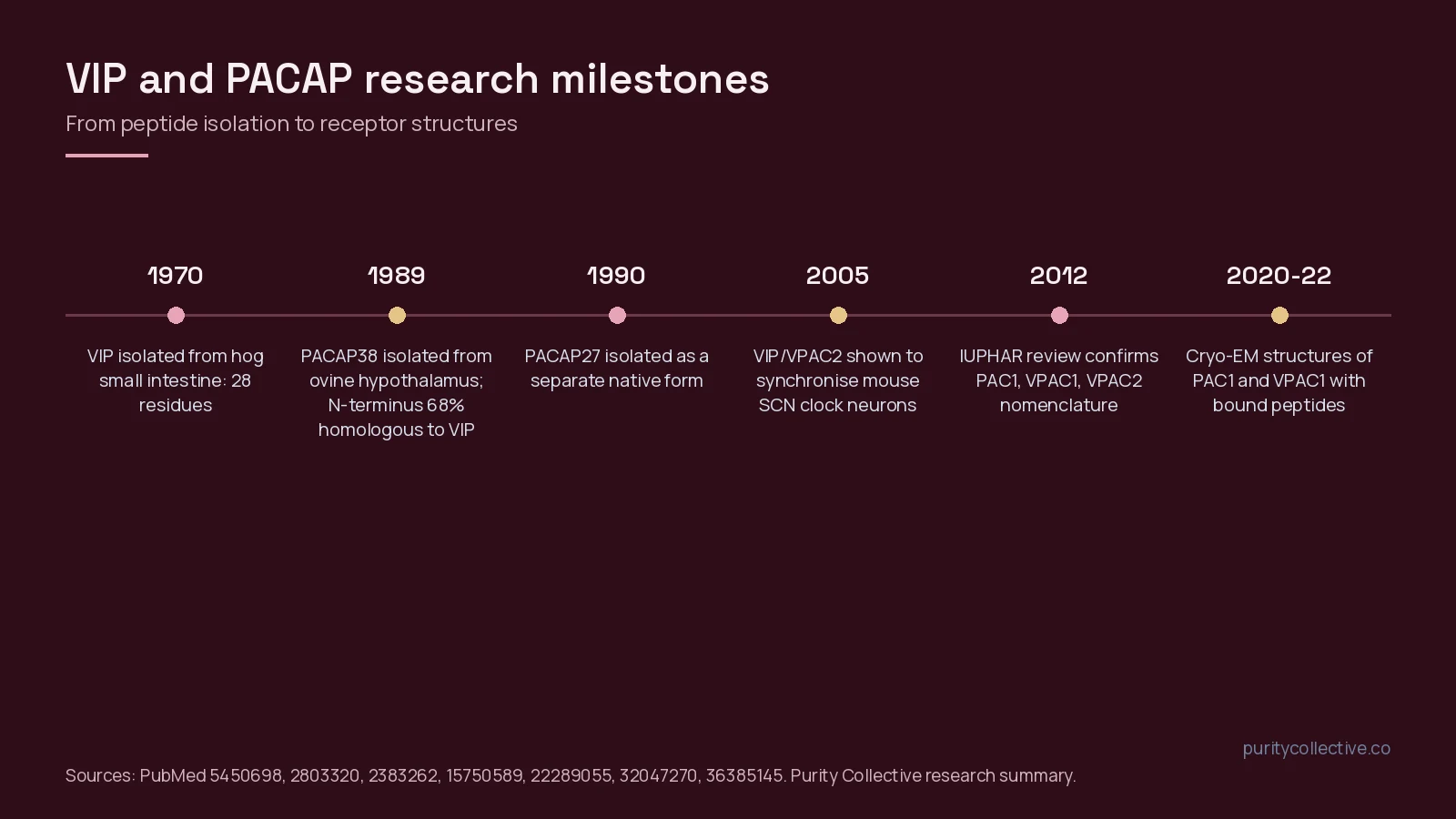
| First isolated from | Hog small intestine (1970) [3] | Ovine hypothalamus: PACAP38 in 1989, PACAP27 in 1990 [4][5] |
| Length | 28 amino acid residues [3] | 38 residues (PACAP38) or the N-terminal 27 residues with an amidated C-terminus (PACAP27) [4][5] |
| Sequence relationship | The N-terminal part of PACAP38 shows 68% homology with VIP [4] | |
| Adenylate cyclase activity in rat pituitary cells | Reference peptide in the original assays | At least 1,000 times greater than VIP in the same cell system [4][5] |
| Receptors | VPAC1 and VPAC2 (high affinity) [1] | PAC1 (selective), VPAC1 and VPAC2 (high affinity) [1] |
| Signalling summary | VPAC receptors couple mainly to adenylyl cyclase [2] | PAC1 couples to several transduction systems [2] |
| PubChem record | Synthetic human VIP is listed as aviptadil, CID 16132300 (C147H237N43O43S, 3326.8 g/mol) | PACAP-38, CID 91935803 (C203H331N63O53S, about 4534 g/mol) |
Where each peptide came from
VIP was found first. In 1970, Said and Mutt reported a polypeptide from hog small intestine with a broad set of actions in their animal preparations, including systemic vasodilation and increased cardiac output. They described it as 28 residues long and chemically distinct from secretin, glucagon, substance P and the kinins [3]. The “intestinal” in its name reflects that source, not a limit on where it is made; later work found VIP across the central and peripheral nervous systems [1].
PACAP was found almost two decades later by a different route. Miyata and colleagues were looking for hypothalamic factors that switch on adenylate cyclase in cultured rat anterior pituitary cells. The peptide they purified from ovine hypothalamus was 38 residues long, and its N-terminal sequence matched VIP at 68% of positions [4]. The surprise was potency: in that pituitary cell assay its adenylate cyclase activity was at least a thousand times that of VIP. In superfused rat pituitary cells it also increased release of growth hormone, prolactin, ACTH and LH, although the authors noted that the physiological meaning of those effects was still open [4].
A year later the same group isolated a shorter peptide from side fractions of the purification. It matched the first 27 residues of PACAP38, carried an amidated C-terminus, and was named PACAP27. Synthetic PACAP27 stimulated adenylate cyclase about as well as PACAP38, and showed vasodepressor activity similar to VIP [5]. For lab buyers, this means “PACAP” on a label is not one molecule. The 38- and 27-residue forms differ in mass and in some receptor-binding details, so the form should be stated in any protocol.
The receptor map: why the overlap matters
Both peptides act through class B (secretin-like) G protein-coupled receptors. The IUPHAR nomenclature subcommittee recognises three: PAC1, VPAC1 and VPAC2 [1]. PAC1 is selective for PACAP. VPAC1 and VPAC2 respond to VIP and PACAP with similarly high affinity [1]. A 2009 review of the first twenty years of PACAP work adds two practical details. PAC1 is coupled to several signalling pathways, while the VPAC receptors are coupled mainly to adenylyl cyclase. PAC1 is particularly abundant in brain, pituitary and adrenal gland, while VPAC receptors are expressed mainly in lung, liver and testis in the tissues surveyed [2].
Structural biology has started to explain the selectivity at the atomic level. Near-atomic cryo-EM structures of PAC1 bound to PACAP38, or to maxadilan (a sand fly peptide that also activates PAC1), showed a flexible extracellular domain that accommodates ligands in different orientations [6]. A 2022 study solved active, Gs-coupled complexes of VIP with VPAC1, PACAP27 with VPAC1, and PACAP27 with PAC1. VIP made fewer stable contacts with VPAC1 than PACAP27 did. Molecular dynamics of VIP modelled into PAC1 predicted more transient contacts in the receptor core, which the authors proposed as one basis for VIP’s preference for VPAC1 over PAC1 [7]. Those simulations are models, not measurements, and the authors frame them that way.
Fragment work in transfected CHO cells is the older pharmacology behind the same picture. Shortening PACAP(1-38) to PACAP(1-27) had little effect on binding, but N-terminally deleted fragments behaved differently across the three receptors, and some fragments could tell one receptor subtype from the others [8]. That is why truncated PACAP fragments appear in the literature as receptor tools rather than as stand-ins for the full peptide.
What knockout mice have shown
Genetic deletion has been the clearest way to separate the two systems, because the peptides overlap at VPAC receptors when they are added to tissue.
- VIP and the circadian clock. In mouse suprachiasmatic nucleus (SCN) recordings, loss of VIP or of the VPAC2 receptor abolished circadian firing rhythms in about half of SCN neurons and disrupted synchrony between the neurons that stayed rhythmic. Applying a VPAC2 agonist each day restored rhythmicity and synchrony in VIP-deficient neurons but not in VPAC2-deficient ones [9]. That rescue pattern is good evidence that VPAC2 is the receptor doing the work in that model.
- PACAP in the brain. A review of PACAP- and PACAP receptor-deficient mice lists behavioural and neurological phenotypes spanning psychomotor behaviour, feeding, stress responses, memory performance, ethanol sensitivity, chronic pain and circadian rhythms [10]. The breadth fits the wide distribution of PAC1 in the nervous system [2].
- Immune phenotypes. Mice lacking VIP, PACAP or one of the three receptors (genes Vip, Adcyap1, Vipr1, Vipr2, Adcyap1r1) have been used to ask whether the body’s own peptides shape immune responses. A 2018 review concluded that the picture is more complex than the anti-inflammatory effects seen when the peptides are added in disease models [11].
Inflammation, brain injury and islet models
Many papers on these peptides add them to an animal or cell model and measure a readout. The results are model-specific, and they include null findings.
VIP in autoimmune models. In collagen-induced arthritis in mice, VIP administration expanded CD4+CD25+Foxp3+ regulatory T cells in the periphery and joints. Transferring VIP-generated regulatory T cells slowed the course of the arthritis model [12]. The same peptide had essentially no effect on experimental autoimmune uveoretinitis in B10.RIII mice across the doses tested, and antibody production was unchanged [13]. The authors of the uveitis study contrasted this directly with the arthritis result. One model working and another not is a reminder that “anti-inflammatory” is not a property that transfers from one disease model to the next.
PACAP in rat stroke models. In transient middle cerebral artery occlusion in rats, PACAP38 given systemically starting 4 hours after the occlusion reduced infarct size compared with vehicle. When treatment began at 8 or 12 hours, infarct volumes tended to be smaller but the reduction was not statistically significant [14]. That time-window result is often left out of summaries.
PACAP in rat beta cells. In rat pancreatic beta cells, PACAP38 increased insulin secretion in a glucose- and dose-dependent manner. Blocking experiments pointed to PAC1, not VPAC1 or VPAC2, along with adenylyl cyclase and protein kinase A, and electrophysiology showed effects on potassium and calcium channels [15]. Islet function in general is one of the peripheral roles the IUPHAR review lists for both peptides [1].
Stability: the short life of native VIP
Native VIP is cleared quickly. In conscious dogs, infused porcine VIP had a measured half-life of about 1.8 minutes, and roughly 73% of immunoreactive VIP was lost in one pass through the liver [16]. That is one animal model with a radioimmunoassay readout, but it explains why VIP studies often discuss delivery and degradation, and why receptor-selective analogues and fragments get so much attention in this field [8]. We found no comparable head-to-head clearance study of PACAP38 and VIP in the same animal, so this article does not claim one is more stable than the other.
What the evidence does not show
- No single “VIP vs PACAP” experiment answers everything. The comparison here assembles separate studies with different species, tissues and readouts. Potency differences measured in rat pituitary cells [4] do not carry over automatically to other cell types.
- Overlap at VPAC receptors complicates interpretation. Because both peptides act at VPAC1 and VPAC2 [1], an effect of added PACAP does not by itself show that PAC1 is involved. Receptor-blocking or knockout controls, as in the beta-cell and SCN studies, are what make that call [15][9].
- Animal and cell results stay animal and cell results. The arthritis, uveitis, stroke and islet findings above come from mice, rats and isolated cells [12][13][14][15]. They do not describe effects in people.
- Structures are snapshots. Cryo-EM complexes show bound, active states, and the VIP-PAC1 interaction in the 2022 paper was a simulation, not a solved structure [7].
Choosing a peptide for a receptor question
The receptor map is the practical guide. A model built around VPAC2, such as SCN clock work, can be studied with VIP and a VPAC2-selective agonist [9]. A question about PAC1 needs PACAP, ideally with a PAC1 antagonist or PAC1-deficient tissue as the control [15]. Purity Collective currently lists VIP 10mg for in vitro and preclinical research; check that the mass on the batch report matches the PubChem formula for synthetic VIP above, and review the batch COA in our COA library before you start. For background on how research peptides are documented and handled, see what research peptides are. To set up a new order, you can buy research peptides online in the USA through our main catalog.
Frequently asked questions
What is the main difference between VIP and PACAP?
VIP is a 28-residue peptide that activates the VPAC1 and VPAC2 receptors. PACAP exists as 38- and 27-residue forms and activates those same two receptors plus PAC1, a receptor that is selective for PACAP. The two peptides share 68% sequence homology at PACAP’s N-terminal region.
Does VIP activate the PAC1 receptor?
PAC1 is classed as PACAP-selective in the IUPHAR nomenclature. Cryo-EM and simulation work from 2022 suggests VIP forms more transient contacts in the PAC1 core than in VPAC1, which may explain its preference for VPAC1.
What is the difference between PACAP38 and PACAP27?
PACAP27 corresponds to the first 27 residues of PACAP38 with an amidated C-terminus. Both were isolated from ovine hypothalamus, and in the original rat pituitary cell assays they stimulated adenylate cyclase to a similar degree.
Why is VIP described as short-lived?
In a study in conscious dogs, infused VIP had a measured half-life of about 1.8 minutes and much of it was cleared in one pass through the liver. That is an animal measurement and does not describe stability in a vial.
Are VIP and PACAP the same as aviptadil?
PubChem lists synthetic human VIP under the name aviptadil (CID 16132300). PACAP-38 has its own record (CID 91935803). Products sold by Purity Collective are for laboratory research only.
References
- Harmar AJ, Fahrenkrug J, Gozes I et al. (2012). Pharmacology and functions of receptors for vasoactive intestinal peptide and pituitary adenylate cyclase-activating polypeptide: IUPHAR review 1. Br J Pharmacol. PMID: 22289055. doi: 10.1111/j.1476-5381.2012.01871.x.
- Vaudry D, Falluel-Morel A, Bourgault S et al. (2009). Pituitary adenylate cyclase-activating polypeptide and its receptors: 20 years after the discovery. Pharmacol Rev. PMID: 19805477. doi: 10.1124/pr.109.001370.
- Said SI, Mutt V (1970). Polypeptide with broad biological activity: isolation from small intestine. Science. PMID: 5450698. doi: 10.1126/science.169.3951.1217.
- Miyata A, Arimura A, Dahl RR et al. (1989). Isolation of a novel 38 residue-hypothalamic polypeptide which stimulates adenylate cyclase in pituitary cells. Biochem Biophys Res Commun. PMID: 2803320. doi: 10.1016/0006-291x(89)91757-9.
- Miyata A, Jiang L, Dahl RD et al. (1990). Isolation of a neuropeptide corresponding to the N-terminal 27 residues of the pituitary adenylate cyclase activating polypeptide with 38 residues (PACAP38). Biochem Biophys Res Commun. PMID: 2383262. doi: 10.1016/0006-291x(90)92140-u.
- Wang J, Song X, Zhang D et al. (2020). Cryo-EM structures of PAC1 receptor reveal ligand binding mechanism. Cell Res. PMID: 32047270. doi: 10.1038/s41422-020-0280-2.
- Piper SJ, Deganutti G, Lu J et al. (2022). Understanding VPAC receptor family peptide binding and selectivity. Nat Commun. PMID: 36385145. doi: 10.1038/s41467-022-34629-3.
- Gourlet P, Vandermeers A, Vandermeers-Piret MC et al. (1995). Fragments of pituitary adenylate cyclase activating polypeptide discriminate between type I and II recombinant receptors. Eur J Pharmacol. PMID: 8666028. doi: 10.1016/0014-2999(95)00467-5.
- Aton SJ, Colwell CS, Harmar AJ et al. (2005). Vasoactive intestinal polypeptide mediates circadian rhythmicity and synchrony in mammalian clock neurons. Nat Neurosci. PMID: 15750589. doi: 10.1038/nn1419.
- Hashimoto H, Shintani N, Baba A (2006). New insights into the central PACAPergic system from the phenotypes in PACAP- and PACAP receptor-knockout mice. Ann N Y Acad Sci. PMID: 16888150. doi: 10.1196/annals.1317.038.
- Abad C, Tan YV (2018). Immunomodulatory Roles of PACAP and VIP: Lessons from Knockout Mice. J Mol Neurosci. PMID: 30105629. doi: 10.1007/s12031-018-1150-y.
- Gonzalez-Rey E, Fernandez-Martin A, Chorny A et al. (2006). Vasoactive intestinal peptide induces CD4+,CD25+ T regulatory cells with therapeutic effect in collagen-induced arthritis. Arthritis Rheum. PMID: 16508968. doi: 10.1002/art.21652.
- Chen J, Vistica B, Wiggert B et al. (2005). The immunomodulator vasoactive intestinal peptide (VIP) does not affect experimental autoimmune uveitis (EAU) in B10.RIII mice. Ocul Immunol Inflamm. PMID: 15804764. doi: 10.1080/09273940490912399.
- Reglodi D, Somogyvari-Vigh A, Vigh S et al. (2000). Delayed systemic administration of PACAP38 is neuroprotective in transient middle cerebral artery occlusion in the rat. Stroke. PMID: 10835464. doi: 10.1161/01.str.31.6.1411.
- Liu M, Yang X, Bai T et al. (2019). PACAP stimulates insulin secretion by PAC(1) receptor and ion channels in β-cells. Cell Signal. PMID: 31085235. doi: 10.1016/j.cellsig.2019.05.006.
- Chayvialle JA, Rayford PL, Thompson JC (1981). Radioimmunoassay study of hepatic clearance and disappearance half-time of somatostatin and vasoactive intestinal peptide in dogs. Gut. PMID: 6117506. doi: 10.1136/gut.22.9.732.