
For laboratory research only. Not for human or animal use. This article gives no dosing, administration or therapeutic advice.
Short answer: Thymosin Alpha-1 and TB-500 share a family name and nothing else that matters on a lab bench. Thymosin alpha-1 is an acidic 28-residue peptide1 taken from the front end of a larger protein, prothymosin alpha2. TB-500, as Purity Collective’s own report identifies it, is thymosin beta-4: a 43-residue peptide6 best known for binding actin inside cells7. Different sequence, different mass, different research literature.
This guide compares the two side by side: where the names come from, the identity fields that separate them, what the published research looks at, and how to read the two product records, Thymosin Alpha-1 10mg and TB-500 10mg, without mixing them up.
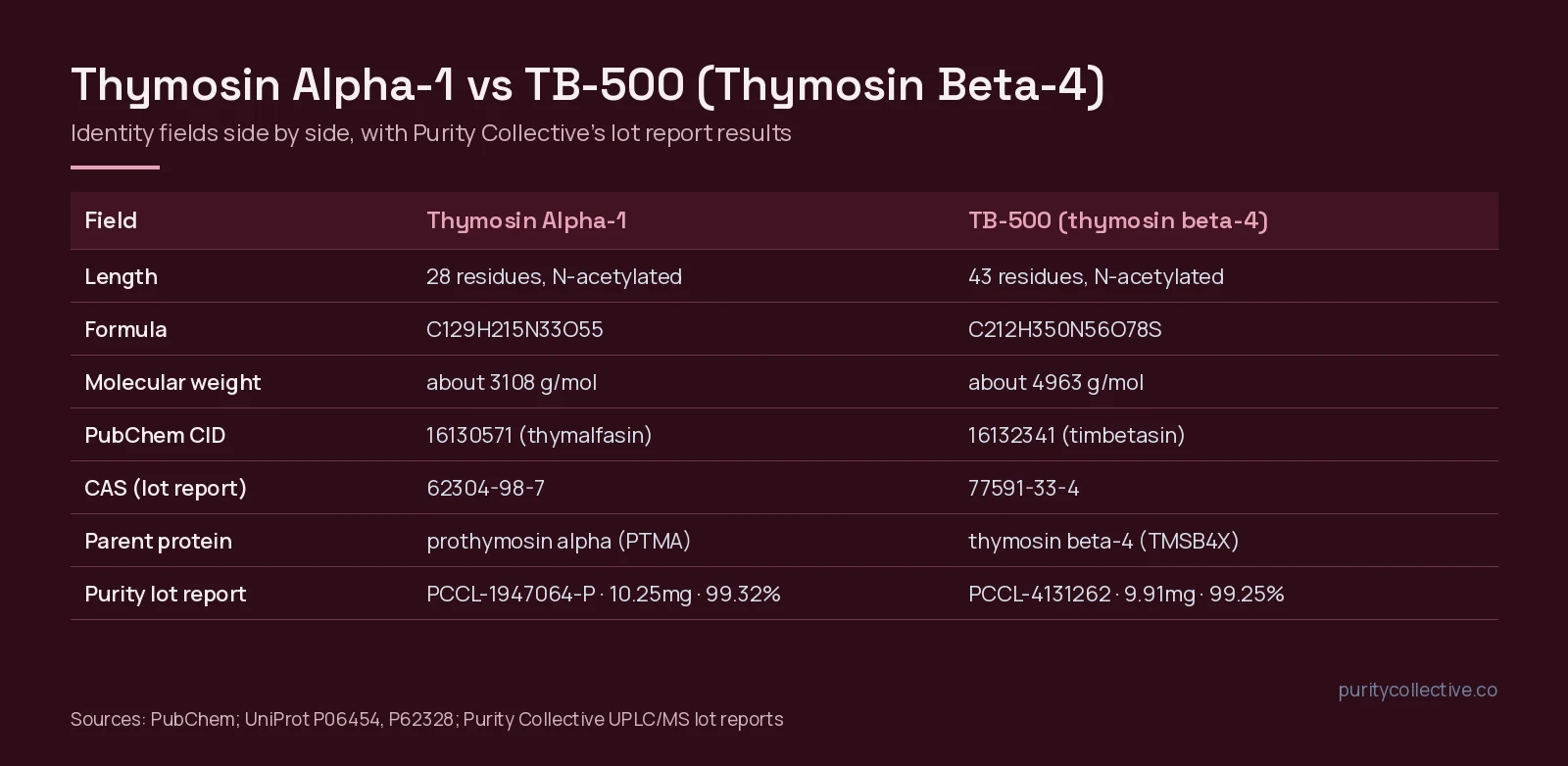
Thymosin Alpha-1 vs TB-500 at a glance
The identity rows come from PubChem and UniProt. The last three rows come from the UPLC/MS report linked on each Purity Collective product page.
| Field | Thymosin Alpha-1 | TB-500 (thymosin beta-4) |
|---|---|---|
| Length | 28 amino acids, N-terminus acetylated | 43 amino acids, N-terminus acetylated |
| Sequence | Ac-SDAAVDTSSEITTKDLKEKKEVVEEAEN | Ac-SDKPDMAEIEKFDKSKLKKTETQEKNPLPSKETIEQEKQAGES |
| Molecular formula | C129H215N33O55 | C212H350N56O78S |
| Average molecular weight | about 3108 g/mol | about 4963 g/mol |
| PubChem CID | 16130571 (thymalfasin) | 16132341 (timbetasin) |
| CAS printed on the lot report | 62304-98-7 | 77591-33-4 |
| Parent protein (UniProt) | Prothymosin alpha, P06454, gene PTMA | Thymosin beta-4, P62328, gene TMSB4X |
| Main research theme in the literature | Immune signaling, especially dendritic cells and Toll-like receptors | Actin sequestration, cell migration, tissue repair models |
| Purity Collective lot (UPLC/MS) | PCCL-1947064-P | PCCL-4131262 |
| Measured quantity vs specification | 10.25mg vs 10mg | 9.91mg vs 10mg |
| Purity result vs specification | 99.32% vs >98% | 99.25% vs >98% |
Why two different peptides are both called thymosin
The shared name is a historical accident. In the 1970s Allan Goldstein’s group fractionated calf thymus and called the active mixture thymosin fraction 5. Individual peptides pulled out of that mixture got Greek-letter names under a nomenclature proposed in 1977. Thymosin alpha-1 was the first named this way, described in 1977 as “a heat stable, highly acidic molecule composed of 28 amino acid residues”1. Thymosin beta-4 came out of the same fraction and was sequenced in 19816.
A 2007 review of the beta-thymosins is blunt about what that naming does and does not mean: several peptides were isolated from fraction 5, but “none of the isolated peptides were really thymic hormones”8. One of them, polypeptide beta-1, turned out to be a truncated form of ubiquitin. So “thymosin” tells you a peptide’s origin story, not its structure or what it does.
Practical rule: treat Thymosin Alpha-1 and TB-500 as two unrelated compounds that happen to share a prefix. Match each one to its own CAS number, formula and molecular weight, never to the word thymosin.
Thymosin alpha-1: a fragment of prothymosin alpha
Thymosin alpha-1 is not a stand-alone gene product. In 1984 researchers using an antibody against synthetic thymosin alpha-1 found that the main cross-reacting substance in rat thymus was a larger polypeptide of about 112 residues “with the thymosin alpha 1 sequence at its NH2 terminus.” They named it prothymosin alpha2. The same paper gives the calculated mass of synthetic thymosin alpha-1 as 3108, which matches the about 3108.3 g/mol printed on Purity Collective’s report.
Most of the research literature on thymosin alpha-1 is about immune signaling. A 2004 mouse study reported that the peptide drove maturation of dendritic cells exposed to a fungus through MyD88-dependent Toll-like receptor pathways3. Later reviews describe the same theme: thymosin alpha-1 acting on myeloid and plasmacytoid dendritic cells through Toll-like receptors4,5. These are cell and animal findings, reported in their own experimental settings.
For more on the record itself, the Thymosin Alpha-1 research records guide walks through the product page and its two reports in detail.
TB-500 and thymosin beta-4: the actin-binding peptide
Thymosin beta-4 was first described as a 43-residue thymic peptide with an acetylated N-terminus and a molecular weight near 5,0006. Its main job inside cells was found later. In 1991 Safer and colleagues showed that a peptide holding most of the unpolymerized actin in human platelets was “indistinguishable from thymosin beta 4”, forming a 1:1 complex with actin monomers and blocking polymerization7. That actin-sequestering role is now the starting point for most thymosin beta-4 research, including cell migration and tissue repair models8.
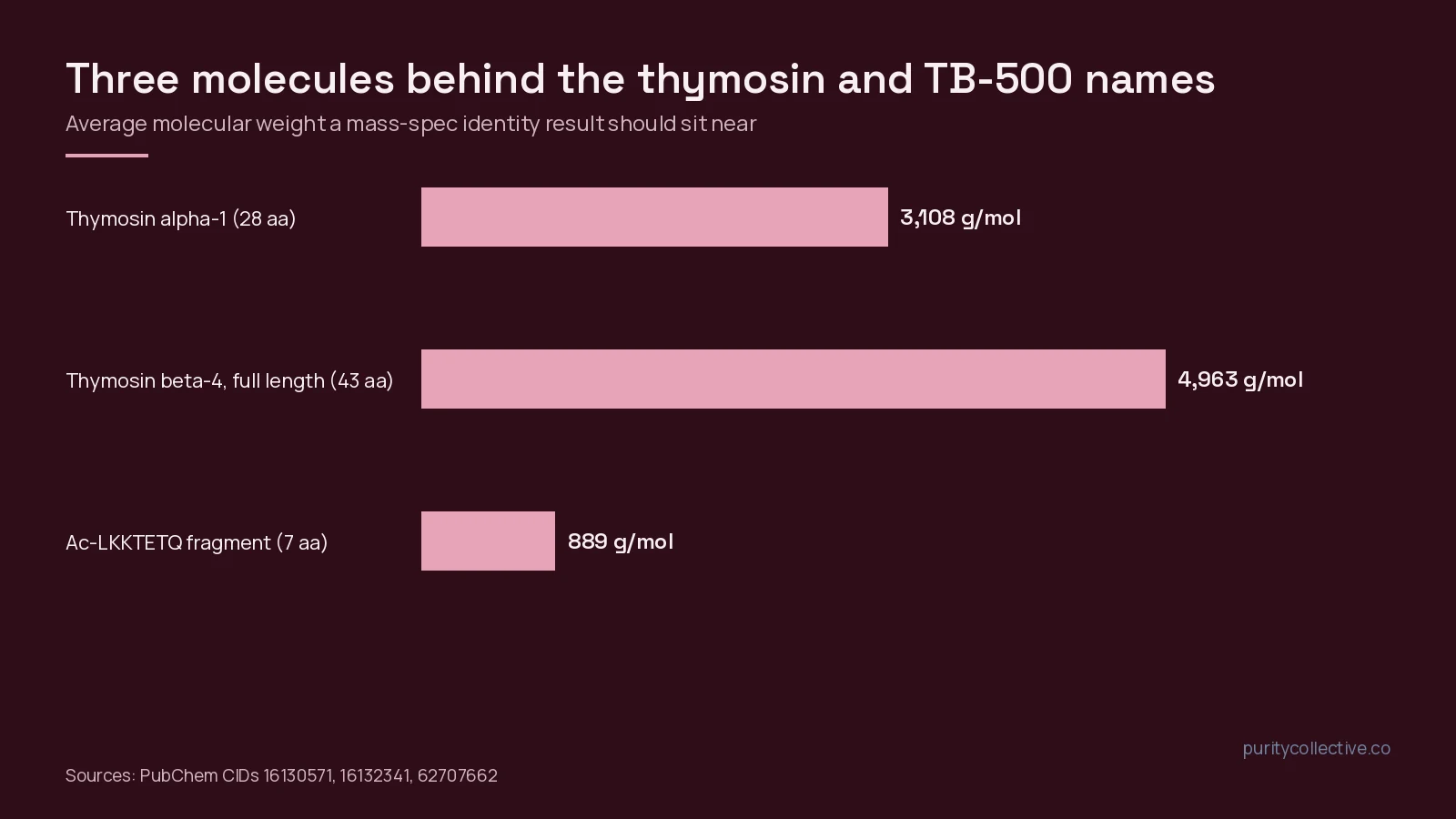
The name TB-500 adds a complication. Two 2012 doping-control papers analyzed products sold as TB-500 and identified the active ingredient as Ac-LKKTETQ, a 7-residue acetylated fragment covering residues 17 to 23 of thymosin beta-49,10. That fragment weighs about 889 g/mol, less than a fifth of the full-length peptide. So “TB-500” on a label can mean either molecule, and only the identity data settles which.
Purity Collective’s TB-500 10mg report settles it for that lot: it lists CAS 77591-33-4, formula C212H350N56O78S, about 4963 g/mol and PubChem CID 16132341, which are the full-length thymosin beta-4 values. The TB-500 research records guide covers this listing on its own.
How to tell them apart on a lab report
Because the two peptides differ in length by 15 residues, the identity fields on a report separate them cleanly. When you read either document, check these fields in order (the guide to reading a peptide COA explains each one):
- Compound name. It should match the product page exactly. A report titled for one compound cannot support a listing for the other.
- Molecular weight. About 3108 g/mol points to thymosin alpha-1. About 4963 g/mol points to full-length thymosin beta-4. About 889 g/mol points to the Ac-LKKTETQ fragment.
- Formula and CAS. C129H215N33O55 with CAS 62304-98-7 for thymosin alpha-1. C212H350N56O78S with CAS 77591-33-4 for thymosin beta-4. The beta-4 formula carries one sulfur atom, from its single methionine. Thymosin alpha-1 has none.
- Lot number. Each result belongs to the lot printed on that report, nothing wider.
- Method and dates. Note the test method and both printed dates exactly as written.
Comparing the two Purity Collective product records
Both listings are 10mg lyophilized vials, and each links two documents from the same lab: a UPLC/MS report and a separate endotoxin report. The table keeps every number tied to its own lot.
| Record field | Thymosin Alpha-1 10mg | TB-500 10mg |
|---|---|---|
| UPLC/MS lot | PCCL-1947064-P | PCCL-4131262 |
| Measured quantity | 10.25mg (spec 10mg) | 9.91mg (spec 10mg) |
| Purity | 99.32% (spec >98%) | 99.25% (spec >98%) |
| UPLC/MS dates as printed | Received 05/09/2026, analysis 05/04/2026 | Received 03/15/2026, analysis 03/22/2026 |
| Endotoxin lot | PCCL-1947064-E | PCCL-4131262-E |
| Endotoxin result | <0.05 EU/mL, no acceptance specification printed | <0.05 EU/mL, no acceptance specification printed |
| Endotoxin dates as printed | Received 05/09/2026, analysis 05/04/2026 | Received 04/08/2026, analysis 04/03/2026 |
Three things are worth recording when you file these. First, the endotoxin values are results without a printed pass limit, so they should be written down as results, not as passes. Second, three of the four documents print an analysis date earlier than the received date. Record the dates exactly as printed rather than correcting them. Third, the purity percentages describe each submitted sample. They are not a ranking of one compound over the other, because the two peptides were tested as separate samples on separate dates.
If you are setting up a documentation-first supplier review, Purity Collective’s page to buy research peptides online in the USA lists the catalog by research area, and the COA library collects every posted report in one place. Labs that already work with thymosin beta-4 in a blend can compare the BPC-157 + TB-500 10mg record, which has its own report for each component.
What the evidence does not show
- It does not show that thymosin alpha-1 and thymosin beta-4 act alike. They share an extraction history1,6, not a sequence, a target or a literature.
- It does not show that a product labeled TB-500 is full-length thymosin beta-4. Published analyses found the 7-residue fragment under that name9,10. Only the lot’s own identity data answers that.
- It does not carry cell or animal findings over to any product. The dendritic-cell and actin results above come from specific experimental systems3,7 and say nothing about any vial.
- It does not make a purity percentage a statement about sterility, stability over time, or suitability for any use. Those are separate questions with separate tests.
- It does not extend one lot’s results to another lot, or to the blend and pen listings that contain thymosin beta-4.
Frequently asked questions
Are Thymosin Alpha-1 and TB-500 the same peptide?
No. Thymosin alpha-1 is a 28-residue acidic peptide (formula C129H215N33O55, about 3108 g/mol) cut from the N-terminus of prothymosin alpha. TB-500 on Purity Collective’s lot report is full-length thymosin beta-4, a 43-residue actin-binding peptide (C212H350N56O78S, about 4963 g/mol). They share a historical name, not a sequence.
Why do both peptides have thymosin in the name?
Both were first isolated from thymosin fraction 5, a calf thymus extract. The name records where they were found, not a shared structure or function. Later work showed thymosin beta-4 is an actin-sequestering peptide with a widespread distribution across cell types.
Does TB-500 always mean full-length thymosin beta-4?
No. Doping-control studies identified products sold as TB-500 that contained the acetylated 7-residue fragment Ac-LKKTETQ (about 889 g/mol), residues 17 to 23 of thymosin beta-4. Purity Collective’s TB-500 10mg report lists CAS 77591-33-4 and about 4963 g/mol, the full-length molecule. The mass on the report is how you tell which one a lot is.
What do Purity Collective’s lot reports show for these two products?
The Thymosin Alpha-1 10mg UPLC/MS report for lot PCCL-1947064-P records 10.25mg measured against a 10mg specification and 99.32% purity. The TB-500 10mg report for lot PCCL-4131262 records 9.91mg measured and 99.25% purity. Each product also has a separate endotoxin report with a result below 0.05 EU/mL and no printed acceptance specification.
Is either product for human use?
No. Both are sold for laboratory research only. They are not drugs, foods or supplements, and Purity Collective gives no dosing, administration or therapeutic guidance for either one.
References
- Goldstein AL, Low TL, McAdoo M et al. (1977). Thymosin alpha1: isolation and sequence analysis of an immunologically active thymic polypeptide. Proc Natl Acad Sci U S A. PMID: 265536. doi: 10.1073/pnas.74.2.725.
- Haritos AA, Goodall GJ, Horecker BL (1984). Prothymosin alpha: isolation and properties of the major immunoreactive form of thymosin alpha 1 in rat thymus. Proc Natl Acad Sci U S A. PMID: 6583693. doi: 10.1073/pnas.81.4.1008.
- Romani L, Bistoni F, Gaziano R et al. (2004). Thymosin alpha 1 activates dendritic cells for antifungal Th1 resistance through toll-like receptor signaling. Blood. PMID: 14982877. doi: 10.1182/blood-2003-11-4036.
- Romani L, Bistoni F, Montagnoli C et al. (2007). Thymosin alpha1: an endogenous regulator of inflammation, immunity, and tolerance. Ann N Y Acad Sci. PMID: 17495242. doi: 10.1196/annals.1415.002.
- King R, Tuthill C (2016). Immune Modulation with Thymosin Alpha 1 Treatment. Vitam Horm. PMID: 27450734. doi: 10.1016/bs.vh.2016.04.003.
- Low TL, Hu SK, Goldstein AL (1981). Complete amino acid sequence of bovine thymosin beta 4: a thymic hormone that induces terminal deoxynucleotidyl transferase activity in thymocyte populations. Proc Natl Acad Sci U S A. PMID: 6940133. doi: 10.1073/pnas.78.2.1162.
- Safer D, Elzinga M, Nachmias VT (1991). Thymosin beta 4 and Fx, an actin-sequestering peptide, are indistinguishable. J Biol Chem. PMID: 1999398.
- Hannappel E (2007). beta-Thymosins. Ann N Y Acad Sci. PMID: 17468232. doi: 10.1196/annals.1415.018.
- Esposito S, Deventer K, Goeman J et al. (2012). Synthesis and characterization of the N-terminal acetylated 17-23 fragment of thymosin beta 4 identified in TB-500, a product suspected to possess doping potential. Drug Test Anal. PMID: 22962027. doi: 10.1002/dta.1402.
- Ho EN, Kwok WH, Lau MY et al. (2012). Doping control analysis of TB-500, a synthetic version of an active region of thymosin β₄, in equine urine and plasma by liquid chromatography-mass spectrometry. J Chromatogr A. PMID: 23084823. doi: 10.1016/j.chroma.2012.09.043.