
For laboratory research only. Not for human or animal use. This article gives no dosing, administration or therapeutic advice.
Short answer: tesamorelin and sermorelin are both synthetic analogues of growth hormone-releasing hormone (GHRH) that act on the same pituitary receptor. Sermorelin is the shortest fully active piece of human GHRH, residues 1-29 with an amidated C-terminus[2],[1]. Tesamorelin is the full 44-residue hormone with a trans-3-hexenoyl group on its first tyrosine, a change that makes it resistant to the plasma enzyme that inactivates native GHRH[4],[3]. In the US, tesamorelin is an FDA-approved prescription drug (Egrifta); sermorelin was approved as Geref and later discontinued for commercial reasons.
Tesamorelin vs sermorelin: structure and identity
The two molecules share the same N-terminal sequence. Structure-activity scans of hGHRH(1-29)-NH2 showed that the first residues carry much of the activity: replacing Tyr1, Ala3, Asp5 or Ile6 with alanine almost abolished potency in vitro, while several mid-chain substitutions were tolerated or even improved it[1]. That is why both designs keep the native N-terminal sequence and differ in what is added or removed around it.
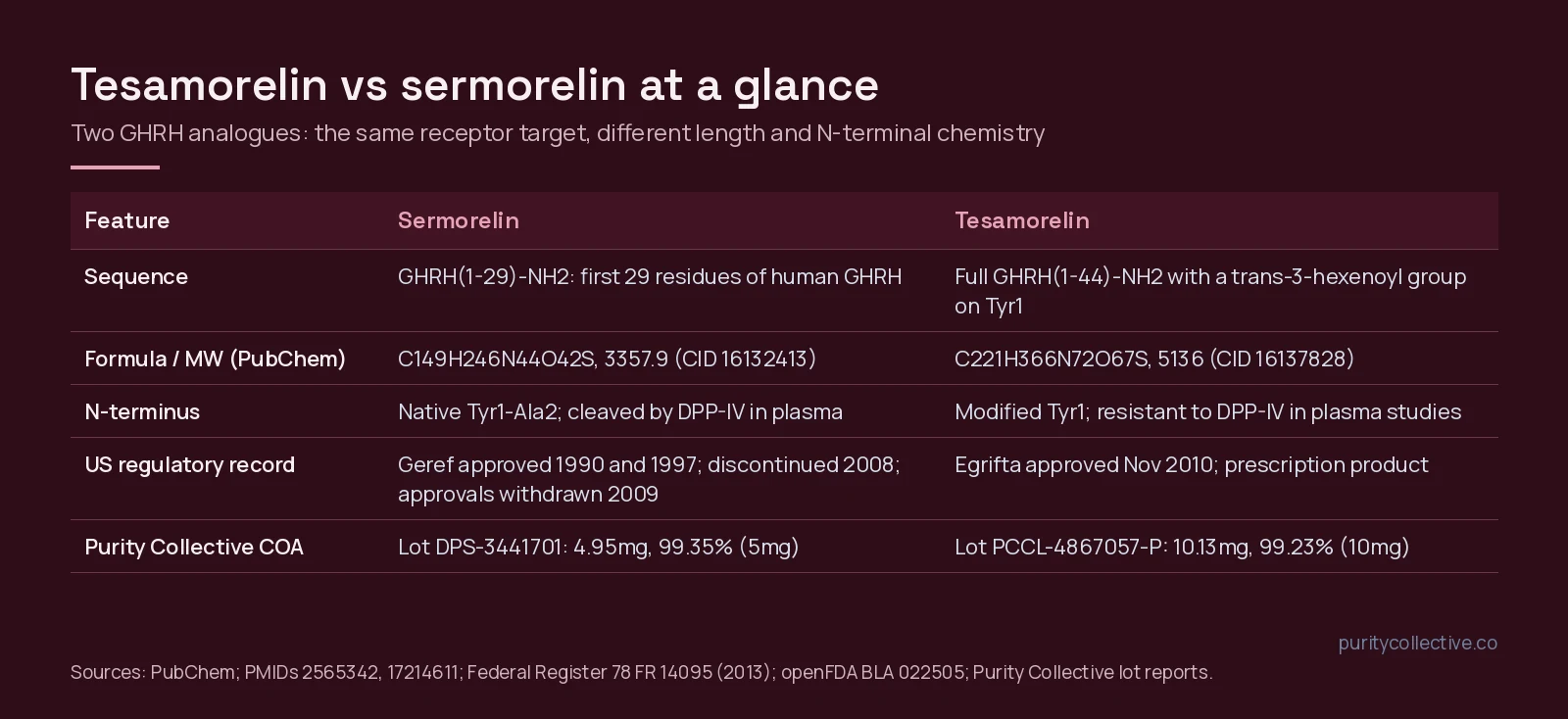
| Identity field | Sermorelin | Tesamorelin |
|---|---|---|
| Definition | Human GHRH(1-29)-NH2 | trans-3-hexenoyl-[Tyr1] human GHRH(1-44)-NH2 (TH9507) |
| Length | 29 residues | 44 residues plus an N-terminal hexenoyl group |
| Molecular formula (free peptide) | C149H246N44O42S | C221H366N72O67S |
| Molecular weight | 3357.9 g/mol | 5136 g/mol |
| PubChem CID | 16132413 (Purity’s report cites 16129620, the Geref record with the same formula and MW) | 16137828 (Purity’s report cites 44147413, the acetate salt record: C223H370N72O69S, ~5196 g/mol) |
| US brand history | Geref (discontinued) | Egrifta (approved) |
A salt form changes the formula and molecular weight printed on a report. The tesamorelin lot report lists the acetate (C223H370N72O69S, about 5196 g/mol), which is the free peptide plus acetic acid, so it is consistent with the free-peptide values above.
Why the chemistry matters: DPP-IV and stability
In human plasma, native GHRH(1-44)-NH2, GHRH(1-40)-OH and the shortened GHRH(1-29)-NH2 are all rapidly cleaved between residues 2 and 3. The enzyme responsible was identified as dipeptidyl peptidase IV: the cleavage was blocked by the DPP-IV inhibitor diprotin A and by D-amino acid substitution at position 1 or 2, and a second, trypsin-like cut occurred at the 11-12 position[3]. Because sermorelin keeps the native Tyr1-Ala2 start, it is exposed to the same cleavage.
Tesamorelin was built to address this. In nonclinical work, the trans-3-hexenoyl modification made TH9507 resistant to DPP-IV, slowed its degradation in rat, dog and human plasma compared with native hGRF(1-44)-NH2, and prolonged plasma elimination in vivo[4]. The same study is also a caution: dogs given repeated treatment showed reversible liver and kidney findings and anemia, which the authors attributed to sustained supraphysiological growth hormone and IGF-1[4]. A population pharmacokinetic model in HIV-infected and healthy volunteers described tesamorelin with a one-compartment model and found no clinically relevant covariates for its kinetics[5].
US regulatory status, stated plainly
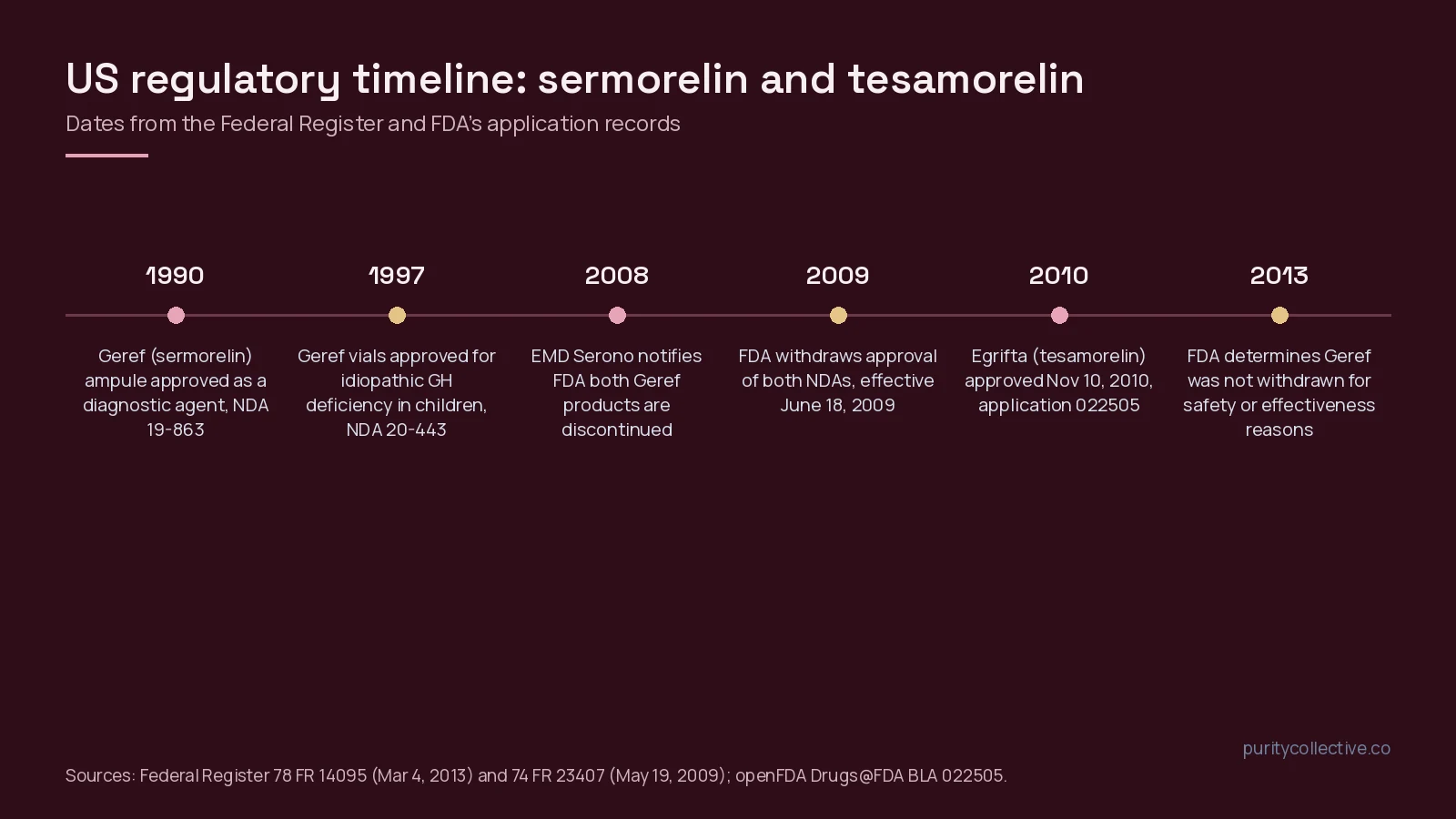
Tesamorelin. The FDA approved Egrifta (tesamorelin) in November 2010[6]; FDA’s application record lists it under 022505 as a prescription product. It is approved for a specific indication in adults with HIV-associated lipodystrophy. The pivotal randomized trial in 412 patients with HIV used change in visceral adipose tissue on CT as its primary end point[7].
Sermorelin. According to a 2013 Federal Register notice, Geref (sermorelin acetate) ampules were approved on December 28, 1990 under NDA 19-863 for evaluating pituitary growth hormone secretion, and Geref vials were approved on September 26, 1997 under NDA 20-443 for idiopathic growth hormone deficiency in children with growth failure. EMD Serono told FDA in 2008 that both were being discontinued, FDA withdrew both approvals effective June 18, 2009, and the 2013 notice determined that the products were not withdrawn for reasons of safety or effectiveness. There is no currently marketed FDA-approved sermorelin product, and neither compound sold for laboratory research is an approved drug product.
What each has been studied in
| Compound | Study | Model | What it found | Ref |
|---|---|---|---|---|
| Sermorelin | Structure-activity scan of hGHRH(1-29)-NH2 | In vitro | N-terminal residues critical; some substitutions raised potency | [1] |
| Sermorelin / GHRH | Plasma degradation | Human plasma in vitro | Rapid DPP-IV cleavage at the 2-3 bond | [3] |
| Sermorelin | Review of diagnostic and pediatric use | Human (children) | Used as a GH stimulation test; catch-up growth in most GH-deficient children studied; height-velocity gains smaller than with somatropin; final-height effect not determined | [2] |
| GHRH(1-29)-NH2 vs GH | Randomized 6-month comparison, 60 children | Human | Negative comparison: growth was better with GH; IGF-I rose then fell back; nearly all GHRH-treated children developed GHRH antibodies | [9] |
| GHRH(1-29) | 6 weeks of nightly treatment, 11 older men | Human | Mixed: nocturnal GH rose but IGF-I, body composition and most strength measures did not change | [10] |
| Tesamorelin | Nonclinical pharmacology and toxicology | Rat, dog, pig; plasma in vitro | DPP-IV resistance; reversible dog toxicity with prolonged exposure | [4] |
| Tesamorelin | Phase 3 randomized trial | Human (HIV) | Primary end point visceral adipose tissue on CT; basis for approval | [7] |
| Tesamorelin | Randomized trial in HIV with fatty liver | Human (HIV) | Liver fat fraction was the end point; glucose measures did not differ | [8] |
| Tesamorelin | 20-week placebo-controlled cognition trial | Human (older adults, MCI) | Favorable effect on executive function composite | [12] |
| Tesamorelin | 6-month open-label phase 2 trial | Human (HIV) | Null: no significant between-group difference in neurocognitive performance | [13] |
The sermorelin literature is older and mostly pediatric or small. A 2006 editorial argued for its use in adult-onset growth hormone insufficiency[11], but that is an opinion piece rather than trial data. Tesamorelin’s literature is larger and more recent, and is concentrated in people with HIV, which limits how far its findings generalize.
Both compounds also appear in anti-doping research: a 2021 study characterized in vitro metabolites of sermorelin, tesamorelin and two CJC-1295 forms and built an LC-MS/MS method to detect them in urine[14]. That work is a useful reference for analytical identity, since it lists metabolites such as sermorelin(3-29)-NH2, the DPP-IV product.
What the evidence does not show
- No head-to-head study. We found no study comparing tesamorelin and sermorelin directly in the same model. Comparisons rest on separate literatures with different populations.
- No demonstrated advantage from longer action alone. DPP-IV resistance is established for tesamorelin[4], but that does not by itself show different outcomes from sermorelin in any model.
- Sermorelin did not match GH in children. In the randomized pediatric comparison, GH produced better growth and most GHRH-treated children developed antibodies[9].
- Mixed results outside the approved setting. A cognition trial in older adults was favorable[12], while a 2025 trial in people with HIV found no significant neurocognitive difference[13]; nightly GHRH(1-29) in older men left IGF-I and body composition unchanged[10].
- Safety signals exist. Prolonged tesamorelin exposure in dogs produced reversible organ findings[4]. Neither research-grade compound carries the safety record of an approved product.
Comparing the product records
Purity Collective lists Tesamorelin 10mg, Tesamorelin 20mg, a Tesamorelin pen and Sermorelin 5mg. Their documentation is not equal, so compare strength by strength:
| Listing | UPLC/MS report | Measured | Endotoxin |
|---|---|---|---|
| Tesamorelin 10mg | Lot PCCL-4867057-P, analysis dated May 4, 2026 | 10.13mg; 99.23% (spec >98%) | <0.05 EU/mL, lot PCCL-4867057-E |
| Tesamorelin 20mg | Lot PCTSA-020 (ILS Laboratories, HPLC), analysis dated August 17, 2026 | 20.71mg net peptide content; 99.91% HPLC purity (spec ≥95.0%); identity confirmed by HPLC retention time | No endotoxin result on this report |
| Tesamorelin pen | The pen listing displays the 10mg vial report (lot PCCL-4867057-P); no pen-specific report is posted. | ||
| Sermorelin 5mg | Lot DPS-3441701, analysis dated July 18, 2026 | 4.95mg; 99.35% (spec >98%) | <0.05 EU/mL, same lot |
The two tesamorelin reports also differ in method: the 10mg lot was analyzed by UPLC/MS, which adds a mass-based identity check, while the 20mg lot was analyzed by HPLC with identity by retention-time match to a reference standard. A report is evidence for its own lot only; the 10mg report should not be read as covering the 20mg vial or the pen. When you check any report, match the compound name, the formula and molecular weight (allowing for the salt form, as above), the lot number and the dates, then read the purity and quantity as results for the tested sample. Our guide to reading a peptide COA walks through each field, the COA library holds every posted report, and the tesamorelin explainer covers that compound in more depth. If you are setting up a broader order, our page on how to buy research peptides online in the USA covers documentation by category.
Related reading: For the full tesamorelin science review and every strength, see the Tesamorelin hub: 10mg, 20mg and pen records with lot reports.
Frequently asked questions
What is the main difference between tesamorelin and sermorelin?
Both are analogues of growth hormone-releasing hormone (GHRH). Sermorelin is the first 29 residues of human GHRH with a C-terminal amide. Tesamorelin is the full 44-residue GHRH with a trans-3-hexenoyl group added to the first tyrosine, a change designed to resist DPP-IV cleavage in plasma.
Is tesamorelin FDA-approved?
Yes. Egrifta (tesamorelin) was approved by the FDA in November 2010 under application 022505 and is a prescription product for a specific indication in adults with HIV. Research-grade tesamorelin sold for laboratory use is not that approved drug product.
Was sermorelin ever FDA-approved?
Yes. Geref (sermorelin acetate) was approved in 1990 as a diagnostic agent and in 1997 for idiopathic growth hormone deficiency in children. EMD Serono discontinued both products in 2008, FDA withdrew the approvals effective June 18, 2009, and a 2013 Federal Register notice determined they were not withdrawn for reasons of safety or effectiveness.
Why is tesamorelin longer-acting than native GHRH?
In plasma, native GHRH and its 1-29 fragment are cleaved between residues 2 and 3 by dipeptidyl peptidase IV. Adding a trans-3-hexenoyl group to Tyr1 made tesamorelin resistant to that cleavage and slowed its degradation in rat, dog and human plasma in nonclinical work.
Do Purity Collective’s tesamorelin and sermorelin listings have COAs?
Tesamorelin 10mg has a UPLC/MS report for lot PCCL-4867057-P (10.13mg, 99.23%) plus an endotoxin report. Tesamorelin 20mg has an HPLC report for lot PCTSA-020 (20.71mg net peptide content, 99.91% purity). Sermorelin 5mg has a UPLC/MS report for lot DPS-3441701 (4.95mg, 99.35%) plus an endotoxin report. The pen listing shows the 10mg vial report rather than a pen-specific one.
References
- Cervini LA, Donaldson CJ, Koerber SC et al. (1998). Human growth hormone-releasing hormone hGHRH(1-29)-NH2: systematic structure-activity relationship studies. J Med Chem. PMID: 9513600. doi: 10.1021/jm970618s.
- Prakash A, Goa KL (1999). Sermorelin: a review of its use in the diagnosis and treatment of children with idiopathic growth hormone deficiency. BioDrugs. PMID: 18031173. doi: 10.2165/00063030-199912020-00007.
- Frohman LA, Downs TR, Heimer EP et al. (1989). Dipeptidylpeptidase IV and trypsin-like enzymatic degradation of human growth hormone-releasing hormone in plasma. J Clin Invest. PMID: 2565342. doi: 10.1172/JCI114049.
- Ferdinandi ES, Brazeau P, High K et al. (2007). Non-clinical pharmacology and safety evaluation of TH9507, a human growth hormone-releasing factor analogue. Basic Clin Pharmacol Toxicol. PMID: 17214611. doi: 10.1111/j.1742-7843.2007.00008.x.
- González-Sales M, Barrière O, Tremblay PO et al. (2015). Population pharmacokinetic analysis of tesamorelin in HIV-infected patients and healthy subjects. Clin Pharmacokinet. PMID: 25358450. doi: 10.1007/s40262-014-0202-x.
- Traynor K (2010). FDA approves tesamorelin for HIV-related lipodystrophy. Am J Health Syst Pharm. PMID: 21115997. doi: 10.2146/news100082.
- Falutz J, Allas S, Blot K et al. (2007). Metabolic effects of a growth hormone-releasing factor in patients with HIV. N Engl J Med. PMID: 18057338. doi: 10.1056/NEJMoa072375.
- Stanley TL, Fourman LT, Feldpausch MN et al. (2019). Effects of tesamorelin on non-alcoholic fatty liver disease in HIV: a randomised, double-blind, multicentre trial. Lancet HIV. PMID: 31611038. doi: 10.1016/S2352-3018(19)30338-8.
- Chen RG, Shen YN, Yei J et al. (1993). A comparative study of growth hormone (GH) and GH-releasing hormone(1-29)-NH2 for stimulation of growth in children with GH deficiency. Acta Paediatr Suppl. PMID: 8329830. doi: 10.1111/j.1651-2227.1993.tb12834.x.
- Vittone J, Blackman MR, Busby-Whitehead J et al. (1997). Effects of single nightly injections of growth hormone-releasing hormone (GHRH 1-29) in healthy elderly men. Metabolism. PMID: 9005976. doi: 10.1016/s0026-0495(97)90174-8.
- Walker RF (2006). Sermorelin: a better approach to management of adult-onset growth hormone insufficiency?. Clin Interv Aging. PMID: 18046908. doi: 10.2147/ciia.2006.1.4.307.
- Baker LD, Barsness SM, Borson S et al. (2012). Effects of growth hormone–releasing hormone on cognitive function in adults with mild cognitive impairment and healthy older adults: results of a controlled trial. Arch Neurol. PMID: 22869065. doi: 10.1001/archneurol.2012.1970.
- Ellis RJ, Vaida F, Hu K et al. (2025). Effects of Tesamorelin on Neurocognitive Impairment in Persons With HIV and Abdominal Obesity. J Infect Dis. PMID: 39813152. doi: 10.1093/infdis/jiaf012.
- Memdouh S, Gavrilović I, Ng K et al. (2021). Advances in the detection of growth hormone releasing hormone synthetic analogs. Drug Test Anal. PMID: 34665524. doi: 10.1002/dta.3183.