
For laboratory research only. Not for human or animal use. This article gives no dosing, administration or therapeutic advice.
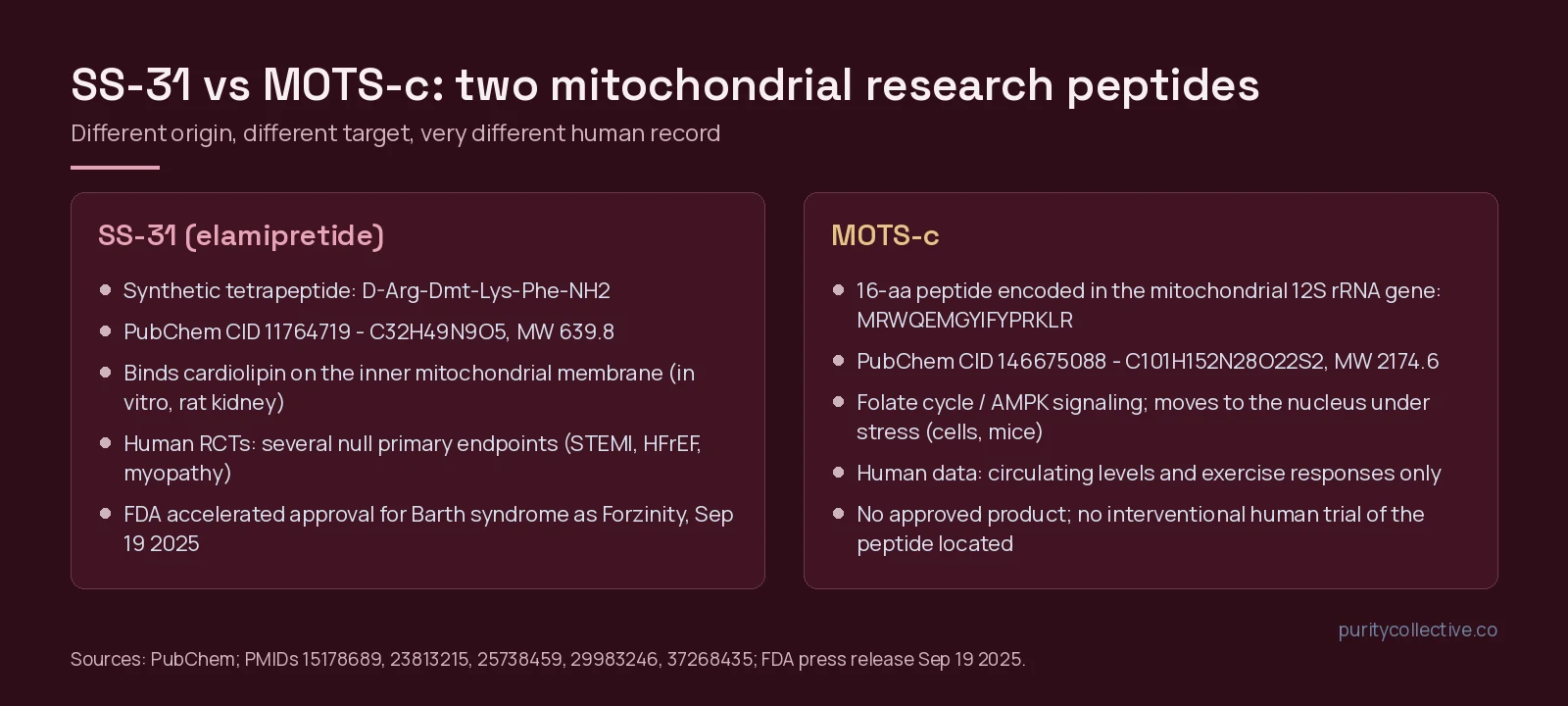
Short answer: SS-31 and MOTS-c are both called “mitochondrial peptides,” but they share almost nothing else. SS-31 (elamipretide) is a synthetic four-residue peptide built to sit on the inner mitochondrial membrane and bind the phospholipid cardiolipin.[1][2] MOTS-c is a 16-residue peptide that cells make from a short open reading frame inside mitochondrial DNA, and most of what is known about it comes from cell and mouse work on metabolic signaling.[3][4] SS-31 has a long, mixed record of randomized human trials and an FDA accelerated approval for one rare disease; MOTS-c has no interventional human trial that we could locate.
Two peptides, two very different origins
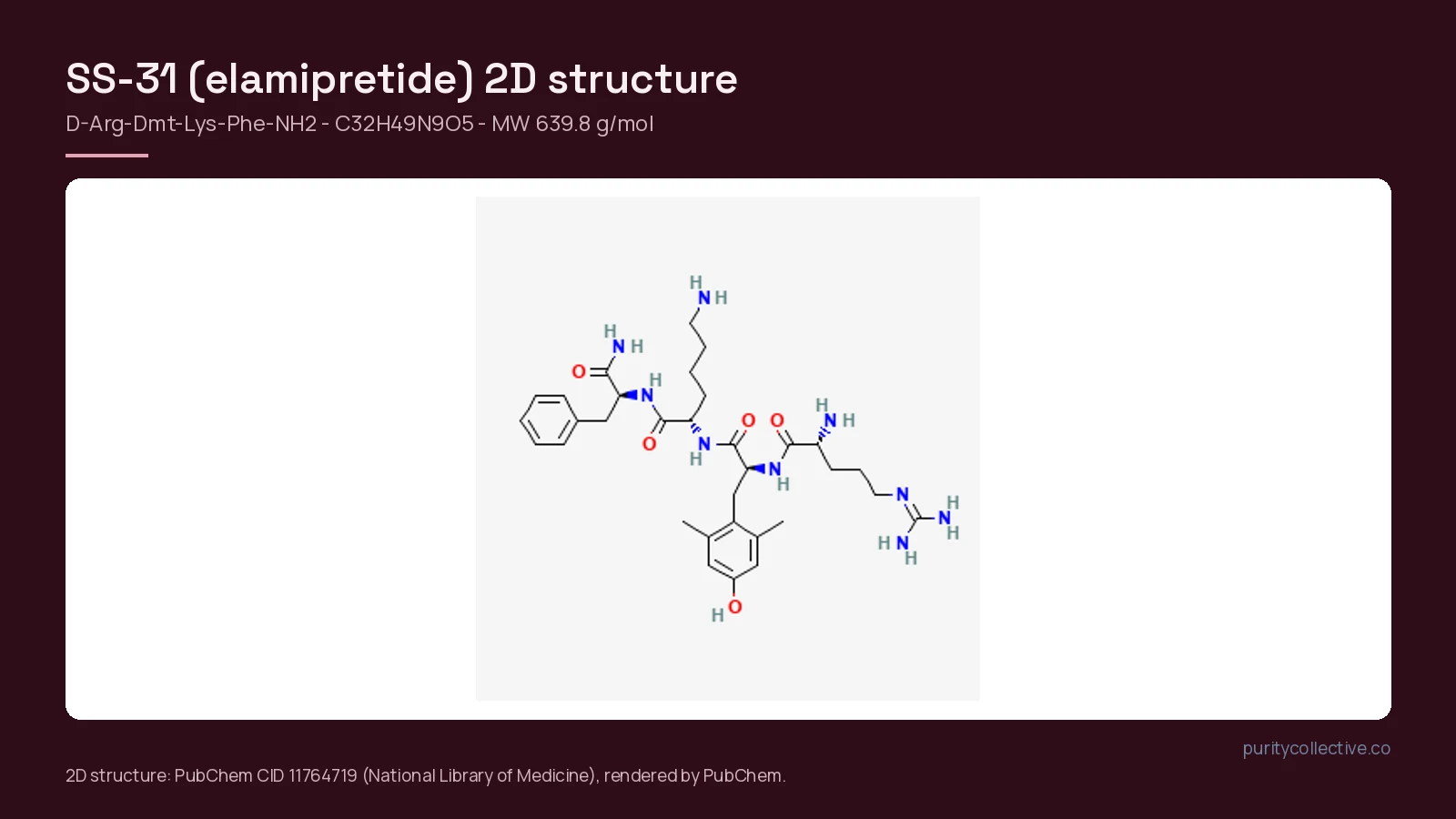
SS-31 came out of a medicinal-chemistry program. The Szeto-Schiller peptides were designed around alternating aromatic and basic residues, with 2′,6′-dimethyltyrosine (Dmt) supplying radical-scavenging chemistry. In the 2004 paper that introduced the series, these peptides concentrated roughly 1000-fold in the inner mitochondrial membrane of cultured cells, reduced mitochondrial reactive oxygen species, and limited swelling and cytochrome c release in isolated mitochondria; analogs without Dmt did not show the antioxidant effect.[1] Later work showed that SS-31 binds cardiolipin, the signature lipid of the inner membrane, and in a rat kidney ischemia model it protected cristae structure and sped ATP recovery after reperfusion.[2][5]
MOTS-c was found by looking for hidden coding sequences in the mitochondrial genome. Lee and colleagues reported in 2015 that a short open reading frame inside the 12S rRNA gene encodes a 16-amino-acid peptide, MOTS-c, whose actions in cultured cells inhibited the folate cycle and de novo purine synthesis, leading to AMPK activation; in mice, MOTS-c treatment countered diet-induced insulin resistance.[3] A 2018 study then showed that under glucose restriction MOTS-c moves into the nucleus in an AMPK-dependent way and regulates nuclear genes, including antioxidant-response genes.[4]
Identity at a glance
| Field | SS-31 (elamipretide) | MOTS-c |
|---|---|---|
| Origin | Synthetic Szeto-Schiller peptide[1] | Encoded in mitochondrial DNA (12S rRNA region)[3] |
| Length / sequence | 4 residues: D-Arg-Dmt-Lys-Phe-NH2 | 16 residues: MRWQEMGYIFYPRKLR |
| PubChem CID | 11764719 | 146675088 |
| Molecular formula | C32H49N9O5 | C101H152N28O22S2 |
| Molecular weight | 639.8 g/mol | 2174.6 g/mol |
| Main studied target | Cardiolipin on the inner mitochondrial membrane[2] | Folate cycle / AMPK; nuclear gene regulation under stress[3][4] |
| Known natural variant | None (synthetic) | K14Q (m.1382A>C), an East Asian mtDNA variant[6] |
| US regulatory status | Elamipretide HCl (Forzinity) received FDA accelerated approval for Barth syndrome on Sep 19, 2025 | No approved product |
Formula and weight are PubChem’s computed values. MOTS-c is more than three times heavier than SS-31 and carries two methionines, so its analytical records deserve a close read.
What the studies used, model by model
Both literatures include aging-muscle mouse work; only SS-31 has randomized human trials.
| Model | Compound | What was reported | Ref |
|---|---|---|---|
| Cell lines, isolated mitochondria, ex vivo heart | SS peptides | Concentrated in the inner membrane; lowered ROS, mitochondrial swelling and cytochrome c release | [1] |
| Rat kidney ischemia | SS-31 | Bound cardiolipin; protected cristae; faster ATP recovery on reperfusion | [2] |
| Aged mice (27 months) | SS-31 | One treatment restored in vivo muscle mitochondrial energetics toward young values; no effect in young muscle | [7] |
| Aged mice, 8 weeks | SS-31 | Better treadmill endurance and redox status without more mitochondrial content; permeabilized-fiber respiration unchanged | [8] |
| Cells and diet-induced obese mice | MOTS-c | Folate cycle inhibition and AMPK activation in cells; less diet-induced insulin resistance in mice | [3] |
| Young, middle-aged and old mice | MOTS-c | Higher physical performance across ages; exercise raised endogenous MOTS-c in human muscle and plasma | [9] |
| Myotubes and obese mice | MOTS-c | Lower myostatin and muscle-atrophy signaling through AKT/FOXO1 | [10] |
| Mouse islets, diabetes models | MOTS-c | Less islet-cell senescence; lower circulating MOTS-c in people with type 2 diabetes | [11] |
| Senescent human fibroblasts | MOTS-c, humanin | Modestly raised respiration and selected pro-inflammatory SASP components | [12] |
| Human randomized trials | Elamipretide | Null primary endpoints in STEMI, HFrEF and primary mitochondrial myopathy; Barth syndrome crossover null, open-label extension improved | [13][14][15][16] |
| Human observational / exercise cohorts | Endogenous MOTS-c | Plasma level tracked insulin sensitivity in lean but not obese adults; rose after a 16-week exercise program in one subgroup only | [17][18] |
The human record: SS-31 has one, MOTS-c mostly does not
SS-31’s clinical history is a useful lesson in how animal signals translate. A single-infusion heart-failure study reported short-term changes in left-ventricular volumes at the highest dose,[19] but the 4-week PROGRESS-HF trial found no difference from placebo in left-ventricular end-systolic volume.[14] In EMBRACE STEMI, the peptide given around coronary reperfusion did not reduce infarct size.[13] The phase 3 MMPOWER-3 trial in primary mitochondrial myopathy did not meet its primary endpoints (6-minute walk and fatigue score), although the peptide was well tolerated.[15]
Barth syndrome, a genetic disorder of cardiolipin remodeling, is where the story changed. In the TAZPOWER crossover phase, neither primary endpoint was met; in the open-label extension, investigators reported improvements in walk distance and symptom scores, sustained through 168 weeks.[16][20] Open-label data carry no placebo comparison, which is why the regulatory pathway matters.
MOTS-c’s human data are a different kind entirely. Researchers have measured circulating MOTS-c in lean and obese adults,[17] in exercise programs,[18] and in large cohorts carrying the K14Q variant, which was associated with type 2 diabetes in sedentary men but not women.[6] These studies describe the body’s own peptide. Reviews from 2023 note that no effective method of applying MOTS-c in the clinic has been developed.[21]
Regulatory status, stated plainly
On September 19, 2025, the FDA granted accelerated approval to Forzinity (elamipretide) as the first treatment for Barth syndrome in patients weighing at least 30 kg. The FDA based the decision on improved knee-extensor muscle strength, a measure it considers reasonably likely to predict benefit, and required a post-approval randomized, placebo-controlled trial to confirm it (FDA press release). Two 2026 drug-profile papers describe the same approval and the confirmatory-trial condition.[22][23] MOTS-c has no approval anywhere. Neither fact changes what a research vial is: Purity’s SS-31 and MOTS-c listings are laboratory reagents for in vitro and preclinical research only.
What the evidence does not show
- It does not show the two peptides do the same thing. Sharing the word “mitochondrial” is not a shared mechanism; one binds a membrane lipid, the other signals through AMPK and the nucleus.[5][4]
- It does not show that mouse results carry over. SS-31’s strong rodent data were followed by several null human trials.[13][14][15]
- It does not show MOTS-c works as a drug in people. No interventional human trial of synthetic MOTS-c was located; the human studies are measurements of endogenous levels.[17][18]
- It does not show uniform effects. MOTS-c raised some pro-inflammatory secretions in senescent cells,[12] and the K14Q variant blunted the peptide’s effect in male mice.[6]
- It does not show any head-to-head comparison. We found no study testing SS-31 against MOTS-c in the same model.
How to compare the Purity product records
Read each record for its own lot. A result printed for one strength says nothing about another strength or another lot. Here is what the product pages link as of October 1, 2026, read from the PDFs themselves:
| Listing | Posted report | What the report shows |
|---|---|---|
| SS-31 10mg | None | A batch COA for this product isn’t posted yet. |
| SS-31 50mg | ILS Laboratories COA-2026-Z9DG6S, lot PCSS31-50, analyzed 08/17/2026 | HPLC purity 99.64% (spec ≥95.0%); net peptide content 53.11 mg against a 50mg label; identity by HPLC retention-time match; fentanyl screen not detected. No endotoxin line. |
| MOTS-c 10mg | Horizon Analytical, lot PCCL-8553761 (UPLC/MS), plus endotoxin lot PCCL-8553761-E | 10.35 mg against a 10mg spec; purity 99.28% (spec >98%); endotoxin <0.05 EU/mL |
| MOTS-c 40mg | ILS Laboratories COA-2026-TOCLOQ, lot PCMOT-040, analyzed 08/18/2026 | HPLC purity 99.60%; net peptide content 42.48 mg; identity by HPLC retention-time match; fentanyl not detected. No endotoxin line. |
| MOTS-c (Pen) | Links the MOTS-c 10mg lot report (PCCL-8553761) | No pen-specific report is posted. |
Two details are worth noticing. First, the labs used different identity methods: the Horizon report pairs chromatography with mass spectrometry, while the ILS reports confirm identity by retention time against a reference standard. Our explainer on HPLC vs mass spectrometry covers why that difference matters. Second, only the Horizon lot has an endotoxin report. For background on MOTS-c itself, see What is MOTS-c?, and every posted report lives in the Purity COA library. If you are comparing these listings with the rest of the catalog, the overview of how to buy research peptides online in the USA groups every category and its documentation in one place.
Frequently asked questions
Is SS-31 the same compound as elamipretide?
Yes. SS-31 is the original Szeto-Schiller laboratory name, and elamipretide is the international nonproprietary name for the same tetrapeptide, D-Arg-Dmt-Lys-Phe-NH2 (PubChem CID 11764719). Some clinical papers also call it MTP-131 or Bendavia. Forzinity is the brand name of the FDA-approved elamipretide hydrochloride drug product.
Is MOTS-c a mitochondria-targeted peptide like SS-31?
Not in the same sense. SS-31 is a synthetic peptide designed to concentrate at the inner mitochondrial membrane and bind cardiolipin. MOTS-c is a natural 16-amino-acid peptide encoded inside mitochondrial DNA; in cell and mouse studies it acts through the folate cycle and AMPK and can move into the nucleus under metabolic stress.
Have SS-31 and MOTS-c been tested in people?
SS-31 has been studied in randomized human trials, several of which did not meet their primary endpoints, and it now has an FDA accelerated approval for Barth syndrome. For MOTS-c, the human literature we found measures the body’s own MOTS-c levels; we located no interventional human trial of the synthetic peptide.
Does the Forzinity approval cover research-grade SS-31?
No. An FDA approval applies to a specific drug product, its manufacturer and its labeled use. A research-grade SS-31 vial is a laboratory reagent sold for in vitro and preclinical work only, and it is not Forzinity.
Which Purity SS-31 and MOTS-c listings have a posted batch COA?
As of October 1, 2026: SS-31 50mg (ILS Laboratories, lot PCSS31-50), MOTS-c 10mg (Horizon Analytical, lot PCCL-8553761, plus an endotoxin report) and MOTS-c 40mg (ILS Laboratories, lot PCMOT-040). The MOTS-c pen listing links the 10mg lot report. A batch COA for SS-31 10mg isn’t posted yet.
References
- Zhao K, Zhao GM, Wu D et al. (2004). Cell-permeable peptide antioxidants targeted to inner mitochondrial membrane inhibit mitochondrial swelling, oxidative cell death, and reperfusion injury. J Biol Chem. PMID: 15178689. doi: 10.1074/jbc.M402999200.
- Birk AV, Liu S, Soong Y et al. (2013). The mitochondrial-targeted compound SS-31 re-energizes ischemic mitochondria by interacting with cardiolipin. J Am Soc Nephrol. PMID: 23813215. doi: 10.1681/ASN.2012121216.
- Lee C, Zeng J, Drew BG et al. (2015). The mitochondrial-derived peptide MOTS-c promotes metabolic homeostasis and reduces obesity and insulin resistance. Cell Metab. PMID: 25738459. doi: 10.1016/j.cmet.2015.02.009.
- Kim KH, Son JM, Benayoun BA et al. (2018). The Mitochondrial-Encoded Peptide MOTS-c Translocates to the Nucleus to Regulate Nuclear Gene Expression in Response to Metabolic Stress. Cell Metab. PMID: 29983246. doi: 10.1016/j.cmet.2018.06.008.
- Szeto HH (2014). First-in-class cardiolipin-protective compound as a therapeutic agent to restore mitochondrial bioenergetics. Br J Pharmacol. PMID: 24117165. doi: 10.1111/bph.12461.
- Zempo H, Kim SJ, Fuku N et al. (2021). A pro-diabetogenic mtDNA polymorphism in the mitochondrial-derived peptide, MOTS-c. Aging (Albany NY). PMID: 33468709. doi: 10.18632/aging.202529.
- Siegel MP, Kruse SE, Percival JM et al. (2013). Mitochondrial-targeted peptide rapidly improves mitochondrial energetics and skeletal muscle performance in aged mice. Aging Cell. PMID: 23692570. doi: 10.1111/acel.12102.
- Campbell MD, Duan J, Samuelson AT et al. (2019). Improving mitochondrial function with SS-31 reverses age-related redox stress and improves exercise tolerance in aged mice. Free Radic Biol Med. PMID: 30597195. doi: 10.1016/j.freeradbiomed.2018.12.031.
- Reynolds JC, Lai RW, Woodhead JST et al. (2021). MOTS-c is an exercise-induced mitochondrial-encoded regulator of age-dependent physical decline and muscle homeostasis. Nat Commun. PMID: 33473109. doi: 10.1038/s41467-020-20790-0.
- Kumagai H, Coelho AR, Wan J et al. (2021). MOTS-c reduces myostatin and muscle atrophy signaling. Am J Physiol Endocrinol Metab. PMID: 33554779. doi: 10.1152/ajpendo.00275.2020.
- Kong BS, Lee H, L’Yi S et al. (2025). Mitochondrial-encoded peptide MOTS-c prevents pancreatic islet cell senescence to delay diabetes. Exp Mol Med. PMID: 40855115. doi: 10.1038/s12276-025-01521-1.
- Kim SJ, Mehta HH, Wan J et al. (2018). Mitochondrial peptides modulate mitochondrial function during cellular senescence. Aging (Albany NY). PMID: 29886458. doi: 10.18632/aging.101463.
- Gibson CM, Giugliano RP, Kloner RA et al. (2016). EMBRACE STEMI study: a Phase 2a trial to evaluate the safety, tolerability, and efficacy of intravenous MTP-131 on reperfusion injury in patients undergoing primary percutaneous coronary intervention. Eur Heart J. PMID: 26586786. doi: 10.1093/eurheartj/ehv597.
- Butler J, Khan MS, Anker SD et al. (2020). Effects of Elamipretide on Left Ventricular Function in Patients With Heart Failure With Reduced Ejection Fraction: The PROGRESS-HF Phase 2 Trial. J Card Fail. PMID: 32068002. doi: 10.1016/j.cardfail.2020.02.001.
- Karaa A, Bertini E, Carelli V et al. (2023). Efficacy and Safety of Elamipretide in Individuals With Primary Mitochondrial Myopathy: The MMPOWER-3 Randomized Clinical Trial. Neurology. PMID: 37268435. doi: 10.1212/WNL.0000000000207402.
- Reid Thompson W, Hornby B, Manuel R et al. (2021). A phase 2/3 randomized clinical trial followed by an open-label extension to evaluate the effectiveness of elamipretide in Barth syndrome, a genetic disorder of mitochondrial cardiolipin metabolism. Genet Med. PMID: 33077895. doi: 10.1038/s41436-020-01006-8.
- Cataldo LR, Fernández-Verdejo R, Santos JL et al. (2018). Plasma MOTS-c levels are associated with insulin sensitivity in lean but not in obese individuals. J Investig Med. PMID: 29593067. doi: 10.1136/jim-2017-000681.
- Dieli-Conwright CM, Sami N, Norris MK et al. (2021). Effect of aerobic and resistance exercise on the mitochondrial peptide MOTS-c in Hispanic and Non-Hispanic White breast cancer survivors. Sci Rep. PMID: 34413391. doi: 10.1038/s41598-021-96419-z.
- Daubert MA, Yow E, Dunn G et al. (2017). Novel Mitochondria-Targeting Peptide in Heart Failure Treatment: A Randomized, Placebo-Controlled Trial of Elamipretide. Circ Heart Fail. PMID: 29217757. doi: 10.1161/CIRCHEARTFAILURE.117.004389.
- Thompson WR, Manuel R, Abbruscato A et al. (2024). Long-term efficacy and safety of elamipretide in patients with Barth syndrome: 168-week open-label extension results of TAZPOWER. Genet Med. PMID: 38602181. doi: 10.1016/j.gim.2024.101138.
- Zheng Y, Wei Z, Wang T (2023). MOTS-c: A promising mitochondrial-derived peptide for therapeutic exploitation. Front Endocrinol (Lausanne). PMID: 36761202. doi: 10.3389/fendo.2023.1120533.
- Zhao C, Zhuang X, Gao J (2026). Elamipretide: The first cardiolipin-directed mitochondrial therapeutic for Barth syndrome approved under accelerated approval. Drug Discov Ther. PMID: 41260682. doi: 10.5582/ddt.2025.01111.
- Shirley M (2026). Elamipretide: First Approval. Drugs. PMID: 41335372. doi: 10.1007/s40265-025-02269-8.