
For laboratory research only. Not for human or animal use. This article gives no dosing, administration or therapeutic advice.
Short answer: SLU-PP-332 and 5-Amino-1MQ are both small molecules, not peptides, and they act on different targets. SLU-PP-332 is a synthetic agonist of the three estrogen-related receptors (ERR-alpha, ERR-beta and ERR-gamma), nuclear receptors that control mitochondrial and fatty-acid genes; its developers describe it as an “exercise mimetic” based on mouse work[1],[2]. 5-Amino-1MQ (5-amino-1-methylquinolinium) inhibits nicotinamide N-methyltransferase (NNMT), a cytosolic enzyme that uses SAM to methylate nicotinamide[3],[4],[5]. One switches gene programs on at the receptor level; the other blocks an enzyme step. Every finding below comes from cell or animal models, and neither compound has published human trial data.
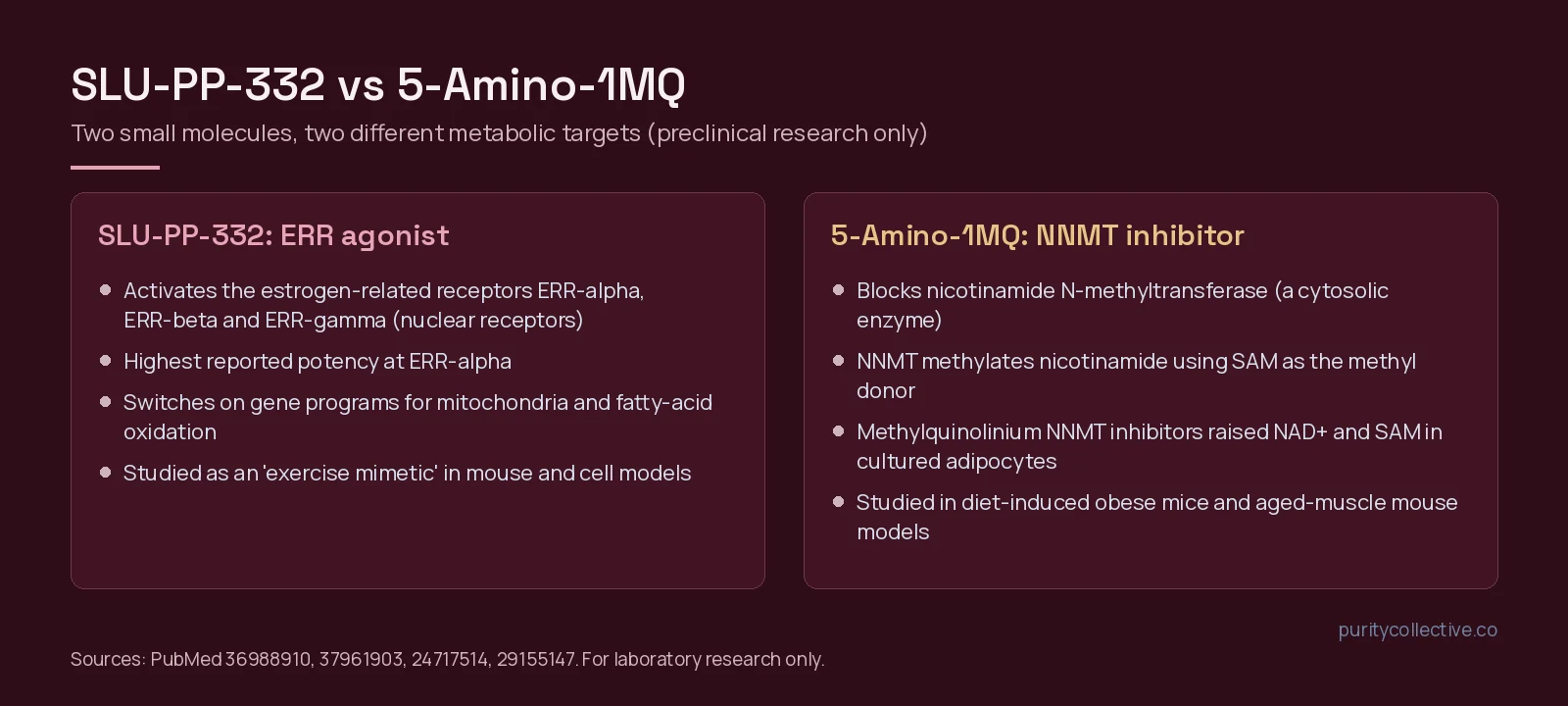
SLU-PP-332 vs 5-Amino-1MQ at a glance
| Question | SLU-PP-332 | 5-Amino-1MQ |
|---|---|---|
| What kind of molecule? | Synthetic small molecule (an acyl hydrazone); not a peptide | Synthetic small molecule (a methylquinolinium cation); not a peptide |
| Target | ERR-alpha, ERR-beta and ERR-gamma nuclear receptors (agonist), most potent at ERR-alpha[1] | NNMT enzyme (inhibitor)[4] |
| What the target does | Transcription factors that regulate mitochondrial biogenesis, oxidative phosphorylation and fatty-acid oxidation genes[2] | Transfers a methyl group from SAM to nicotinamide, a precursor of NAD+[3] |
| Main research models | Muscle cell lines, lean and obese mice, a mouse heart-failure model, aged mice[1],[6],[2],[7] | Cultured adipocytes, diet-induced obese mice, aged-mouse muscle models[4],[5],[8] |
| Human clinical trials in PubMed | None found (October 2026) | None found (October 2026) |
Identity of each compound
Because neither compound is a peptide, sequence-based checks do not apply. Identity is a question of chemical structure, formula and mass. PubChem lists SLU-PP-332 as CID 5338394, 4-hydroxy-N’-(naphthalen-2-ylmethylene)benzohydrazide, formula C18H14N2O2, molecular weight 290.3 g/mol. 5-Amino-1MQ is listed as CID 950107, the 5-amino-1-methylquinolinium cation, formula C10H11N2+, 159.21 g/mol. Since the PubChem record covers the cation alone, a supplied material is normally a salt with a counter-ion, and the counter-ion changes the formula weight. A lab should check which salt form its documentation names before comparing any mass value.
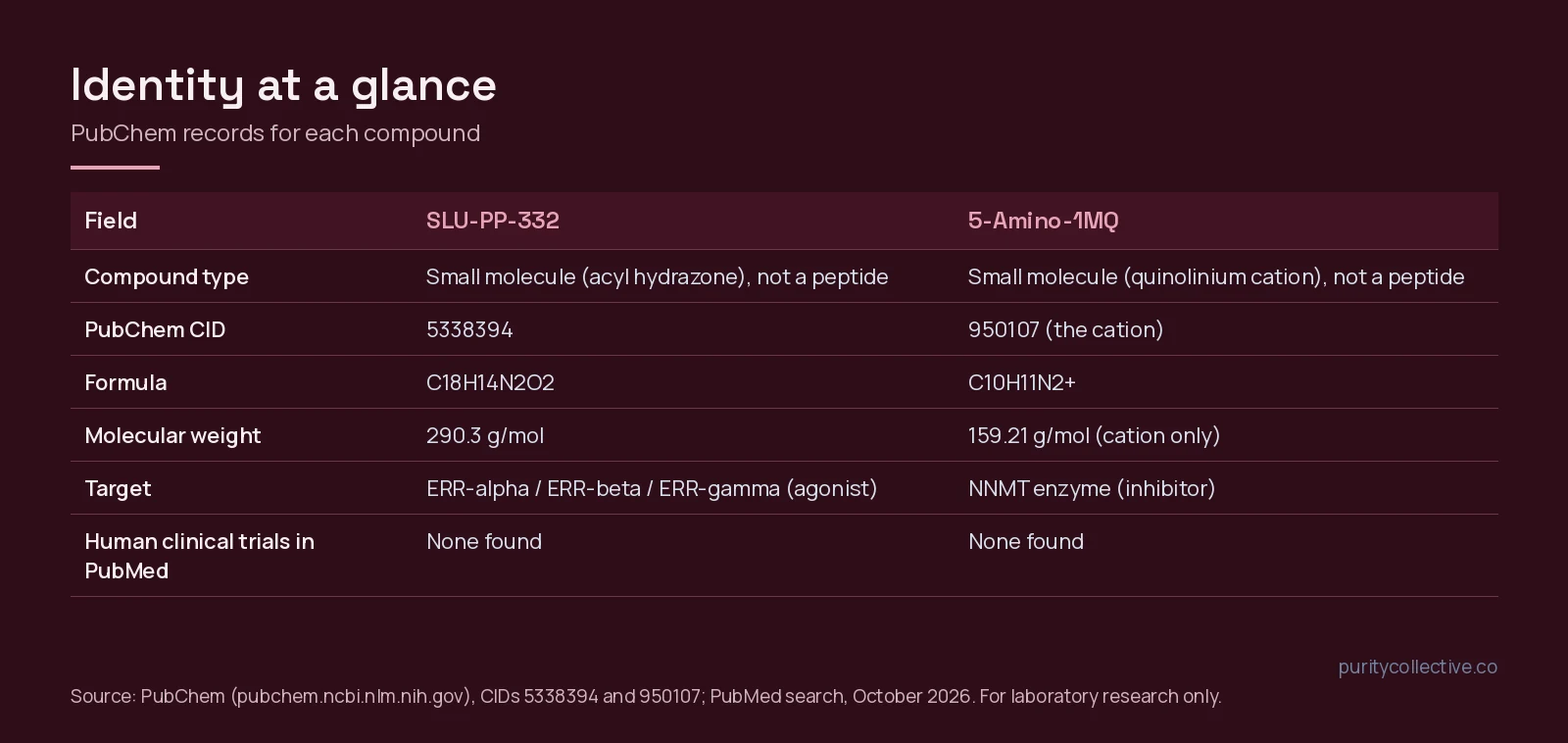
SLU-PP-332: an ERR agonist studied as an “exercise mimetic”
ERRs are “orphan” nuclear receptors: they have no confirmed natural hormone ligand, but genetic studies tie them to skeletal muscle exercise capacity. Billon and colleagues reported that SLU-PP-332 activates all three ERR subtypes, with the highest potency at ERR-alpha, and that its pharmacokinetics were good enough to use it in live animals. In a skeletal muscle cell line it increased mitochondrial function and cellular respiration. In mice it increased type IIa oxidative muscle fibers and endurance, and the endurance effect depended on ERR-alpha[1].
Follow-up mouse studies broadened the picture:
- Obesity models. In diet-induced obese and ob/ob mice, the same group reported higher energy expenditure and fatty-acid oxidation, less fat mass accumulation and improved insulin sensitivity[6].
- Heart failure model. In mice with pressure-overload heart failure, SLU-PP-332 and a second pan-ERR agonist, SLU-PP-915, improved ejection fraction, reduced fibrosis and increased survival without changing cardiac hypertrophy. Genetic experiments pointed to ERR-gamma as the main mediator in heart tissue[2].
- Aging kidney. In 21-month-old mice, eight weeks of treatment reversed age-related albuminuria, podocyte loss, mitochondrial dysfunction and inflammatory markers[7].
- Human cells in culture. In myoblasts isolated from muscle biopsies of inactive women, SLU-PP-332 raised SIRT1, PGC-1alpha and ERR-alpha expression, lowered NOX4 and oxidative-stress markers, and promoted myotube formation. The authors called it a pilot study and said further work is needed[9]. This was a cell-culture experiment, not a treatment study in people.
Two limits are worth stating plainly. First, the developers later wrote that SLU-PP-332 lacks oral bioavailability, which is part of why they built the orally active analogue SLU-PP-915[10]. Second, anti-doping laboratories have already mapped its metabolites in human liver fractions, noting that the World Anti-Doping Agency prohibits exercise mimetics and metabolic modulators in sport[11].
5-Amino-1MQ: an NNMT inhibitor
The interest in NNMT comes from a 2014 mouse study. Kraus and colleagues found that NNMT expression was raised in white fat and liver of obese and diabetic mice, and that knocking NNMT down in those tissues protected against diet-induced obesity by increasing cellular energy expenditure. Lower NNMT activity raised adipose SAM and NAD+ levels and increased polyamine flux[3]. NNMT therefore sits where two pathways meet: the NAD+ salvage pathway (nicotinamide is an NAD+ precursor) and the methyl-donor cycle (SAM).
Neelakantan and colleagues then tested a series of methylquinolinium NNMT inhibitors, the scaffold 5-Amino-1MQ belongs to. Analogues with primary-amine substitutions crossed membranes well and did not inhibit related SAM-dependent methyltransferases or NAD+ salvage enzymes. In cultured adipocytes the inhibitors lowered the NNMT product 1-methylnicotinamide, raised intracellular NAD+ and SAM, and suppressed lipogenesis. In diet-induced obese mice, a potent inhibitor reduced body weight, white fat mass and adipocyte size without changing food intake[4].
Later work named the compound directly:
- Diet-induced obese mice, 28 days. 5-Amino-1MQ (written “5A1MQ”) dose-dependently limited body weight and fat mass gains, improved glucose tolerance and insulin sensitivity, and reduced hepatic steatosis. Pharmacokinetic work in mice found exposure in fat, muscle and liver[5].
- Diet switch and gut microbiome. In obese mice moved to a low-fat diet, the NNMT inhibitor (named as 5-amino-1-methylquinolinium) plus diet produced a distinct cecal microbiome pattern. The authors also reported minimal microbiome differences between lean and obese controls[12].
A separate line of mouse work on aged muscle describes its compound only as an “NNMT inhibitor” in the abstracts, so we do not assume which molecule it was. In 24-month-old mice after muscle injury, treatment increased muscle stem cell activity, myofiber size and contractile torque[8]. In mice treated from 22 to 24 months of age, an NNMT inhibitor alone or combined with intensive exercise was compared on grip strength, running capacity and muscle mass[13]. In a mouse model of peripheral artery disease, an NNMT inhibitor improved ischemic muscle strength and power independent of any change in limb perfusion[14].
Study table
| Compound | Model | What was measured | Reported finding | Ref. |
|---|---|---|---|---|
| SLU-PP-332 | Muscle cell line; mice | Respiration, fiber type, endurance | More oxidative fibers and endurance; ERR-alpha dependent | [1] |
| SLU-PP-332 | Diet-induced obese and ob/ob mice | Energy expenditure, fat mass, insulin sensitivity | Higher energy expenditure, less fat accumulation | [6] |
| SLU-PP-332, SLU-PP-915 | Mouse pressure-overload heart failure | Ejection fraction, fibrosis, survival | Improved; ERR-gamma main mediator; no effect on hypertrophy | [2] |
| SLU-PP-332 | 21-month-old mice | Kidney function and inflammation markers | Age-related changes reversed | [7] |
| SLU-PP-332 | Human donor myoblasts in culture | Gene and protein expression, myotube formation | Higher SIRT1, PGC-1alpha, ERR-alpha; pilot study | [9] |
| Methylquinolinium NNMT inhibitors | Adipocytes; diet-induced obese mice | 1-MNA, NAD+, SAM, lipogenesis, fat mass | NAD+ and SAM up, lipogenesis down; no food-intake change | [4] |
| 5-Amino-1MQ | Diet-induced obese mice | Body composition, glucose, liver histology, tissue exposure | Smaller weight and fat gains, less steatosis | [5] |
| NNMT inhibitor (unnamed in abstract) | Mouse peripheral artery disease | Strength, power, perfusion | Strength up; perfusion unchanged | [14] |
What the evidence does not show
- No human outcome data. PubMed lists no clinical trial for either compound. The only human material used with SLU-PP-332 was donor muscle cells in a dish[9] and liver fractions in doping-control labs[11].
- Mostly one or two research groups. Most SLU-PP-332 papers come from its developers, and the core NNMT inhibitor papers come from one group. Independent replication is still thin.
- Not every result was positive. In the peripheral artery disease model, NNMT inhibition did not change limb perfusion[14]. SLU-PP-332 did not change cardiac hypertrophy in the heart-failure model[2] and is not orally bioavailable[10].
- No head-to-head study. We found no published paper that tested SLU-PP-332 and an NNMT inhibitor together or against each other. Any comparison, including this one, is drawn across separate studies with different designs.
Reading the product records
For a small molecule, the useful documents are a structure-level identity test and a purity value tied to the exact lot in hand. Purity Collective’s COA library lists a report for each 5-Amino-1MQ strength. The 5-Amino-1MQ 10mg report (lot PC5AM-10) and the 5-Amino-1MQ 50mg report (lot PC5AM-50) are both from ILS Laboratories, analyzed August 18, 2026. Each lists HPLC purity of 99.90% (the lab caps reported values at 99.9%) and measured content of 10.35 mg and 51.76 mg respectively. On both, identity was confirmed by HPLC retention time against a reference standard. The template labels the purity line “peptide purity” even though 5-Amino-1MQ is not a peptide, and the reports do not state a salt form. Retention-time matching is a weaker identity check than mass spectrometry; our guide to HPLC vs mass spectrometry explains the difference. For SLU-PP-332, a batch COA for this product isn’t posted yet.
Whichever supplier you use, match the lot number on the vial to the report, confirm the testing lab and the analysis date, and check which identity method was used. The same checks apply whenever you buy research peptides online in the USA or source a small-molecule reference compound.
Frequently asked questions
Are SLU-PP-332 and 5-Amino-1MQ peptides?
No. Both are synthetic small molecules. PubChem lists SLU-PP-332 as CID 5338394 (C18H14N2O2) and the 5-amino-1-methylquinolinium cation as CID 950107 (C10H11N2+). Identity is checked by structure and mass, not by amino-acid sequence.
What is the main difference between SLU-PP-332 and 5-Amino-1MQ?
The target. SLU-PP-332 activates the estrogen-related receptors ERR-alpha, ERR-beta and ERR-gamma, which control mitochondrial and fatty-acid genes. 5-Amino-1MQ inhibits the enzyme nicotinamide N-methyltransferase (NNMT), which methylates nicotinamide using SAM.
Has either compound been tested in humans?
PubMed lists no clinical trial for either compound as of October 2026. Published work uses cell lines, cultured human donor cells and mice. Mouse findings should not be read as human outcomes.
Have SLU-PP-332 and 5-Amino-1MQ been studied together?
We found no published study that tested them together or head to head. Comparisons, including this article, are drawn across separate studies with different models and designs.
What should a lab check on the COA for these compounds?
Match the lot number to the vial, then check the testing lab, the analysis date, the purity method and the identity method. For 5-Amino-1MQ, also check which salt form is named, because the counter-ion changes the formula weight. Purity Collective posts reports for both 5-Amino-1MQ strengths; a batch COA for SLU-PP-332 isn’t posted yet.
References
- Billon C, Sitaula S, Banerjee S et al. (2023). Synthetic ERRα/β/γ Agonist Induces an ERRα-Dependent Acute Aerobic Exercise Response and Enhances Exercise Capacity. ACS Chem Biol. PMID: 36988910. doi: 10.1021/acschembio.2c00720.
- Xu W, Billon C, Li H et al. (2024). Novel Pan-ERR Agonists Ameliorate Heart Failure Through Enhancing Cardiac Fatty Acid Metabolism and Mitochondrial Function. Circulation. PMID: 37961903. doi: 10.1161/CIRCULATIONAHA.123.066542.
- Kraus D, Yang Q, Kong D et al. (2014). Nicotinamide N-methyltransferase knockdown protects against diet-induced obesity. Nature. PMID: 24717514. doi: 10.1038/nature13198.
- Neelakantan H, Vance V, Wetzel MD et al. (2018). Selective and membrane-permeable small molecule inhibitors of nicotinamide N-methyltransferase reverse high fat diet-induced obesity in mice. Biochem Pharmacol. PMID: 29155147. doi: 10.1016/j.bcp.2017.11.007.
- Babula JJ, Bui D, Stevenson HL et al. (2024). Nicotinamide N-methyltransferase inhibition mitigates obesity-related metabolic dysfunction. Diabetes Obes Metab. PMID: 39161060. doi: 10.1111/dom.15879.
- Billon C, Schoepke E, Avdagic A et al. (2024). A Synthetic ERR Agonist Alleviates Metabolic Syndrome. J Pharmacol Exp Ther. PMID: 37739806. doi: 10.1124/jpet.123.001733.
- Wang XX, Myakala K, Libby AE et al. (2023). Estrogen-Related Receptor Agonism Reverses Mitochondrial Dysfunction and Inflammation in the Aging Kidney. Am J Pathol. PMID: 37717940. doi: 10.1016/j.ajpath.2023.07.008.
- Neelakantan H, Brightwell CR, Graber TG et al. (2019). Small molecule nicotinamide N-methyltransferase inhibitor activates senescent muscle stem cells and improves regenerative capacity of aged skeletal muscle. Biochem Pharmacol. PMID: 30753815. doi: 10.1016/j.bcp.2019.02.008.
- Bonanni R, Falvino A, Matticari A et al. (2025). Targeting ERRs to counteract age-related muscle atrophy associated with physical inactivity: a pilot study. Front Physiol. PMID: 40692696. doi: 10.3389/fphys.2025.1616693.
- Billon C, Appourchaux K, Côté I et al. (2026). An orally active estrogen receptor-related receptor agonist, SLU-PP-915, enhances aerobic exercise capacity. J Pharmacol Exp Ther. PMID: 41421047. doi: 10.1016/j.jpet.2025.103787.
- Avliyakulov NK, Sobolevsky T, Ahrens E (2026). Analysis and Identification of In Vitro Metabolites of Exercise Mimetic SLU-PP-332 ERRα/β/γ Agonist for Doping-Control Purposes. Drug Test Anal. PMID: 41688415. doi: 10.1002/dta.70035.
- Dimet-Wiley A, Wu Q, Wiley JT et al. (2022). Reduced calorie diet combined with NNMT inhibition establishes a distinct microbiome in DIO mice. Sci Rep. PMID: 35013352. doi: 10.1038/s41598-021-03670-5.
- Dimet-Wiley AL, Latham CM, Brightwell CR et al. (2024). Nicotinamide N-methyltransferase inhibition mimics and boosts exercise-mediated improvements in muscle function in aged mice. Sci Rep. PMID: 38969654. doi: 10.1038/s41598-024-66034-9.
- Dong G, Choi J, Li Y et al. (2025). Nicotinamide N-methyltransferase inhibition improves limb function in experimental peripheral artery disease. Physiol Rep. PMID: 41108586. doi: 10.14814/phy2.70615.