
Your cart is currently empty!.
You may check out all the available products and buy some in the shop.
Continue ShoppingCompound guide · Retatrutide
Retatrutide (development code LY3437943) is a single peptide that activates three receptors: GIP, GLP-1 and glucagon. It is an investigational drug in phase 3 trials and is not approved by the FDA for any use. This guide sets out its identity checked against PubChem, the receptor rationale, how the clinical program is designed, the preclinical record, what the evidence does not show, and what Purity Collective’s lot reports cover for each of its five listings.
For laboratory research only. Not for human or animal use. Retatrutide is an unapproved investigational compound; nothing here is medical, dosing, weight-loss or administration advice.


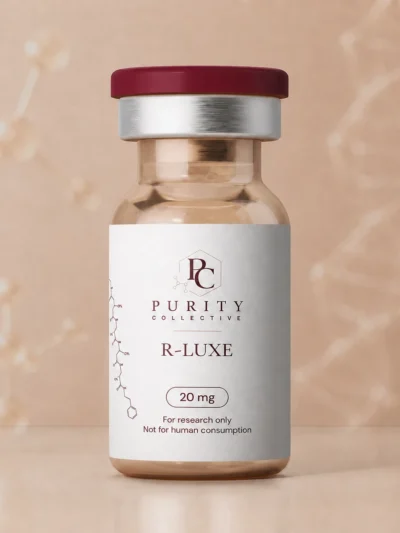

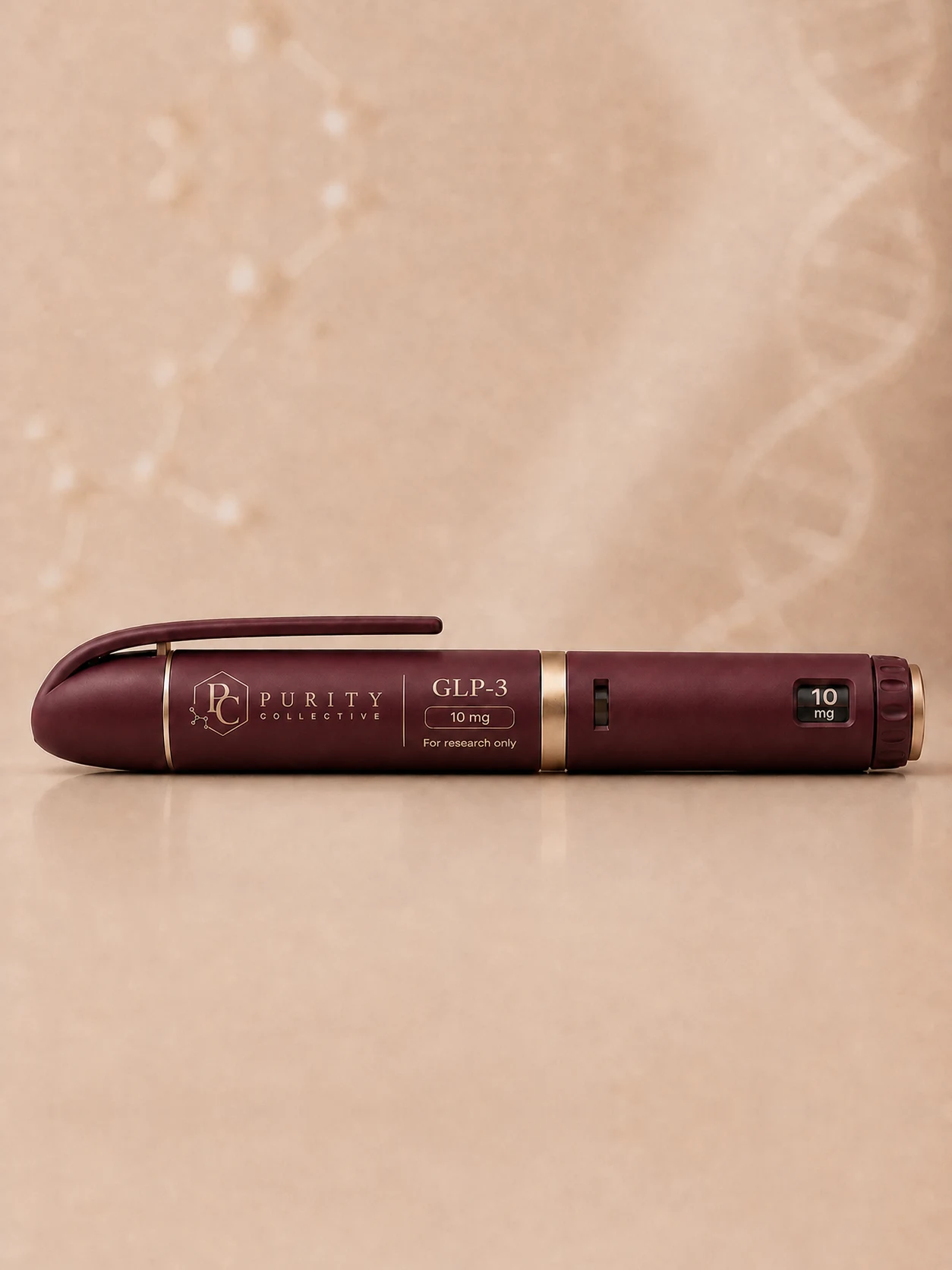
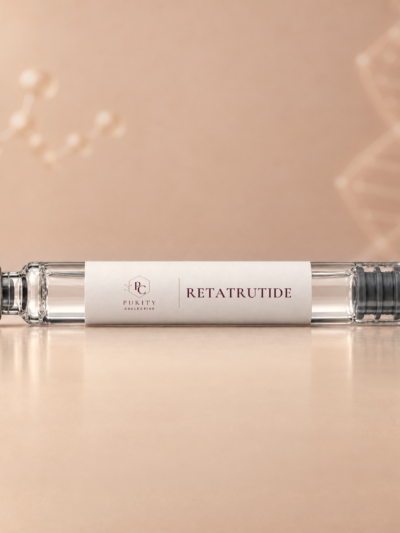
Purity Collective lists retatrutide in four vial sizes and one pen. Four of the five have a posted lot report; the 20mg vial does not. The pen shares the 10mg vial’s lot.
| Listing | Format | Lot on report | Report |
|---|---|---|---|
| Retatrutide 10mg | Lyophilized vial | PCCL-5859103-P (endotoxin: -E) | Horizon Analytical, UPLC/MS + endotoxin |
| Retatrutide 15mg | Lyophilized vial | PCCL-5244055-P (endotoxin: -E) | Horizon Analytical, UPLC/MS + endotoxin |
| Retatrutide 20mg | Lyophilized vial | None posted | No batch certificate published as of October 1, 2026 |
| Retatrutide 30mg | Lyophilized vial | PCCL-1857910-P (endotoxin: -E) | Horizon Analytical, UPLC/MS + endotoxin |
| Retatrutide (Pen) | Pre-filled pen | PCCL-5859103-P (shared with 10mg vial) | Same certificates as the 10mg vial |
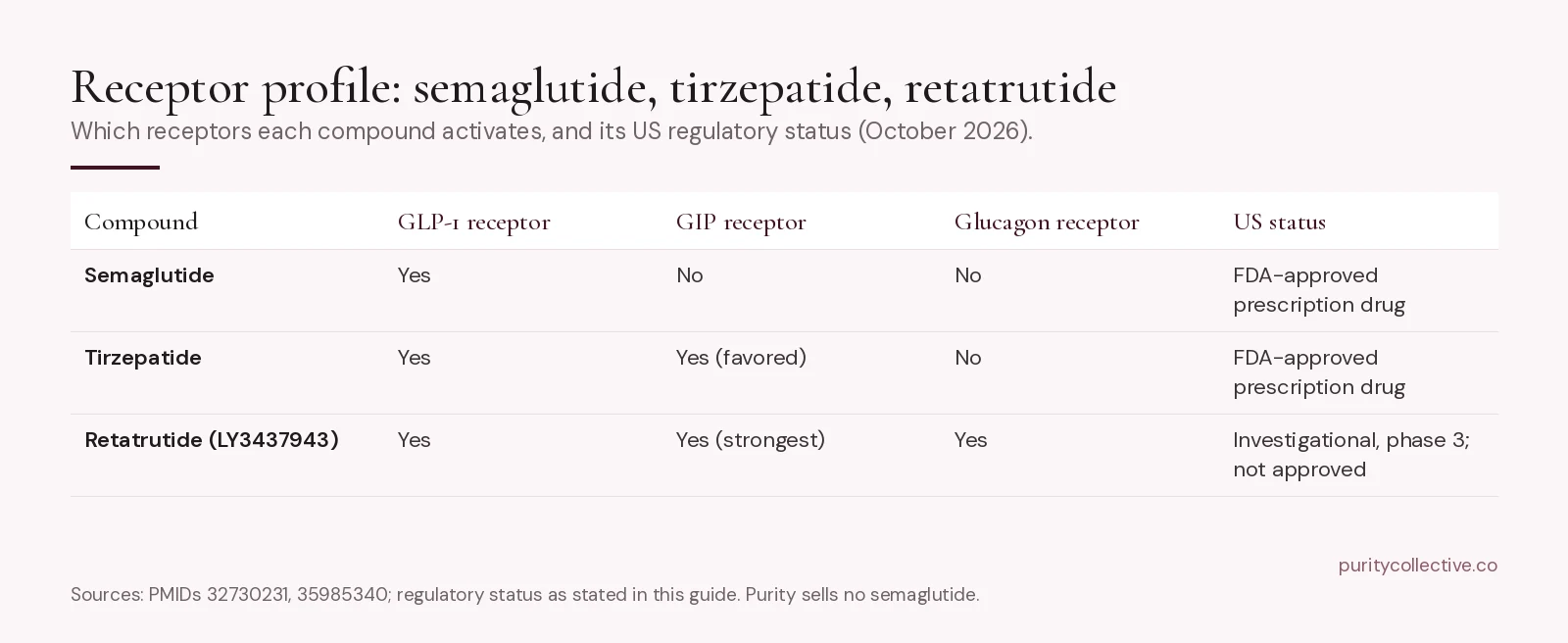
Key facts. Retatrutide is a GIP, GLP-1 and glucagon receptor triple agonist developed by Eli Lilly. As of October 1, 2026 it is investigational: the first phase 3 results were published in 2026 and no FDA approval has been granted. Its two US-approved relatives are tirzepatide (GIP + GLP-1) and semaglutide (GLP-1 only). The material sold here is a research reference standard, not a drug product.
The incretin-drug field moved in steps: first GLP-1 receptor agonists, then dual GIP/GLP-1 agonists such as tirzepatide, then compounds that add glucagon receptor activity. Each receptor was added for a different reason. GLP-1 receptor activation lowers glucose and food intake; the GIP receptor arm became a target in its own right once mouse work linked GIPR agonism to weight-independent insulin sensitization by tirzepatide[34003802], and tirzepatide itself turned out to be an imbalanced agonist favoring the GIP receptor[32730231]. Glucagon receptor activation raises energy expenditure and acts on the liver.
The discovery paper for LY3437943 described a peptide with balanced glucagon and GLP-1 receptor activity and stronger GIP receptor activity in vitro. In obese mice it lowered body weight and improved glycemic control, and the authors attributed the extra weight effect to glucagon-receptor-driven energy expenditure added to GIP- and GLP-1-driven reductions in intake; the same paper reported a single ascending dose study in people with a tolerability profile similar to other incretins and a pharmacokinetic profile long enough for weekly intervals[35985340]. Cryo-electron microscopy structures later showed how one peptide engages all three receptors[39019866].
Checked against PubChem on October 1, 2026, not copied from a lot report.
| Attribute | Value |
|---|---|
| Names | Retatrutide; development code LY3437943 |
| Class | Acylated peptide; GIP, GLP-1 and glucagon receptor triple agonist |
| Molecular formula | C221H342N46O68 |
| Molecular weight | 4731 g/mol |
| PubChem CID | 171390338. PubChem indexes this record under the vendor synonym “Triple G” rather than the name retatrutide; its formula matches the one printed on Purity’s reports. |
| Developer | Eli Lilly and Company |
| US regulatory status | Investigational. Not approved by the FDA for any indication as of October 1, 2026. |
| Supplied here as | Lyophilized powder (vials) or pre-filled pen, for laboratory research only |
This section describes trial designs, populations and endpoints so that the literature can be located and read. It deliberately does not repeat effect sizes: retatrutide is unapproved, and trial results are not claims about the research material sold here.
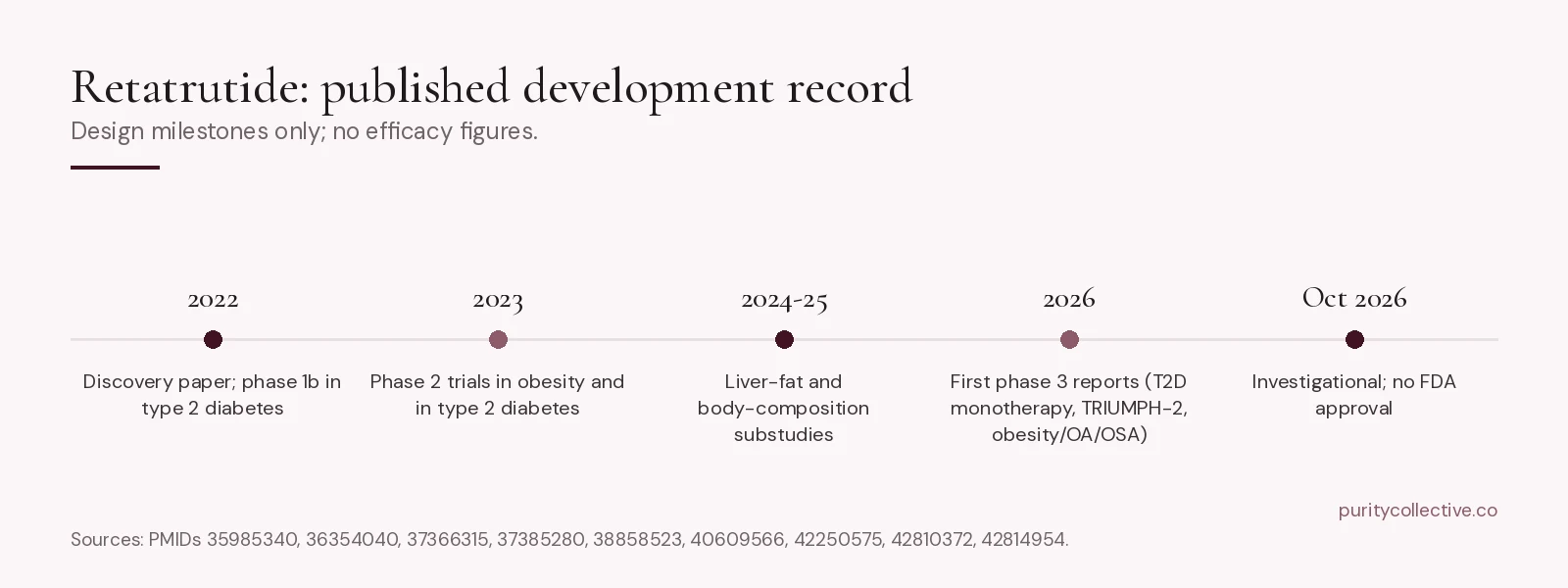
A 12-week phase 1b trial in adults with type 2 diabetes had safety and tolerability as its primary outcome, with pharmacokinetics and pharmacodynamics as secondary outcomes, and included placebo and dulaglutide arms[36354040]. Two 2023 phase 2 trials followed: a 48-week placebo-controlled study in adults with obesity whose primary endpoint was percentage change in body weight at 24 weeks[37366315], and a 36-week placebo- and dulaglutide-controlled study in type 2 diabetes whose primary endpoint was change in HbA1c at 24 weeks[37385280]. In the obesity trial the most common adverse events were gastrointestinal, dose-related and mostly mild to moderate[37366315]. Substudies of those trials examined liver fat in metabolic dysfunction-associated steatotic liver disease[38858523] and body composition by DXA[40609566].
The TRIUMPH program is a set of phase 3, randomized, double-blind, placebo-controlled trials in more than 5,800 participants, using a basket design that nests knee osteoarthritis and obstructive sleep apnea protocols inside weight-management trials[41090431]. In 2026 three phase 3 reports were published: a 40-week monotherapy trial in type 2 diabetes with change in HbA1c as the primary endpoint[42250575]; TRIUMPH-2 in adults with obesity and type 2 diabetes[42810372]; and an 80-week trial in adults with obesity without diabetes whose primary outcomes were body weight, a knee osteoarthritis pain score and the apnea-hypopnea index in the relevant subgroups[42814954]. Regulatory review is a separate step that had not concluded as of this guide’s review date.
Beyond the discovery work in obese mice[35985340], two recent laboratory studies show the kind of questions researchers are asking. In isolated mouse atria, retatrutide did not increase force of contraction in left atrial preparations but raised beating rate in right atrial preparations, an effect blocked by a glucagon receptor antagonist[40464942], which points to the glucagon arm when studying heart-rate effects. In mouse models of kidney fibrosis (unilateral ureteral obstruction and aging) and in HK-2 kidney cells, semaglutide, tirzepatide and retatrutide each showed model- and drug-specific pathway patterns[42630988]. Both are animal or tissue studies and say nothing on their own about people.
| Study | Model / population | Design | Primary endpoint | Status | PMID |
|---|---|---|---|---|---|
| Discovery + SAD | Cells; obese mice; healthy people | Laboratory + phase 1 | Receptor activity, body weight (mice), safety | Published 2022 | [35985340] |
| Phase 1b | Type 2 diabetes | 12-week RCT vs placebo, dulaglutide | Safety and tolerability | Published 2022 | [36354040] |
| Phase 2 obesity | Adults with obesity or overweight + comorbidity | 48-week RCT vs placebo | % change in body weight at 24 weeks | Published 2023 | [37366315] |
| Phase 2 T2D | Type 2 diabetes | 36-week RCT vs placebo, dulaglutide | Change in HbA1c at 24 weeks | Published 2023 | [37385280] |
| MASLD substudy | Obesity + liver fat ≥10% | Substudy of phase 2 | Relative change in liver fat at 24 weeks | Published 2024 | [38858523] |
| Body composition substudy | Type 2 diabetes | Substudy of phase 2 | % change in total fat mass at 36 weeks | Published 2025 | [40609566] |
| Phase 3 monotherapy | Type 2 diabetes on diet and exercise | 40-week RCT vs placebo | Change in HbA1c at 40 weeks | Published 2026 | [42250575] |
| TRIUMPH-2 | Obesity + type 2 diabetes | Phase 3 RCT vs placebo | Body weight | Published 2026 | [42810372] |
| Phase 3 obesity (TRIUMPH program) | Obesity without diabetes; knee OA and OSA subgroups | 80-week RCT vs placebo | Body weight; WOMAC pain; AHI | Published 2026 | [42814954] |
| Atrial pharmacology | Isolated mouse atria | Laboratory | Force and rate of contraction | Published 2025 | [40464942] |
| Kidney fibrosis | HK-2 cells; UUO and aged mice | Laboratory, 3-drug comparison | Fibrosis and inflammation pathways | Published 2026 | [42630988] |
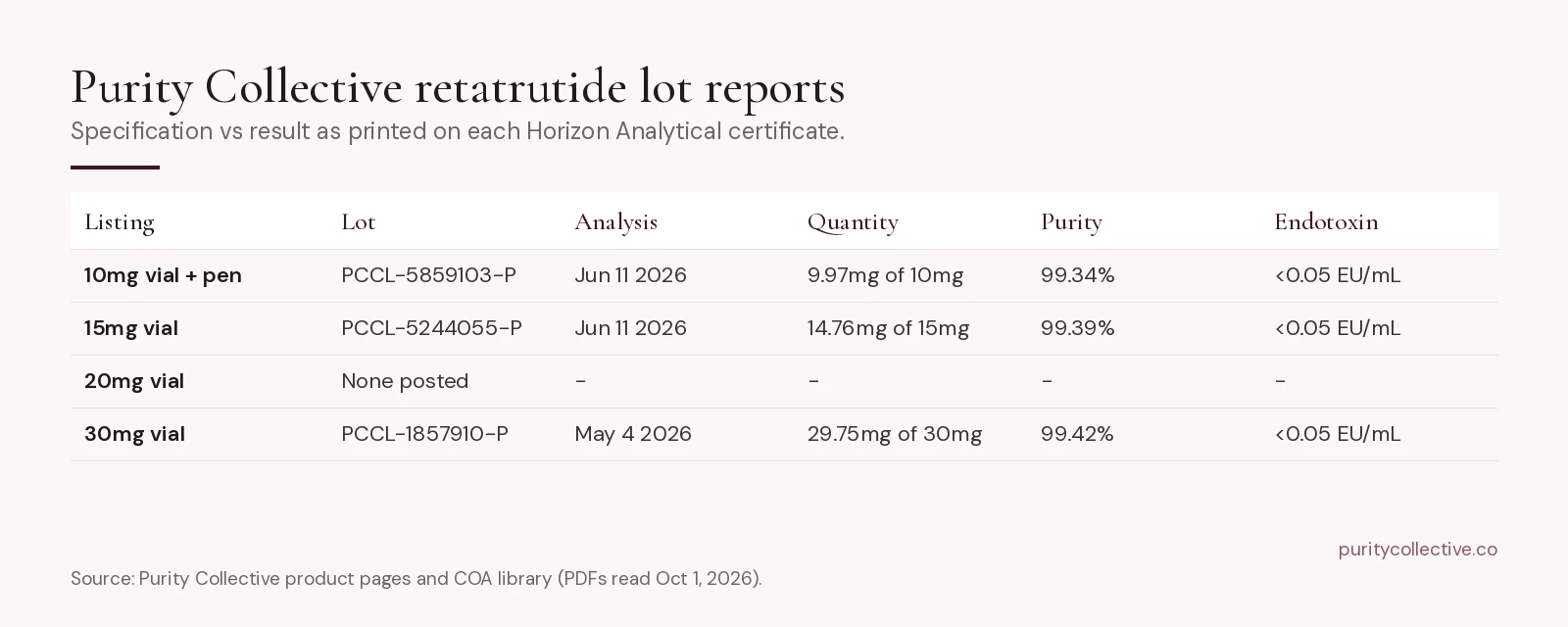
Retatrutide 10mg, lot PCCL-5859103-P (Horizon Analytical, analysis June 11, 2026, UPLC/MS): 9.97mg against a 10mg specification, purity 99.34%; endotoxin report PCCL-5859103-E reads <0.05 EU/mL. The pen links the same lot. Purity’s media library also holds reports for an earlier 10mg lot, PCCL-6141790 (April 2026), whose endotoxin result was 0.061 EU/mL; this guide quotes the current lot, PCCL-5859103.
Retatrutide 15mg, lot PCCL-5244055-P (Horizon, June 11, 2026): 14.76mg against 15mg, purity 99.39%; endotoxin <0.05 EU/mL (PCCL-5244055-E). Retatrutide 30mg, lot PCCL-1857910-P (Horizon, May 4, 2026): 29.75mg against 30mg, purity 99.42%; endotoxin <0.05 EU/mL (PCCL-1857910-E).
Retatrutide 20mg: a batch COA for this product isn’t posted yet. No certificate for another strength should be read as documenting the 20mg vial.
All reports print the formula C221H342N46O68 and PubChem CID 171390338, which match the PubChem record above. The PDFs are in the COA library; for what each field means see how to read a peptide COA.
Vials are lyophilized powder; keep them cold, dry and away from light until use. The pen holds a liquid formulation and should be stored refrigerated as stated on the product page. Record the lot number with each experiment so a result traces back to its certificate. Purity Collective publishes no reconstitution, dosing or administration instructions for any product.
Purity Collective lists retatrutide as 10mg, 15mg, 20mg and 30mg lyophilized vials and a pen, sold to qualified researchers for laboratory use only. Four listings have posted lot reports; the 20mg vial does not yet.
No. As of October 1, 2026 retatrutide is an investigational drug in phase 3 trials with no FDA approval for any use. Its relatives tirzepatide and semaglutide are approved prescription drugs; retatrutide is not.
Three: the GIP receptor, the GLP-1 receptor and the glucagon receptor. In vitro it has balanced glucagon and GLP-1 activity with stronger GIP activity, according to its discovery paper.
Not yet. No batch certificate is posted for the 20mg vial. The 10mg (and pen), 15mg and 30mg listings each have a Horizon Analytical purity and endotoxin report.
Purity’s media library holds reports for an earlier 10mg lot, PCCL-6141790, with an endotoxin result of 0.061 EU/mL. The current lot, PCCL-5859103, reads below 0.05 EU/mL and is the one quoted in this guide.
No. It is a research reference material for laboratory use only. Purity Collective publishes no dosing, reconstitution or administration information for any product.