
For laboratory research only. Not for human or animal use. This article gives no dosing, administration or therapeutic advice.
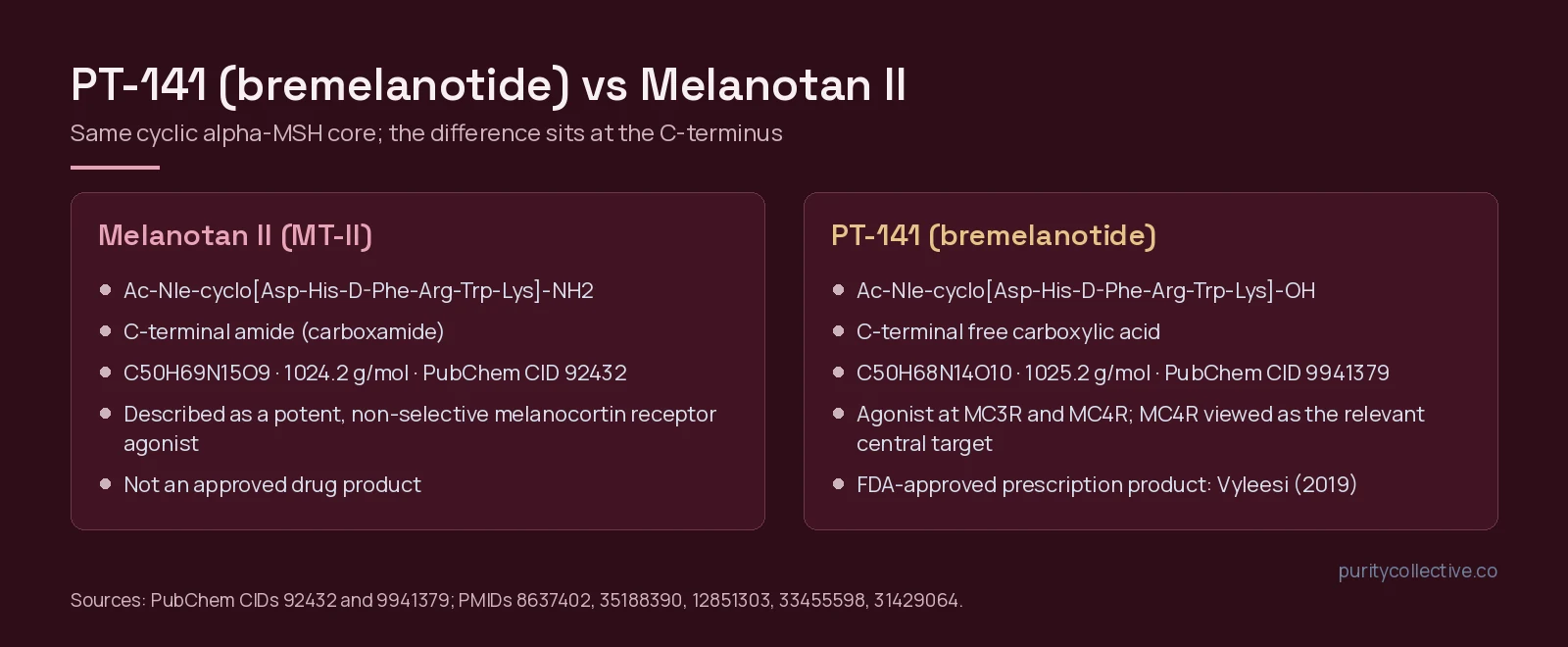
Short answer: PT-141 (bremelanotide) and Melanotan II (MT-II) are close relatives. Both are cyclic, lactam-bridged peptides built on a fragment of alpha-melanocyte-stimulating hormone (α-MSH), and their PubChem records describe the same ring and side chains. The one structural difference is the end of the chain: MT-II ends in an amide, bremelanotide in a free carboxylic acid. MT-II is described in the literature as a potent, non-selective melanocortin receptor agonist[1],[2]. Bremelanotide is described as an agonist at the central MC3 and MC4 receptors, with MC4R treated as its relevant target[3],[4]. Their regulatory paths split completely: bremelanotide is an FDA-approved prescription product, Vyleesi, while MT-II is not an approved drug[5],[6].
PT-141 vs Melanotan II at a glance
| Feature | Melanotan II (MT-II) | PT-141 (bremelanotide) |
|---|---|---|
| Origin | Cyclic lactam analogue of α-MSH(4-10) from structure-activity work on the hormone[7],[1] | Synthetic α-MSH analogue developed by Palatin Technologies[5] |
| Sequence | Ac-Nle-cyclo[Asp-His-D-Phe-Arg-Trp-Lys]-NH2 | Ac-Nle-cyclo[Asp-His-D-Phe-Arg-Trp-Lys]-OH |
| Formula / MW | C50H69N15O9 / 1024.2 g/mol (PubChem CID 92432) | C50H68N14O10 / 1025.2 g/mol (PubChem CID 9941379) |
| Receptor profile in published work | Potent, non-selective across human melanocortin receptors[2],[8] | Agonist at MC3R and MC4R; reviewed as non-selective, with MC4R the most relevant subtype[3],[4] |
| Main research themes | Pigmentation, feeding and energy balance | Central MC4R signalling and behaviour |
| Regulatory status | Not approved; sold through unregulated channels, subject to health-agency warnings[6],[9] | FDA-approved as Vyleesi (2019)[5] |
| Purity Collective listing | MT-2 10mg (Melanotan 2) | PT-141 10mg |
One ring, two endings: the structural relationship
MT-II came out of structure-activity work on α-MSH in the late 1980s. Researchers designed cyclic lactam fragments of the hormone by bridging an aspartic or glutamic acid side chain to a lysine (or shorter analogue) side chain, then ranked them in frog and lizard skin pigment bioassays. Analogues with a 23-membered ring were about 100-fold more potent than α-MSH in the lizard assay, and making the ring larger or smaller reduced potency[7]. The Asp5/Lys10 heptapeptide in this series has the structure later reported for Melanotan II, Ac-Nle4-Asp5-His6-D-Phe7-Arg8-Trp9-Lys10-α-MSH(4-10)-NH2[1].
Bremelanotide keeps that ring intact. Comparing the two PubChem records, the IUPAC names are identical up to the last group: MT-II (CID 92432) ends in a carboxamide and bremelanotide (CID 9941379) in a carboxylic acid. That single swap, an -NH2 for an -OH, accounts for the one-nitrogen, one-oxygen difference between the formulas and the 1 g/mol gap in molecular weight. Because the two masses are so close, a mass-spectrometry identity result needs to be read against the correct reference compound, not just “about 1,024”.
Receptor selectivity: MC1R, MC3R and MC4R
There are five melanocortin receptors. MC1R is the melanocyte receptor linked to eumelanin pigment synthesis[10], while MC3R and MC4R are expressed mainly in the central nervous system and are often called the neural melanocortin receptors[11]. The two compounds sit differently across this family in the literature:
- MT-II is repeatedly described as a potent and unselective agonist of the human melanocortin receptors. A 2022 medicinal chemistry study used it as the non-selective parent scaffold and replaced its lactam bridge with xylene-based linkers; one resulting analogue became functionally selective for hMC1R, unlike MT-II itself[2].
- Bremelanotide is described as an agonist at MC3R and MC4R[3]. A 2022 review states that it activates several receptor subtypes non-selectively, with MC4R considered the most relevant, and that MC4R is concentrated in the medial preoptic area of the hypothalamus[4]. The approval review describes high affinity for MC4R[5].
Put simply, neither compound is a clean single-receptor tool. MT-II carries strong MC1R (pigmentation) activity alongside central activity, while bremelanotide’s research and development history centred on central MC4R signalling.
What the preclinical research looked at
Melanotan II: pigmentation and feeding models
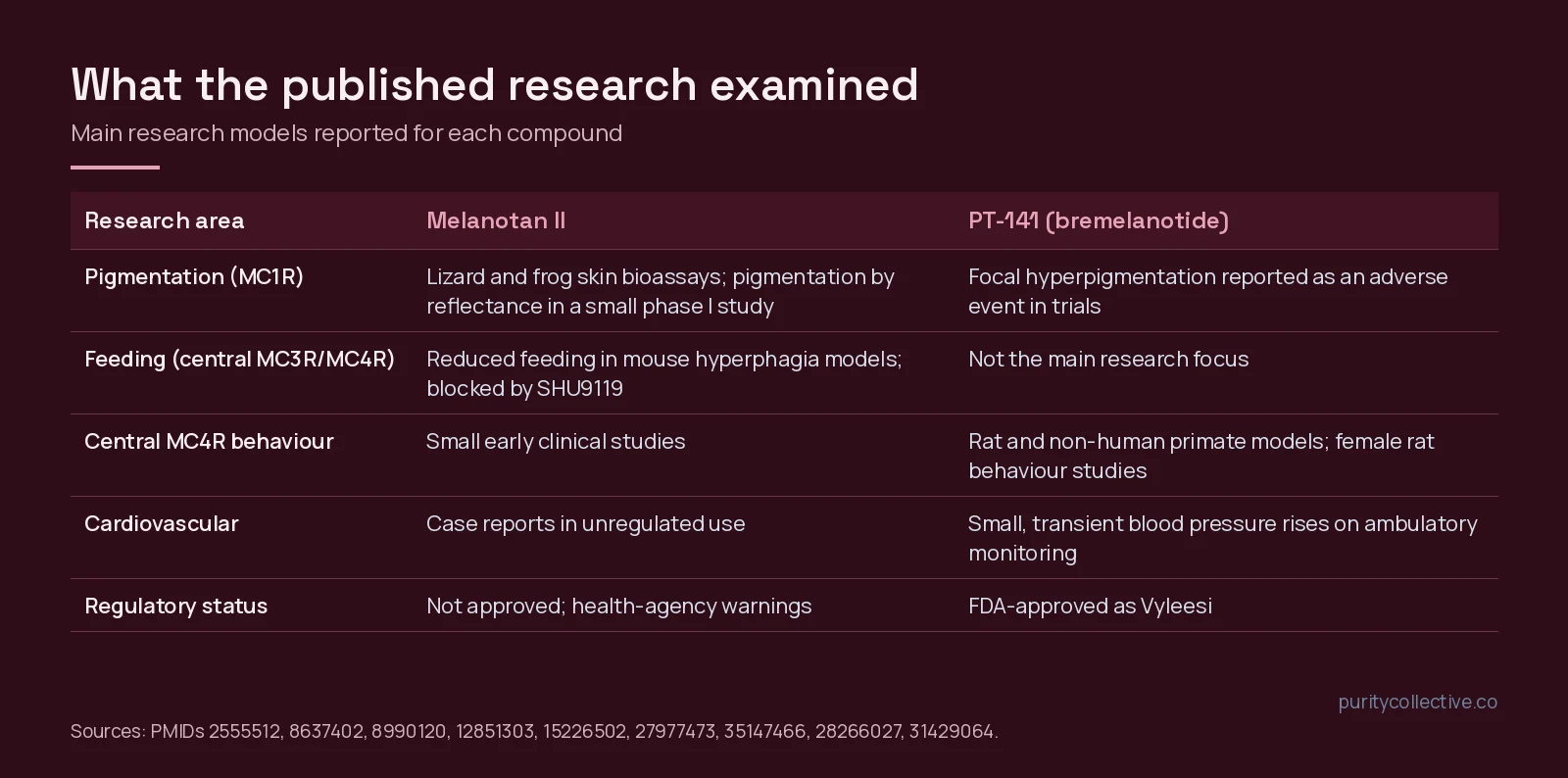
MT-II’s first research use was as a melanotropin. Beyond the skin bioassays used to design it[7], its only early clinical record is a small phase I pilot in three volunteers that measured skin reflectance; with three participants it cannot support conclusions, and the adverse events it recorded included somnolence, fatigue, mild nausea and a stretching-and-yawning complex[1].
MT-II also became a standard tool for central melanocortin research. In mice, MT-II given into the brain ventricles inhibited feeding in four hyperphagia models (fasted C57BL/6J, ob/ob and Ay mice, and mice given neuropeptide Y), and the melanocortin antagonist SHU9119 completely blocked the effect[10]. A later 7-day central infusion study in male rats is a useful limit on that picture: MT-II produced near-complete anorexia for 1–2 days, but feeding then returned to normal despite continued infusion. It did reduce adiposity versus pair-fed rats and blunted NPY-driven fat gain, yet it did not reverse NPY’s suppression of the gonadotropic and somatotropic axes[12]. These are rodent findings with central delivery and should not be read beyond those models.
PT-141: central MC4R signalling
PT-141 was profiled as a centrally acting melanocortin agonist. In rats and non-human primates it produced erectile responses, and in rats systemic administration increased c-Fos immunoreactivity, a marker of neuronal activation, in the hypothalamus[3]. In female rats, PT-141 selectively increased solicitational (appetitive) behaviours without changing lordosis, pacing or other measures, and it did not cause general motor activation or alter sexual reward measures[13]. A later review links these animal findings to presynaptic MC4R activation in the medial preoptic area and increased dopamine release, while making clear that this mechanism comes from animal work[4].
Regulatory status, stated plainly
Bremelanotide was approved in the USA in 2019 as Vyleesi, a prescription product for a specific indication in premenopausal women, after phase 3 trials sponsored by Palatin Technologies[5]. The label is public: FDA prescribing information for Vyleesi (NDA 210557). A 2022 independent review discusses the limits of the trial program behind that approval[14]. Approval applies to that product and its labeling only; it does not carry over to any research-grade material.
Melanotan II has no approval anywhere. A dermatology review notes that it and Melanotan I circulate as untested, unregulated products and that several national health organisations have issued safety warnings[6]. The UK medicines regulator has also flagged the potential impurity of these products[9].
Safety signals reported in the literature
The two compounds have very different evidence bases. Bremelanotide’s signals come from a controlled development program; MT-II’s come mostly from case reports involving products of unknown origin.
- Bremelanotide, controlled trials: a review of 43 completed studies listed nausea, flushing and headache among the most common adverse events, with nausea the main reason for stopping. Focal hyperpigmentation was rare under label conditions but became frequent with repeated consecutive exposure. Ambulatory monitoring found small, transient blood pressure increases[15]. A dedicated ambulatory study saw these increases accompanied by a fall in heart rate, with peaks typically lasting under 15 minutes[16].
- MT-II, early clinical studies: nausea and yawning were frequent in small early clinical studies[1],[17].
- MT-II, case reports: new and changing pigmented moles, including atypical nevi that faded after use stopped[18]; melanoma cases reported during or after use, although the review states that conclusive evidence of a causal link is lacking[6],[19]; systemic toxicity with rhabdomyolysis[20]; and a renal infarction the authors considered most likely related to MT-II[8]. Case reports describe single patients and cannot establish frequency or cause.
What the evidence does not show
- The papers cited here profile the two compounds separately. We did not find one assay comparing both across all five receptors, so “more selective” statements rest on separate studies[2],[4].
- MT-II’s feeding effects in rodents faded with continued central delivery, so short-term results are not a guide to longer exposure in those models[12].
- The MT-II human data are a pilot in three volunteers and a small crossover study; they were never developed into an approved product[1],[17].
Reading the product records for each listing
Because the two molecules differ by 1 g/mol, identity documentation matters more than usual. One case report is a reminder of why: the material involved was confirmed as MT-II by mass spectrometry against a purchased reference standard[20]. When reviewing either listing:
- Match the compound, not the nickname. A PT-141 report should match bremelanotide (C50H68N14O10, 1025.2 g/mol); an MT-2 report should match Melanotan II (C50H69N15O9, 1024.2 g/mol).
- PT-141 10mg. The PT-141 10mg page links a UPLC/MS report for batch PCCL-2061592-P, which lists the specification, a measured quantity result and 99.25% purity, plus a separate endotoxin report for related batch PCCL-2061592-E that reports 0.075 EU/mL.
- MT-2 10mg. The MT-2 10mg (Melanotan 2) page asks buyers to review the documentation for the saleable lot. Confirm the lot, method, result and date on any report you receive.
- Keep reports with their own lots. One compound’s or one batch’s report does not describe another.
For background on PT-141’s public records, see our PT-141 research guide; for a field-by-field walk-through, read how to read a peptide COA. Our page on how to buy research peptides online in the USA covers documentation across the catalog.
Frequently asked questions
What is the difference between PT-141 and Melanotan II?
Both are cyclic peptides built on the same alpha-MSH fragment and share the same ring and side chains. Melanotan II ends in a C-terminal amide; PT-141 (bremelanotide) ends in a free carboxylic acid. Published work describes MT-II as a potent, non-selective melanocortin agonist with strong pigmentation (MC1R) activity, while bremelanotide research centred on central MC4R signalling.
Is PT-141 the same as bremelanotide?
Yes. PT-141 is the development code for bremelanotide, PubChem CID 9941379. The FDA-approved prescription product containing bremelanotide is sold as Vyleesi. A research-grade PT-141 vial is not that approved product and does not carry its labeling.
Is Melanotan II approved by the FDA?
No. Melanotan II is not an approved drug. Dermatology reviews describe it as an untested product sold through unregulated channels, and several national health agencies have issued safety warnings about it.
Which melanocortin receptors do PT-141 and MT-II act on?
MT-II is described as a non-selective agonist across the human melanocortin receptors, including MC1R. Bremelanotide is described as an agonist at MC3R and MC4R, with reviews noting it also activates other subtypes and treating MC4R as the most relevant one.
How can I tell a PT-141 report from an MT-2 report?
Check the compound name and the identity data. Bremelanotide is C50H68N14O10 at 1025.2 g/mol; Melanotan II is C50H69N15O9 at 1024.2 g/mol. Because the masses differ by only about 1 g/mol, make sure the mass-spectrometry result is compared with the correct reference compound and that the lot on the report matches the lot you are reviewing.
References
- Dorr RT, Lines R, Levine N et al. (1996). Evaluation of melanotan-II, a superpotent cyclic melanotropic peptide in a pilot phase-I clinical study. Life Sci. PMID: 8637402. doi: 10.1016/0024-3205(96)00160-9.
- Tomassi S, Dimmito MP, Cai M et al. (2022). CLIPSing Melanotan-II to Discover Multiple Functionally Selective hMCR Agonists. J Med Chem. PMID: 35188390. doi: 10.1021/acs.jmedchem.1c01848.
- Molinoff PB, Shadiack AM, Earle D et al. (2003). PT-141: a melanocortin agonist for the treatment of sexual dysfunction. Ann N Y Acad Sci. PMID: 12851303. doi: 10.1111/j.1749-6632.2003.tb03167.x.
- Pfaus JG, Sadiq A, Spana C et al. (2022). The neurobiology of bremelanotide for the treatment of hypoactive sexual desire disorder in premenopausal women. CNS Spectr. PMID: 33455598. doi: 10.1017/S109285292100002X.
- Dhillon S, Keam SJ (2019). Bremelanotide: First Approval. Drugs. PMID: 31429064. doi: 10.1007/s40265-019-01187-w.
- Habbema L, Halk AB, Neumann M et al. (2017). Risks of unregulated use of alpha-melanocyte-stimulating hormone analogues: a review. Int J Dermatol. PMID: 28266027. doi: 10.1111/ijd.13585.
- Al-Obeidi F, Castrucci AM, Hadley ME et al. (1989). Potent and prolonged acting cyclic lactam analogues of alpha-melanotropin: design based on molecular dynamics. J Med Chem. PMID: 2555512. doi: 10.1021/jm00132a010.
- Peters B, Hadimeri H, Wahlberg R et al. (2020). Melanotan II: a possible cause of renal infarction: review of the literature and case report. CEN Case Rep. PMID: 31953620. doi: 10.1007/s13730-020-00447-z.
- Langan EA, Nie Z, Rhodes LE (2010). Melanotropic peptides: more than just ‘Barbie drugs’ and ‘sun-tan jabs’?. Br J Dermatol. PMID: 20545686. doi: 10.1111/j.1365-2133.2010.09891.x.
- Fan W, Boston BA, Kesterson RA et al. (1997). Role of melanocortinergic neurons in feeding and the agouti obesity syndrome. Nature. PMID: 8990120. doi: 10.1038/385165a0.
- Yuan XC, Tao YX (2022). Ligands for Melanocortin Receptors: Beyond Melanocyte-Stimulating Hormones and Adrenocorticotropin. Biomolecules. PMID: 36291616. doi: 10.3390/biom12101407.
- Raposinho PD, White RB, Aubert ML (2003). The melanocortin agonist Melanotan-II reduces the orexigenic and adipogenic effects of neuropeptide Y (NPY) but does not affect the NPY-driven suppressive effects on the gonadotropic and somatotropic axes in the male rat. J Neuroendocrinol. PMID: 12535159. doi: 10.1046/j.1365-2826.2003.00962.x.
- Pfaus JG, Shadiack A, Van Soest T et al. (2004). Selective facilitation of sexual solicitation in the female rat by a melanocortin receptor agonist. Proc Natl Acad Sci U S A. PMID: 15226502. doi: 10.1073/pnas.0400491101.
- Cipriani S, Alfaroli C, Maseroli E et al. (2023). An evaluation of bremelanotide injection for the treatment of hypoactive sexual desire disorder. Expert Opin Pharmacother. PMID: 36242769. doi: 10.1080/14656566.2022.2132144.
- Clayton AH, Kingsberg SA, Portman D et al. (2022). Safety Profile of Bremelanotide Across the Clinical Development Program. J Womens Health (Larchmt). PMID: 35147466. doi: 10.1089/jwh.2021.0191.
- White WB, Myers MG, Jordan R et al. (2017). Usefulness of ambulatory blood pressure monitoring to assess the melanocortin receptor agonist bremelanotide. J Hypertens. PMID: 27977473. doi: 10.1097/HJH.0000000000001221.
- Wessells H, Levine N, Hadley ME et al. (2000). Melanocortin receptor agonists, penile erection, and sexual motivation: human studies with Melanotan II. Int J Impot Res. PMID: 11035391. doi: 10.1038/sj.ijir.3900582.
- Cardones AR, Grichnik JM (2009). alpha-Melanocyte-stimulating hormone-induced eruptive nevi. Arch Dermatol. PMID: 19380666. doi: 10.1001/archdermatol.2008.623.
- Ong S, Bowling J (2012). Melanotan-associated melanoma in situ. Australas J Dermatol. PMID: 22724573. doi: 10.1111/j.1440-0960.2012.00915.x.
- Nelson ME, Bryant SM, Aks SE (2012). Melanotan II injection resulting in systemic toxicity and rhabdomyolysis. Clin Toxicol (Phila). PMID: 23121206. doi: 10.3109/15563650.2012.740637.