
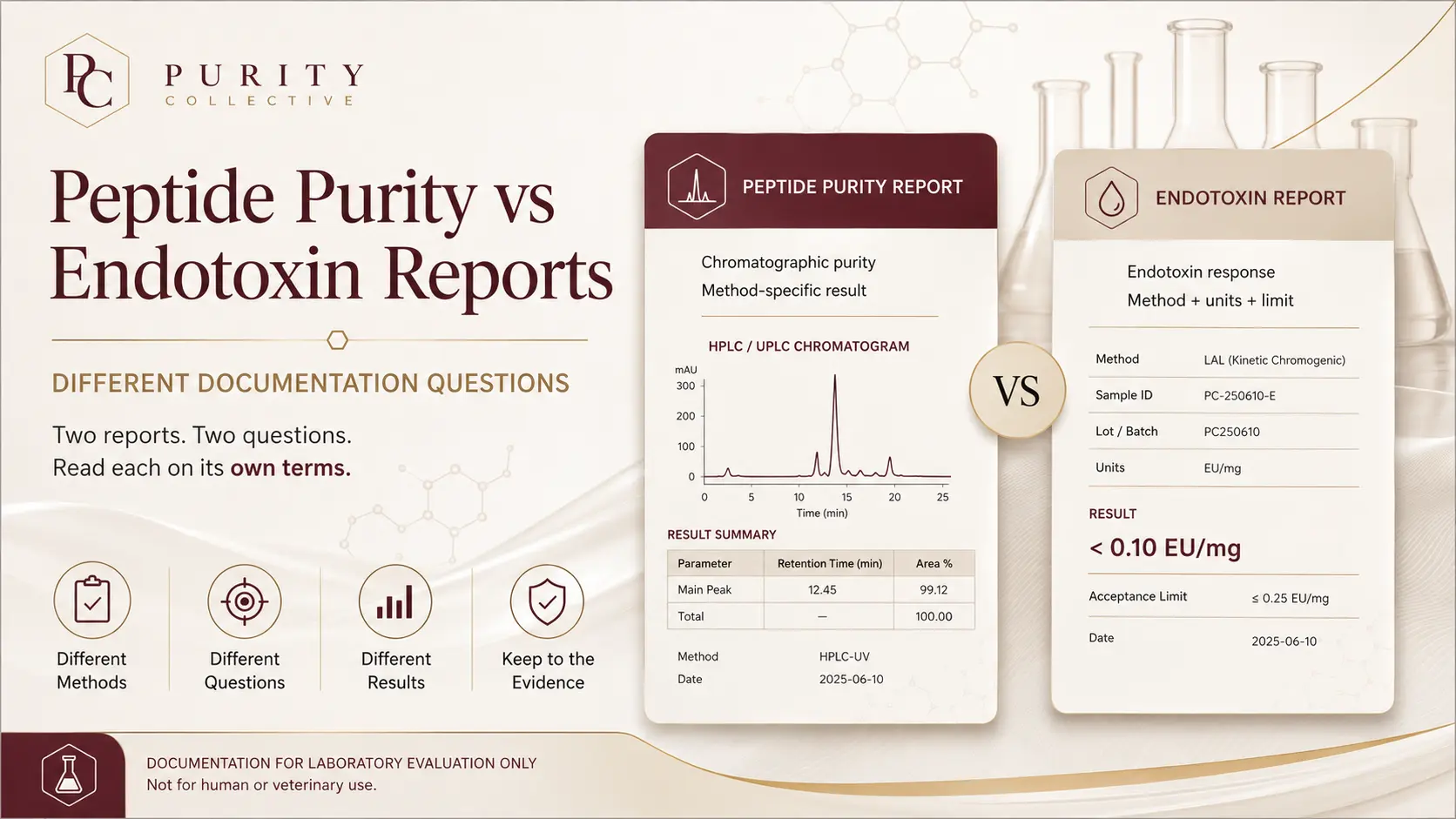
Peptide purity and endotoxin reports answer different documentation questions. A chromatographic purity result describes the profile measured by a stated analytical method. An endotoxin report addresses a separate contamination attribute, using its own method, units, sample relationship, and acceptance criterion.
Neither record can stand in for the other. A high chromatographic percentage does not establish an endotoxin result. An endotoxin result does not establish chromatographic purity, molecular identity, content, fill quantity, sterility, stability, or suitability for any particular use.
The practical rule is simple: keep the result attached to its method, batch or sample identifier, units, date, and stated limit.
Documentation boundary: This guide explains how to read analytical records for laboratory evaluation. It does not establish suitability for human or veterinary use and does not provide dosing, administration, or clinical guidance.
Quick comparison: two reports, two questions
| Documentation question | Chromatographic purity record | Endotoxin record |
|---|---|---|
| What does it usually examine? | The relative chromatographic profile of a submitted sample under a stated separation and detection method. | The reported endotoxin response of a submitted sample under the stated endotoxin procedure. |
| What should be visible? | Compound/sample identity, batch connection, method, chromatogram or data table, reported result, date, and any acceptance criterion. | Sample or batch connection, method, units, reported result, date, and any acceptance criterion. |
| What does the number not establish alone? | Endotoxin status, complete identity, net peptide content, fill quantity, sterility, or suitability. | Chromatographic purity, molecular identity, net peptide content, fill quantity, sterility, or suitability. |
| What makes the record usable? | The result can be connected to the exact material and interpreted against the method and any documented specification. | The result can be connected to the exact material and interpreted against the method, units, and any documented specification. |
What a chromatographic purity report can show
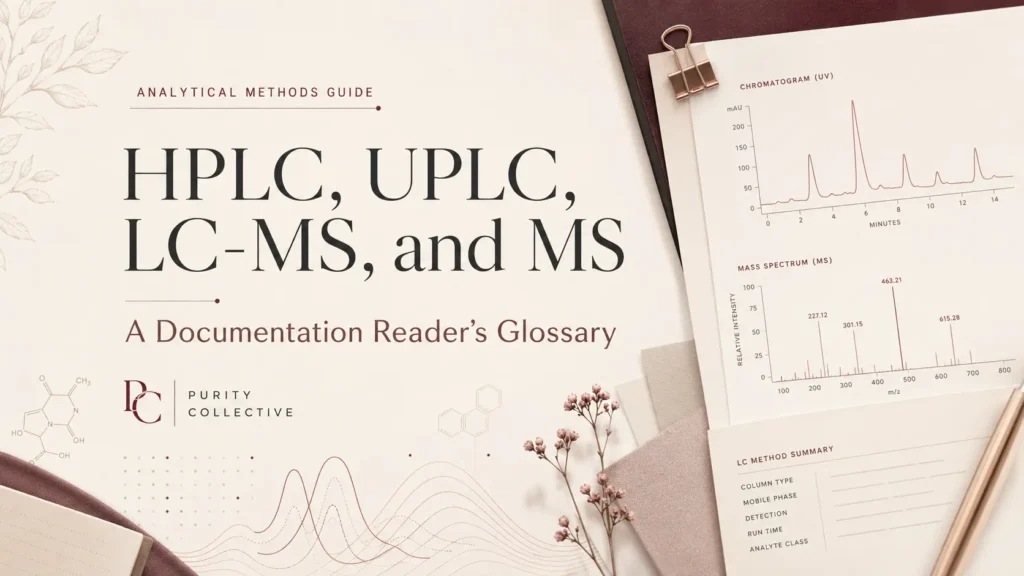
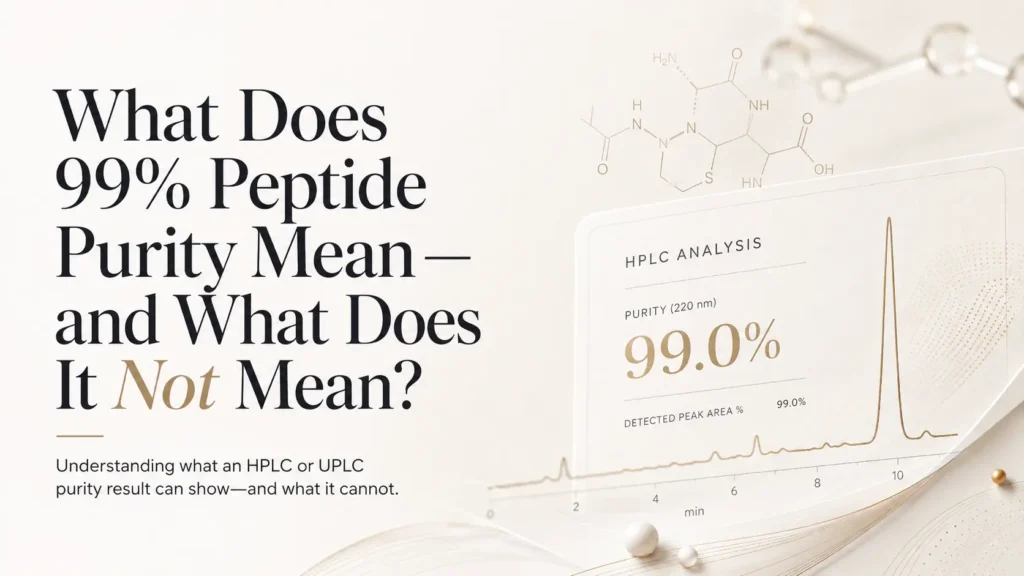
High-performance liquid chromatography (HPLC) and ultra-performance liquid chromatography (UPLC) separate detectable sample components under defined conditions. A report may show a chromatogram, retention time, integration table, and a main-peak area percentage. That percentage is a result of the stated method and detector response; it should be described as such rather than expanded into a general quality verdict.
For example, a report that identifies a main peak as 99% of integrated area can support a method-specific statement about that chromatographic result. It does not, by itself, show the material’s endotoxin status. It also should not be silently converted into net peptide content, labeled quantity, sterility, or a conclusion about a different lot.
FDA’s analytical-procedure guidance treats analytical methods as fit-for-purpose procedures. The result therefore needs its method context: the assay is not a free-standing number that carries the same meaning in every document.1 For a fuller explanation of chromatographic and mass evidence, see HPLC vs Mass Spectrometry for Peptides.
What an endotoxin report can show
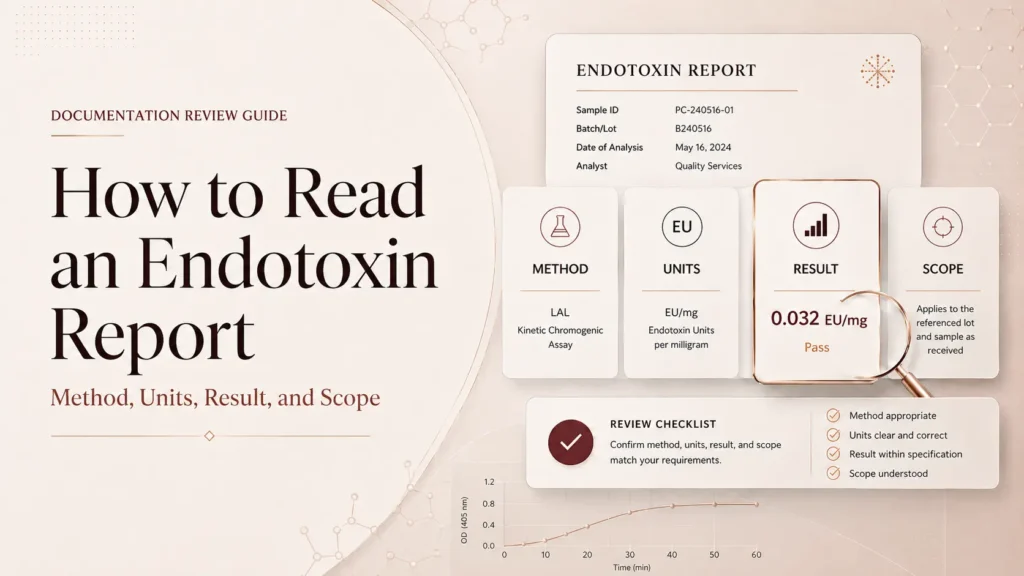
An endotoxin report concerns a different analytical target. The report should state the sample or material identifier, the method, the units, the result, the date, and—where one has been set—the acceptance criterion. These details matter because a numerical result without units, method context, or a visible limit does not tell a reviewer how the issuer intended it to be interpreted.
Do not turn an endotoxin number into a pass statement unless the source itself supplies an applicable acceptance criterion and the product or batch relationship is clear. Likewise, do not treat an endotoxin record as evidence that an unrelated chromatographic, identity, or quantity claim has been verified.
FDA distinguishes endotoxin testing from broader pyrogen testing and emphasizes that a method must be appropriate to the question being evaluated.2 That distinction is useful when reading a catalog document: the method name and the exact reported scope matter more than a testing badge or an isolated headline number.
Why the two results should never be merged
The most common documentation error is scope transfer: using one report to make a claim that belongs to another method, another batch, or another attribute.
- A chromatographic result is not an endotoxin result.
- An endotoxin result is not chromatographic purity.
- A result for one submitted sample is not automatically evidence for every catalog quantity, format, or future batch.
- A test record is not a substitute for a laboratory’s own acceptance criteria, supplier qualification, storage controls, or fit-for-purpose evaluation.
Keeping these statements separate is not a technicality. It makes it possible to see what is actually documented, what remains unknown, and what needs clarification before a conclusion is drawn.
A record-by-record review workflow
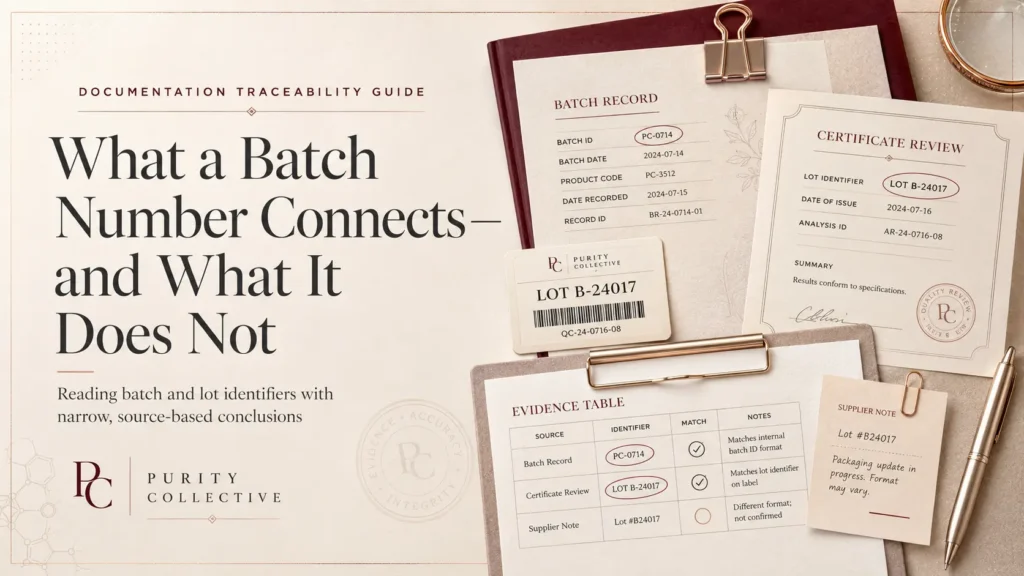
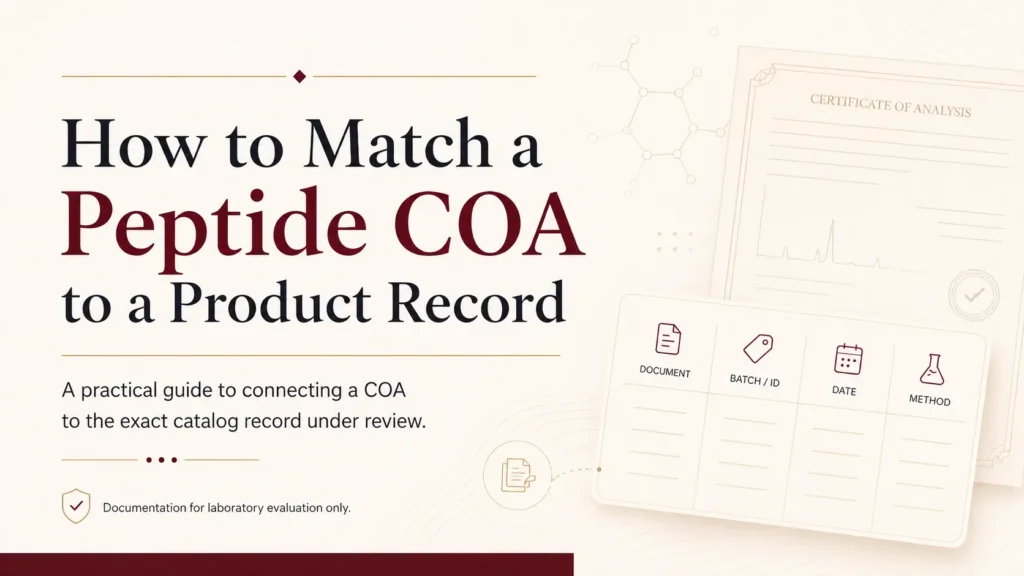
- Start with the catalog record. Note the exact product name, quantity, format, and any displayed batch or lot identifier.
- Open the chromatographic document. Confirm the compound or sample identifier, method, result, date, and whether the document prints a criterion.
- Open the endotoxin document separately. Confirm the material connection, method, units, result, date, and any criterion.
- Check the relationship. Do not assume two PDFs belong to the same batch merely because the compound name is similar.
- Write down unresolved gaps. Missing units, a vague sample name, unclear lot mapping, or an unstated acceptance criterion should remain a documented limitation.
- Keep conclusions narrow. Summarize only what each source directly supports.
The companion guide, How to Read a Peptide COA, provides the broader workflow for identity, method, result, date, specification, and document scope.
Common record-review red flags
- A purity percentage with no stated analytical method or chromatogram.
- An endotoxin number with no units, method, sample mapping, or criterion.
- One report reused to support a different quantity, format, or named blend without an explicit connection.
- A document that identifies only a compound name but no batch, lot, sample code, or other traceable material reference.
- A report date that cannot be reconciled with the associated product record.
- Marketing language that says a material “passed” when the linked report does not print the relevant acceptance limit.
A red flag does not prove an unfavorable outcome. It means the available documentation does not yet support a clean conclusion and should be clarified rather than filled in by assumption.
Questions readers often ask
Does a high purity percentage prove an endotoxin result?
No. Chromatographic purity and endotoxin testing address different analytical attributes. Review the endotoxin document itself for its method, units, material mapping, result, and stated criterion.
Can an endotoxin report prove the product quantity?
No. An endotoxin record does not establish the labeled quantity or net peptide content. Those are separate documentation questions.
Can a result from one batch be used for another batch?
Not without an explicit source connection. Each batch or sample should be reviewed against its own product record and supporting documents.
What if an acceptance criterion is not printed?
Record the numerical result exactly as shown, but do not translate it into a pass or fail statement. A reviewer needs the applicable criterion before making that determination.
Do these documents establish suitability for human use?
No. Analytical documents support only the limited, method-specific statements they contain. They do not establish suitability for human or veterinary use.
Sources
- U.S. Food and Drug Administration, Q14 Analytical Procedure Development, final guidance, March 2024.
- U.S. Food and Drug Administration, FDA Clarifies Current Thinking on Pyrogen and Endotoxins Testing, March 2026.