
For laboratory research only. Not for human or animal use. This article gives no dosing, administration or therapeutic advice.
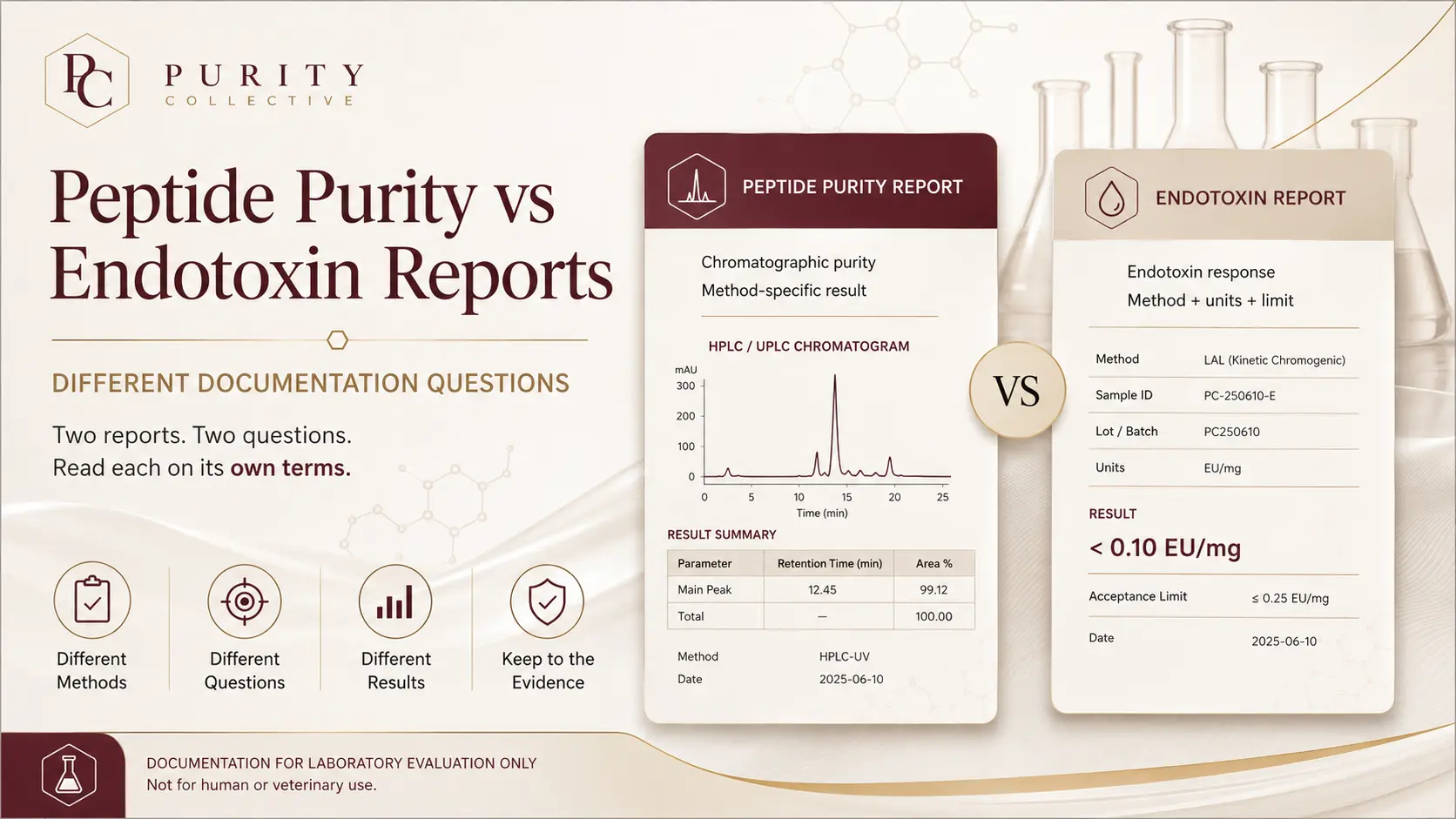
Short answer: a purity report and an endotoxin report measure two unrelated things. Purity (by HPLC or UPLC) describes how much of the detected peptide material is the intended peptide rather than related impurities. Endotoxin (by LAL or recombinant factor C) measures a bacterial contaminant, lipopolysaccharide, at trace levels the purity method is not built to see. A 99% purity result says nothing about endotoxin, and a low endotoxin result says nothing about purity, identity, quantity or sterility. Each needs its own document, its own units and its own limit.
| Purity report | Endotoxin report | |
|---|---|---|
| What it measures | The main peptide’s share of UV-detected peaks | Lipopolysaccharide activity from Gram-negative bacteria |
| Typical method | Reversed-phase HPLC or UPLC, often with MS | LAL (gel-clot, turbidimetric, chromogenic) or rFC |
| Units | Area-% (plus mg for quantity) | Endotoxin units: EU/mL or EU/mg |
| What it cannot tell you | Endotoxin, sterility, net peptide content | Purity, identity, quantity, sterility |
What endotoxin is
Endotoxin is lipopolysaccharide (LPS), a structural part of the outer membrane of Gram-negative bacteria. Each LPS molecule has three regions: a variable O-antigen chain, a core oligosaccharide, and lipid A, the hydrophobic anchor[1]. Lipid A carries the biological activity; its primary structure and conformation determine how strongly a given LPS acts on mammalian cells[2]. Cells sense it through the TLR4-MD-2 receptor complex, where five of lipid A’s six fatty-acid chains sit inside a hydrophobic pocket of MD-2 and bridge two receptor units[3].
That sensitivity is why endotoxin matters even for work that never leaves a culture dish. Bacteria release LPS as they divide, shed membrane vesicles and die[4], and it is potent at very low concentrations: in one study, primary human monocytes produced pro-inflammatory cytokines in response to LPS at very low levels[5]. In a cell assay, an endotoxin-contaminated reagent can produce an inflammatory signal that looks like an effect of the compound being studied. Endotoxin is not a product of the peptide chemistry itself; it is a contaminant that can arrive with water, reagents, equipment and handling, which is why it is controlled and tested separately.
What a purity report shows, and why it cannot see endotoxin
A chromatographic purity report separates the sample on a column and reads UV absorbance as components elute. The area-% result is the main peak’s share of the peaks the method detected. It is designed to resolve peptide-related impurities such as deletion sequences and oxidized variants, which differ from the parent peptide in hydrophobicity. Endotoxin is a different molecule class present at trace amounts, and endotoxin assays detect LPS in picogram quantities[6]; a purity chromatogram is not built for that job. Our guide to HPLC vs mass spectrometry covers what the chromatogram and mass panel can and cannot establish, including how peak areas are integrated.
How endotoxin is measured: LAL and rFC
The classic test uses a lysate of horseshoe crab blood cells (Limulus amebocyte lysate, LAL). Those cells hold a chain of serine-protease zymogens: endotoxin activates factor C, which activates factor B, which activates the proclotting enzyme, which converts coagulogen into a gel[7]. LAL has been used for decades in quality control of injectable drugs and devices, and factor C is the primer of the whole cascade[8]. A second pathway in the same lysate, through factor G, responds to (1,3)-β-D-glucan rather than endotoxin, which is one known source of false positives[7][9].
LAL comes in three formats. Gel-clot gives a yes-or-no answer at a set sensitivity. Turbidimetric and chromogenic tests read the reaction kinetically or at an endpoint and give a number against a standard curve. The alternative is recombinant factor C (rFC): the first enzyme of the cascade, produced recombinantly, paired with a fluorescent substrate. Because the glucan pathway is absent, rFC is specific to endotoxin, and it does not need horseshoe crab blood[10][9].
The two are close but not identical. Six years of proficiency-test data from 2014 to 2019 compared LAL and rFC results on the same samples[9]. A study across many LPS types found most were detected equally, but some (from K. pneumoniae, S. marcescens, B. pertussis and P. aeruginosa) reacted differently between rFC and LAL[6], and in purified pharmaceutical water an rFC assay was less prone to interference than the lab’s existing LAL method[11]. FDA’s own statement on pyrogen and endotoxins testing separates endotoxin tests from broader pyrogen tests. The practical point for a reader: the method name on the report matters, and a report that names none leaves a question open.
Units: EU/mL, EU/mg and what “<” means
Endotoxin results are reported in endotoxin units (EU), a measure of activity calibrated against a reference standard endotoxin, not a mass of LPS. The denominator is where reports differ:
- EU/mL describes the solution the lab actually tested. Its meaning depends on how much material was dissolved in how much liquid. The same powder can give different EU/mL values at different concentrations.
- EU/mg ties the result to the material itself and is easier to compare between lots and sellers. Converting EU/mL to EU/mg needs the sample concentration the lab used.
- “<0.05 EU/mL” means the result was below the lowest level the test reported under those conditions. It is not zero, and it is not a statement that a limit was met unless a limit is printed.
If a report gives EU/mL and does not state the sample concentration, that is a fair question to ask the seller.
Masking and low endotoxin recovery
A low result is only as good as the test’s ability to see endotoxin in that sample. Low endotoxin recovery (LER) describes cases where an LAL assay fails to recover endotoxin that is present, often because chelators or detergents in a formulation change the physical state of LPS[12][4]. Masked endotoxin can be invisible to factor C based assays and still activate a TLR4 reporter assay and primary human monocytes[5]. LER has been described mainly in formulated biologics with buffers and excipients rather than in plain lyophilized peptides, but it shows why a method must be suitable for the specific material it tests.
Endotoxin on Purity Collective reports
Our Horizon Analytical reports issue endotoxin as a separate document with its own lot suffix (-E), beside the purity report (-P). Lots with a posted endotoxin document include:
| Listing | Endotoxin document | Result |
|---|---|---|
| KLOW 80mg (and the KLOW pen, same lot) | PCCL-7964352-E | <0.05 EU/mL |
| Tesamorelin 10mg (and pen) | PCCL-4867057-E | <0.05 EU/mL |
| CJC-1295 + Ipamorelin 10mg | PCCL-3437208-E | <0.05 EU/mL |
| Retatrutide 10mg (and pen) | PCCL-5859103-E | <0.05 EU/mL |
Read these honestly. The Tesamorelin 10mg endotoxin document names no test method and prints no limit, so the result is a reported value: below 0.05 EU/mL in the lab’s test, for that lot. It is not a sterility result. Our ILS Laboratories reports (for example Tesamorelin 20mg, CJC-1295 + Ipamorelin 20mg and SS-31 50mg) cover purity, identity, net peptide content and a fentanyl screen, with no endotoxin line, and the NAD+ nasal-spray report has no endotoxin result either. 21 of our 70 listings have no posted report of any kind yet. The COA library lists everything that is posted.
Why the two results should never be merged
The common error is scope transfer: letting one report answer a question that belongs to another method, lot or attribute.
- A purity result is not an endotoxin result, and the reverse.
- An endotoxin result for one lot says nothing about another lot, strength or format.
- Neither is a sterility test. Sterility asks whether living microorganisms are present, which is a separate test that research-peptide reports, including ours, do not include.
- Neither replaces your own lab’s acceptance criteria. FDA’s guidance on analytical procedure development treats every method as fit for a defined purpose; a result means what its method was set up to measure.
A six-step review
- Note the exact listing: compound, strength, format and lot.
- Open the purity report. Check lot, identity, method, result and any specification.
- Open the endotoxin report separately. Check lot, method, units, result and any limit.
- Confirm both documents carry the same lot. Similar names are not enough.
- Convert units only if the sample concentration is stated.
- Write down what is missing: no method name, no limit, no concentration, no endotoxin test at all.
Our field-by-field peptide COA guide covers the rest of the certificate, including how to read a result against a specification. If you are comparing documentation across sellers before you buy research peptides online in the USA, run these six steps on every listing.
Red flags worth a question
- “Endotoxin tested” on a listing with no endotoxin document linked.
- An endotoxin number with no units, no method or no lot.
- “Passed” with no limit printed on the report.
- One endotoxin report used for several strengths or formats with no stated lot connection.
- A purity percentage presented as if it covered contamination.
A red flag does not prove a problem. It means the documents do not yet support a clean conclusion.
Frequently asked questions
Does a high purity result mean low endotoxin?
No. HPLC or UPLC purity describes peptide-related impurities under one separation method. Endotoxin is a bacterial contaminant measured by a separate LAL or rFC test, at trace levels a purity chromatogram is not designed to detect.
What does <0.05 EU/mL mean on an endotoxin report?
The result was below the lowest level the test reported, in the solution the lab prepared. It is not zero, and it is only a pass if the report prints a limit. Converting it to EU per mg needs the sample concentration.
Is an endotoxin-tested peptide sterile?
No. Endotoxin tests measure bacterial lipopolysaccharide activity. Sterility is whether living microorganisms are present, which is a different test that research-peptide reports usually do not include.
What is the difference between LAL and rFC endotoxin tests?
LAL uses a horseshoe crab blood-cell lysate and its clotting cascade. rFC uses only the first enzyme of that cascade, made recombinantly, so it is specific to endotoxin and does not respond to glucans. Results are close but can differ for some LPS types.
Do all Purity Collective reports include an endotoxin result?
No. Several Horizon Analytical lots have a separate endotoxin document, all reading below 0.05 EU/mL. Our ILS Laboratories reports have no endotoxin line, and some listings have no posted report yet.
References
- Raetz CR, Whitfield C (2002). Lipopolysaccharide endotoxins. Annu Rev Biochem. PMID: 12045108. doi: 10.1146/annurev.biochem.71.110601.135414.
- Rietschel ET, Kirikae T, Schade FU et al. (1994). Bacterial endotoxin: molecular relationships of structure to activity and function. FASEB J. PMID: 8119492. doi: 10.1096/fasebj.8.2.8119492.
- Park BS, Song DH, Kim HM et al. (2009). The structural basis of lipopolysaccharide recognition by the TLR4-MD-2 complex. Nature. PMID: 19252480. doi: 10.1038/nature07830.
- Gorman A, Golovanov AP (2022). Lipopolysaccharide Structure and the Phenomenon of Low Endotoxin Recovery. Eur J Pharm Biopharm. PMID: 36272656. doi: 10.1016/j.ejpb.2022.10.006.
- Schwarz H, Gornicec J, Neuper T et al. (2017). Biological Activity of Masked Endotoxin. Sci Rep. PMID: 28317862. doi: 10.1038/srep44750.
- Abate W, Sattar AA, Liu J et al. (2017). Evaluation of recombinant factor C assay for the detection of divergent lipopolysaccharide structural species and comparison with Limulus amebocyte lysate-based assays and a human monocyte activity assay. J Med Microbiol. PMID: 28693666. doi: 10.1099/jmm.0.000510.
- Iwanaga S (2007). Biochemical principle of Limulus test for detecting bacterial endotoxins. Proc Jpn Acad Ser B Phys Biol Sci. PMID: 24019589. doi: 10.2183/pjab.83.110.
- Ding JL, Ho B (2010). Endotoxin detection–from limulus amebocyte lysate to recombinant factor C. Subcell Biochem. PMID: 20593268. doi: 10.1007/978-90-481-9078-2_9.
- Piehler M, Roeder R, Blessing S et al. (2020). Comparison of LAL and rFC Assays-Participation in a Proficiency Test Program between 2014 and 2019. Microorganisms. PMID: 32188126. doi: 10.3390/microorganisms8030418.
- Ding JL, Ho B (2001). A new era in pyrogen testing. Trends Biotechnol. PMID: 11451451. doi: 10.1016/s0167-7799(01)01694-8.
- Marius M, Vacher F, Bonnevay T (2020). Comparison of bacterial endotoxin testing methods in purified pharmaceutical water matrices. Biologicals. PMID: 32753293. doi: 10.1016/j.biologicals.2020.07.001.
- Cao Y, Zhang Y, Qiu F (2021). Low endotoxin recovery and its impact on endotoxin detection. Biopolymers. PMID: 34407207. doi: 10.1002/bip.23470.
Regulatory sources: U.S. FDA, FDA clarifies current thinking on pyrogen and endotoxins testing; U.S. FDA, Q14 Analytical Procedure Development.