
For laboratory research only. Not for human or animal use. This article gives no dosing, administration or therapeutic advice.
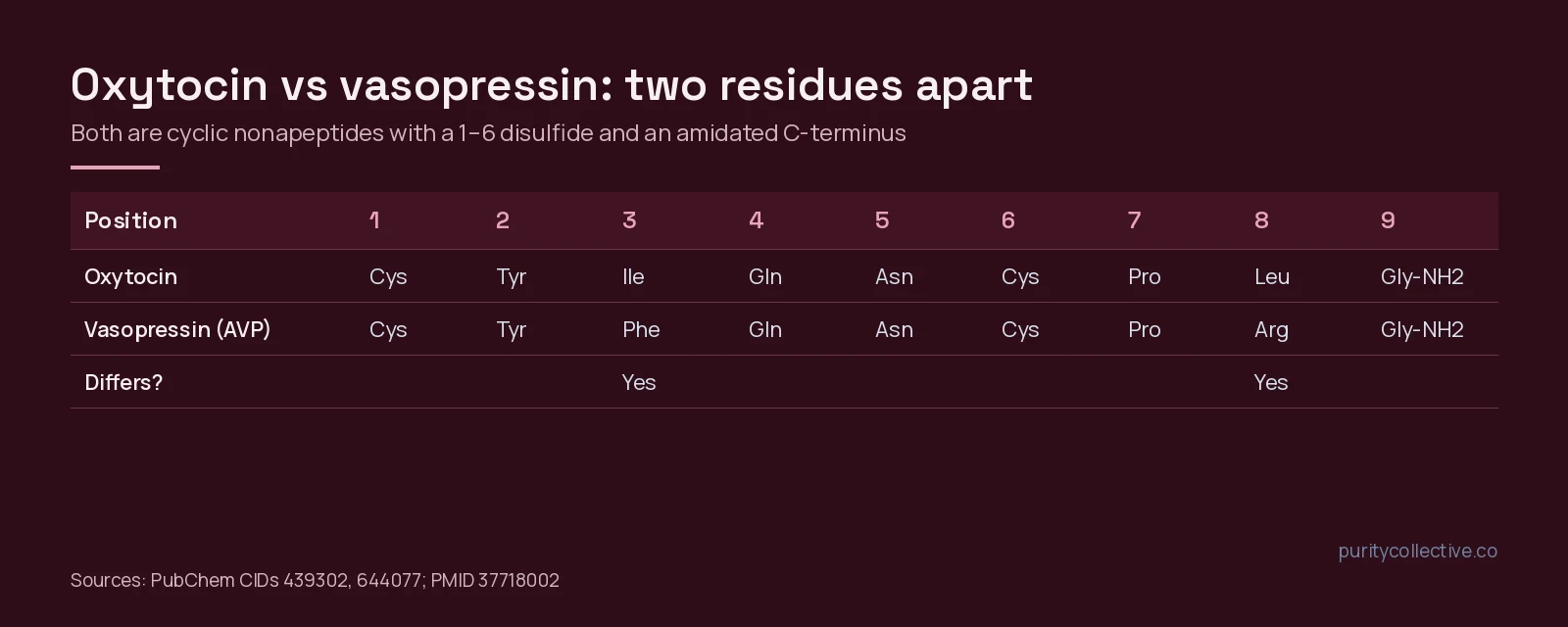
Short answer: oxytocin and arginine vasopressin (AVP) are sister hormones. Both are cyclic, C-terminally amidated nonapeptides, and they differ at only two positions, 3 and 8 [1]. Both are made in the hypothalamus and released from the posterior pituitary [2]. What separates them is receptor use: vasopressin acts mainly on the V1a, V1b and V2 receptors, and oxytocin on the oxytocin receptor (OTR) [3][4]. Because the peptides are so similar, they cross-react, and some effects of oxytocin in rodents run through the V1a receptor rather than its own [5]. Vasopressin’s classic job is water balance; oxytocin’s is reproduction, birth and lactation, with both reaching into social behavior in animal models [2][6].
Oxytocin vs vasopressin at a glance
| Feature | Oxytocin | Arginine vasopressin |
|---|---|---|
| Sequence | Cys-Tyr-Ile-Gln-Asn-Cys-Pro-Leu-Gly-NH2, 1–6 disulfide | Cys-Tyr-Phe-Gln-Asn-Cys-Pro-Arg-Gly-NH2, 1–6 disulfide |
| Formula / MW | C43H66N12O12S2 / 1007.2 g/mol (CID 439302) | C46H65N15O12S2 / 1084.2 g/mol (CID 644077) |
| Main source | Magnocellular neurons of the paraventricular and supraoptic nuclei; also peripheral tissues [7] | Hypothalamus, stored in and released from the neurohypophysis [2] |
| Receptors | OTR, coupled mainly to Gq and phospholipase C-β [7] | V1a and V1b (Gq/11), V2 (cAMP in kidney collecting duct) [3] |
| Classic physiology | Myometrial contraction, milk ejection, renal natriuresis, affiliative and maternal behaviors [3] | Water reabsorption via aquaporin-2, vasoconstriction, pituitary ACTH release [3][8] |
| Ancestral form | Both trace back to vasotocin; oxytocin is estimated to have evolved from it about 650 million years ago [9][10] | |
Sequence and formula come from the PubChem records linked above. The single basic arginine at position 8 explains the larger nitrogen count and the higher mass of vasopressin, which is a quick sanity check when reading a mass spectrometry result for either peptide.
One family, four receptors
By the mid-1990s all four mammalian receptors had been cloned, and they form their own subfamily of G protein-coupled receptors [3]. A 1996 review lays out the split. Renal V2 receptors drive water reabsorption through cAMP in collecting duct cells. V1a receptors, coupled to Gq/11, handle most other vasopressin actions, including vessel constriction, liver glycogenolysis and platelet adhesion. V1b receptors on pituitary corticotrophs mediate ACTH release. The oxytocin receptor, also Gq/11-coupled, mediates myometrial contraction, milk ejection and specific affiliative and maternal behaviors [3].
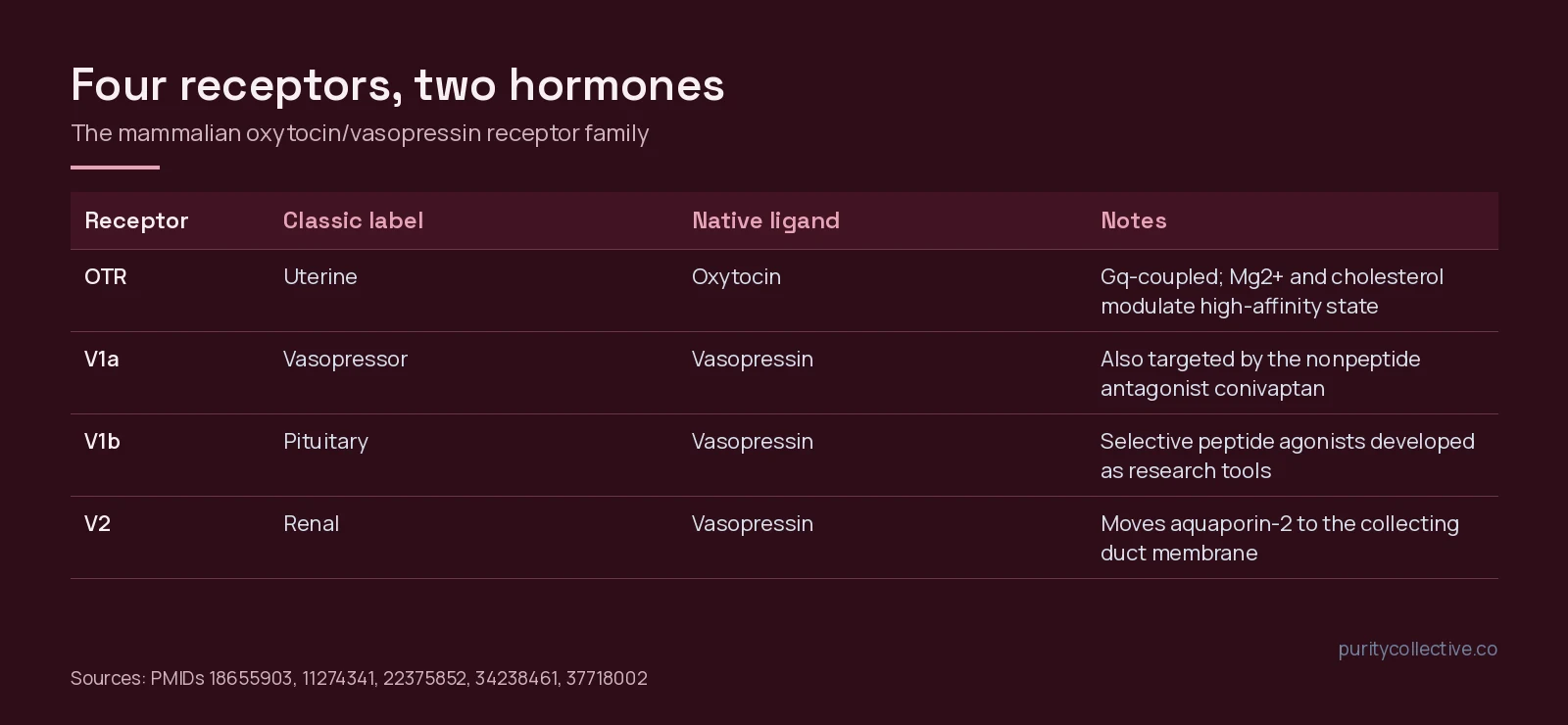
Structural biology caught up only recently. The chemical structures of both hormones were solved in the early 1950s, but it took about 70 more years to determine three-dimensional structures of the OTR and V2R bound to their natural agonists and to G proteins and β-arrestins [1]. A 2022 cryo-EM structure of human OTR bound to oxytocin showed activation through a magnesium coordination complex between peptide and receptor plus disruption of transmembrane helix 7, and found that a single cation-coordinating residue decides whether a receptor in this family is cation-dependent [11]. That fits an older observation that the high-affinity OTR state needs both Mg2+ and cholesterol [7].
Selective tools matter here more than in most peptide families. A long-running medicinal chemistry program built selective peptide agonists, antagonists and labelled ligands for each of the four receptors precisely because the native hormones are not selective enough to assign an effect to one receptor [4][12].
Vasopressin: water balance first
Vasopressin is the key hormone for water conservation. In the kidney collecting duct it binds the V2 receptor and redistributes aquaporin-2 water channels to the luminal membrane, raising water permeability [8]. Loss of that response is the basis of congenital nephrogenic diabetes insipidus, and non-osmotic vasopressin release underlies the syndrome of inappropriate antidiuretic hormone secretion, which is why the V2 pathway is so heavily studied [8].
Vasopressin is also the reason this receptor family has approved small-molecule drugs. As of a 2012 review, the only Food and Drug Administration-approved nonpeptide ligands in the family were conivaptan, a V2/V1a antagonist, and tolvaptan, a V2 antagonist; several large companies had abandoned other nonpeptide programs [12].
Oxytocin: reproduction, then behavior
Oxytocin is expressed mainly in magnocellular neurons of the paraventricular and supraoptic nuclei and released into the circulation in response to stimuli such as suckling and parturition. It is also released inside those nuclei, projects widely through the brain, and is made in peripheral tissues including uterus, placenta, corpus luteum, testis and heart [7]. In non-human mammals, mothering depends on hormones, with central roles for oxytocin and prolactin [9].
The behavioral research grew out of voles. Prairie voles are socially monogamous, and comparative work across vole species linked species-specific brain patterns of oxytocin and vasopressin receptor expression to monogamous versus non-monogamous social structure, with changes in receptor gene regulation proposed as the mechanism [13]. A 2006 review extends this to social recognition, communication, parental care and territorial aggression, while stressing that effects are species-specific and depend on where receptors sit in each species’ brain [6]. For context on the format Purity lists, our overview of nasal spray research peptides explains how sprays differ from vials as research materials.
Cross-talk: when oxytocin uses a vasopressin receptor
Two residues apart is close enough for overlap. In a rat study of methamphetamine-primed reinstatement, systemic oxytocin blocked reinstatement, and that effect was significantly reduced by a V1a antagonist but not by an OTR antagonist. Oxytocin microinjected into the nucleus accumbens core also lost its effect when V1a was blocked [5]. The authors note that oxytocin has high affinity for the V1a receptor, which has been implicated in many oxytocin-dependent social behaviors [5]. Any experiment that gives oxytocin and attributes the result to OTR without a selective antagonist leaves this possibility open.
Research models compared
| Model | Question asked | Peptide focus | Source |
|---|---|---|---|
| Prairie vs montane voles | Receptor distribution and pair bonding | Both | [13][6] |
| Rat self-administration | Which receptor carries oxytocin’s effect | Oxytocin (via V1a) | [5] |
| Kidney collecting duct | V2 signaling and aquaporin-2 trafficking | Vasopressin | [8] |
| Cryo-EM of receptor complexes | Ligand pocket, activation, G protein interfaces | Both | [1][11] |
| Comparative genomics | Origin of the receptor family from vasotocin | Both | [10][14] |
What the evidence does not show
- Vole findings are species-specific by the authors’ own account and do not transfer automatically to other species [6].
- Human intranasal oxytocin studies have been judged generally underpowered, with a high probability that most published intranasal findings do not represent true effects [15].
- Very little intranasally applied oxytocin appears to reach cerebrospinal fluid, while peripheral concentrations rise to supraphysiologic levels, and many published oxytocin measurements were made with discredited methods [16].
- Native oxytocin and vasopressin are not receptor-selective, so receptor attribution needs selective ligands [4][5].
For sourcing, the two-residue difference is the main identity risk. An oxytocin research product should match the oxytocin PubChem record, not vasopressin’s, on the batch report; our guide on how to read a peptide COA shows where that appears. If you buy research peptides online in the USA, ask for batch-specific HPLC and mass spectrometry data.
Frequently asked questions
How different are oxytocin and vasopressin chemically?
Very little. Both are cyclic, C-terminally amidated nonapeptides with a disulfide bridge between positions 1 and 6, and they differ only at positions 3 and 8: isoleucine and leucine in oxytocin, phenylalanine and arginine in arginine vasopressin (PubChem CIDs 439302, 644077; PMID 37718002).
How many receptors do they act on?
Four are characterized in mammals: the oxytocin receptor and the vasopressin V1a, V1b and V2 receptors. A fifth, putative V1c vasodilating receptor has been proposed (PMIDs 37718002, 18655903).
Can oxytocin act on a vasopressin receptor?
Yes, in research models. Oxytocin has high affinity for the V1a receptor, and in a rat study its effect on methamphetamine-primed reinstatement was reduced by a V1a antagonist but not by an oxytocin receptor antagonist (PMID 29353054). Receptor-selective tools are needed to tell the two systems apart.
Why do so many oxytocin behavior studies disagree?
A 2016 analysis concluded that intranasal oxytocin studies in humans are generally underpowered, and a companion review noted that very little intranasally applied oxytocin appears to reach cerebrospinal fluid while peripheral levels rise (PMIDs 26210057, 26049207).
What does Purity Collective sell in this family?
An oxytocin research product. Purity Collective does not list vasopressin. All products are for laboratory research only, not for human or animal use, and identity should be checked against the batch certificate and the PubChem record (CID 439302).
References
- Bous J, Fouillen A, Orcel H et al. (2023). Structures of the arginine-vasopressin and oxytocin receptor signaling complexes. Vitam Horm. PMID: 37718002. doi: 10.1016/bs.vh.2022.12.003.
- Iwasaki Y, Yamaguchi Y, Nishiyama M (2024). Structure and function of neurohypophysial hormones. Peptides. PMID: 39395442. doi: 10.1016/j.peptides.2024.171300.
- Zingg HH (1996). Vasopressin and oxytocin receptors. Baillieres Clin Endocrinol Metab. PMID: 8734452. doi: 10.1016/s0950-351x(96)80314-4.
- Manning M, Stoev S, Chini B et al. (2008). Peptide and non-peptide agonists and antagonists for the vasopressin and oxytocin V1a, V1b, V2 and OT receptors: research tools and potential therapeutic agents. Prog Brain Res. PMID: 18655903. doi: 10.1016/S0079-6123(08)00437-8.
- Everett NA, McGregor IS, Baracz SJ et al. (2018). The role of the vasopressin V1A receptor in oxytocin modulation of methamphetamine primed reinstatement. Neuropharmacology. PMID: 29353054. doi: 10.1016/j.neuropharm.2017.12.036.
- Hammock EA, Young LJ (2006). Oxytocin, vasopressin and pair bonding: implications for autism. Philos Trans R Soc Lond B Biol Sci. PMID: 17118932. doi: 10.1098/rstb.2006.1939.
- Gimpl G, Fahrenholz F (2001). The oxytocin receptor system: structure, function, and regulation. Physiol Rev. PMID: 11274341. doi: 10.1152/physrev.2001.81.2.629.
- Valenti G, Tamma G (2021). The vasopressin-aquaporin-2 pathway syndromes. Handb Clin Neurol. PMID: 34238461. doi: 10.1016/B978-0-12-820683-6.00018-X.
- Feldman R, Bakermans-Kranenburg MJ (2017). Oxytocin: a parenting hormone. Curr Opin Psychol. PMID: 28813252. doi: 10.1016/j.copsyc.2017.02.011.
- Mayasich SA, Clarke BL (2020). Vasotocin and the origins of the vasopressin/oxytocin receptor gene family. Vitam Horm. PMID: 32138945. doi: 10.1016/bs.vh.2019.08.018.
- Meyerowitz JG, Robertson MJ, Barros-Álvarez X et al. (2022). The oxytocin signaling complex reveals a molecular switch for cation dependence. Nat Struct Mol Biol. PMID: 35241813. doi: 10.1038/s41594-022-00728-4.
- Manning M, Misicka A, Olma A et al. (2012). Oxytocin and vasopressin agonists and antagonists as research tools and potential therapeutics. J Neuroendocrinol. PMID: 22375852. doi: 10.1111/j.1365-2826.2012.02303.x.
- Young LJ, Wang Z, Insel TR (1998). Neuroendocrine bases of monogamy. Trends Neurosci. PMID: 9498302. doi: 10.1016/s0166-2236(97)01167-3.
- Banerjee P, Joy KP, Chaube R (2017). Structural and functional diversity of nonapeptide hormones from an evolutionary perspective: A review. Gen Comp Endocrinol. PMID: 27133544. doi: 10.1016/j.ygcen.2016.04.025.
- Walum H, Waldman ID, Young LJ (2016). Statistical and Methodological Considerations for the Interpretation of Intranasal Oxytocin Studies. Biol Psychiatry. PMID: 26210057. doi: 10.1016/j.biopsych.2015.06.016.
- Leng G, Ludwig M (2016). Intranasal Oxytocin: Myths and Delusions. Biol Psychiatry. PMID: 26049207. doi: 10.1016/j.biopsych.2015.05.003.