
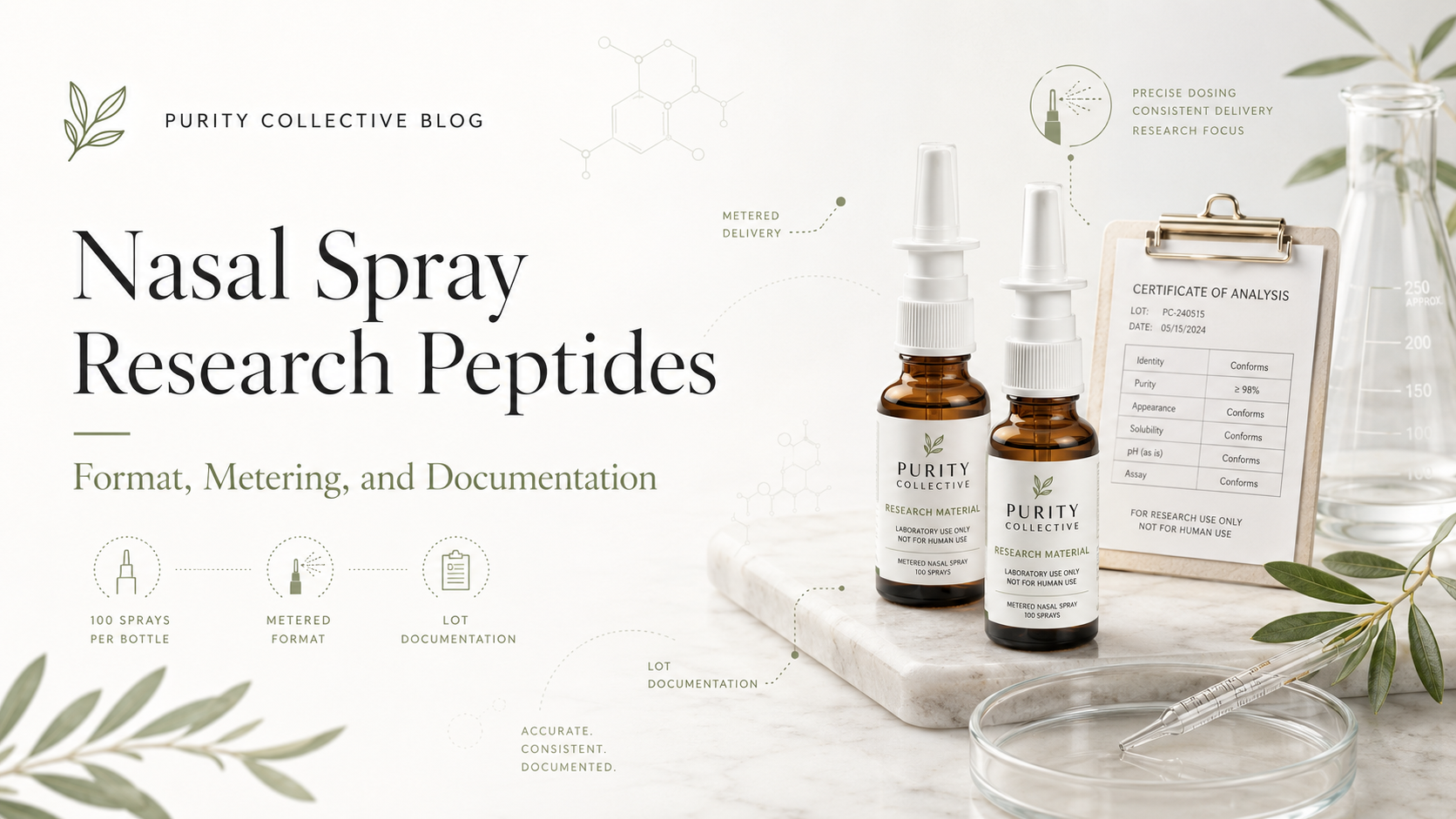
Nasal spray research peptides should be reviewed first as catalog records, not as use instructions. The phrase describes how a reference material is presented in the catalog, but it does not replace the product page, Certificate of Analysis, storage notes, SKU, quantity, availability, or laboratory purchasing review.
For a research buyer, the useful question is simple: what exactly is listed, what documentation is available, and how clearly does the record connect the item to its supporting reports? This guide explains how to read format labels responsibly while staying inside a laboratory research boundary.
Start with the product identity
Every review should begin with the product identity. Confirm the compound name, blend name, listed quantity, SKU, stock status and product category before comparing one listing with another. Similar-looking catalog entries can differ by quantity, supplied format, documentation status or intended research context.
For example, a buyer comparing several entries in the catalog should not rely on the format label alone. The safer workflow is to open the individual product page, check the exact product title, confirm the listed quantity, then review whether the page links product-specific documentation.
Read format labels as catalog descriptors
A format label is a catalog descriptor. It helps distinguish one product record from another, but it should not be read as use guidance or an outcome claim. The label can help with inventory comparison, procurement notes and documentation matching, while the product page remains the source of truth for the listed item.
When reviewing a format-labeled item, look for neutral catalog facts: total listed quantity, packaging or presentation notes, SKU, availability, storage language and links to analytical documents. If any of those items are unclear, the record should be clarified before a laboratory considers the listing procurement-ready.
Check the documentation before comparing products
Documentation quality matters more than category placement. A useful product record should make it easy to review available analytical reports and understand their scope. Some records may include a Certificate of Analysis, UPLC/MS report, endotoxin report or other supporting file. Other records may have limited or pending documentation.
When a report is available, compare the product name, lot or sample identifier, dates, method and result fields with the product page. A report can support review of the tested sample, but it does not automatically prove every future unit, every storage condition, or every possible research context.
- Identity: Does the report name or sample description match the product record?
- Quantity: Does the listed amount align with the product page?
- Method: Does the document state how the sample was evaluated?
- Date relationship: Do received, tested and issued dates make sense?
- Scope: Is the report tied to this product record, or is it only related background documentation?
For a deeper walkthrough, use the peptide COA guide and the COA library before comparing similar catalog records.
Use category context carefully
Purity Collective organizes products into broad research collections such as Radiance, Mind, Physique and Recovery + Repair. These collections are navigation tools. They help buyers find related records, but they are not substitutes for product-specific review.
Format-based subcategories may exist for user navigation, but broad category labels should not be used to infer product scope, research suitability or documentation coverage. Use the category page to discover records, then verify each record individually.
A practical review workflow
A clean review workflow keeps the page useful for research procurement while avoiding unsupported assumptions:
- Open the individual product page from the research peptide catalog.
- Record the product title, SKU, listed quantity and availability.
- Check whether the page links product-specific analytical documents.
- Compare report identifiers and dates with the product record.
- Note any missing or unclear fields before purchasing for qualified laboratory work.
This workflow keeps the focus where it belongs: product identity, documentation and procurement clarity. It also prevents a format label from becoming broader than the evidence on the page supports.
Bottom line
Nasal spray research peptide pages should be evaluated as product records with format labels, not as guidance documents. Use the label to distinguish catalog entries, then rely on the product page and available reports to confirm identity, listed quantity and documentation scope.
If you are new to the catalog, start with What Are Research Peptides?, then use the COA guide to compare documentation before reviewing individual product listings.