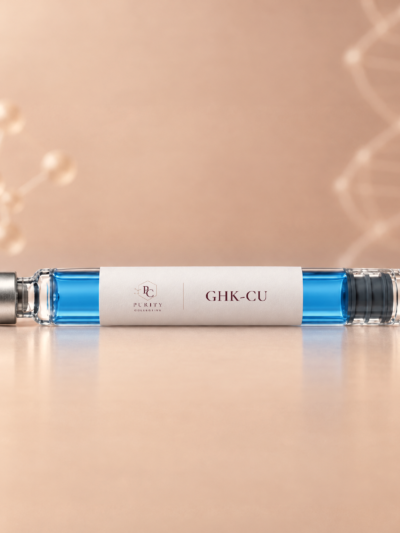

For laboratory research only. Not for human or animal use. This article gives no dosing, administration or therapeutic advice.
Short answer: KLOW and GLOW are the same three-peptide base (GHK-Cu, BPC-157 and TB-500) and KLOW adds one more tripeptide, KPV. On Purity Collective’s catalog that means KLOW 80mg lists GHK-Cu 50mg, BPC-157 10mg, TB-500 10mg and KPV 10mg, while GLOW 70mg lists the first three at the same amounts. So a KLOW vs GLOW comparison is mostly a question about one compound: what KPV has been studied for, and what it has not.
This post walks through the composition, the identity of each component, what the published cell and animal work does and does not show, and how to compare the two product records using Purity Collective’s own lot reports.
KLOW vs GLOW at a glance
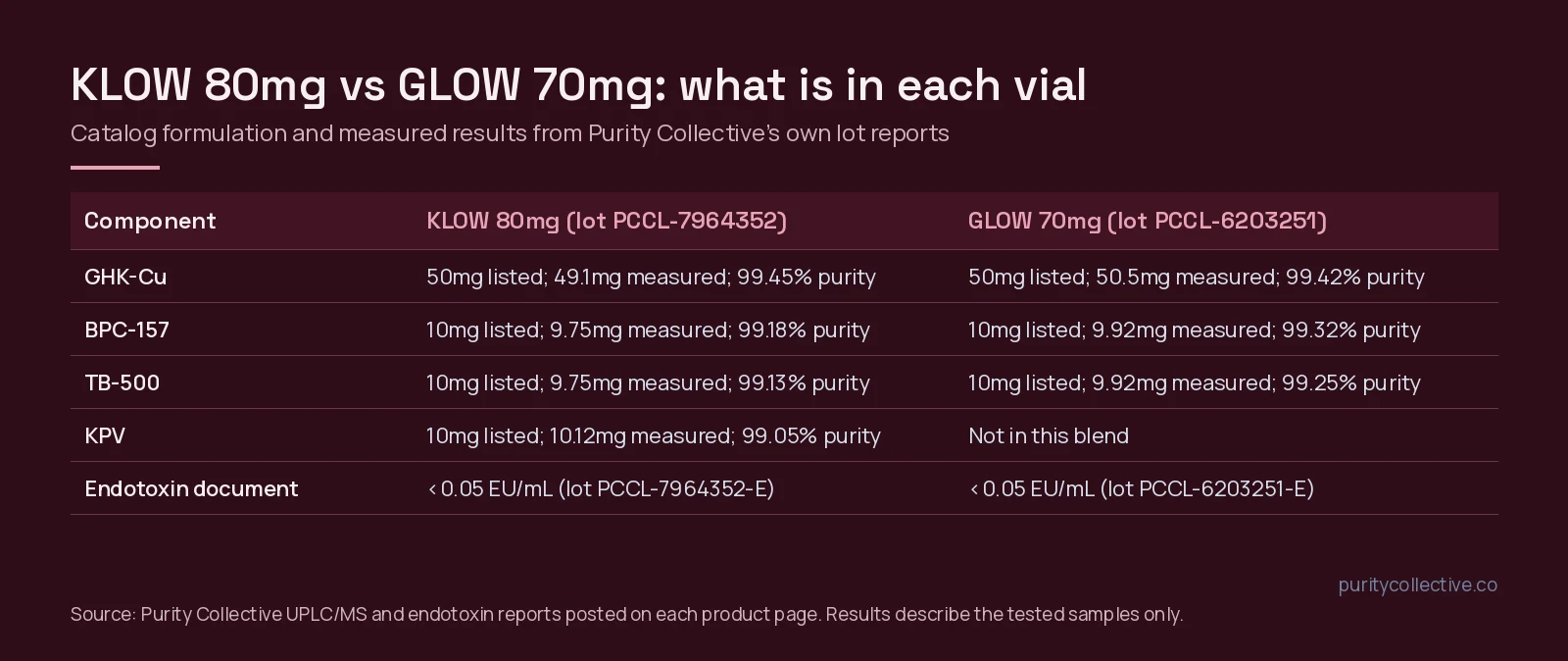
The table below uses the catalog formulation and the measured results printed on each product’s posted UPLC/MS report. Both reports test each component as a separate sample, so there is no single purity number for either blend.
| Item | KLOW 80mg | GLOW 70mg |
|---|---|---|
| GHK-Cu | 50mg listed · 49.1mg measured · 99.45% | 50mg listed · 50.5mg measured · 99.42% |
| BPC-157 | 10mg listed · 9.75mg measured · 99.18% | 10mg listed · 9.92mg measured · 99.32% |
| TB-500 | 10mg listed · 9.75mg measured · 99.13% | 10mg listed · 9.92mg measured · 99.25% |
| KPV | 10mg listed · 10.12mg measured · 99.05% | Not included |
| Label total | 80mg (four components) | 70mg (three components) |
| UPLC/MS lot | PCCL-7964352 | PCCL-6203251 |
| Endotoxin document | <0.05 EU/mL, lot PCCL-7964352-E | <0.05 EU/mL, lot PCCL-6203251-E |
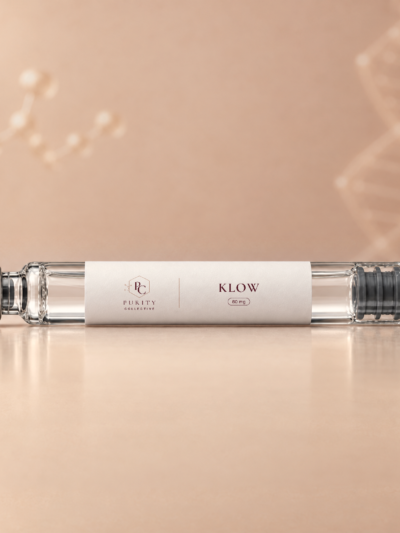
| Formats on the catalog | Vial; also a KLOW 80 mg pen listing | Vial |
The measured results are close for the three shared components in both lots. The differences between, for example, 9.75mg and 9.92mg of BPC-157 are lot-to-lot results from two separate samples, not a property of the blend design.
Identity of the four components
Identity values below come from PubChem. When you compare a lot report against them, the useful checks are the compound name, the molecular formula and the molecular weight; a PubChem CID is a pointer to a record, and different records can describe the same molecule.
| Component | What it is | Formula | MW (g/mol) | PubChem CID | In KLOW / GLOW |
|---|---|---|---|---|---|
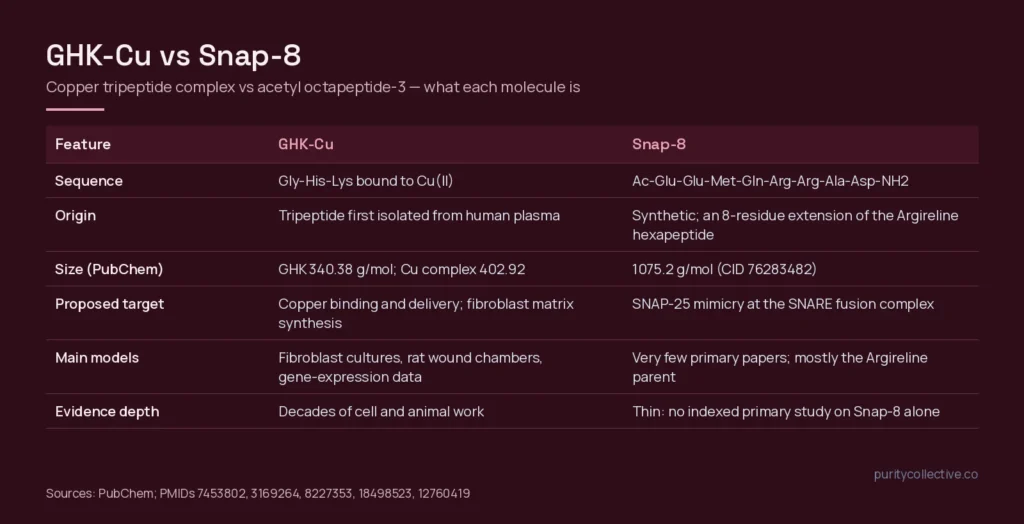
| GHK-Cu | Gly-His-Lys copper(II) complex (prezatide copper) | C14H23CuN6O4+ | 402.92 | 71587328 | Yes / Yes |
| BPC-157 | 15-residue peptide GEPPPGKPADDAGLV | C62H98N16O22 | 1419.5 | 9941957 (the lot reports cite 108101, a record with the same formula and MW) | Yes / Yes |
| TB-500 | Thymosin beta-4 material; the posted reports list the full 43-residue protein (timbetasin) | C212H350N56O78S | 4963 | 16132341 | Yes / Yes |
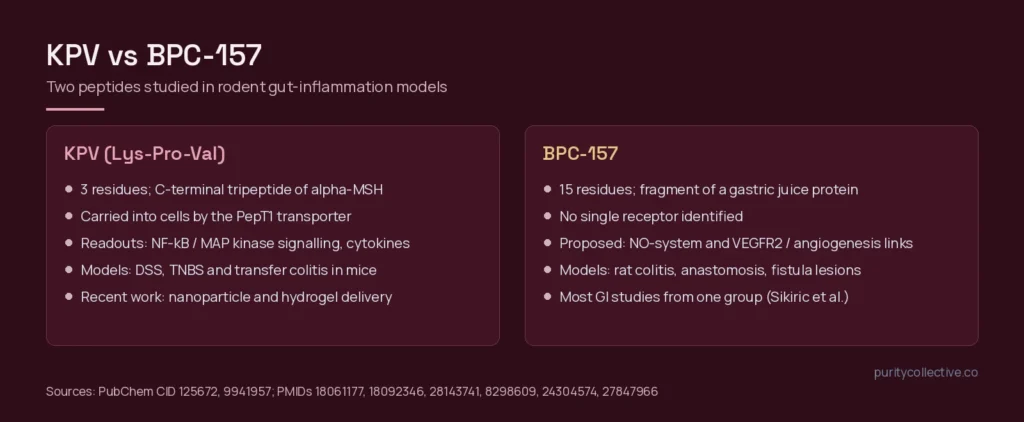
| KPV | Lys-Pro-Val, residues 11-13 of alpha-MSH | C16H30N4O4 | 342.43 | 125672 | Yes / No |
“TB-500” is not used consistently across the market. Analytical papers on products sold under that name identified the N-acetylated 17-23 fragment of thymosin beta-4 (Ac-LKKTETQ) as the key ingredient[11],[12], while Purity Collective’s GLOW and KLOW reports list the full thymosin beta-4 formula and weight. When you compare TB-500 records from any source, check which molecule the report actually names.
KPV: the only component that differs
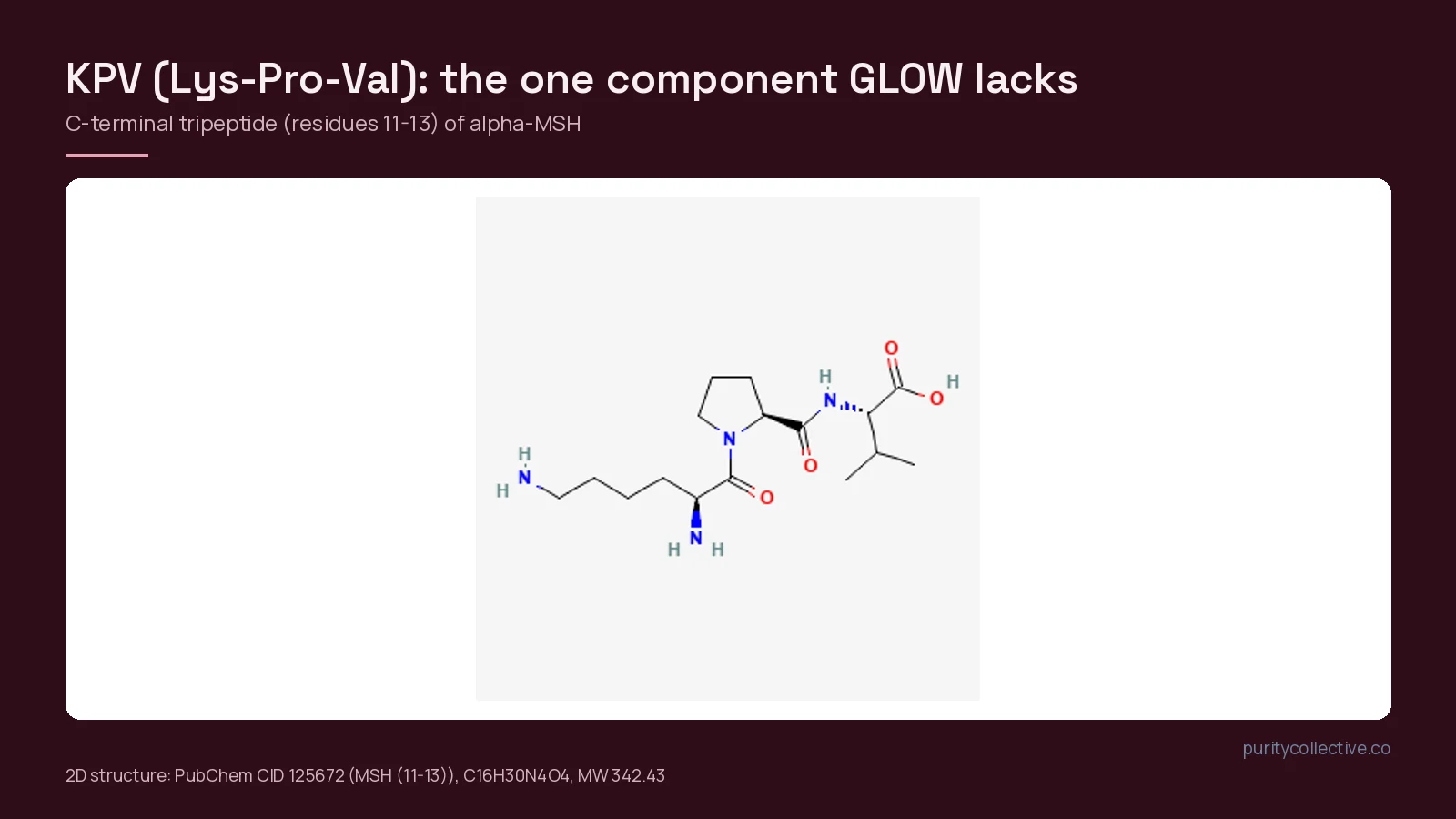
KPV is a three-residue fragment of alpha-melanocyte-stimulating hormone (alpha-MSH). Reviews of the melanocortin literature describe it as a fragment that keeps anti-inflammatory activity in experimental models without alpha-MSH’s pigmentary action, which is why it was studied on its own[3]. For the full background see our KPV explainer.
Intestinal inflammation models (cells and mice)
In human intestinal epithelial cell lines and human T cells, nanomolar KPV reduced NF-kappaB and MAP kinase signaling and lowered pro-inflammatory cytokine secretion. The authors traced its uptake to the PepT1 di/tripeptide transporter, and KPV given in drinking water reduced DSS- and TNBS-induced colitis in mice[1]. A separate group tested KPV in DSS colitis and in a T-cell transfer colitis model; treated mice regained weight faster and had fewer inflammatory infiltrates, and the effect persisted in mice with a nonfunctional melanocortin-1 receptor, suggesting at least part of the activity does not run through MC1R[2].
Antimicrobial activity in culture
Alpha-MSH and its KPV fragment inhibited Staphylococcus aureus colony formation and reduced Candida albicans viability and germ-tube formation in vitro, across a broad concentration range; in the same work they did not reduce, and appeared to enhance, pathogen killing by human neutrophils[4]. This is a culture finding and says nothing about infection in a living organism.
Limits of the KPV evidence
The KPV literature is small, concentrated in rodent colitis models and cell lines, and mostly from a limited number of groups. We found no controlled human trial of KPV, and none of the KPV studies tested it combined with GHK-Cu, BPC-157 or TB-500.
The shared base: GHK-Cu, BPC-157 and TB-500
Because both blends carry identical listed amounts of these three, nothing in this section separates KLOW from GLOW. It matters for context: most of each vial’s mass (70mg in both) is the same material.
| Component | Study | Model | Finding | Ref |
|---|---|---|---|---|
| GHK-Cu | Collagen synthesis assay | Fibroblast culture | Collagen synthesis rose from picomolar concentrations, independent of cell number | [5] |
| GHK-Cu | Wound-chamber model | Rat | Connective tissue accumulation in implanted chambers increased | [6] |
| GHK-Cu | Randomized, evaluator-blinded venous ulcer trial (86 patients) | Human | Null: a topical tripeptide-copper cream did not differ from placebo; silver sulfadiazine did better than both | [7] |
| BPC-157 | Transected Achilles tendon | Rat; tendon fibroblasts in vitro | Improved functional, biomechanical and histological healing measures | [8] |
| BPC-157 | Systematic review of orthopaedic use | Mostly preclinical; level IV-V evidence | Preclinical promise; no clinical safety data found; half-life under 30 minutes | [9] |
| Thymosin beta-4 | Full-thickness wound | Rat | Faster re-epithelialization, more collagen deposition and angiogenesis | [10] |
| BPC-157 + TB-500 | Achilles tendon repair, single and combined | Rat | Null for combining: the combination gave no additional benefit over either agent alone | [13] |
GHK-Cu. The copper tripeptide raised collagen synthesis in fibroblast cultures[5] and increased connective tissue in a rat wound-chamber model[6]. The one controlled human wound trial in our reading was negative: in venous stasis ulcers, a tripeptide-copper cream performed no better than placebo[7].
BPC-157. The pentadecapeptide improved healing of transected Achilles tendon in rats and stimulated tendon fibroblast outgrowth in culture[8]. A 2025 systematic review found the orthopaedic evidence was almost entirely preclinical (level IV and V), found no clinical safety data, and noted risks from unregulated manufacturing[9].
TB-500 / thymosin beta-4. Thymosin beta-4 accelerated re-epithelialization and increased angiogenesis in a rat full-thickness wound model and stimulated keratinocyte migration in vitro[10]. As noted above, products sold as TB-500 have been shown to contain a short acetylated fragment rather than the full protein[11],[12], so findings on full thymosin beta-4 should not be assumed for the fragment or vice versa.
Combining components. The closest thing to a blend study is a 2026 rat Achilles tendon experiment. BPC-157 and TB-500 were each associated with better histology in early repair, TB-500 alone showed a biomechanical advantage at four weeks, and the combination conferred no additional benefit over either agent alone[13]. That is one exploratory animal study, but it is a useful caution against assuming that more components means more effect.
What the evidence does not show
- No study of either blend. We found no published study of KLOW, GLOW, or any mixture of GHK-Cu, BPC-157, TB-500 and KPV. Any statement about what “the blend” does is extrapolation from separate components.
- No evidence that adding KPV changes anything in combination. KPV’s data are from colitis models and cell culture[1],[2]; none tested it alongside the other three.
- No evidence of additive effects. The only multi-component experiment found no added benefit from combining BPC-157 and TB-500[13].
- Little human data. The controlled human GHK-Cu wound trial was null[7], and the BPC-157 review found no clinical safety data[9]. None of the four is an approved drug in the US.
- No stability data for the mixtures. We found no published data on how these components behave together in one lyophilized vial over time.
How to compare the two product records
A blend’s documentation is only comparable component by component. When you put the KLOW and GLOW records side by side:
- Match the lot. KLOW’s UPLC/MS report is lot PCCL-7964352 and its endotoxin document is PCCL-7964352-E; GLOW’s are PCCL-6203251 and PCCL-6203251-E. The results describe those tested samples, not every vial ever made.
- Read each component panel. Each report gives a separate quantity and purity per component against a specification of at least 98%. Compare GHK-Cu with GHK-Cu, BPC-157 with BPC-157, and so on.
- Check identity fields against a public record. Confirm that the name, formula and molecular weight printed on each panel match the compound’s PubChem entry (see the identity table above). A mismatch is a documentation question to raise with the seller before you use the material.
- Read the endotoxin document separately. Both blends have one reporting below 0.05 EU/mL; neither prints an acceptance limit, so record the result as reported.
- Look up the full library. All posted reports sit in the Purity Collective COA library, and our guide on single-compound listings vs blend records covers the blend-specific pitfalls.
If your protocol does not need KPV, GLOW is the same base without it; if you are studying KPV specifically, a single-compound KPV 10mg vial keeps it separate from the other three. The GLOW blend explainer covers the three-component base in more depth.
Both blends sit in the same US catalog, so a researcher who wants to buy research peptides online in the USA can compare the two lot reports side by side before choosing; that hub lists every category and strength Purity Collective carries.
Related reading: For the full KLOW science review, identity table and lot reports, see the KLOW peptide hub: every strength, pen and lot report.
Frequently asked questions
What is the difference between KLOW and GLOW?
On Purity Collective’s catalog, both blends contain GHK-Cu 50mg, BPC-157 10mg and TB-500 10mg. KLOW adds a fourth component, KPV 10mg, which is why its label total is 80mg instead of 70mg. Everything else in the listed formulation is the same.
What is KPV studied for?
KPV (Lys-Pro-Val) is the C-terminal tripeptide of alpha-MSH. Published work describes reduced inflammatory signaling in human intestinal cell lines and less severe chemically induced colitis in mice, plus antimicrobial activity against S. aureus and C. albicans in culture. These are cell and animal findings, not human results.
Has anyone studied the KLOW or GLOW blend itself?
We found no peer-reviewed study of either four-component KLOW or three-component GLOW as a mixture. The literature covers the components separately, and one 2026 rat tendon study tested BPC-157 and TB-500 together and found no added benefit over either alone.
Does each blend have a COA?
Yes. KLOW 80mg has a UPLC/MS report for lot PCCL-7964352 with a separate panel for each of its four components, plus an endotoxin document for lot PCCL-7964352-E. GLOW 70mg has a UPLC/MS report for lot PCCL-6203251 covering its three components and an endotoxin document for lot PCCL-6203251-E. Both are linked on the product pages.
Is there a single purity figure for a blend?
No. Neither report states one blend-wide purity. Each component is measured as its own sample against a purity specification of at least 98%, so the fair comparison is component by component, using the lot number printed on each page.
References
- Dalmasso G, Charrier-Hisamuddin L, Nguyen HT et al. (2008). PepT1-mediated tripeptide KPV uptake reduces intestinal inflammation. Gastroenterology. PMID: 18061177. doi: 10.1053/j.gastro.2007.10.026.
- Kannengiesser K, Maaser C, Heidemann J et al. (2008). Melanocortin-derived tripeptide KPV has anti-inflammatory potential in murine models of inflammatory bowel disease. Inflamm Bowel Dis. PMID: 18092346. doi: 10.1002/ibd.20334.
- Brzoska T, Luger TA, Maaser C et al. (2008). Alpha-melanocyte-stimulating hormone and related tripeptides: biochemistry, antiinflammatory and protective effects in vitro and in vivo, and future perspectives for the treatment of immune-mediated inflammatory diseases. Endocr Rev. PMID: 18612139. doi: 10.1210/er.2007-0027.
- Cutuli M, Cristiani S, Lipton JM et al. (2000). Antimicrobial effects of alpha-MSH peptides. J Leukoc Biol. PMID: 10670585. doi: 10.1002/jlb.67.2.233.
- Maquart FX, Pickart L, Laurent M et al. (1988). Stimulation of collagen synthesis in fibroblast cultures by the tripeptide-copper complex glycyl-L-histidyl-L-lysine-Cu2+. FEBS Lett. PMID: 3169264. doi: 10.1016/0014-5793(88)80509-x.
- Maquart FX, Bellon G, Chaqour B et al. (1993). In vivo stimulation of connective tissue accumulation by the tripeptide-copper complex glycyl-L-histidyl-L-lysine-Cu2+ in rat experimental wounds. J Clin Invest. PMID: 8227353. doi: 10.1172/JCI116842.
- Bishop JB, Phillips LG, Mustoe TA et al. (1992). A prospective randomized evaluator-blinded trial of two potential wound healing agents for the treatment of venous stasis ulcers. J Vasc Surg. PMID: 1495150. doi: 10.1067/mva.1992.37086.
- Staresinic M, Sebecic B, Patrlj L et al. (2003). Gastric pentadecapeptide BPC 157 accelerates healing of transected rat Achilles tendon and in vitro stimulates tendocytes growth. J Orthop Res. PMID: 14554208. doi: 10.1016/S0736-0266(03)00110-4.
- Vasireddi N, Hahamyan H, Salata MJ et al. (2025). Emerging Use of BPC-157 in Orthopaedic Sports Medicine: A Systematic Review. HSS J. PMID: 40756949. doi: 10.1177/15563316251355551.
- Malinda KM, Sidhu GS, Mani H et al. (1999). Thymosin beta4 accelerates wound healing. J Invest Dermatol. PMID: 10469335. doi: 10.1046/j.1523-1747.1999.00708.x.
- Esposito S, Deventer K, Goeman J et al. (2012). Synthesis and characterization of the N-terminal acetylated 17-23 fragment of thymosin beta 4 identified in TB-500, a product suspected to possess doping potential. Drug Test Anal. PMID: 22962027. doi: 10.1002/dta.1402.
- Ho EN, Kwok WH, Lau MY et al. (2012). Doping control analysis of TB-500, a synthetic version of an active region of thymosin β₄, in equine urine and plasma by liquid chromatography-mass spectrometry. J Chromatogr A. PMID: 23084823. doi: 10.1016/j.chroma.2012.09.043.
- Biçer O, Adanir O, Güleryüz Y et al. (2026). Effects of BPC-157 and TB-500 on Achilles tendon healing in rats: A histopathological and biomechanical study. Jt Dis Relat Surg. PMID: 42542926. doi: 10.52312/jdrs.2026.2951.