
For laboratory research only. Not for human or animal use. This article gives no dosing, administration or therapeutic advice.
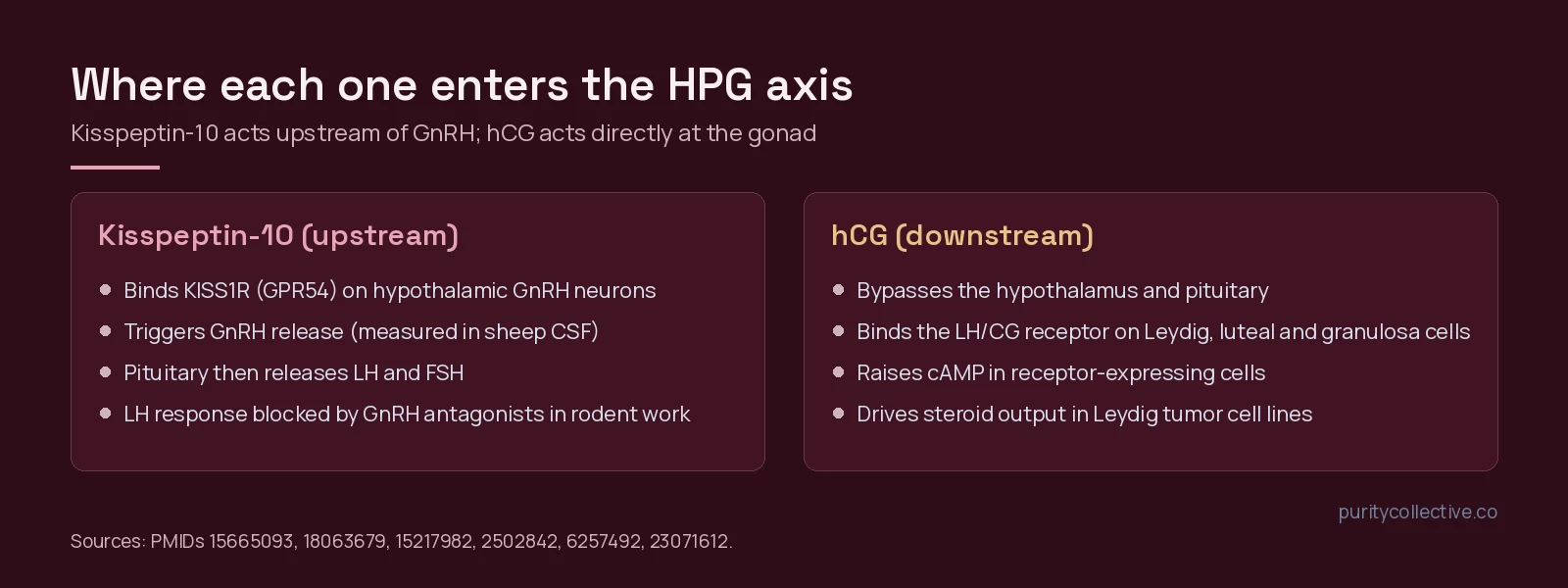
Short answer: kisspeptin-10 and hCG both end up raising LH-type signaling at the gonads, but they enter the hypothalamic-pituitary-gonadal (HPG) axis at opposite ends. Kisspeptin-10 is a ten-residue peptide that binds KISS1R (also called GPR54) [1]. In mouse and sheep work it acts on GnRH neurons in the hypothalamus, so its effect on LH depends on GnRH [2]. hCG is a two-subunit glycoprotein hormone [3] that binds the LH/CG receptor on gonadal cells directly [4]. It skips the hypothalamus and the pituitary. One is a signal at the top of the axis; the other acts at the bottom.
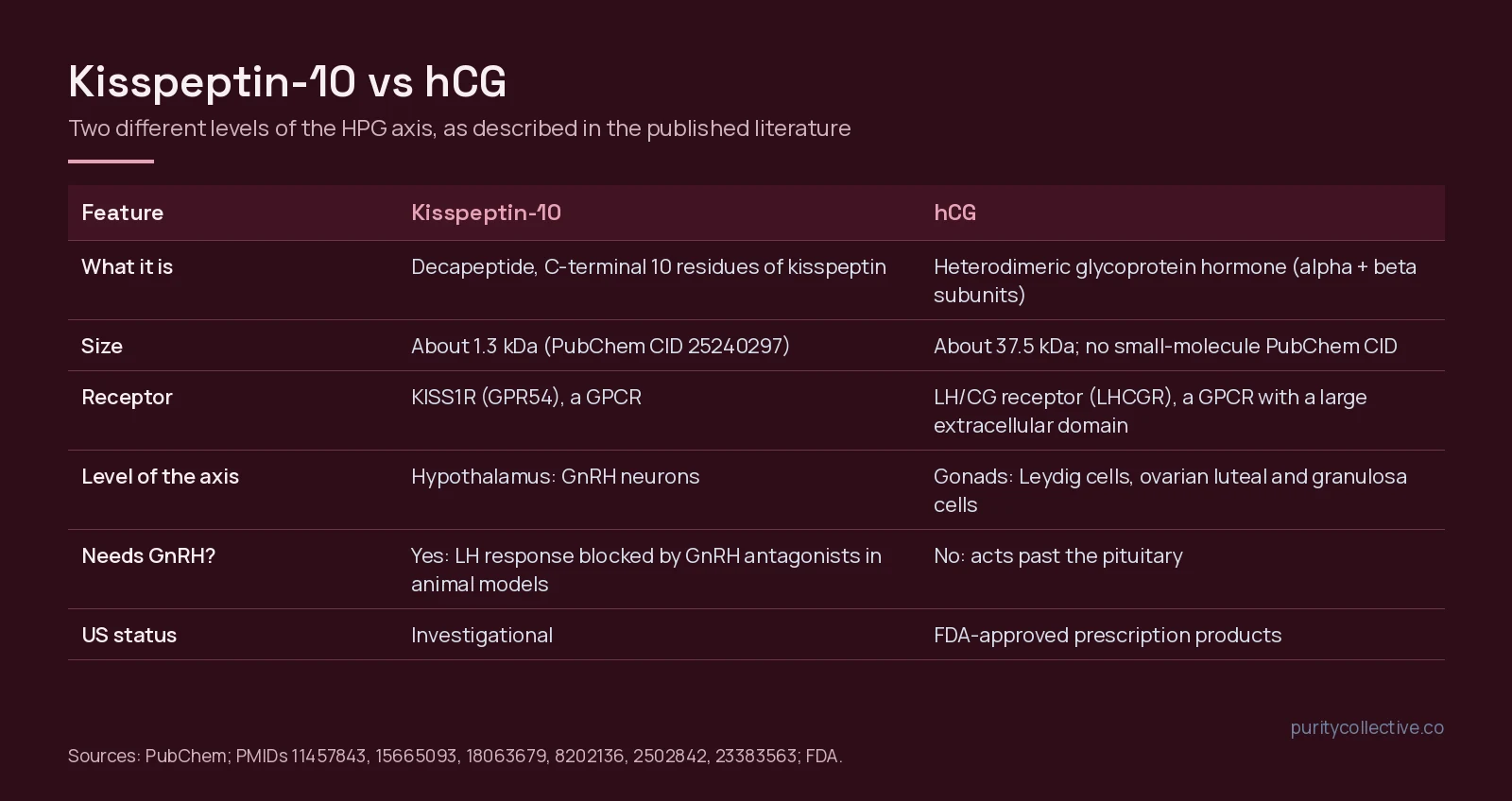
Kisspeptin-10 vs hCG at a glance
| Feature | Kisspeptin-10 | hCG |
|---|---|---|
| What it is | The C-terminal decapeptide of kisspeptin, the peptide family encoded by the KiSS-1 gene [5][6] | A heterodimer of an alpha and a beta subunit. Each subunit folds around a cystine knot [3] |
| Approximate size | About 1.3 kDa (PubChem) | About 37.5 kDa for the normal placental form; heavier hyperglycosylated variants exist [7] |
| Receptor | KISS1R / GPR54, a G protein-coupled receptor first cloned as an orphan related to galanin receptors [8] | The LH/CG receptor (LHCGR), a G protein-coupled receptor with a large leucine-rich extracellular domain [4] |
| Level of the HPG axis | Hypothalamus. GPR54 transcripts sit in GnRH neurons, and kisspeptin released GnRH into sheep cerebrospinal fluid [2] | Gonads. The receptor is expressed in the ovary and in Leydig cells [4][9] |
| Depends on GnRH? | Yes in the animal models: GnRH antagonists blocked the LH response [5][10] | No. It binds the gonadal receptor directly [4] |
| US regulatory status | Not an approved drug. Studied in research settings, including as a possible test of hypothalamic function [11] | hCG preparations are FDA-approved prescription products, regulated as biological products since March 23, 2020 (FDA notice) |
Identity of each compound
| Compound | Structure | Formula | MW | PubChem CID |
|---|---|---|---|---|
| Kisspeptin-10 (human) | 10 residues, YNWNSFGLRF-NH2, C-terminal amide | C63H83N17O14 | 1302.4 g/mol | 25240297 |
| hCG | Glycoprotein heterodimer; alpha subunit shared with LH, FSH and TSH, hormone-specific beta subunit [7] | Not applicable (variable glycosylation) | About 37.5 kDa [7] | None. hCG is a glycoprotein, so PubChem has no small-molecule compound record for it |
The size gap is close to 30-fold. A lab report for kisspeptin-10 can print one exact molecular weight that matches PubChem. hCG can’t be described that way: its sugar chains vary from one preparation to the next, so it’s characterized by activity and protein assays rather than one formula.
Kisspeptin-10: the upstream signal
The story starts in cancer biology. KiSS-1 was first described in 1996 as a gene expressed in non-metastatic melanoma cells, with its highest normal expression in the placenta [12]. In 1999, a separate group cloned GPR54, an orphan receptor that did not bind galanin and was expressed in brain regions including the hypothalamus [8]. In 2001, two groups matched them up. One isolated a 54-residue amidated peptide from human placenta and named it metastin [13]. The other isolated 54-, 14- and 13-residue peptides with a shared RF-amide C-terminus, named them kisspeptins, and showed they bound rat and human GPR54 with low nanomolar affinity in CHO cells [1].
The link to reproduction came from genetics. In 2003, a consanguineous family with isolated hypogonadotropic hypogonadism carried a homozygous deletion in GPR54 [14]. The same year, another group reported GPR54 mutations in an affected family and in an unrelated patient, and built a Gpr54-deficient mouse model alongside the human genetics [15].
Mechanism work followed quickly. In mice, kisspeptin-10 and kisspeptin-54 given into the brain both raised LH, and a GnRH antagonist blocked the kisspeptin-54 response [5]. A 2005 study found GPR54 transcripts inside GnRH neurons. Kisspeptin had no effect on LH or FSH in gpr54 knockout mice, and in sheep it released GnRH into the cerebrospinal fluid alongside a rise in serum LH [2]. That placed kisspeptin’s main reproductive action at GnRH release, two steps above the gonad.
Kisspeptin-10 itself is the shortest form that keeps full activity at the receptor. A structure-activity study reported that it had higher receptor affinity than longer forms. Alanine swaps at position 6 or 10 sharply raised the concentration needed in KISS1R-expressing cells and reduced or removed the LH response in rats. NMR work showed a helical shape between residues 4 and 10 [6]. In ovariectomized rats, kisspeptin-10 raised LH, and the GnRH antagonist cetrorelix blocked that rise. The electrical activity of the GnRH pulse generator did not change in frequency [10].
hCG: the downstream signal
hCG belongs to the glycoprotein hormone family with LH, FSH and TSH. All four share one alpha subunit and differ in their beta subunit [7]. The 1994 crystal structure showed that each subunit has a cystine-knot fold. Part of the beta subunit wraps around the alpha subunit and is held by a disulfide bond, a “seat belt” the authors linked to both dimer assembly and receptor binding [3].
Its receptor was cloned from rat luteal tissue in 1989. The LH/CG receptor has a 341-residue extracellular domain with leucine-rich repeats and a seven-transmembrane region. Cells engineered to express it bound hCG with high affinity and raised cAMP in response [4]. hCG became a standard tool for gonadal cell models for that reason. In 1981, clonal Leydig tumor cell lines were characterized by whether they bound hCG. In the lines that did, hCG drove steroid production to the same extent as cholera toxin or a cAMP analogue [9].
hCG and LH share the receptor, but they are not interchangeable in the lab. In cells expressing LHCGR, hCG was about five times more potent than LH for cAMP. LH gave stronger and longer ERK1/2 and AKT activation in primary human granulosa cells [16]. A 2014 review argued that the two hormones’ downstream signaling differs despite the shared receptor [17].
Where the two pathways touch
The neat “top versus bottom” picture has one wrinkle. KISS1R signaling also appears in Leydig cells. In MA-10 mouse Leydig tumor cells, knocking down Kiss1r lowered progesterone output with and without hCG, along with lower Lhcgr and StAR expression. Adding back human LHCGR restored the hCG response [18]. That is one cell line, but it suggests kisspeptin signaling may affect how well gonadal cells respond to hCG, not only whether LH is released.
What human physiology studies measured
Kisspeptin-10 has been given to people in physiology studies, and those studies measured hormones. A 2011 study in healthy men measured serum LH, LH pulse frequency and testosterone after kisspeptin-10. LH rose within 30 minutes, and the LH response did not rise in step across the levels tested [19]. A 2026 review discusses kisspeptin as a possible way to test hypothalamic function, since GnRH can’t be measured directly in the portal blood of humans [11]. These are measurements of gonadotropin output under study conditions, not evidence for any use.
Regulatory status in the US
hCG preparations, such as the urine-derived product described in the FDA-archived Pregnyl label, are FDA-approved prescription products. On March 23, 2020, approved applications for hCG and several other protein products were deemed biologics licenses (FDA notice). Kisspeptin-10 is not an approved drug. In human work it appears as an investigational research compound, for example in studies of kisspeptin as a test of hypothalamic function [11].
Study table
| Study | Compound | Model | What was measured | Main finding |
|---|---|---|---|---|
| Kotani 2001 [1] | Kisspeptins | CHO cells expressing GPR54 | Binding, Ca2+ and kinase signaling | Low nanomolar binding to rat and human GPR54 |
| Messager 2005 [2] | Kisspeptin | Wild-type and gpr54 knockout mice; sheep | LH, FSH; GnRH in cerebrospinal fluid | No LH response in knockouts; GnRH release in sheep |
| Kinsey-Jones 2008 [10] | Kisspeptin-10 | Ovariectomized rats | LH pulses; arcuate electrical activity | LH rose and was blocked by cetrorelix; pulse-generator frequency unchanged |
| Gutiérrez-Pascual 2009 [6] | Kisspeptin-10 analogues | KISS1R cells; rats; NMR | Ca2+ responses, LH, structure | Residues 6 and 10 critical for activity |
| McFarland 1989 [4] | hCG | Cells expressing cloned rat LH/CG receptor | Binding, cAMP | High-affinity hCG binding and cAMP rise |
| Ascoli 1981 [9] | hCG | Clonal mouse Leydig tumor cells | hCG binding, steroid output | Responsive clones made steroids under hCG |
| Casarini 2012 [16] | hCG vs LH | LHCGR cell lines; primary human granulosa cells | cAMP, ERK1/2, AKT, progesterone | hCG more potent for cAMP; LH stronger for ERK and AKT |
What the evidence does not show
- No head-to-head studies. We found no published study that compared kisspeptin-10 and hCG directly in the same model. Any “which is stronger” claim is not supported by primary data.
- Kisspeptin-10 needs a working axis. Its LH effect ran through GnRH in rodents [5][10] and was absent without GPR54 [2]. A model with pituitary or GnRH blockade will not respond the way an intact one does. hCG does not have that dependency.
- Longer exposure is not the same as a single pulse. In prepubertal male rats given kisspeptin-10 for 12 days, plasma LH and testosterone ended lower, and the testes showed degenerative changes [20]. Acute LH release does not predict what continuous exposure does.
- No effect on pulse frequency in female rats. Kisspeptin-10 raised LH without changing the frequency of the GnRH pulse generator’s electrical activity [10].
- hCG is not a stand-in for LH. The two differ in cAMP potency and kinase signaling at the same receptor [16], so results with one don’t transfer directly to the other [17].
- Human data are hormone measurements. The physiology work measured LH and related hormones [19]. It does not establish any health effect.
Reading the product records for each compound
For kisspeptin-10, check that the batch COA reports an identity result consistent with about 1302.4 g/mol (PubChem CID 25240297) and an HPLC purity figure for the same lot. For hCG, a single formula weight doesn’t apply, so look for the lot number and the assay used, and check the batch COA before relying on any figure. The listings are Kisspeptin-10, HCG 5,000 IU and HCG 10,000 IU.
Posted reports sit in the COA library, and our guide on how to read a peptide COA walks through each field. When you’re ready to buy research peptides online in the USA, match the lot number on the vial to the lot number on its report.
Frequently asked questions
What is the difference between kisspeptin-10 and hCG?
They act at opposite ends of the HPG axis. Kisspeptin-10 is a ten-residue peptide that binds KISS1R (GPR54) on hypothalamic GnRH neurons, so its effect on LH runs through GnRH in animal models. hCG is a glycoprotein hormone of about 37.5 kDa that binds the LH/CG receptor on gonadal cells directly.
Does kisspeptin-10 work without GnRH?
Not in the published animal work we found. In rats, the GnRH antagonist cetrorelix blocked the LH rise after kisspeptin-10 (PMID 18063679), and kisspeptin had no effect on LH or FSH in gpr54 knockout mice (PMID 15665093).
Why doesn’t hCG have a PubChem CID?
PubChem compound records describe defined small molecules and peptides. hCG is a two-subunit glycoprotein whose sugar chains vary, so it has no single formula. Kisspeptin-10, by contrast, has CID 25240297, formula C63H83N17O14 and a weight of 1302.4 g/mol.
Do hCG and LH act the same way?
They share the LH/CG receptor but signal differently. In LHCGR-expressing cells, hCG was about five times more potent than LH for cAMP, while LH gave stronger ERK1/2 and AKT activation in human granulosa cells (PMID 23071612).
Is kisspeptin-10 FDA-approved? Is hCG?
hCG preparations are FDA-approved prescription products and have been regulated as biological products since March 23, 2020. Kisspeptin-10 is not an approved drug; it is studied as an investigational research compound.
References
- Kotani M, Detheux M, Vandenbogaerde A et al. (2001). The metastasis suppressor gene KiSS-1 encodes kisspeptins, the natural ligands of the orphan G protein-coupled receptor GPR54. J Biol Chem. PMID: 11457843. doi: 10.1074/jbc.M104847200.
- Messager S, Chatzidaki EE, Ma D et al. (2005). Kisspeptin directly stimulates gonadotropin-releasing hormone release via G protein-coupled receptor 54. Proc Natl Acad Sci U S A. PMID: 15665093. doi: 10.1073/pnas.0409330102.
- Lapthorn AJ, Harris DC, Littlejohn A et al. (1994). Crystal structure of human chorionic gonadotropin. Nature. PMID: 8202136. doi: 10.1038/369455a0.
- McFarland KC, Sprengel R, Phillips HS et al. (1989). Lutropin-choriogonadotropin receptor: an unusual member of the G protein-coupled receptor family. Science. PMID: 2502842. doi: 10.1126/science.2502842.
- Gottsch ML, Cunningham MJ, Smith JT et al. (2004). A role for kisspeptins in the regulation of gonadotropin secretion in the mouse. Endocrinology. PMID: 15217982. doi: 10.1210/en.2004-0431.
- Gutiérrez-Pascual E, Leprince J, Martínez-Fuentes AJ et al. (2009). In vivo and in vitro structure-activity relationships and structural conformation of Kisspeptin-10-related peptides. Mol Pharmacol. PMID: 19389922. doi: 10.1124/mol.108.053751.
- Głodek A, Kubiczak M, Urbaniak P et al. (2012). [Human chorionic gonadotropin–a well-known hormone with unknown functions]. Ginekol Pol. PMID: 23383563.
- Lee DK, Nguyen T, O’Neill GP et al. (1999). Discovery of a receptor related to the galanin receptors. FEBS Lett. PMID: 10100623. doi: 10.1016/s0014-5793(99)00009-5.
- Ascoli M (1981). Characterization of several clonal lines of cultured Leydig tumor cells: gonadotropin receptors and steroidogenic responses. Endocrinology. PMID: 6257492. doi: 10.1210/endo-108-1-88.
- Kinsey-Jones JS, Li XF, Luckman SM et al. (2008). Effects of kisspeptin-10 on the electrophysiological manifestation of gonadotropin-releasing hormone pulse generator activity in the female rat. Endocrinology. PMID: 18063679. doi: 10.1210/en.2007-1505.
- Pierret ACS, Patel AH, Daniels E et al. (2026). Kisspeptin as a test of hypothalamic dysfunction in pubertal and reproductive disorders. Andrology. PMID: 39834030. doi: 10.1111/andr.13843.
- Lee JH, Miele ME, Hicks DJ et al. (1996). KiSS-1, a novel human malignant melanoma metastasis-suppressor gene. J Natl Cancer Inst. PMID: 8944003. doi: 10.1093/jnci/88.23.1731.
- Ohtaki T, Shintani Y, Honda S et al. (2001). Metastasis suppressor gene KiSS-1 encodes peptide ligand of a G-protein-coupled receptor. Nature. PMID: 11385580. doi: 10.1038/35079135.
- de Roux N, Genin E, Carel JC et al. (2003). Hypogonadotropic hypogonadism due to loss of function of the KiSS1-derived peptide receptor GPR54. Proc Natl Acad Sci U S A. PMID: 12944565. doi: 10.1073/pnas.1834399100.
- Seminara SB, Messager S, Chatzidaki EE et al. (2003). The GPR54 gene as a regulator of puberty. N Engl J Med. PMID: 14573733. doi: 10.1056/NEJMoa035322.
- Casarini L, Lispi M, Longobardi S et al. (2012). LH and hCG action on the same receptor results in quantitatively and qualitatively different intracellular signalling. PLoS One. PMID: 23071612. doi: 10.1371/journal.pone.0046682.
- Choi J, Smitz J (2014). Luteinizing hormone and human chorionic gonadotropin: origins of difference. Mol Cell Endocrinol. PMID: 24365330. doi: 10.1016/j.mce.2013.12.009.
- Hsu MC, Wu LS, Jong DS et al. (2020). KISS1R signaling modulates gonadotropin sensitivity in mouse Leydig cell. Reproduction. PMID: 33112765. doi: 10.1530/REP-20-0328.
- George JT, Veldhuis JD, Roseweir AK et al. (2011). Kisspeptin-10 is a potent stimulator of LH and increases pulse frequency in men. J Clin Endocrinol Metab. PMID: 21632807. doi: 10.1210/jc.2011-0089.
- Ramzan F, Qureshi IZ (2011). Intraperitoneal kisspeptin-10 administration induces dose-dependent degenerative changes in maturing rat testes. Life Sci. PMID: 21112339. doi: 10.1016/j.lfs.2010.11.019.