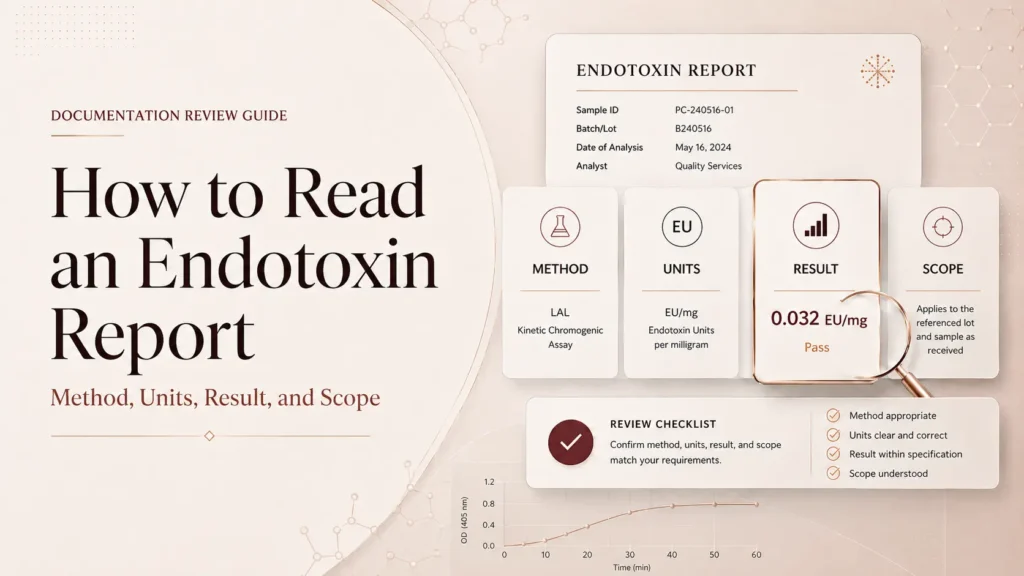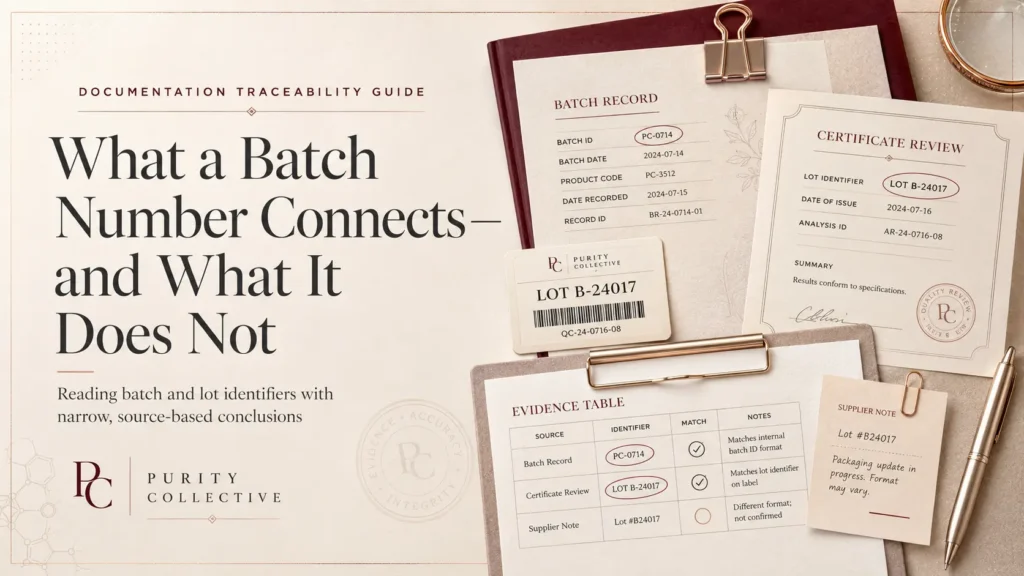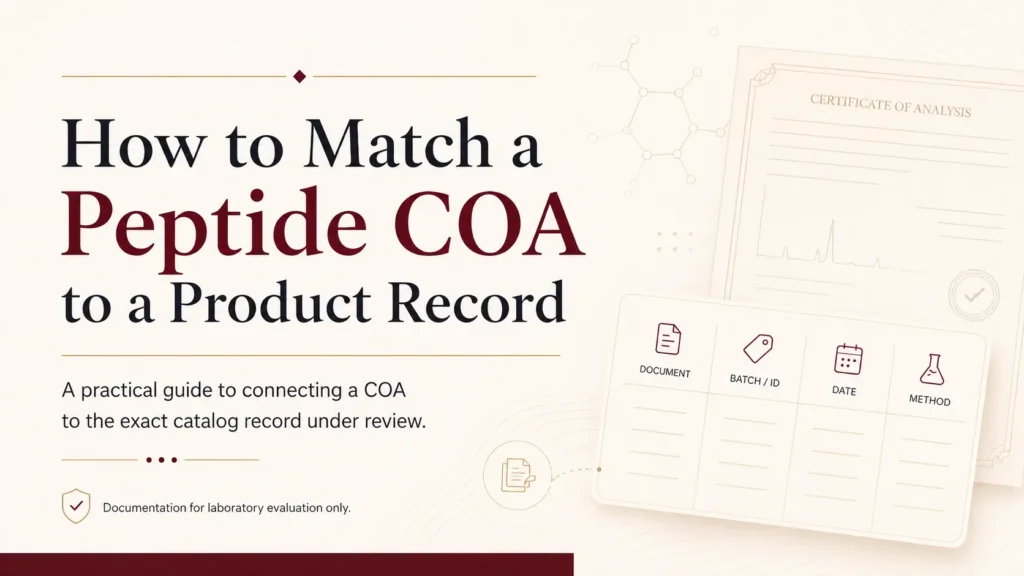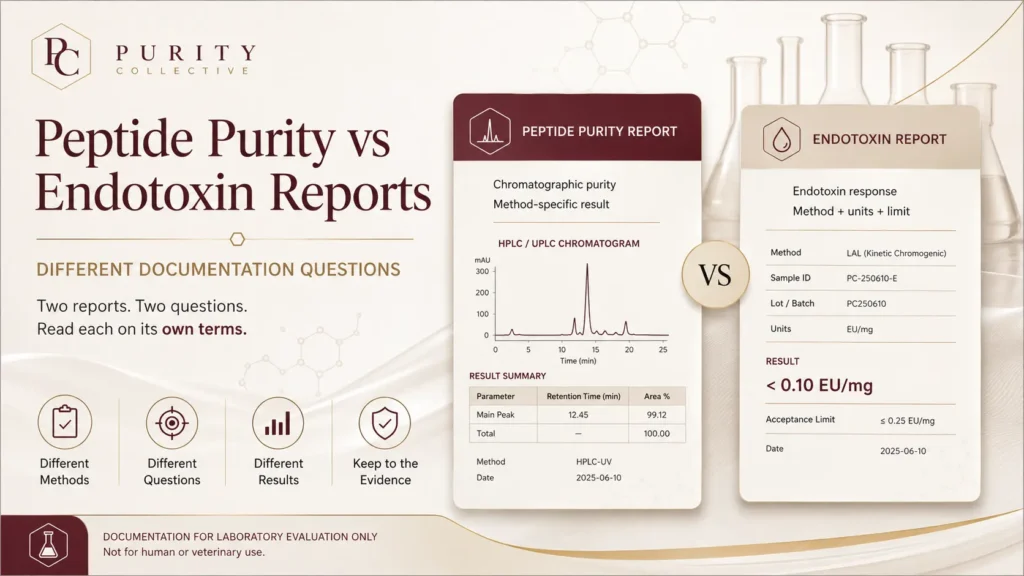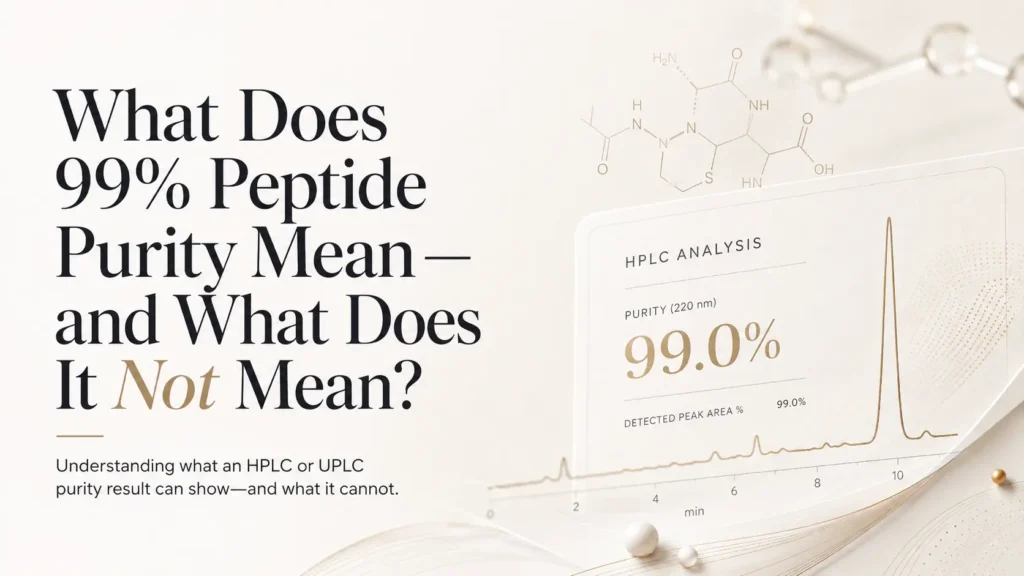
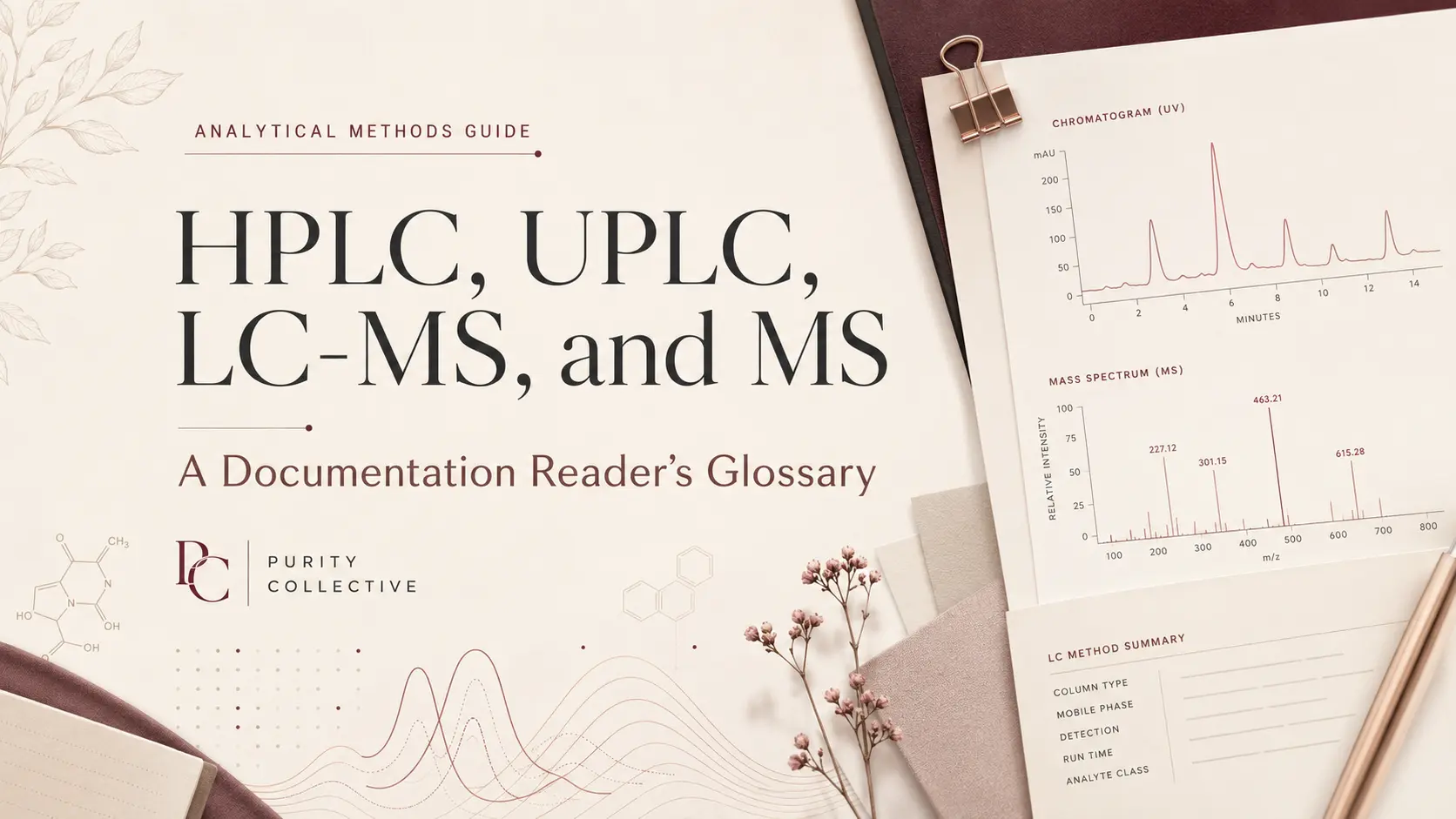
Analytical abbreviations describe different methods and evidence types. The useful question is what the stated method measured and what the document actually reports.
Documentation boundary: This guide concerns record review for laboratory evaluation. It does not establish suitability for human or veterinary use and does not provide dosing, administration, or clinical guidance.
Start with the exact record
Before comparing sources, write down the exact title, quantity, format, and canonical URL of the catalog record. This prevents a nearby product, historical listing, or public reference from being treated as evidence for the wrong material.
What this guide helps review
This guide focuses on reading method labels without broadening their scope. The strongest conclusion is one that stays attached to the source field that supports it.
- whether the document names HPLC, UPLC, MS, or LC-MS
- the detector or mass-result context when provided
- the report conclusion and its underlying data
A practical review sequence
- Identify the exact catalog record.
- Open the linked document or source rather than relying on a summary.
- Match identifiers, dates, method language, and units where applicable.
- Record the result exactly as shown.
- Keep unresolved gaps visible instead of filling them with an assumption.
Scope matters
A method name alone is not a complete quality conclusion. A document can be useful while still leaving other questions unanswered. That is why a product page, a certificate, a public identity record, and a site policy should be read as separate sources.
Build a small evidence table
A simple table makes the review repeatable. Use one row for the catalog record and one row for every linked source. Capture the source title, URL or file name, material or batch identifier, date, method, reported result, units where applicable, and the narrow question that source can answer. This approach keeps a statement traceable when pages are revised or a document is replaced.
Do not use the table to turn a collection of partial records into a broader conclusion. Its purpose is to show the connection between a source and a statement, as well as the questions that remain open.
Read the source before the summary
Product-page summaries and search snippets can help locate a record, but they are not a substitute for the underlying document. Open the certificate, report, or public identity reference itself. Confirm that its heading, identifier, date, and method context match the statement being considered. If the primary source cannot be accessed, record that limitation rather than relying on a copied excerpt.
This is especially important when terms are similar. A shared ingredient name, a related batch prefix, or a comparable quantity can make two records look connected even when the source does not say they are.
When sources do not line up
Differences in spelling, dates, lot codes, quantities, formats, or report terminology should be treated as review points. Check whether the difference is explained on the record or in an accompanying document. If it is not, keep the discrepancy visible and seek clarification from the relevant source owner. Avoid silently normalizing a mismatch in a note, label, or catalog summary.
A careful review can end with an unresolved question. That is a more accurate outcome than assigning a result to a record without a documented connection.
Write a narrow conclusion
A good conclusion identifies the source, the exact record it concerns, and the limit of what it shows. For example, a reviewer may note that a named report presents a stated result for a matching batch under a named method. The reviewer should not add attributes the document does not measure, or transform an observation into a promise about another record.
Keeping language narrow also makes later review easier: another reader can retrace the path from the catalog record to the document and decide whether it supports the same limited statement.
Questions to keep asking
Does the source identify the exact material?
Confirm the product, batch, sample, quantity, format, or other identifier before applying the source to a catalog record.
Does the result include its method and context?
A numerical result is more useful when the method, date, units where applicable, and any stated criterion remain visible.
What does the source leave unanswered?
Keep the answer narrow. Missing information should remain a limitation until an appropriate source clarifies it.
Related documentation
Use How to Read a Peptide COA, HPLC vs Mass Spectrometry for Peptides, What Does 99% Peptide Purity Mean?, and the Research Library for related record-review context.
Sources and methodology
This is a documentation-reading guide. It uses the current Purity Collective public record structure and method-specific source reading. For analytical-procedure context, see the U.S. Food and Drug Administration’s Q14 Analytical Procedure Development guidance.