
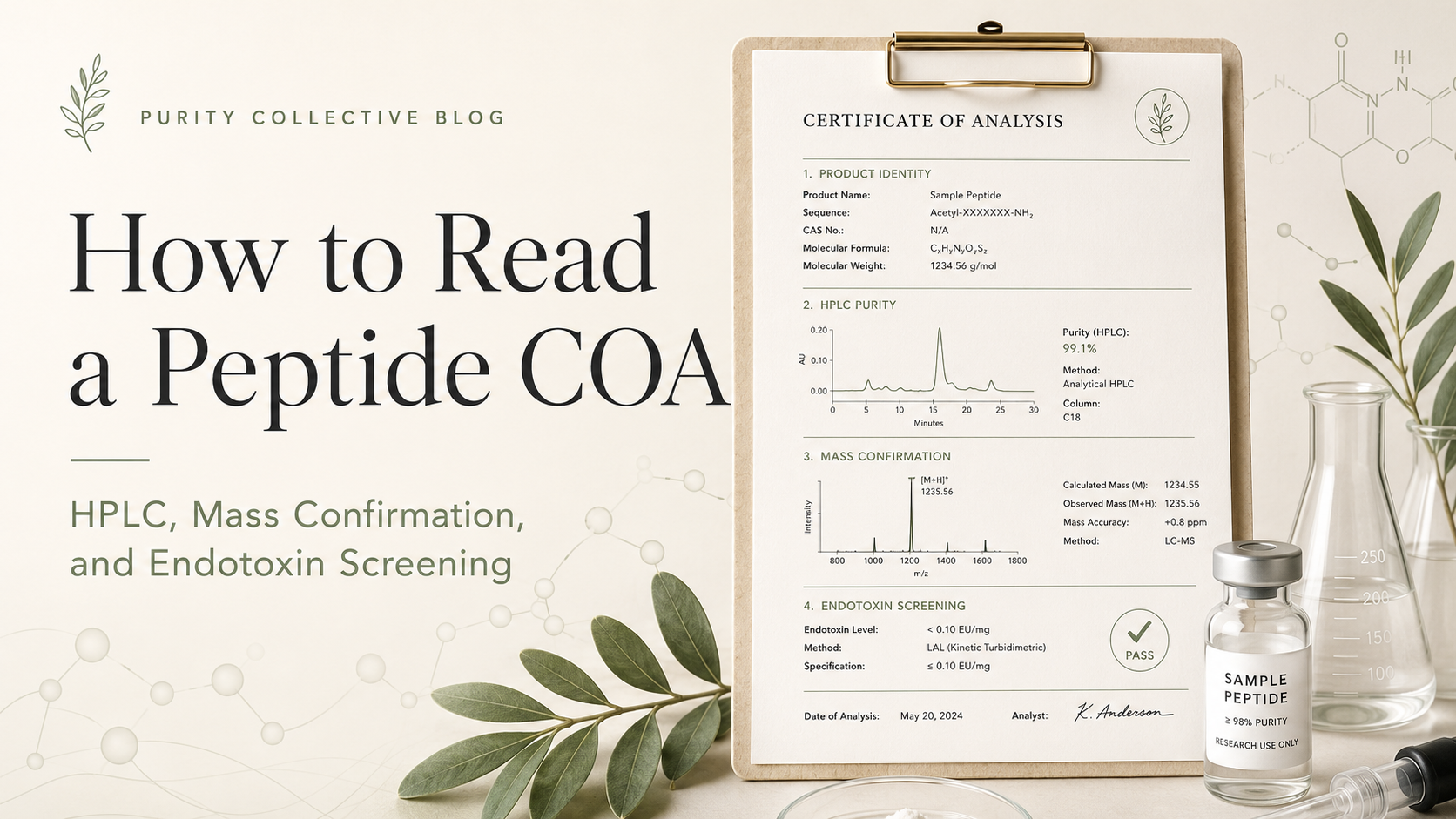
A Certificate of Analysis, or COA, is one of the most important documents attached to a peptide reference compound. It helps researchers review identity, purity, and quality markers before the material enters a laboratory workflow.
Not every COA is formatted the same way, but most peptide documentation includes several recurring sections: product identity, lot or batch number, test method, purity result, and sometimes mass confirmation or endotoxin screening.
HPLC Purity
High-performance liquid chromatography, commonly abbreviated as HPLC, is used to evaluate purity by separating components within a sample. In peptide research catalogs, an HPLC purity percentage helps indicate how much of the detected material corresponds to the target compound versus related impurities.
A high HPLC percentage is useful, but it should not be the only detail reviewed. Researchers should also confirm that the COA belongs to the same product and lot being evaluated.
Mass Confirmation
Mass confirmation helps verify that the compound aligns with the expected molecular mass. This is a different question from purity. A sample can show a high purity percentage while still requiring identity confirmation, which is why mass confirmation is often reviewed alongside HPLC.
When available, mass documentation adds confidence that the reference compound corresponds to the expected peptide structure.
Endotoxin Screening
Endotoxin screening is another quality marker commonly reviewed in peptide reference materials. Endotoxins are bacterial byproducts that can interfere with certain research workflows. Screening helps researchers understand whether a material meets the quality profile needed for their model.
What to Check Before Using a COA
Confirm the product name, lot number, date, test method, and result. If a product page includes multiple documents, review each one separately. For example, one document may cover HPLC purity while another covers endotoxin screening.
A COA should support careful material review. It should not be treated as a substitute for a laboratory's own protocols, acceptance criteria, or regulatory responsibilities.