
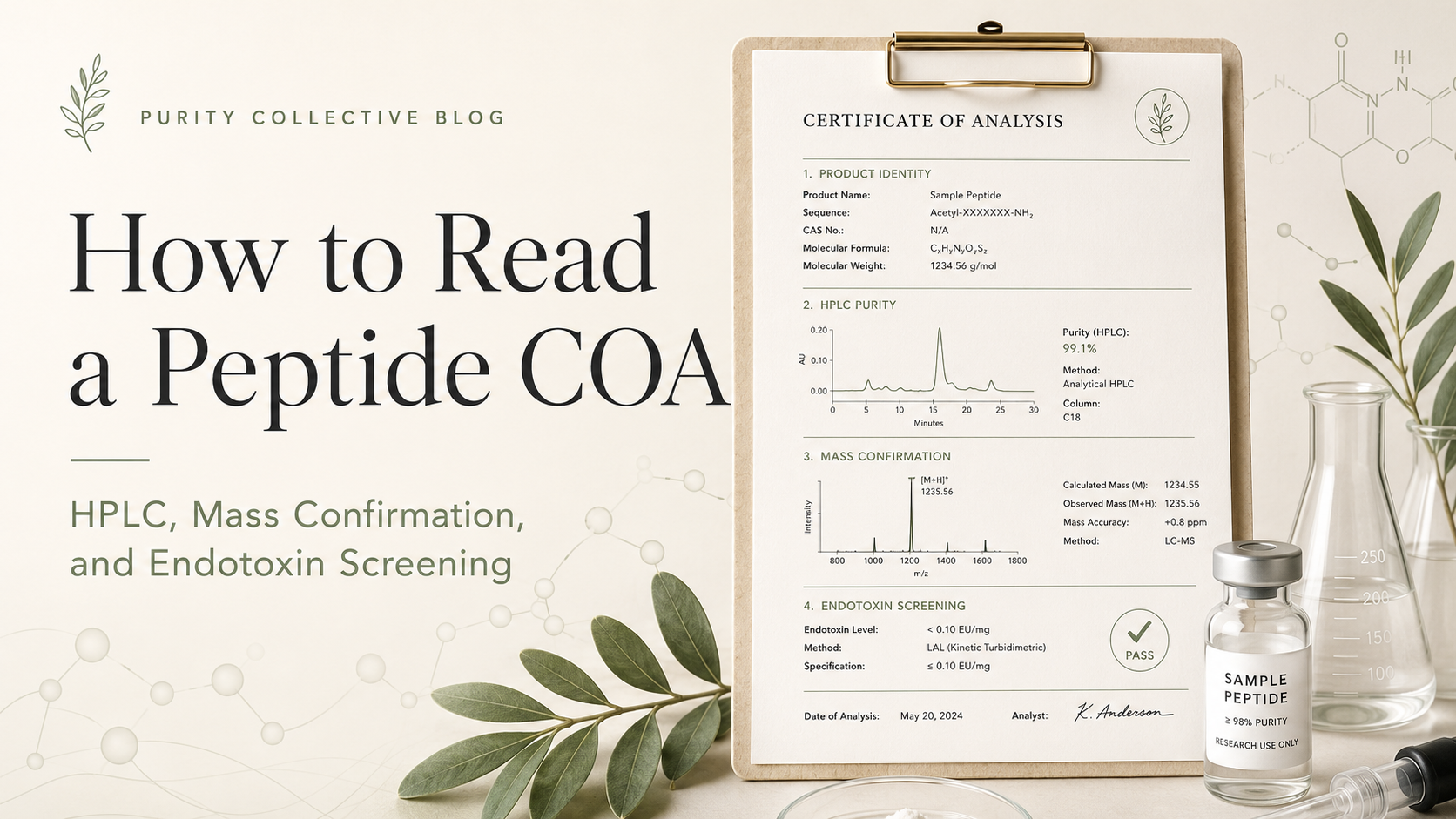
A peptide Certificate of Analysis, usually called a COA, is an analytical record for a named material or sample. It can help a laboratory review identity, method, result fields and document-to-product mapping, but only when the record is connected clearly to the product page being evaluated.
The most useful COA review is not a quick scan for one impressive number. It is a structured reading of the whole record: product name, sample or lot identifier, method, date sequence, result, units, stated limit where one exists, and the scope of what the document can support.
This guide explains how to read peptide COAs and related analytical files for qualified laboratory research purchasing. It is focused on documentation review, not procedural use instructions.
Start with product-to-document matching
Before reading any result, confirm that the document appears to belong with the product record. Match the product title, compound name, blend name, listed quantity, SKU, sample description, lot or batch reference and any file title shown on the product page.
If the product page lists one item but the document names another, the relationship should be clarified before the report is used as product-specific support. The same is true when dates, quantities or identifiers do not align. A COA is strongest when the page and the document make their relationship easy to verify.
Read HPLC or UPLC results in context
HPLC and UPLC reports describe chromatographic evaluation under a stated method. A common result is an area percentage, which reflects the relative chromatographic profile under the method shown in the report. That number should be read together with the chromatogram, integration table, sample description and method notes.
A chromatographic percentage is not the same as a filled quantity, complete structure assignment or universal product statement. It answers one analytical question from one method. When a product page displays a number from a report, the best practice is to link the source document and avoid converting the number into a broader catalog-wide claim.
Use mass confirmation for identity review
Mass confirmation compares an observed signal with an expected molecular mass or mass-to-charge value. It is useful because it addresses a different question from chromatographic purity. A record with both chromatographic and mass-confirmation data gives a reviewer more context than either result alone.
Mass confirmation should still be read with boundaries. A matching mass supports consistency with the expected identity under the method shown, but it does not replace every other product fact. Reviewers should still check listed quantity, format, document date, sample identifier and any other available report fields.
Review endotoxin reports as a separate analytical question
Endotoxin reporting, when present, is a separate analytical record. Review the stated method, result, units and limit field. Do not combine an endotoxin value with an HPLC or mass-confirmation result as though they prove the same attribute.
Some documents include blank or incomplete limit fields, unclear units, or result language that needs context. In those cases, the storefront copy should avoid interpreting the result beyond what the document itself states.
Check dates and report chronology
Date review is often overlooked. A useful document may show a received date, analysis date, issue date or approval date. Those dates should make sense together and should not conflict with the product record being shown to buyers.
If a report date appears earlier than the sample receipt date, or if the page presents a document from a different product variant, record the limitation clearly. Good SEO copy can still be commercial and confident while acknowledging that a document must match the product record before it is used as support.
A COA review checklist
- Product identity: Does the document name the same material or blend shown on the product page?
- Quantity and format: Does the product record clearly list the supplied amount and presentation?
- Sample or lot reference: Is there an identifier that connects the report to the product record?
- Method: Is the analytical method stated clearly enough to understand the result?
- Result and units: Are values, units and area percentages shown with enough context?
- Limit field: Where a limit appears, is it populated and relevant to the result?
- Date sequence: Do received, analysis, issue and approval dates make sense together?
- Scope statement: Does the storefront avoid extending one report beyond what it can support?
Examples of document patterns to compare
Different product families create different document-review questions. A single-compound vial, a multi-component blend and a quantity-variant family should not be read with the same shortcut. Use the examples below to choose the right review pattern before recording any result.
- Single-compound records: Use the GHK-Cu guide or TB-500 guide to see how identity, quantity, purity and endotoxin files stay tied to one product record.
- Blend records: Use the GLOW peptide blend guide or KPV and KLOW guide to keep component panels separate instead of creating one blend-wide result.
- Quantity-variant records: Use the NAD+ guide, Tirzepatide guide or MOTS-C guide when one quantity has documents and another quantity has a different document status.
- Format-review records: Use the Selank and Semax guide or PT-141 guide when the title, format label and document availability must be kept separate.
These examples are navigation aids. They do not replace the current product page or the attached file. The exact product URL, SKU, lot, report date and printed result fields remain the source of truth.
How COA review supports better product pages
Strong product pages make analytical documents easier to review. They link available reports close to the product facts, describe document scope plainly, and avoid unsupported blanket claims. A buyer should be able to move from product title to report link to result fields without guessing how the pieces connect.
For example, compare a product record such as GHK-Cu 100mg or Retatrutide 10mg with the documents linked from the page. The goal is not to search for one number in isolation. The goal is to understand what the record says, what the document says, and where the evidence boundary sits.
For broader catalog context, start with What Are Research Peptides? and the research peptide catalog. To browse available files, use the COA library.
Bottom line
A peptide COA is most useful when it is read as part of a complete product record. Match identity first, then review method, result, units, date sequence and scope. The strongest catalog copy helps qualified buyers understand the documentation without turning analytical results into broader promises than the reports support.