
For laboratory research only. Not for human or animal use. This article gives no dosing, administration or therapeutic advice.
Short answer: GHK-Cu and Snap-8 are both short peptides that show up in cosmetic-science papers, but they have almost nothing else in common. GHK-Cu is the tripeptide glycyl-L-histidyl-L-lysine holding a copper(II) ion. It was first found in human plasma [1][2], and most of its literature is about copper binding and what fibroblasts and wound tissue do when it is present [3][4][5]. Snap-8 (acetyl octapeptide-3) is a synthetic eight-residue peptide built on the Argireline hexapeptide. That design copies the N-terminal end of the neuronal protein SNAP-25 and was meant to interfere with the SNARE complex that drives vesicle release [6]. The other big difference is evidence depth: GHK-Cu has decades of cell and animal work, while Snap-8 alone has almost no indexed primary studies.
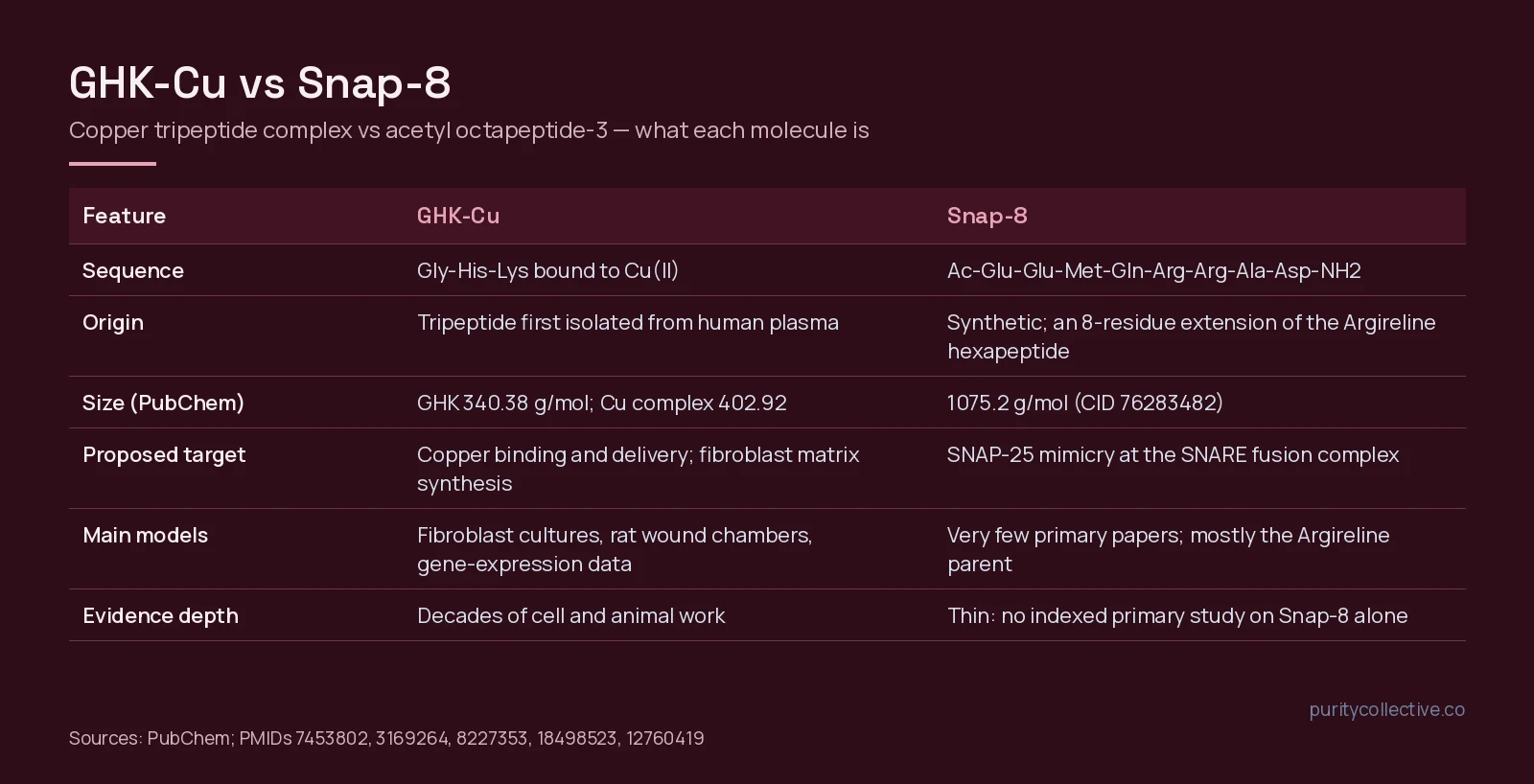
GHK-Cu vs Snap-8 at a glance
| Feature | GHK-Cu | Snap-8 (acetyl octapeptide-3) |
|---|---|---|
| What it is | Gly-His-Lys, a plasma tripeptide, as a 1:1 complex with Cu(II) [2][7] | Ac-Glu-Glu-Met-Gln-Arg-Arg-Ala-Asp-NH2: the Argireline sequence (Ac-EEMQRR-NH2) plus two residues [6] |
| Proposed target | Copper transport into cells; matrix synthesis by fibroblasts [3][4] | The SNARE fusion complex, by mimicking the SNAP-25 N-terminus. Shown for Argireline and SNAP-25 peptides, not for Snap-8 itself [6][8] |
| Main models | Hepatoma and fibroblast cultures, rat wound chambers, gene-expression datasets [3][4][5][9] | For the parent hexapeptide: cell secretion assays, neuron cultures, skin permeation cells [6][10][11] |
| Skin penetration data | Copper measured across human skin layers in diffusion cells; microneedle pre-treatment studied [12][13] | No indexed permeation study on Snap-8. Hexapeptide data show poor permeation tied to size and charge [10] |
| Human studies | One randomized venous-ulcer trial of a copper tripeptide cream [14]; few cosmetic trials [15] | Only multi-ingredient microneedle patches that list acetyl octapeptide-3 among several actives [16][17] |
| Regulatory status (US) | Neither is an FDA-approved drug. Both are sold as research materials or cosmetic ingredients. | |
Identity of each compound
Identity numbers below come from PubChem. GHK-Cu has two useful records: the free tripeptide and the copper complex. Snap-8 is trickier. PubChem holds one record (CID 76283482) whose drawn structure matches the sequence Ac-EEMQRRAD-NH2 and carries CAS 868844-74-0. A second record filed under the trade name and INCI label (CID 71587832) lists a different formula, C42H72N16O15S, with a modified N-terminal residue in its drawn structure. A lab confirming Snap-8 identity should go by sequence and measured mass, not by whichever database record a supplier copied.
| Compound | PubChem CID | Formula | Molecular weight (g/mol) | CAS |
|---|---|---|---|---|
| GHK (free tripeptide) | 73587 | C14H24N6O4 | 340.38 | 49557-75-7 |
| GHK-Cu (prezatide copper) | 71587328 | C14H23CuN6O4+ | 402.92 | 89030-95-5 |
| Snap-8 (acetyl octapeptide-3) | 76283482 | C41H70N16O16S | 1075.2 | 868844-74-0 |
Size alone sets up one of the main contrasts. The copper complex is about 400 g/mol. Snap-8 is a charged octapeptide of roughly 1,075 g/mol, and that matters for any question about whether it can cross the outer skin barrier.
GHK-Cu: a copper-binding tripeptide
GHK was described in 1973 as a factor in human serum that kept normal liver cells alive and stimulated growth in hepatoma cells [1]. It was identified as glycyl-histidyl-lysine in 1977 [2]. In 1980, Pickart and colleagues reported that it co-purified with roughly equimolar copper, formed complexes with copper(II) readily, and raised copper uptake into cultured hepatoma cells. They proposed it acts as a copper transport factor, much like the copper sites on albumin [3]. Spectroscopy later showed that at neutral pH GHK forms a 1:1 Cu(II) complex in which one coordinating nitrogen sits on the histidine imidazole ring [7].
Most of the matrix data come from fibroblasts and rats. In fibroblast cultures, collagen synthesis rose starting between 10-12 and 10-11 M GHK-Cu, peaked near 10-9 M, and did not depend on cell number [4]. In a rat wound-chamber model, chambers injected with GHK-Cu showed concentration-dependent increases in dry weight, DNA, total protein, collagen and glycosaminoglycans, and collagen synthesis rose about twice as much as non-collagen protein [5]. A follow-up in the same model found more chondroitin sulfate and dermatan sulfate, with shifts in decorin and biglycan expression [18].
Gene-expression work widened the picture. Using lung tissue from smokers with COPD, one group built an emphysema-severity gene signature and then searched the Connectivity Map for compounds that reverse it. GHK came up. In cultured human fibroblasts, GHK reproduced TGF-β-like expression patterns, and in fibroblasts from COPD lungs it restored collagen I gel contraction [9]. Later reviews, including ones by the group that first described GHK, compile these datasets [19]. Those reviews are interpretive summaries, not new experiments.
Snap-8: a SNAP-25 mimic built on Argireline
The design logic behind Snap-8 comes from Argireline, the hexapeptide Ac-EEMQRR-NH2. Its developers described it as the product of a rational design programme to mimic botulinum toxin action without the toxicity. They reported that it inhibited neurotransmitter release with a potency similar to botulinum toxin A but much lower efficacy. They attributed this to interference with formation or stability of the SNARE complex [6]. Snap-8 extends that sequence by two residues (Ala-Asp) at the C-terminus.
The target itself is well characterized. The 2.4 Å crystal structure of the synaptic fusion complex shows syntaxin-1A, synaptobrevin-II and SNAP-25B twisted into a parallel four-helix bundle [20]. Assembly appears to start with a slow interaction between syntaxin and the N-terminal region of SNAP-25 [21], which is why a peptide copying that region is a plausible decoy. In an earlier test of that idea, truncated SNAP-25 N-terminal products inhibited depolarization-triggered glutamate release from rat hippocampal cultures and depressed synaptic transmission in Aplysia neurons [8]. Those were SNAP-25 fragments, not Snap-8.
Work on the parent hexapeptide is where the rest of the data sit. Modified Argireline analogues were compared for human skin permeation in vitro and for inhibition of glutamate release from stem-cell-derived neurons. The authors noted that unmodified Argireline permeates poorly because of its size and zwitterionic charge [10]. A Franz-cell and tape-stripping study on porcine skin found that the vehicle (a multiple W/O/W emulsion versus simple emulsions) changed how much of the hexapeptide entered the skin [11]. Analytical chemists found both Argireline and its methionine-oxidized form in commercial creams and sera [22]. One cytotoxicity study saw concentration-dependent anti-proliferative effects in HEK-293, IMR-32 neuroblastoma cells and primary skin fibroblasts, at concentrations far above the reference drug [23]. There is even a copper link: Argireline binds Cu(II), and modified analogues were designed to tune that affinity [24].
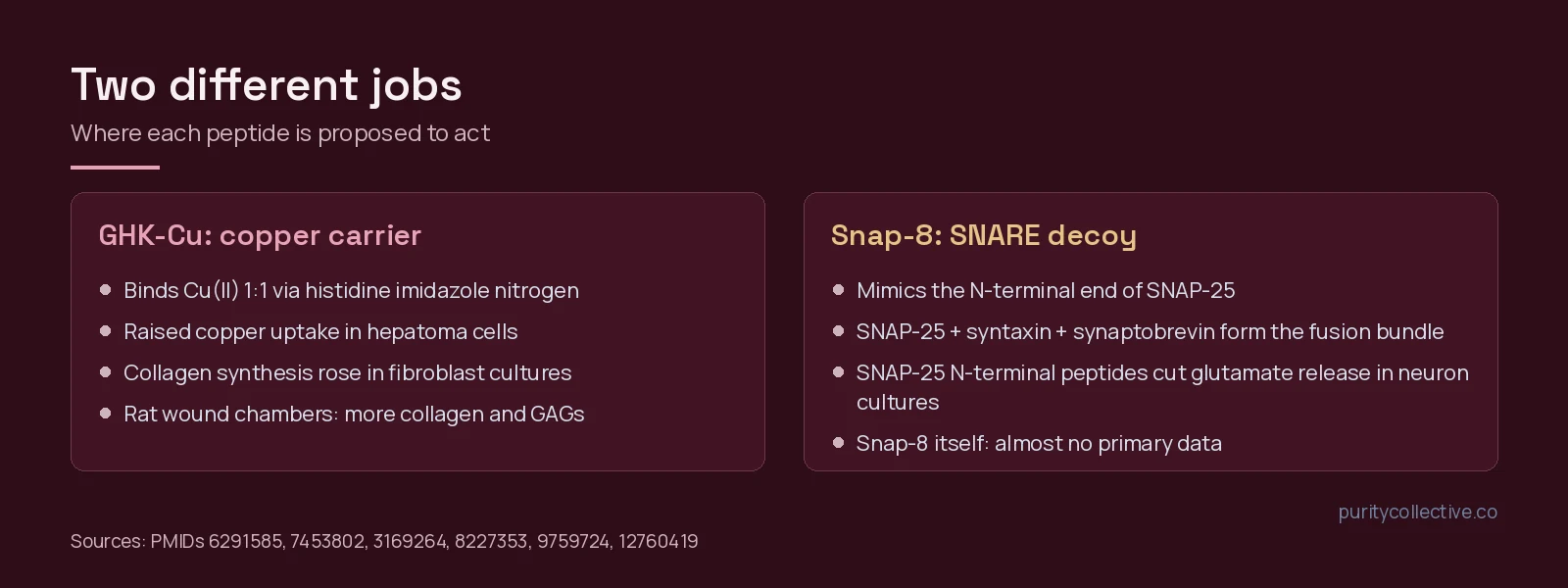
For Snap-8 itself, a PubMed search for “acetyl octapeptide-3” returns two human studies. Both tested hyaluronic-acid microneedle patches that combine the octapeptide with several other actives: one with an ascorbic-acid derivative and a lysophosphatidic acid in 24 volunteers against an HA-only placebo patch [16], and one with an arginine/lysine polypeptide, palmitoyl tripeptide-5, adenosine and seaweed extracts in a 12-week single-centre study [17]. Because each patch carried several actives, neither design can isolate the octapeptide.
Study table
| Study | Compound | Model | What was measured |
|---|---|---|---|
| Pickart 1980 [3] | GHK + Cu(II) | Hepatoma cell culture | Complex formation; copper uptake into cells |
| Maquart 1988 [4] | GHK-Cu | Fibroblast culture | Collagen synthesis across a concentration range |
| Maquart 1993 [5] | GHK-Cu | Rat subcutaneous wound chamber | Dry weight, protein, collagen, GAGs, collagen mRNAs |
| Hostynek 2011 [12] | Copper tripeptide | Human skin layers, flow-through diffusion cells | Copper retained in and permeating each layer over 48 h |
| Campbell 2012 [9] | GHK | COPD lung tissue profiles; human lung fibroblasts | Gene-expression reversal; collagen gel contraction |
| Blanes-Mira 2002 [6] | Argireline (parent of Snap-8) | Secretion assays, emulsion on volunteers | Neurotransmitter release; SNARE complex formation |
| Apland 2003 [8] | SNAP-25 N-terminal fragments | Rat hippocampal culture; Aplysia neurons | Glutamate release; synaptic transmission |
| Microneedle patch trials [16][17] | Acetyl octapeptide-3 within multi-ingredient patches | Healthy volunteers | Skin measurements against placebo patches; design cannot isolate Snap-8 |
Getting into skin: the shared problem
Both peptides face the same barrier, but only GHK-Cu has been measured directly. In flow-through diffusion cells, copper applied as the tripeptide was quantified by ICP-MS in isolated stratum corneum, heat-separated epidermis and dermatomed human skin over 48 hours. The authors reported a permeability coefficient and a dermal depot [12]. Note that this measured copper, not the intact peptide. Microneedle pre-treatment increased GHK-Cu permeation in two in vitro skin models, with depth tied to application force [13]. A 2025 review argues that copper complexation and lipid modification raise GHK permeability, but also points to a surprising absence of clinical studies [15]. For Snap-8 the equivalent data simply don’t exist yet. The closest evidence is hexapeptide work showing that charge and size limit permeation [10].
What the evidence does not show
- No primary Snap-8 pharmacology. We found no indexed study that tested Snap-8 alone in a SNARE assembly assay, a neurotransmitter release assay or a skin permeation cell. Statements about its mechanism are extrapolated from Argireline [6] and from SNAP-25 fragment work [8].
- No head-to-head work. No paper compares GHK-Cu and Snap-8 in the same model, and no study tests the two together outside multi-ingredient products.
- Combination products can’t be split. The microneedle studies that include acetyl octapeptide-3 cannot attribute any measurement to it [16][17].
- Copper ≠ peptide. The human-skin penetration data for GHK-Cu tracked copper, not intact GHK [12].
- Human data are thin and mixed. In a randomized, evaluator-blinded venous-ulcer trial, a copper tripeptide cream did not differ from inert placebo on ulcer size, while a silver sulfadiazine arm did [14]. That trial doesn’t show any human use for either compound.
- Gene signatures are hypotheses. Connectivity Map hits and fibroblast expression changes [9] describe cell behavior. They are not tissue outcomes.
Reading the product records for each compound
For GHK-Cu, Purity lists GHK-Cu 50mg and GHK-Cu 100mg. Both product pages link batch purity and endotoxin reports, so check the batch COA for the lot you receive. For the background on the molecule itself, see what GHK-Cu is. The Snap-8 10mg listing does not currently have a product-specific analytical document attached. Ask for the lot’s COA and confirm the measured mass against the Ac-EEMQRRAD-NH2 sequence, given the PubChem record mismatch above. Methionine oxidation (+16 Da) is worth looking for too, since it has been documented for the parent hexapeptide [22]. Our guide to reading a peptide COA covers what to check, and you can browse or buy research peptides online in the USA from the catalog.
Frequently asked questions
What is the difference between GHK-Cu and Snap-8?
GHK-Cu is a naturally occurring tripeptide (Gly-His-Lys) bound to copper(II), studied mainly for copper transport and fibroblast matrix synthesis. Snap-8 is a synthetic acetylated octapeptide built on the Argireline sequence and designed to mimic the N-terminus of SNAP-25 at the SNARE complex.
Is Snap-8 the same as Argireline?
No. Argireline is the hexapeptide Ac-EEMQRR-NH2 (acetyl hexapeptide-3/-8). Snap-8 adds alanine and aspartate at the C-terminus to make Ac-EEMQRRAD-NH2. Most mechanism data published so far are for Argireline, not Snap-8.
How much published research exists on Snap-8?
Very little. A PubMed search for acetyl octapeptide-3 returns two human studies, and both tested multi-ingredient microneedle patches. We found no indexed study of Snap-8 alone in a cell, tissue or permeation model.
Does GHK-Cu penetrate skin?
In vitro, copper applied as the tripeptide was measured in each human skin layer and in the receptor fluid of diffusion cells, and microneedle pre-treatment increased GHK-Cu permeation in skin models. Those studies measured copper or peptide in tissue, not any effect on skin.
Are GHK-Cu or Snap-8 FDA-approved?
Neither is an FDA-approved drug. Purity Collective supplies both for laboratory research only.
What should a lab check on the COA for each compound?
For GHK-Cu, check identity, HPLC purity, copper content and endotoxin on the batch report. For Snap-8, confirm measured mass against the Ac-EEMQRRAD-NH2 sequence, check for the methionine-oxidized form, and match the lot number to your vial.
References
- Pickart L, Thaler MM (1973). Tripeptide in human serum which prolongs survival of normal liver cells and stimulates growth in neoplastic liver. Nat New Biol. PMID: 4349963.
- Schlesinger DH, Pickart L, Thaler MM (1977). Growth-modulating serum tripeptide is glycyl-histidyl-lysine. Experientia. PMID: 858356. doi: 10.1007/BF02002806.
- Pickart L, Freedman JH, Loker WJ et al. (1980). Growth-modulating plasma tripeptide may function by facilitating copper uptake into cells. Nature. PMID: 7453802. doi: 10.1038/288715a0.
- Maquart FX, Pickart L, Laurent M et al. (1988). Stimulation of collagen synthesis in fibroblast cultures by the tripeptide-copper complex glycyl-L-histidyl-L-lysine-Cu2+. FEBS Lett. PMID: 3169264. doi: 10.1016/0014-5793(88)80509-x.
- Maquart FX, Bellon G, Chaqour B et al. (1993). In vivo stimulation of connective tissue accumulation by the tripeptide-copper complex glycyl-L-histidyl-L-lysine-Cu2+ in rat experimental wounds. J Clin Invest. PMID: 8227353. doi: 10.1172/JCI116842.
- Blanes-Mira C, Clemente J, Jodas G et al. (2002). A synthetic hexapeptide (Argireline) with antiwrinkle activity. Int J Cosmet Sci. PMID: 18498523. doi: 10.1046/j.1467-2494.2002.00153.x.
- Freedman JH, Pickart L, Weinstein B et al. (1982). Structure of the Glycyl-L-histidyl-L-lysine–copper(II) complex in solution. Biochemistry. PMID: 6291585. doi: 10.1021/bi00262a004.
- Apland JP, Adler M, Oyler GA (2003). Inhibition of neurotransmitter release by peptides that mimic the N-terminal domain of SNAP-25. J Protein Chem. PMID: 12760419. doi: 10.1023/a:1023423013741.
- Campbell JD, McDonough JE, Zeskind JE et al. (2012). A gene expression signature of emphysema-related lung destruction and its reversal by the tripeptide GHK. Genome Med. PMID: 22937864. doi: 10.1186/gm367.
- Lim SH, Sun Y, Thiruvallur Madanagopal T et al. (2018). Enhanced Skin Permeation of Anti-wrinkle Peptides via Molecular Modification. Sci Rep. PMID: 29371611. doi: 10.1038/s41598-017-18454-z.
- Hoppel M, Reznicek G, Kählig H et al. (2015). Topical delivery of acetyl hexapeptide-8 from different emulsions: influence of emulsion composition and internal structure. Eur J Pharm Sci. PMID: 25497319. doi: 10.1016/j.ejps.2014.12.006.
- Hostynek JJ, Dreher F, Maibach HI (2011). Human skin penetration of a copper tripeptide in vitro as a function of skin layer. Inflamm Res. PMID: 20721598. doi: 10.1007/s00011-010-0238-9.
- Li H, Low YS, Chong HP et al. (2015). Microneedle-Mediated Delivery of Copper Peptide Through Skin. Pharm Res. PMID: 25690343. doi: 10.1007/s11095-015-1652-z.
- Bishop JB, Phillips LG, Mustoe TA et al. (1992). A prospective randomized evaluator-blinded trial of two potential wound healing agents for the treatment of venous stasis ulcers. J Vasc Surg. PMID: 1495150. doi: 10.1067/mva.1992.37086.
- Mortazavi SM, Mohammadi Vadoud SA, Moghimi HR (2025). Topically applied GHK as an anti-wrinkle peptide: Advantages, problems and prospective. Bioimpacts. PMID: 39963574. doi: 10.34172/bi.30071.
- Shin JY, Han D, Yoon KY et al. (2024). Clinical Safety and Efficacy Evaluation of a Dissolving Microneedle Patch Having Dual Anti-Wrinkle Effects With Safe and Long-Term Activities. Ann Dermatol. PMID: 39082657. doi: 10.5021/ad.23.136.
- Avcil M, Akman G, Klokkers J et al. (2020). Efficacy of bioactive peptides loaded on hyaluronic acid microneedle patches: A monocentric clinical study. J Cosmet Dermatol. PMID: 31134751. doi: 10.1111/jocd.13009.
- Siméon A, Wegrowski Y, Bontemps Y et al. (2000). Expression of glycosaminoglycans and small proteoglycans in wounds: modulation by the tripeptide-copper complex glycyl-L-histidyl-L-lysine-Cu(2+). J Invest Dermatol. PMID: 11121126. doi: 10.1046/j.1523-1747.2000.00166.x.
- Pickart L, Margolina A (2018). Regenerative and Protective Actions of the GHK-Cu Peptide in the Light of the New Gene Data. Int J Mol Sci. PMID: 29986520. doi: 10.3390/ijms19071987.
- Sutton RB, Fasshauer D, Jahn R et al. (1998). Crystal structure of a SNARE complex involved in synaptic exocytosis at 2.4 A resolution. Nature. PMID: 9759724. doi: 10.1038/26412.
- Fasshauer D, Margittai M (2004). A transient N-terminal interaction of SNAP-25 and syntaxin nucleates SNARE assembly. J Biol Chem. PMID: 14665625. doi: 10.1074/jbc.M312064200.
- Kluczyk A, Ludwiczak J, Modzel M et al. (2021). Argireline: Needle-Free Botox as Analytical Challenge. Chem Biodivers. PMID: 33482052. doi: 10.1002/cbdv.202000992.
- Grosicki M, Latacz G, Szopa A et al. (2014). The study of cellular cytotoxicity of argireline – an anti-aging peptide. Acta Biochim Pol. PMID: 24644551.
- Wyrzykowski D, Wieczorek R, Kloska A et al. (2024). Influence of the modification of the cosmetic peptide Argireline on the affinity toward copper(II) ions. J Pept Sci. PMID: 37752675. doi: 10.1002/psc.3547.