
For laboratory research only. Not for human or animal use. This article gives no dosing, administration or therapeutic advice.
Short answer: CJC-1295 and ipamorelin both raise growth hormone (GH) release in experimental models, but through different receptors. CJC-1295 is an analogue of growth hormone-releasing hormone (GHRH) and acts on the GHRH receptor. Ipamorelin is a synthetic pentapeptide that acts on the growth hormone secretagogue receptor, GHS-R1a, the same receptor as the stomach hormone ghrelin[1],[2],[3]. Because the two pathways are separate, researchers pair them to study combined signaling. Purity Collective’s CJC-1295, sold alone and in the blend, is the form without DAC, according to its posted reports.
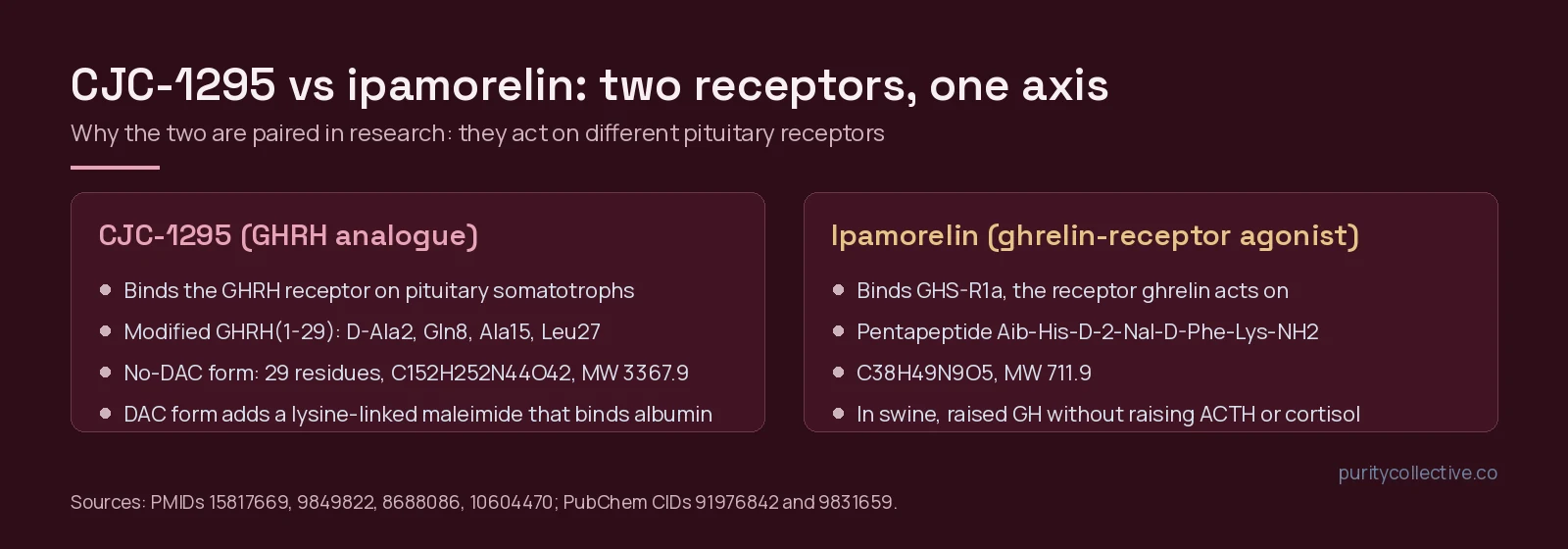
CJC-1295 vs ipamorelin at a glance
| Feature | CJC-1295 (no DAC) | Ipamorelin | CJC-1295 + Ipamorelin blend |
|---|---|---|---|
| Class | GHRH analogue | GHS-R1a (ghrelin receptor) agonist | One of each in a single vial |
| Receptor | GHRH receptor | GHS-R1a | Both |
| Structure | Modified GHRH(1-29)-NH2: D-Ala2, Gln8, Ala15, Leu27 | Aib-His-D-2-Nal-D-Phe-Lys-NH2 | Two separate peptides, not a conjugate |
| Key early finding | Parent DAC form extended GH and IGF-I elevation in healthy adults[5] | Selective GH release without ACTH or cortisol rise in swine[3] | Rationale from GHRH + GHS synergy studies[9],[10] |
| Purity Collective listings | CJC-1295 10mg | Ipamorelin 10mg | 10mg and 20mg |
Identity of each compound
| Compound | Formula | MW (g/mol) | PubChem CID | Note |
|---|---|---|---|---|
| CJC-1295 without DAC | C152H252N44O42 | 3367.9 | 91976842 | Formula and MW printed on Purity’s CJC-1295 reports match this record |
| CJC-1295 with DAC | C165H269N47O46 | 3647.2 | 91971820 | Not what Purity Collective sells |
| Ipamorelin | C38H49N9O5 | 711.9 | 9831659 | Matches the ipamorelin reports |
With DAC vs without DAC
The name CJC-1295 first described a long-acting compound. In the original rat work, three maleimido derivatives of hGRF(1-29) were designed to bind the free thiol on serum albumin; the best one, named CJC-1295, was a tetrasubstituted hGRF(1-29) with an added maleimidopropionamide-lysine at the C-terminus. It resisted DPP-IV in vitro, attached to albumin in rat plasma and was detectable beyond 72 hours[4]. That albumin-binding group is the “drug affinity complex” (DAC).
In healthy adults, the DAC form produced dose-dependent increases in GH and IGF-I lasting days after a single injection, with an estimated half-life of about 6 to 8 days[5]. A follow-up in healthy men found that GH secretion still came in pulses: pulse frequency and size were unchanged, while trough GH and IGF-I rose[6].
The form without DAC keeps the four substitutions but drops the albumin-binding lysine. The substitutions follow earlier structure-activity work: native GHRH and GHRH(1-29) are cut by DPP-IV between residues 2 and 3, and a D-amino acid at position 2 blocks that cleavage[7]; alanine scans of hGHRH(1-29)-NH2 identified substitutions such as Ala15 that kept or raised potency in vitro[8]. Without the albumin anchor, the no-DAC form is expected to act for a much shorter time than the DAC form, but we found no peer-reviewed human pharmacokinetic study of it.
How to tell which one a product is: the molecular weight on the report. About 3368 g/mol means no DAC; about 3647 g/mol means the DAC form. Purity Collective’s CJC-1295 reports print C152H252N44O42 and about 3367.9 g/mol, the no-DAC form.
Ipamorelin and the ghrelin receptor
The GHS receptor was cloned in 1996 from pituitary and hypothalamus as the target of small synthetic GH secretagogues[1]; ghrelin was identified three years later as its natural ligand[2]. Ipamorelin came out of a Novo Nordisk chemistry program as a pentapeptide with GH-releasing potency and efficacy similar to GHRP-6. In swine it did not raise FSH, LH, prolactin or TSH, and unlike GHRP-6 and GHRP-2 it did not raise ACTH or cortisol, even far above the dose needed for GH release[3]. A pharmacokinetic and pharmacodynamic study in healthy volunteers modeled GH release as episodic and found more person-to-person variability in the response than in drug levels[12].
Why the two are combined in research
GHRH-receptor and GHS-receptor agonists act independently, so combining them tests whether the pathways add up or multiply. In 18 normal men, a GH-releasing peptide plus GHRH released GH synergistically[9]. Ghrelin with GHRH did the same in humans, with no synergy for ACTH or prolactin[10]. That synergy has limits: in patients with hypothalamopituitary disconnection, the GHRP-6 response was blocked and GHRH plus GHRP-6 produced no more than the sum of each alone[11], which points to a role for intact hypothalamic input.
Study table
| Compound | Study | Model | Finding | Ref |
|---|---|---|---|---|
| CJC-1295 (DAC) | Albumin-bioconjugate design | Rat; rat pituitary cells | DPP-IV resistance; plasma presence beyond 72 h | [4] |
| CJC-1295 (DAC) | Two randomized ascending-dose trials | Healthy adults | Sustained GH and IGF-I rise; half-life about 6-8 days | [5] |
| CJC-1295 (DAC) | Overnight GH pulsatility | Healthy men | Pulses preserved; trough GH raised | [6] |
| Ipamorelin | Discovery and selectivity | Rat, swine, in vitro | Selective GH release; no ACTH or cortisol rise | [3] |
| Ipamorelin | Postoperative ileus | Rat | Repeated dosing increased fecal output, food intake and weight gain after surgery | [13] |
| Ipamorelin | Randomized phase 2 trial in bowel resection | Human | Null: no significant difference from placebo on the key efficacy measures | [14] |
| Ipamorelin | Body composition | GH-deficient and normal mice | Caution: increased body fat by GH-independent mechanisms | [15] |
| GHRP + GHRH | Combined stimulation | Healthy men | Synergistic GH release | [9] |
| GHRP-6 + GHRH | Combined stimulation | Patients with hypothalamic disconnection | Limit: synergy absent | [11] |
What the evidence does not show
- No study of the blend. We found no peer-reviewed study of CJC-1295 (with or without DAC) combined with ipamorelin. The rationale comes from other GHRH plus GHS pairs[9],[10].
- Little data on the no-DAC form. The human CJC-1295 studies used the DAC form[5],[6]; their multi-day kinetics do not transfer to the no-DAC peptide.
- Rodent results did not hold in people. Ipamorelin improved postoperative gut measures in rats[13], but a randomized human trial found no significant difference from placebo[14].
- Raising GH is not the same as an outcome. In mice, ipamorelin increased body fat through GH-independent routes[15], a reminder that secretagogues have effects beyond GH.
- Neither compound is an approved drug. Both are prohibited in sport, and anti-doping labs have built LC-MS/MS methods to detect CJC-1295 with and without DAC in urine[16].
Reading the product records, including the two-component blend
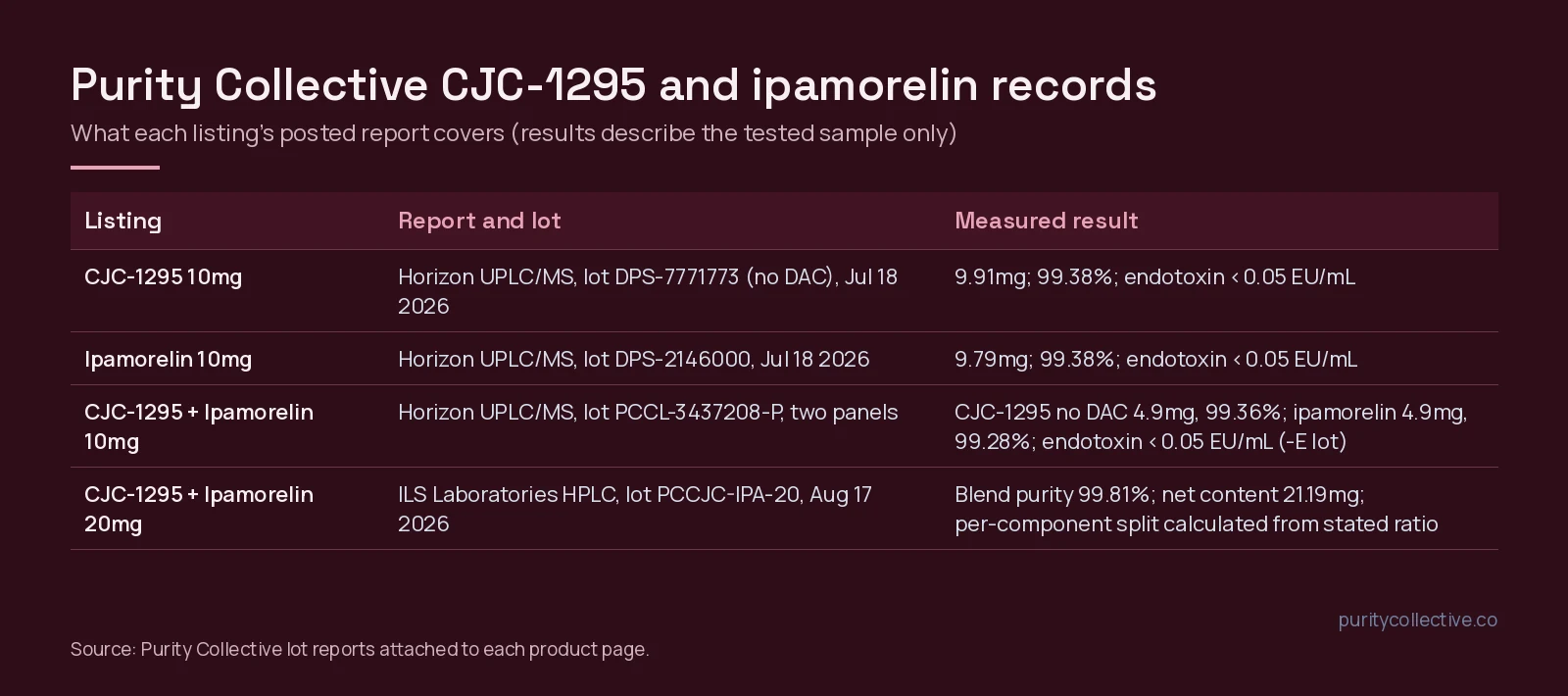
Each Purity Collective listing has a report attached on its product page. For the single compounds, check that the name, formula and molecular weight match the identity table above and that the lot on the report is the lot you are reviewing: CJC-1295 10mg links lot DPS-7771773 (9.91mg, 99.38%), and Ipamorelin 10mg links lot DPS-2146000 (9.79mg, 99.38%); both lots also have an endotoxin report below 0.05 EU/mL.
Blend reports need one more step, because there are two peptides in one sample:
- 10mg blend, two panels. The UPLC/MS report for lot PCCL-3437208-P lists a 5mg specification for each component and measures each one separately: CJC-1295 no DAC 4.9mg at 99.36% and ipamorelin 4.9mg at 99.28%. The endotoxin report for lot PCCL-3437208-E covers the blend at below 0.05 EU/mL.
- 20mg blend, one blend result. The ILS Laboratories HPLC report for lot PCCJC-IPA-20 gives a single blend purity of 99.81%, a net peptide content of 21.19mg, and identity confirmed by retention-time match. Its notes say the per-component figures (CJC-1295 10.38mg, ipamorelin 10.81mg) are calculated from the manufacturer’s stated ratio, so they are not independent measurements of each peptide. The report prints no endotoxin result.
- Do not mix strengths. The 10mg blend report does not describe the 20mg vial, and a single-compound report does not describe either blend.
All posted reports sit in the COA library. Our CJC-1295 + ipamorelin explainer covers the blend’s background, and our page on how to buy research peptides online in the USA covers documentation across categories.
Frequently asked questions
What is the difference between CJC-1295 and ipamorelin?
They act on different receptors. CJC-1295 is a modified fragment of growth hormone-releasing hormone (GHRH) and acts on the GHRH receptor. Ipamorelin is a synthetic pentapeptide that acts on the growth hormone secretagogue receptor (GHS-R1a), the receptor ghrelin binds.
Is Purity Collective’s CJC-1295 with or without DAC?
Without DAC. The posted reports for CJC-1295 10mg (lot DPS-7771773) and for the CJC-1295 + Ipamorelin 10mg blend (lot PCCL-3437208-P) name the compound as CJC-1295 no DAC, with formula C152H252N44O42 and a molecular weight of about 3367.9, which matches PubChem’s record for CJC-1295 without DAC.
Why are CJC-1295 and ipamorelin combined in research?
Because GHRH-receptor and GHS-receptor agonists act through separate pathways, and human studies found that a GH-releasing peptide or ghrelin given with GHRH released more GH than the sum of each alone. No published study has tested CJC-1295 no DAC combined with ipamorelin specifically.
Do the human CJC-1295 studies apply to the no-DAC form?
Not directly. The published human pharmacokinetic studies used CJC-1295 with DAC, the albumin-binding form with a reported half-life of several days. The no-DAC form lacks that albumin-binding group, and we found no peer-reviewed human study of it.
How do I read the blend’s COA?
Read each component separately. The 10mg blend report (lot PCCL-3437208-P) gives one panel for CJC-1295 no DAC and one for ipamorelin, each with its own quantity and purity. The 20mg report (lot PCCJC-IPA-20) gives one blend purity and a net content, and its per-component split is calculated from the stated ratio, not measured separately.
References
- Howard AD, Feighner SD, Cully DF et al. (1996). A receptor in pituitary and hypothalamus that functions in growth hormone release. Science. PMID: 8688086. doi: 10.1126/science.273.5277.974.
- Kojima M, Hosoda H, Date Y et al. (1999). Ghrelin is a growth-hormone-releasing acylated peptide from stomach. Nature. PMID: 10604470. doi: 10.1038/45230.
- Raun K, Hansen BS, Johansen NL et al. (1998). Ipamorelin, the first selective growth hormone secretagogue. Eur J Endocrinol. PMID: 9849822. doi: 10.1530/eje.0.1390552.
- Jetté L, Léger R, Thibaudeau K et al. (2005). Human growth hormone-releasing factor (hGRF)1-29-albumin bioconjugates activate the GRF receptor on the anterior pituitary in rats: identification of CJC-1295 as a long-lasting GRF analog. Endocrinology. PMID: 15817669. doi: 10.1210/en.2004-1286.
- Teichman SL, Neale A, Lawrence B et al. (2006). Prolonged stimulation of growth hormone (GH) and insulin-like growth factor I secretion by CJC-1295, a long-acting analog of GH-releasing hormone, in healthy adults. J Clin Endocrinol Metab. PMID: 16352683. doi: 10.1210/jc.2005-1536.
- Ionescu M, Frohman LA (2006). Pulsatile secretion of growth hormone (GH) persists during continuous stimulation by CJC-1295, a long-acting GH-releasing hormone analog. J Clin Endocrinol Metab. PMID: 17018654. doi: 10.1210/jc.2006-1702.
- Frohman LA, Downs TR, Heimer EP et al. (1989). Dipeptidylpeptidase IV and trypsin-like enzymatic degradation of human growth hormone-releasing hormone in plasma. J Clin Invest. PMID: 2565342. doi: 10.1172/JCI114049.
- Cervini LA, Donaldson CJ, Koerber SC et al. (1998). Human growth hormone-releasing hormone hGHRH(1-29)-NH2: systematic structure-activity relationship studies. J Med Chem. PMID: 9513600. doi: 10.1021/jm970618s.
- Bowers CY, Reynolds GA, Durham D et al. (1990). Growth hormone (GH)-releasing peptide stimulates GH release in normal men and acts synergistically with GH-releasing hormone. J Clin Endocrinol Metab. PMID: 2108187. doi: 10.1210/jcem-70-4-975.
- Hataya Y, Akamizu T, Takaya K et al. (2001). A low dose of ghrelin stimulates growth hormone (GH) release synergistically with GH-releasing hormone in humans. J Clin Endocrinol Metab. PMID: 11549707. doi: 10.1210/jcem.86.9.8002.
- Popovic V, Damjanovic S, Micic D et al. (1995). Blocked growth hormone-releasing peptide (GHRP-6)-induced GH secretion and absence of the synergic action of GHRP-6 plus GH-releasing hormone in patients with hypothalamopituitary disconnection: evidence that GHRP-6 main action is exerted at the hypothalamic level. J Clin Endocrinol Metab. PMID: 7883854. doi: 10.1210/jcem.80.3.7883854.
- Gobburu JV, Agersø H, Jusko WJ et al. (1999). Pharmacokinetic-pharmacodynamic modeling of ipamorelin, a growth hormone releasing peptide, in human volunteers. Pharm Res. PMID: 10496658. doi: 10.1023/a:1018955126402.
- Venkova K, Mann W, Nelson R et al. (2009). Efficacy of ipamorelin, a novel ghrelin mimetic, in a rodent model of postoperative ileus. J Pharmacol Exp Ther. PMID: 19289567. doi: 10.1124/jpet.108.149211.
- Beck DE, Sweeney WB, McCarter MD et al. (2014). Prospective, randomized, controlled, proof-of-concept study of the Ghrelin mimetic ipamorelin for the management of postoperative ileus in bowel resection patients. Int J Colorectal Dis. PMID: 25331030. doi: 10.1007/s00384-014-2030-8.
- Lall S, Tung LY, Ohlsson C et al. (2001). Growth hormone (GH)-independent stimulation of adiposity by GH secretagogues. Biochem Biophys Res Commun. PMID: 11162489. doi: 10.1006/bbrc.2000.4065.
- Memdouh S, Gavrilović I, Ng K et al. (2021). Advances in the detection of growth hormone releasing hormone synthetic analogs. Drug Test Anal. PMID: 34665524. doi: 10.1002/dta.3183.