
For laboratory research only. Not for human or animal use. This article gives no dosing, administration or therapeutic advice.
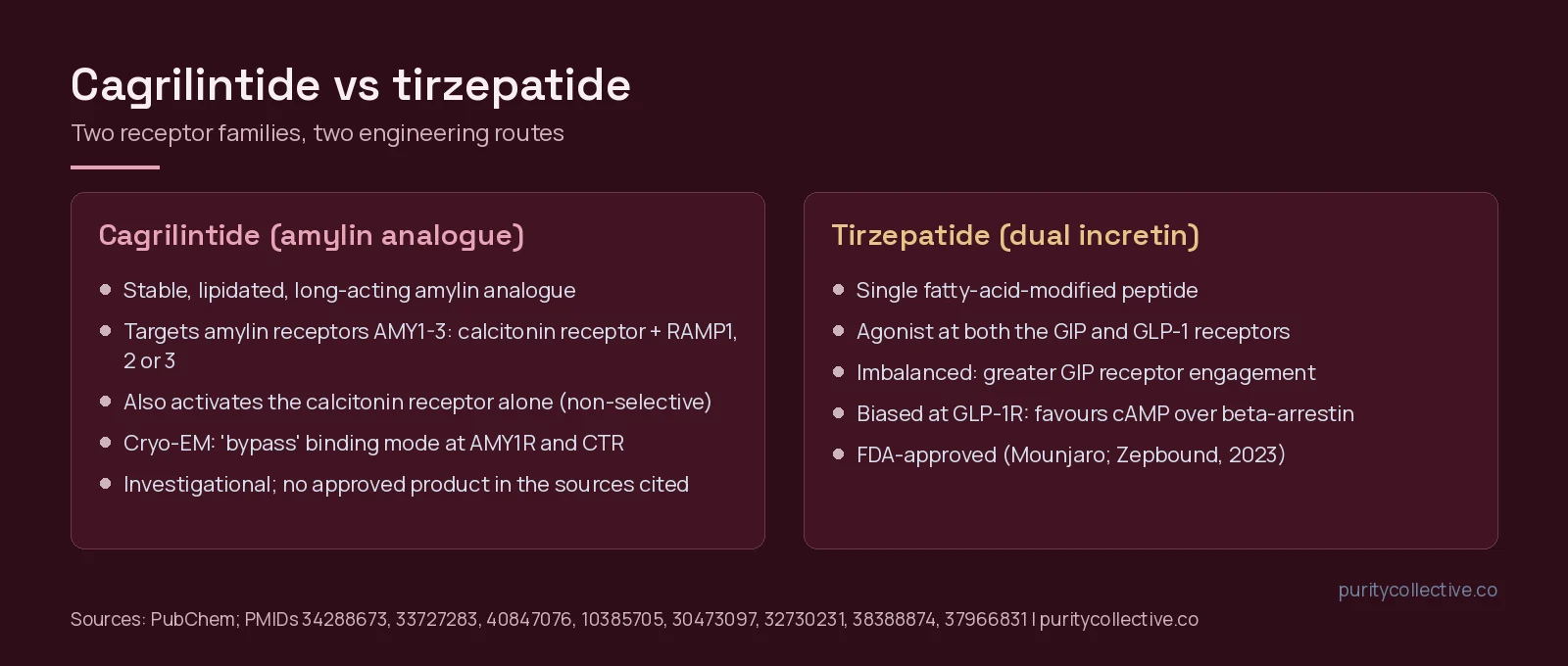
Short answer: cagrilintide and tirzepatide are both long-acting, lipidated peptides from obesity and metabolic research, but they hit different receptor families. Cagrilintide is a stable amylin analogue developed by structure-activity work on the pancreatic hormone amylin [1]. It acts at the amylin receptors and also at the calcitonin receptor on its own [2]. Tirzepatide is one peptide that activates two incretin receptors, the GIP receptor and the GLP-1 receptor [3], with more engagement of the GIP side and a biased signaling profile at the GLP-1 side [4]. Cagrilintide is still investigational. Tirzepatide is FDA-approved as Mounjaro and Zepbound [5][6].
Cagrilintide vs tirzepatide at a glance
| Feature | Cagrilintide | Tirzepatide |
|---|---|---|
| What it is | Stable, lipidated, long-acting amylin analogue (also coded AM833) [1][2] | Fatty acid-modified peptide with dual GIP and GLP-1 receptor agonist activity (coded LY3298176) [3] |
| Native hormone it builds on | Amylin, a 37-amino-acid pancreatic β-cell hormone [7] | The incretins GIP and GLP-1; at the GIP receptor it closely resembles native GIP [8] |
| Receptors | Amylin receptors AMY1, AMY2 and AMY3 (calcitonin receptor plus RAMP1, 2 or 3) and the calcitonin receptor alone [9][2] | GIP receptor and GLP-1 receptor [3] |
| Signalling notes | Non-selective Gs activation through the calcitonin receptor and AMY1R in cryo-EM and functional work [10] | Mimics GIP at the GIP receptor; favours cAMP over β-arrestin recruitment at the GLP-1 receptor [4] |
| Key animal finding | Body-weight effect in high-fat-fed mice depended on AMY1R and AMY3R (RAMP1/3 knockout study) [11] | Insulin sensitization in obese mice partly independent of weight, linked to GIP receptor agonism [12] |
| Regulatory status (US) | Investigational; studied alone in phase 2 and with semaglutide in phase 3a trials [13][14] | Approved as Mounjaro (type 2 diabetes) and, in November 2023, as Zepbound (chronic weight management) [5][6] |
Identity of each compound
| Compound | Class | Formula | MW (g/mol) | PubChem CID |
|---|---|---|---|---|
| Cagrilintide | Acylated amylin analogue | C194H312N54O59S2 | 4409 | 171397054 |
| Tirzepatide | Acylated dual GIP/GLP-1 receptor agonist | C225H348N48O68 | 4813 | 166567236 |
| Pramlintide (reference amylin analogue) | Non-lipidated amylin analogue | C171H267N51O53S2 | 3949 | 70691388 |
The two research compounds sit about 400 g/mol apart, close enough that a molecular weight printed on a lab report needs to be read against the right PubChem record. Both carry a lipid modification, which is why their masses run well above the unmodified peptide backbones. Pramlintide is listed only as the older, non-lipidated amylin analogue that cagrilintide was designed to improve on.
Cagrilintide: an amylin analogue built to last
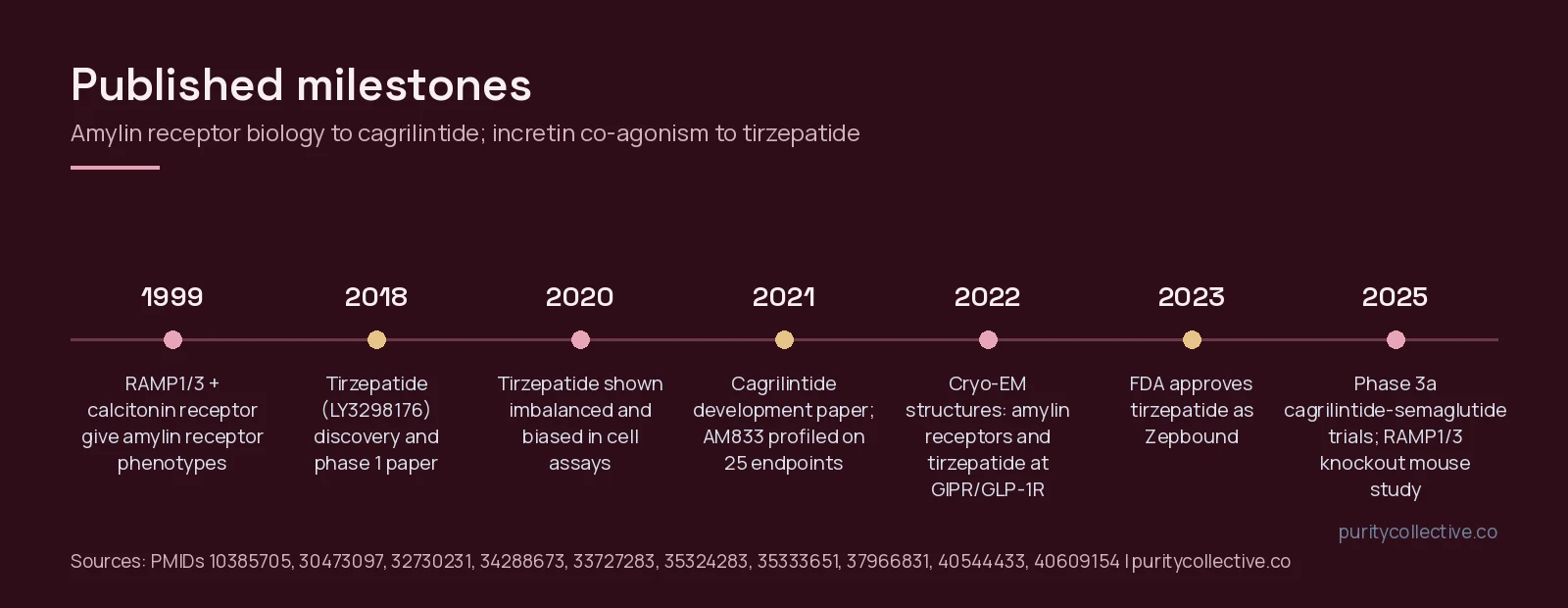
Amylin is co-secreted with insulin from pancreatic β-cells. A 2015 review describes it as a glucoregulatory hormone and a regulator of energy metabolism that acts mainly in the circumventricular organs of the brain [7]. Its receptors are unusual. They are not a single protein: the calcitonin receptor gene product pairs with a receptor activity-modifying protein (RAMP). In transfected COS-7 cells, adding RAMP1 or RAMP3 to the human calcitonin receptor created specific amylin binding and cAMP responses, while RAMP2 did not in that system [15]. Later cryo-EM work solved active AMY1, AMY2 and AMY3 receptor structures and found that amylin binds all three in a similar way, through an ordered mid-peptide motif the authors called the bypass motif. Calcitonin-based peptides engaged the same receptors differently [9].
Native amylin is a difficult drug design starting point because it readily forms amyloid fibrils. The cagrilintide development paper describes the structure-activity work that produced a stable, lipidated, long-acting analogue and led to its selection for clinical development [1]. A pharmacology study profiled it (as AM833) across 25 endpoints of receptor binding, activation and regulation against selective and non-selective comparators, including pramlintide and salmon calcitonin. Its profile was distinct from all of them, and the authors class it as a non-selective agonist of amylin receptors and the calcitonin receptor [2].
A 2026 cryo-EM study added structural detail. Cagrilintide bound AMY1R and the calcitonin receptor in similar bypass-type poses. The authors point to a phenylalanine at position 23 anchoring the peptide near the transmembrane bundle, an intramolecular salt bridge stabilizing the helix, and a C-terminal proline contacting the receptor extracellular domain [10]. Those features, in their reading, explain why one peptide activates several receptors.
Which receptor matters in vivo? In high-fat-fed male mice lacking RAMP1 and RAMP3, cagrilintide lost potency on body weight compared with wild-type littermates, while salmon calcitonin behaved differently. Both peptides activated neurons in brainstem feeding centers of wild-type mice, and the knockouts showed less signal in the area postrema with cagrilintide. The authors concluded the compound depends on AMY1R and AMY3R in that model [11]. It is one mouse study with male animals only.
Pharmacokinetics in humans have been measured, not just modeled. In a phase 1b trial run with semaglutide, cagrilintide showed a half-life of roughly 159 to 195 hours across the doses tested, and its exposure did not change semaglutide exposure or elimination [16]. A separate thorough QT study in healthy participants found no clinically relevant QTc prolongation with cagrilintide [17].
Tirzepatide: one peptide, two incretin receptors
Tirzepatide began as LY3298176, a fatty acid-modified peptide designed to activate both the GIP and GLP-1 receptors. In the discovery paper it activated signaling at both receptors in cell lines, showed glucose-dependent insulin secretion in mice through both receptors, and with chronic dosing in mice reduced body weight and food intake more than a selective GLP-1 receptor agonist [3]. The same paper reports phase 1 safety, tolerability and pharmacokinetics in healthy subjects and people with type 2 diabetes [3]. Our what is tirzepatide explainer covers the compound on its own; here the point is how it differs from an amylin analogue.
The more interesting papers are about how it signals. A 2020 study calculated receptor occupancy and concluded tirzepatide engages the GIP receptor more than the GLP-1 receptor, an “imbalanced” profile. At the GIP receptor it mimicked native GIP. At the GLP-1 receptor it favored cAMP generation over β-arrestin recruitment and drove less receptor internalization than GLP-1 [4]. A separate group, working in HEK293 cells, found tirzepatide biased toward ERK1/2 phosphorylation relative to cAMP at both receptors compared with the native ligands [18]. The two papers used different assays and reference ligands, so “biased” does not mean exactly the same thing in each. Cryo-EM and molecular dynamics work then showed how the fatty acid modification, together with the amino acid sequence, shapes this mode of action [8].
In obese mice, tirzepatide improved insulin sensitivity more than GLP-1 receptor agonism alone. In Glp-1r-null mice, where GLP-1-driven weight change was absent, it still improved insulin sensitivity by raising glucose disposal in white adipose tissue, and a long-acting GIP receptor agonist reproduced that effect [12]. That is the main preclinical evidence that the GIP arm does something the GLP-1 arm does not.
Tirzepatide is approved in the US as Mounjaro for glycemic control in adults with type 2 diabetes [5], and the FDA approved it as Zepbound for chronic weight management on November 8, 2023 [6]. We state those approvals only as regulatory status, not as efficacy claims. If you want tirzepatide set against GLP-1-only and triple agonists instead, see retatrutide vs tirzepatide vs semaglutide.
Where each sits in published trials
| Compound | Study | Model or population | What was measured | Ref |
|---|---|---|---|---|
| Cagrilintide | Receptor pharmacology across 25 endpoints | Cell assays | Binding, activation and regulation at amylin and calcitonin receptors vs comparators | [2] |
| Cagrilintide | RAMP1/3 knockout study | High-fat-fed male mice | Body weight, food intake, brainstem cFos, gene expression | [11] |
| Cagrilintide + semaglutide | Phase 1b, multiple ascending dose | Adults with overweight or obesity, otherwise healthy | Primary: treatment-emergent adverse events; pharmacokinetics | [16] |
| Cagrilintide | Phase 2 dose-finding, placebo- and liraglutide-controlled | Adults without diabetes | Primary: percentage change in body weight at week 26; safety | [13] |
| Cagrilintide + semaglutide | Phase 3a trials (REDEFINE 1 and 2) | Adults with overweight or obesity, with or without type 2 diabetes | Coprimary: body-weight endpoints at week 68; glycemic measures in the diabetes trial | [14][19] |
| Tirzepatide | Discovery and phase 1 | Cell lines, mice; healthy subjects and people with type 2 diabetes | Receptor signaling; safety, tolerability and pharmacokinetics | [3] |
| Tirzepatide | Signalling and occupancy | Cell lines, primary islets | GIP vs GLP-1 receptor engagement; cAMP vs β-arrestin | [4] |
| Tirzepatide | Phase 3 (SURMOUNT-1) | Adults with obesity or overweight, without diabetes | Coprimary: body-weight endpoints at week 72 | [20] |
The cagrilintide clinical program has run mainly as a combination with semaglutide. Purity Collective doesn’t sell semaglutide, so we describe that combination from the literature only.
What the evidence does not show
- No head-to-head study of the two compounds alone. We found no peer-reviewed paper comparing cagrilintide with tirzepatide directly. The side-by-side here draws on separate studies with different models, assays and endpoints.
- The “bias” findings are assay-dependent. Two groups described tirzepatide as biased, but toward different readouts against different references [4][18]. Neither result is a property you can read off a vial.
- Mouse receptor data are narrow. The AMY1R/AMY3R dependence of cagrilintide comes from one knockout study in male, high-fat-fed mice [11], and the GIP-arm insulin sensitization from obese mouse models [12].
- Cagrilintide is not approved. The phase 2 and phase 3a reports describe an investigational compound [13][14]. Trial populations were adults studied under medical supervision, and those results say nothing about any other setting.
- Structure papers are snapshots. Cryo-EM structures show bound, active-state complexes [9][10]. They do not show how long a peptide stays bound in tissue.
How to compare the product records
For lab work, the questions are identity and purity of the batch in hand. Check that the mass on the report matches the PubChem formula above for the compound you ordered, and that the HPLC purity and lot number match your vial. Batch reports for Cagrilintide 10 mg and Tirz-Luxe 10mg (our tirzepatide product, also offered as a tirzepatide pen) are in the COA library; check the batch COA for your lot before you start. If you are setting up a new order, you can also buy research peptides online in the USA through our main research catalog.
Frequently asked questions
What is the main difference between cagrilintide and tirzepatide?
Cagrilintide is a lipidated amylin analogue that activates amylin receptors (the calcitonin receptor paired with RAMP1, 2 or 3) and the calcitonin receptor alone. Tirzepatide is a single fatty acid-modified peptide that activates the GIP and GLP-1 incretin receptors. They work through different receptor families.
Is cagrilintide FDA-approved?
Not in the sources we cite. Cagrilintide has been studied alone in a phase 2 trial and together with semaglutide in phase 3a trials, and it remains an investigational compound in those reports. Tirzepatide, by contrast, is approved in the US as Mounjaro and Zepbound.
What does ‘biased agonist’ mean for tirzepatide?
In cell assays, tirzepatide activated the GLP-1 receptor in a way that favored cAMP signaling over beta-arrestin recruitment and caused less receptor internalization than native GLP-1. Another group, using different assays, found bias toward ERK1/2 phosphorylation. The term depends on the assay and reference ligand used.
Why are both peptides lipidated?
Both were engineered for long persistence. The cagrilintide development paper describes a stable, lipidated, long-acting amylin analogue, and tirzepatide was designed as a fatty acid-modified peptide. Structural work on tirzepatide shows the fatty acid also shapes how it engages its receptors.
Has anyone compared cagrilintide and tirzepatide directly?
We found no peer-reviewed study comparing the two compounds alone. Comparisons in this article draw on separate studies with different models and endpoints, so they describe mechanism and research history rather than relative performance.
References
- Kruse T, Hansen JL, Dahl K et al. (2021). Development of Cagrilintide, a Long-Acting Amylin Analogue. J Med Chem. PMID: 34288673. doi: 10.1021/acs.jmedchem.1c00565.
- Fletcher MM, Keov P, Truong TT et al. (2021). AM833 Is a Novel Agonist of Calcitonin Family G Protein-Coupled Receptors: Pharmacological Comparison with Six Selective and Nonselective Agonists. J Pharmacol Exp Ther. PMID: 33727283. doi: 10.1124/jpet.121.000567.
- Coskun T, Sloop KW, Loghin C et al. (2018). LY3298176, a novel dual GIP and GLP-1 receptor agonist for the treatment of type 2 diabetes mellitus: From discovery to clinical proof of concept. Mol Metab. PMID: 30473097. doi: 10.1016/j.molmet.2018.09.009.
- Willard FS, Douros JD, Gabe MB et al. (2020). Tirzepatide is an imbalanced and biased dual GIP and GLP-1 receptor agonist. JCI Insight. PMID: 32730231. doi: 10.1172/jci.insight.140532.
- France NL, Syed YY (2024). Tirzepatide: A Review in Type 2 Diabetes. Drugs. PMID: 38388874. doi: 10.1007/s40265-023-01992-4.
- Abbasi J (2023). FDA Green-Lights Tirzepatide, Marketed as Zepbound, for Chronic Weight Management. JAMA. PMID: 37966831. doi: 10.1001/jama.2023.24539.
- Hay DL, Chen S, Lutz TA et al. (2015). Amylin: Pharmacology, Physiology, and Clinical Potential. Pharmacol Rev. PMID: 26071095. doi: 10.1124/pr.115.010629.
- Sun B, Willard FS, Feng D et al. (2022). Structural determinants of dual incretin receptor agonism by tirzepatide. Proc Natl Acad Sci U S A. PMID: 35333651. doi: 10.1073/pnas.2116506119.
- Cao J, Belousoff MJ, Liang YL et al. (2022). A structural basis for amylin receptor phenotype. Science. PMID: 35324283. doi: 10.1126/science.abm9609.
- Gu YM, Yuan QN, Li X et al. (2026). Structural and mechanistic insights into dual activation of cagrilintide in amylin and calcitonin receptors. Acta Pharmacol Sin. PMID: 40847076. doi: 10.1038/s41401-025-01635-2.
- Carvas AO, Leuthardt A, Kulka P et al. (2025). Cagrilintide lowers bodyweight through brain amylin receptors 1 and 3. EBioMedicine. PMID: 40609154. doi: 10.1016/j.ebiom.2025.105836.
- Samms RJ, Christe ME, Collins KA et al. (2021). GIPR agonism mediates weight-independent insulin sensitization by tirzepatide in obese mice. J Clin Invest. PMID: 34003802. doi: 10.1172/JCI146353.
- Lau DCW, Erichsen L, Francisco AM et al. (2021). Once-weekly cagrilintide for weight management in people with overweight and obesity: a multicentre, randomised, double-blind, placebo-controlled and active-controlled, dose-finding phase 2 trial. Lancet. PMID: 34798060. doi: 10.1016/S0140-6736(21)01751-7.
- Garvey WT, Blüher M, Osorto Contreras CK et al. (2025). Coadministered Cagrilintide and Semaglutide in Adults with Overweight or Obesity. N Engl J Med. PMID: 40544433. doi: 10.1056/NEJMoa2502081.
- Christopoulos G, Perry KJ, Morfis M et al. (1999). Multiple amylin receptors arise from receptor activity-modifying protein interaction with the calcitonin receptor gene product. Mol Pharmacol. PMID: 10385705. doi: 10.1124/mol.56.1.235.
- Enebo LB, Berthelsen KK, Kankam M et al. (2021). Safety, tolerability, pharmacokinetics, and pharmacodynamics of concomitant administration of multiple doses of cagrilintide with semaglutide 2·4 mg for weight management: a randomised, controlled, phase 1b trial. Lancet. PMID: 33894838. doi: 10.1016/S0140-6736(21)00845-X.
- Gabe MBN, Fuhr R, Sinn A et al. (2024). Cagrilintide is not associated with clinically relevant QTc prolongation: A thorough QT study in healthy participants. Diabetes Obes Metab. PMID: 39279639. doi: 10.1111/dom.15951.
- Yuliantie E, Darbalaei S, Dai A et al. (2020). Pharmacological characterization of mono-, dual- and tri-peptidic agonists at GIP and GLP-1 receptors. Biochem Pharmacol. PMID: 32360365. doi: 10.1016/j.bcp.2020.114001.
- Davies MJ, Bajaj HS, Broholm C et al. (2025). Cagrilintide-Semaglutide in Adults with Overweight or Obesity and Type 2 Diabetes. N Engl J Med. PMID: 40544432. doi: 10.1056/NEJMoa2502082.
- Jastreboff AM, Aronne LJ, Ahmad NN et al. (2022). Tirzepatide Once Weekly for the Treatment of Obesity. N Engl J Med. PMID: 35658024. doi: 10.1056/NEJMoa2206038.