
For laboratory research only. Not for human or animal use. This article gives no dosing, administration or therapeutic advice.
Short answer: erythropoietin (EPO) is the 165-residue glycoprotein hormone that drives red blood cell production [1][2]. ARA 290, also called cibinetide or pyroglutamate helix B surface peptide (pHBSP), is an 11-amino-acid peptide modeled on one small face of EPO’s helix B [3][4]. The two split along a receptor line. EPO builds red cells through an EPO receptor homodimer, while its tissue-protective effects in research models run through a heterocomplex of the EPO receptor and the β common receptor, CD131 [5][3]. ARA 290 was designed to use only the second route, and it showed no erythropoietic activity in the founding study [3]. EPO is an FDA-approved biologic; ARA 290 remains investigational [1][6].
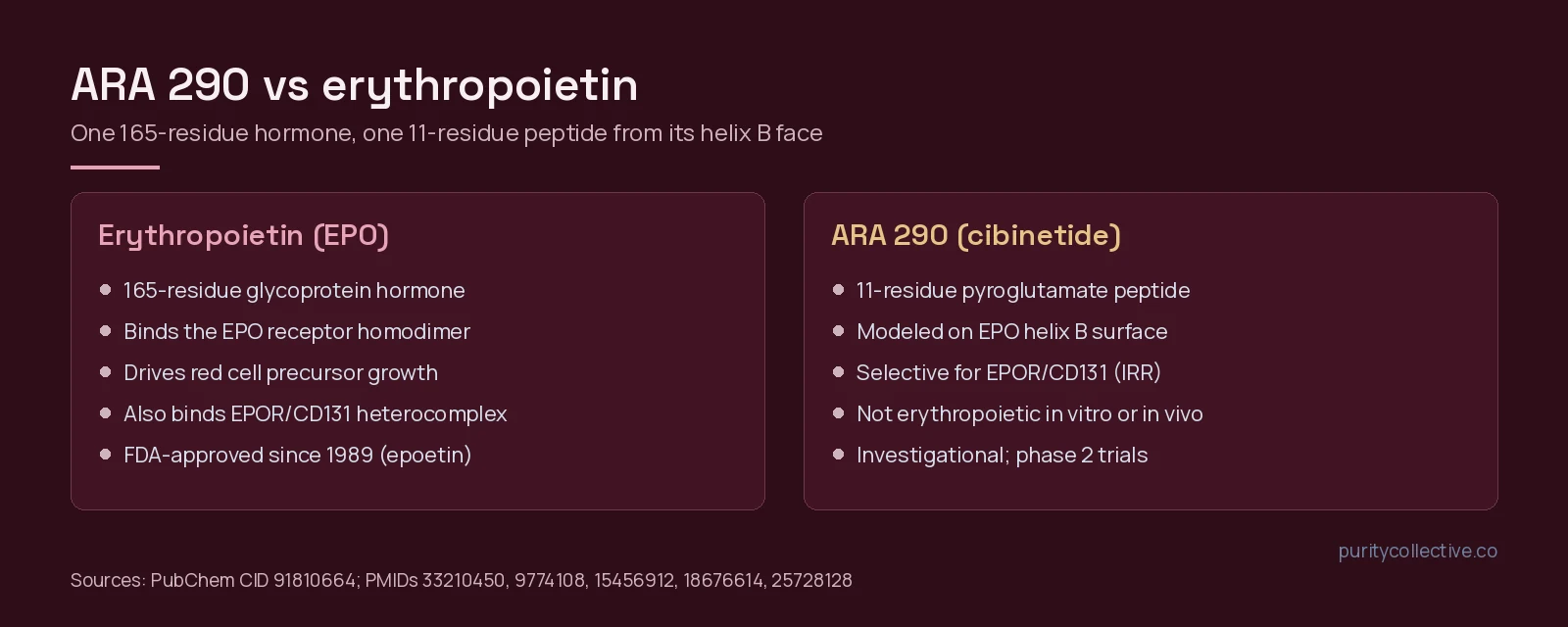
ARA 290 vs erythropoietin at a glance
| Feature | Erythropoietin (EPO) | ARA 290 (cibinetide) |
|---|---|---|
| What it is | 165-residue glycoprotein hormone; recombinant forms are mixtures of glycoforms [1] | 11-amino-acid peptide built from adjacent residues on the aqueous face of EPO helix B [3] |
| Main natural source | Mostly the kidney, with smaller amounts from liver and brain; output tracks blood oxygen [2][7] | Synthetic; no natural counterpart |
| Receptor | EPO receptor homodimer for erythropoiesis; also the EPOR/CD131 heterocomplex [8][5] | EPOR/CD131 heterocomplex, termed the innate repair receptor (IRR) [4] |
| Red cell effect | Stimulates proliferation and differentiation of erythroid precursors [2] | Not erythropoietic in vitro or in vivo in the founding study [3] |
| Glycans and half-life | Carries attached glycans; recombinant EPO is a mix of glycoforms with one amino acid sequence [1] | Short unglycosylated peptide; plasma half-life of about 2 minutes, with longer-lasting downstream effects reported [4] |
| Regulatory status (US) | FDA-approved since 1989; class boxed warning issued in 2007 [1][9] | Investigational; small phase 2 trials published [6][10] |
Identity of each compound
| Compound | Class | Formula | MW (g/mol) | PubChem CID |
|---|---|---|---|---|
| ARA 290 (cibinetide) | Linear 11-residue peptide with N-terminal pyroglutamate | C51H84N16O21 | 1257.3 | 91810664 |
| Erythropoietin | Glycoprotein hormone (165 residues plus attached glycans) | Not applicable | Varies with glycoform | No compound record for the protein |
A name search for “erythropoietin” in PubChem’s compound database returns an unrelated small molecule, not the hormone, so any lab paperwork citing a CID for EPO deserves a second look. ARA 290, by contrast, has a clean compound record with a fixed formula and mass. That makes it straightforward to check against a mass spectrometry identity result on a batch report; our guide on how to read a peptide COA walks through what each line means.
Erythropoietin: one hormone, two receptor complexes
EPO is the main humoral regulator of red cell production. It is made mainly in the kidney, and its plasma level is inversely related to blood oxygen content [2]. The control point is transcription. Low oxygen raises the activity of hypoxia-inducible factors, and HIF-2 in particular switches on EPO synthesis in kidney and liver while also adjusting iron uptake [7].
On erythroid precursors, EPO works by bringing two receptor chains together. A 1.9 Å crystal structure of EPO bound to the receptor’s extracellular domains showed the hormone holding the pair at a fixed 120° angle, and the authors argued that this orientation, not just dimerization, sets signaling efficiency [8]. Earlier mutagenesis work found that cysteine substitutions at the predicted dimer interface left the receptor permanently switched on, which supported ligand-induced homodimerization as the activation step [11].
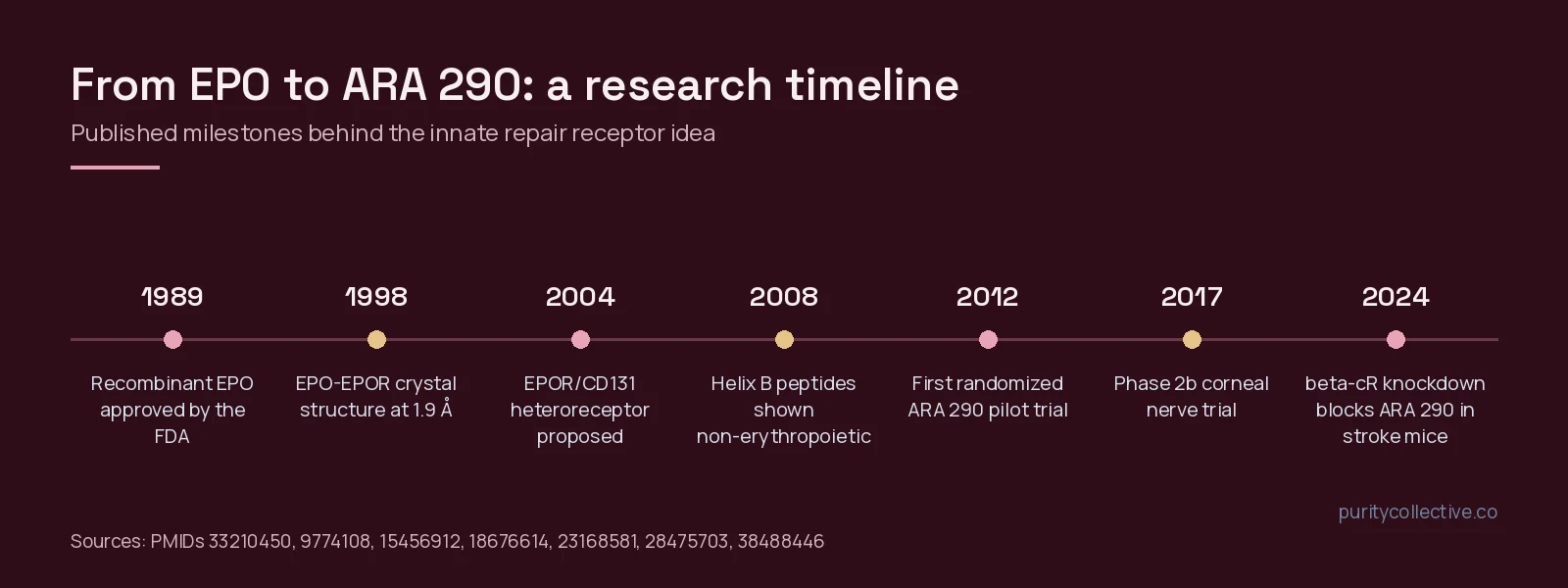
The second receptor came from a puzzle. Carbamylated EPO does not bind the classical receptor or raise red cell production, yet it protected tissue across many injury models. In 2004, Brines and colleagues reported that EPO receptor protein from rat brain, heart, liver and kidney membranes was bound in a complex with the β common receptor, the signaling subunit shared with the GM-CSF, IL-3 and IL-5 receptors. β common receptor knockout mice make red cells normally, so the subunit is not needed for erythropoiesis [5]. A 2015 review describes this heterocomplex as the innate repair receptor and notes that it is usually not expressed in normal tissue but is induced quickly by injury or inflammation [4].
The receptor split cuts both ways. In isolated mouse mesenteric arteries, both EPO and a peptide that activates only the EPOR/β common receptor complex impaired acetylcholine-induced vasodilation, by 100% and 60% respectively [12]. The heterocomplex is therefore not a purely protective pathway in every tissue model.
ARA 290: EPO’s helix B, without the red cell signal
The founding 2008 study mapped EPO’s tissue-protective activity down to short sequences. Helix B, residues 58 to 82, faces the surrounding water when EPO sits on the receptor homodimer. That helix alone was neuroprotective in vitro and tissue protective in rodent models of ischemic stroke, diabetic retinal edema and peripheral nerve trauma. An 11-amino-acid peptide built from the adjacent residues forming helix B’s aqueous face kept that activity in stroke and renal ischemia-reperfusion models, and neither helix B nor the 11-mer was erythropoietic [3]. That 11-mer, with a pyroglutamate at its N-terminus, is the molecule now called ARA 290 or cibinetide [4].
Later work tested whether the β common receptor really carries its effect. In male mice with middle cerebral artery occlusion, ARA 290 gave a neuroprotective effect qualitatively similar to EPO, lowered neuronal apoptosis and brain cytokine levels, and lost much of that effect after siRNA knockdown of the β common receptor [13]. In dextran sulfate colitis in mice, both cibinetide and EPO lessened the disease course, and in LPS-activated primary macrophages the anti-inflammatory effect of cibinetide depended on CD131 and JAK2 and ran through inhibition of the NF-κB p65 subunit [14].
Where each one shows up in research models
| Model | What was measured | Compound(s) | Source |
|---|---|---|---|
| Rat spared nerve injury | Mechanical and cold allodynia up to 20 weeks; spinal microglia and astrocyte markers | ARA 290 vs vehicle, four dose levels | [15] |
| Pig renal ischemia-reperfusion | Glomerular filtration rate over 7 days; MCP-1, IL-6; interstitial fibrosis | ARA 290 vs saline (8 animals) | [16] |
| Mouse ischemic stroke | Infarct size, apoptosis, cytokines; effect after βcR siRNA | ARA 290 and EPO | [13] |
| Mouse DSS colitis; primary macrophages | Disease course, myeloid infiltration; CD131/JAK2 dependence | Cibinetide and EPO | [14] |
| Mouse mesenteric arteries | Endothelium-dependent vasodilation | EPO and an EPOR/βcR-selective peptide | [12] |
In the rat nerve injury study, ARA 290 reduced mechanical allodynia for up to 20 weeks against vehicle in a dose-dependent pattern, and lowered the spinal microglia response [15]. In the pig kidney model, it raised glomerular filtration over seven days and lowered interstitial fibrosis, but the study used eight animals and the cytokine changes only trended [16]. The same pig paper frames the rationale bluntly: high-dose EPO after kidney transplantation did not help short-term outcome in clinical trials and raised thrombotic risk, which is why a non-erythropoietic derivative was tested [16].
What the human studies measured
ARA 290 has been through small, short clinical studies, and the endpoints matter more than the headlines. A 2012 double-blind pilot in 22 people with sarcoidosis and small fiber neuropathy symptoms measured neuropathy screening scores, pain scales, quality of life, depressive symptoms and fatigue over four weeks; the authors reported no safety concerns from clinical or laboratory checks [17]. A 28-day phase 2b trial in 64 participants used corneal nerve fiber area on confocal microscopy as its primary surrogate endpoint; a statistically significant placebo-corrected change appeared in only one of three dose groups [6]. A phase 2 study in type 2 diabetes with painful neuropathy tracked HbA1c, lipids, a neuropathic symptom questionnaire and corneal nerve fiber density over 56 days [18].
Not every study came back positive. A nine-person phase 2 trial in diabetic macular edema found no mean change in visual acuity, central retinal thickness, retinal sensitivity or tear production at week 12, and no anti-cibinetide antibodies [10]. In 36 healthy volunteers, a neuropsychological model of antidepressant action found shifts in emotional face processing but no effects on mood or affective symptoms [19]. All of these are small samples, short follow-up and largely one research network, so they describe what was measured, not an established effect.
Recombinant EPO sits in a different place entirely. It has been an FDA-approved therapeutic glycoprotein since 1989 [1], biosimilar epoetin is now licensed in the US [20], and in March 2007 the FDA added a boxed warning to the erythropoiesis-stimulating agent class covering serious adverse events such as venous thromboembolism [9]. Those clotting and hematocrit concerns are the reason researchers went looking for a receptor-selective fragment in the first place [4].
What the evidence does not show
- No head-to-head human study compares ARA 290 with EPO; the direct comparisons are in mice [13][14].
- The evidence for the innate repair receptor cited here comes from co-precipitation, knockout and knockdown experiments, not from a crystal structure like the one solved for EPO on its homodimer [5][13][8].
- Many of the foundational and clinical ARA 290 papers share authors, and the published trials are phase 2 or earlier [3][18][17][6].
- Activating the EPOR/βcR complex had an unfavorable vascular readout in one mouse artery model [12].
For a lab sourcing material, the practical point is identity. An ARA 290 research peptide should match the cibinetide formula and mass above, and the batch report should cover purity and, where the protocol needs it, endotoxin; our note on purity versus endotoxin reports explains the difference. If you are comparing suppliers before you buy research peptides online in the USA, ask for batch-specific documentation rather than a generic sheet.
Frequently asked questions
Is ARA 290 the same thing as erythropoietin?
No. Erythropoietin is a 165-residue glycoprotein hormone, while ARA 290 (cibinetide) is an 11-amino-acid peptide modeled on the surface of EPO’s helix B. The peptide was designed to keep EPO’s tissue-protective signaling in research models without its red cell effect, and it was not erythropoietic in vitro or in vivo in the founding study (PMID 18676614).
Which receptor does ARA 290 act on?
It is described as a selective ligand of the innate repair receptor, a heterocomplex of the EPO receptor and the β common receptor (CD131). EPO itself signals for red cell production through an EPO receptor homodimer. In stroke mice, silencing the β common receptor suppressed ARA 290’s neuroprotective effect (PMIDs 25728128, 38488446).
Is ARA 290 FDA-approved?
No. ARA 290 is investigational and has been studied in small phase 2 trials. Recombinant erythropoietin (epoetin) has been FDA-approved since 1989, and its class carries an FDA boxed warning issued in 2007 (PMIDs 33210450, 28441110).
Why does a research peptide need a separate comparison with EPO?
Because the two are easy to confuse on paper. They share a parent structure and some overlapping readouts in injury models, but they differ in size, receptor, half-life and regulatory status. Reading a paper correctly depends on knowing which receptor complex a result was tied to.
What should a lab check on an ARA 290 batch?
Identity and purity on the batch certificate of analysis, read against the PubChem record for cibinetide (CID 91810664, formula C51H84N16O21). Purity Collective sells it for laboratory research only, not for human or animal use.
References
- Wang Y, Yang SH, Brimble MA et al. (2020). Recent Progress in the Synthesis of Homogeneous Erythropoietin (EPO) Glycoforms. Chembiochem. PMID: 33210450. doi: 10.1002/cbic.202000347.
- Wenger RH, Kurtz A (2011). Erythropoietin. Compr Physiol. PMID: 23733688. doi: 10.1002/cphy.c100075.
- Brines M, Patel NS, Villa P et al. (2008). Nonerythropoietic, tissue-protective peptides derived from the tertiary structure of erythropoietin. Proc Natl Acad Sci U S A. PMID: 18676614. doi: 10.1073/pnas.0805594105.
- Collino M, Thiemermann C, Cerami A et al. (2015). Flipping the molecular switch for innate protection and repair of tissues: Long-lasting effects of a non-erythropoietic small peptide engineered from erythropoietin. Pharmacol Ther. PMID: 25728128. doi: 10.1016/j.pharmthera.2015.02.005.
- Brines M, Grasso G, Fiordaliso F et al. (2004). Erythropoietin mediates tissue protection through an erythropoietin and common beta-subunit heteroreceptor. Proc Natl Acad Sci U S A. PMID: 15456912. doi: 10.1073/pnas.0406491101.
- Culver DA, Dahan A, Bajorunas D et al. (2017). Cibinetide Improves Corneal Nerve Fiber Abundance in Patients With Sarcoidosis-Associated Small Nerve Fiber Loss and Neuropathic Pain. Invest Ophthalmol Vis Sci. PMID: 28475703. doi: 10.1167/iovs.16-21291.
- Haase VH (2013). Regulation of erythropoiesis by hypoxia-inducible factors. Blood Rev. PMID: 23291219. doi: 10.1016/j.blre.2012.12.003.
- Syed RS, Reid SW, Li C et al. (1998). Efficiency of signalling through cytokine receptors depends critically on receptor orientation. Nature. PMID: 9774108. doi: 10.1038/26773.
- Bian J, Chen B, Hershman DL et al. (2017). Effects of the US Food and Drug Administration Boxed Warning of Erythropoietin-Stimulating Agents on Utilization and Adverse Outcome. J Clin Oncol. PMID: 28441110. doi: 10.1200/JCO.2017.72.6273.
- Lois N, Gardner E, McFarland M et al. (2020). A Phase 2 Clinical Trial on the Use of Cibinetide for the Treatment of Diabetic Macular Edema. J Clin Med. PMID: 32674280. doi: 10.3390/jcm9072225.
- Watowich SS, Hilton DJ, Lodish HF (1994). Activation and inhibition of erythropoietin receptor function: role of receptor dimerization. Mol Cell Biol. PMID: 8196600. doi: 10.1128/mcb.14.6.3535-3549.1994.
- Kilar CR, Diao Y, Sautina L et al. (2018). Activation of the β-common receptor by erythropoietin impairs acetylcholine-mediated vasodilation in mouse mesenteric arterioles. Physiol Rep. PMID: 29939494. doi: 10.14814/phy2.13751.
- Wang RL, Yang ZH, Huang YY et al. (2024). Erythropoietin-derived peptide ARA290 mediates brain tissue protection through the β-common receptor in mice with cerebral ischemic stroke. CNS Neurosci Ther. PMID: 38488446. doi: 10.1111/cns.14676.
- Nairz M, Haschka D, Dichtl S et al. (2017). Cibinetide dampens innate immune cell functions thus ameliorating the course of experimental colitis. Sci Rep. PMID: 29026145. doi: 10.1038/s41598-017-13046-3.
- Swartjes M, van Velzen M, Niesters M et al. (2014). ARA 290, a peptide derived from the tertiary structure of erythropoietin, produces long-term relief of neuropathic pain coupled with suppression of the spinal microglia response. Mol Pain. PMID: 24529189. doi: 10.1186/1744-8069-10-13.
- van Rijt WG, Nieuwenhuijs-Moeke GJ, van Goor H et al. (2013). ARA290, a non-erythropoietic EPO derivative, attenuates renal ischemia/reperfusion injury. J Transl Med. PMID: 23302512. doi: 10.1186/1479-5876-11-9.
- Heij L, Niesters M, Swartjes M et al. (2012). Safety and efficacy of ARA 290 in sarcoidosis patients with symptoms of small fiber neuropathy: a randomized, double-blind pilot study. Mol Med. PMID: 23168581. doi: 10.2119/molmed.2012.00332.
- Brines M, Dunne AN, van Velzen M et al. (2015). ARA 290, a nonerythropoietic peptide engineered from erythropoietin, improves metabolic control and neuropathic symptoms in patients with type 2 diabetes. Mol Med. PMID: 25387363. doi: 10.2119/molmed.2014.00215.
- Cerit H, Veer IM, Dahan A et al. (2015). Testing the antidepressant properties of the peptide ARA290 in a human neuropsychological model of drug action. Eur Neuropsychopharmacol. PMID: 26431906. doi: 10.1016/j.euroneuro.2015.09.005.
- Kalantar-Zadeh K (2017). History of Erythropoiesis-Stimulating Agents, the Development of Biosimilars, and the Future of Anemia Treatment in Nephrology. Am J Nephrol. PMID: 28142147. doi: 10.1159/000455387.