
For laboratory research only. Not for human or animal use. This article gives no dosing, administration or therapeutic advice.
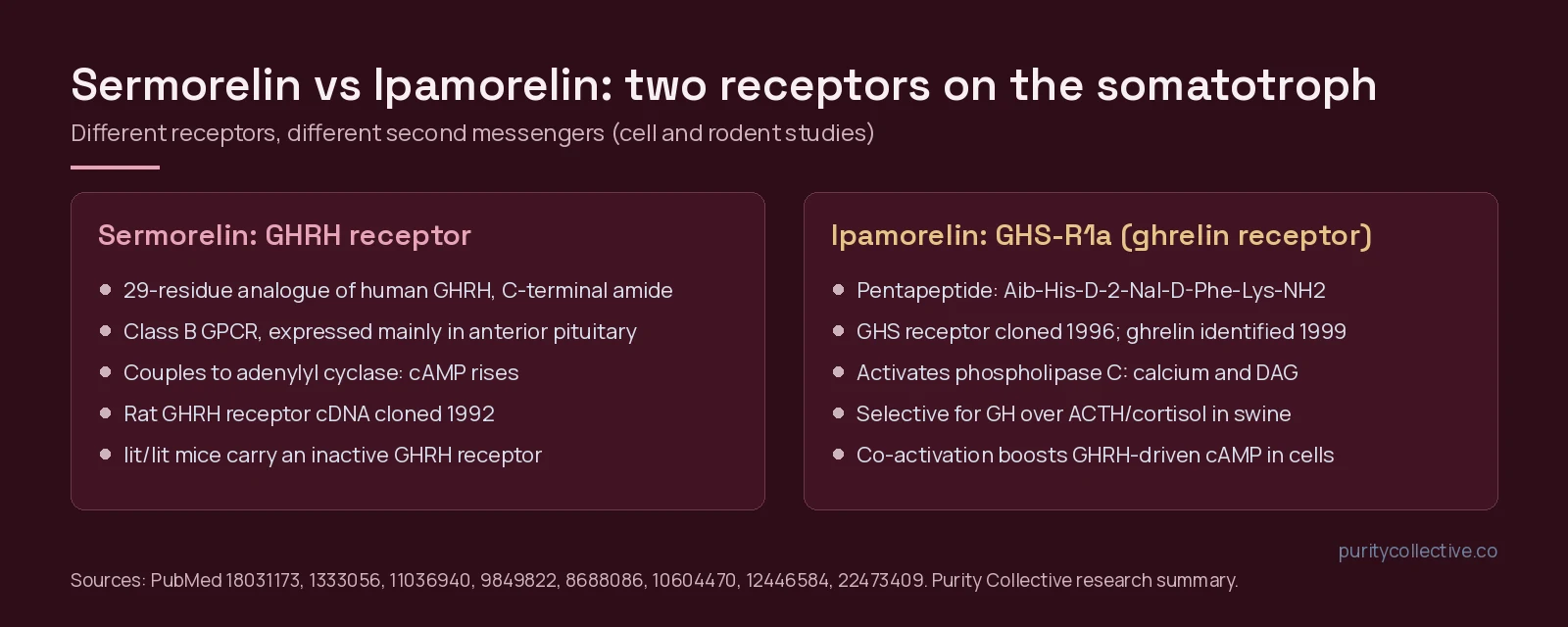
Short answer: sermorelin and ipamorelin both release growth hormone from rat pituitary cells, but they start at different receptors. Sermorelin is a 29-amino-acid analogue of human growth hormone-releasing hormone (GHRH), the shortest synthetic peptide reported to carry GHRH’s full biological activity [1]. It acts at the GHRH receptor, which raises cAMP [2][3]. Ipamorelin is a pentapeptide growth hormone secretagogue (GHS) [4] that acts at the GHS receptor, now known as the ghrelin receptor [5][6]. That receptor works through phospholipase C and calcium, not cAMP [3][7]. Because the two pathways are separate, they can add to each other in cell and rodent studies [3][8]. Neither compound sold for research is an approved drug product.
Sermorelin vs ipamorelin at a glance
| Feature | Sermorelin | Ipamorelin |
|---|---|---|
| What it is | 29-amino-acid analogue of human GHRH [1] | Synthetic pentapeptide, Aib-His-D-2-Nal-D-Phe-Lys-NH2 [4] |
| Design origin | The N-terminal 1-29 region of the hypothalamic hormone GHRH [1] | A chemistry programme on GHRP-1 analogues lacking its central Ala-Trp dipeptide [4] |
| Receptor | GHRH receptor, a class B GPCR found mainly in the anterior pituitary [2][9] | GHS receptor type 1a (ghrelin receptor), in pituitary and hypothalamus [5][6] |
| Second messenger | Adenylyl cyclase and cAMP [2][3] | Phospholipase C, calcium and diacylglycerol; no cAMP on its own [3][7] |
| Natural ligand of the receptor | GHRH from the hypothalamus [9] | Ghrelin, an octanoylated 28-residue stomach peptide [6] |
| Hormone selectivity in animals | GHRH is the reference for GH-selective release in the ipamorelin swine study [4] | No ACTH or cortisol rise beyond the GHRH comparison in swine, unlike GHRP-6 and GHRP-2 [4] |
| US regulatory status | Former Geref products withdrawn in 2009 after the sponsor discontinued them (Federal Register, 2013); none currently marketed | We found no FDA-approved ipamorelin product; it appears in the literature as an investigational compound |
Identity of each compound
| Compound | Class | Formula | MW (g/mol) | PubChem CID |
|---|---|---|---|---|
| Sermorelin | GHRH(1-29) analogue | C149H246N44O42S | 3357.9 | 16132413 |
| Ipamorelin | Pentapeptide GHS | C38H49N9O5 | 711.9 | 9831659 |
The two differ almost five-fold in mass. That is a useful first check on a batch report: a mass spectrum for sermorelin should sit near 3,358, and one for ipamorelin near 712. A report that shows the wrong neighbourhood points to the wrong compound, not a minor purity issue.
Sermorelin and the GHRH receptor
GHRH is the hypothalamic peptide that drives somatotroph cells in the anterior pituitary to make and secrete growth hormone, and it also stimulates their proliferation during development [9]. Sermorelin keeps the first 29 residues of human GHRH, which a 1999 review describes as the shortest synthetic peptide with GHRH’s full biological activity [1].
Its receptor was cloned in 1992. A cDNA isolated from rat pituitary encoded a seven-transmembrane G protein-coupled receptor. Its human homologue, expressed in kidney 293 cells, bound human GHRH with high affinity and specificity and raised intracellular cAMP. The receptor is homologous to the secretin and VIP receptors, and in the rat its mRNA was found mainly, perhaps only, in the anterior pituitary [2]. Later work placed it in family B-III of the GPCR superfamily and showed that its gene promoter is selectively active in pituitary cells [9]. That narrow tissue distribution is one reason GHRH analogues are treated as pituitary-focused tools.
For the chemistry of sermorelin versus the longer-acting GHRH analogue tesamorelin, including DPP-IV cleavage, see our tesamorelin vs sermorelin comparison.
Ipamorelin and the ghrelin receptor
The ghrelin receptor was found before ghrelin. In 1996, Howard and colleagues cloned a G protein-coupled receptor from pig and human pituitary and hypothalamus and showed it was the target of small synthetic growth hormone secretagogues. They proposed that these compounds mimicked a hormone nobody had found yet [5]. In 1999, Kojima and colleagues purified that hormone from rat stomach: a 28-amino-acid peptide with an n-octanoyl group on serine 3, which they named ghrelin [6].
Ipamorelin came out of the synthetic side of that story. Raun and colleagues described it in 1998 as a pentapeptide from a series that dropped the central Ala-Trp of GHRP-1. In primary rat pituitary cells its potency and efficacy for growth hormone release were comparable to GHRP-6 [4]. The result that gave it its name as “the first selective” secretagogue came from conscious swine. None of the secretagogues tested changed FSH, LH, prolactin or TSH. GHRP-6 and GHRP-2 raised ACTH and cortisol, but ipamorelin did not raise them beyond the levels seen after GHRH, even well above the amounts needed for growth hormone release [4]. That is one species and one research group, which matters when the selectivity claim is repeated.
The ghrelin receptor signals differently from the GHRH receptor. It activates phospholipase C and raises intracellular calcium [7], and in a cell system expressing both receptors, activating the GHS receptor alone produced no cAMP [3]. For how ipamorelin is paired with the GHRH analogue CJC-1295 in research, see CJC-1295 vs ipamorelin.
Where the two pathways meet
The comparison gets more interesting when both receptors are present.
- cAMP potentiation in engineered cells. In cells expressing cloned GHRH and GHS receptors, co-activation produced a cAMP response about twice that of GHRH receptor activation alone. The effect needed both receptors, worked with several peptide and non-peptide secretagogues, and did not appear with forskolin or with the related VIP and secretin receptors. Blocking phospholipase C, protein kinase C or G protein βγ subunits did not remove it, and the authors speculated about a direct interaction between the two receptors [3].
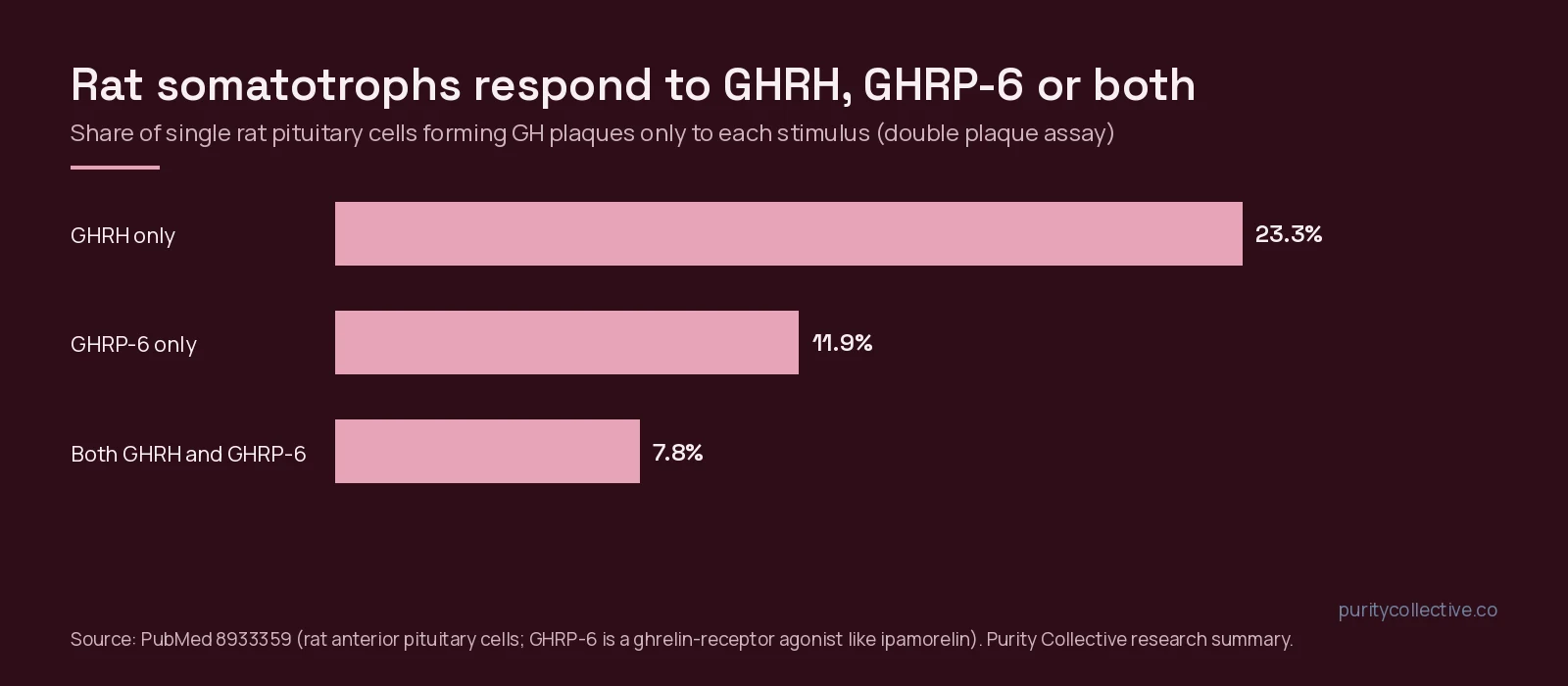
- Additive, not synergistic, in rat cells. In single rat anterior pituitary cells studied by reverse haemolytic plaque assay, GHRH and GHRP-6 each increased growth hormone release, and together they increased it further. The authors described the combined effect as additive but not synergistic. A somatostatin analogue partly suppressed the response to either stimulus [8].
- Different cells answer each signal. The same study found somatotrophs that responded only to GHRH, others only to GHRP-6, and a smaller group that responded to both [8]. GHRP-6 is used here as a ghrelin-receptor agonist in the same class as ipamorelin; the study did not test ipamorelin itself.
- A broken GHRH receptor does not fully silence the GHS route. In lit/lit mice, which carry mutated GHRH receptors, a GHS (GHRP-2) still produced a limited but statistically significant growth hormone rise, smaller than in heterozygous and wild-type mice [10].
What rodent studies of ipamorelin measured
| Model | What was measured | Result as reported | Ref |
|---|---|---|---|
| Adult female rats, 15 days | Longitudinal tibial growth rate, IGF-I, bone markers, pituitary GH response | Growth rate rose dose-dependently; IGF-I, IGFBPs and bone turnover markers did not change; the GH response to an ipamorelin challenge was marginally reduced afterwards, while the response to GHRH was unchanged | [11] |
| Adult female rats (ipamorelin and GHRP-6) | Bone mineral content (DXA), pQCT, ash weight | Bone mineral content rose with bone size, but volumetric density and mineral concentration were unchanged | [12] |
| Adult rats given a glucocorticoid | Calf muscle tension, periosteal bone formation | Combined glucocorticoid plus ipamorelin groups had higher muscle tension and bone formation than glucocorticoid alone | [13] |
| Rat postoperative ileus model | Time to first bowel movement, faecal output, food intake | A single dose shortened time to first bowel movement but did not change 48-hour faecal output; repeated dosing increased output and food intake | [14] |
The bone results are a good example of reading past the headline. “Increased bone mineral content” in the second study came from bigger bones, not denser bone [12]. And the reduced pituitary response after repeated ipamorelin in the first study fits the cell finding that the GHS receptor desensitises within minutes of stimulation by another secretagogue, hexarelin [11][7].
What the evidence does not show
- No direct sermorelin vs ipamorelin study. We found no paper that tests sermorelin and ipamorelin side by side. The pathway work used native GHRH and other secretagogues such as GHRP-6 and GHRP-2 [3][8][10].
- The selectivity result is narrow. Ipamorelin’s lack of ACTH and cortisol release comes from conscious swine in the original report [4]. It is a species-specific measurement, not a general property.
- Animal findings stay animal findings. The bone, muscle and gut results come from rats [11][12][13][14] and do not describe effects in people.
- Regulatory history is not a recommendation. Geref’s approvals were withdrawn after the sponsor discontinued the products, and FDA later determined that this was not for reasons of safety or effectiveness (Federal Register, 2013). That history does not apply to research-grade material.
Reading the product records
For lab work, the first questions are identity and purity of the lot in hand. Compare the mass on the report for Sermorelin 5mg or Ipamorelin 10mg with the PubChem formulas above, check that the HPLC purity and lot number match your vial, and review the batch COA in our COA library before you start. If you are setting up a new order, you can also buy research peptides online in the USA through our main catalog.
Frequently asked questions
What is the main difference between sermorelin and ipamorelin?
Sermorelin is a 29-amino-acid GHRH analogue that acts at the GHRH receptor and raises cAMP. Ipamorelin is a pentapeptide that acts at the ghrelin (GHS) receptor, which signals through phospholipase C and calcium. Both release growth hormone from rat pituitary cells, through separate pathways.
Is ipamorelin a ghrelin mimetic?
Ipamorelin is an agonist at the GHS receptor type 1a, the receptor for the stomach hormone ghrelin. It is a synthetic pentapeptide and is structurally unrelated to ghrelin itself, which is an octanoylated 28-residue peptide.
Do GHRH and ghrelin-receptor agonists work together?
In engineered cells, activating both receptors roughly doubled the cAMP response to GHRH. In rat pituitary cells, GHRH and GHRP-6 together released more growth hormone than either alone, an effect the authors called additive rather than synergistic.
Why is ipamorelin called selective?
In conscious swine, GHRP-6 and GHRP-2 raised ACTH and cortisol, but ipamorelin did not raise them beyond the levels seen after GHRH. That result comes from one animal species in the original 1998 report.
Is sermorelin FDA-approved?
Not currently. A 2013 Federal Register notice records that FDA withdrew approval of the Geref (sermorelin acetate) products in 2009 after the sponsor discontinued them, and determined the withdrawal was not for reasons of safety or effectiveness.
References
- Prakash A, Goa KL (1999). Sermorelin: a review of its use in the diagnosis and treatment of children with idiopathic growth hormone deficiency. BioDrugs. PMID: 18031173. doi: 10.2165/00063030-199912020-00007.
- Mayo KE (1992). Molecular cloning and expression of a pituitary-specific receptor for growth hormone-releasing hormone. Mol Endocrinol. PMID: 1333056. doi: 10.1210/mend.6.10.1333056.
- Cunha SR, Mayo KE (2002). Ghrelin and growth hormone (GH) secretagogues potentiate GH-releasing hormone (GHRH)-induced cyclic adenosine 3′,5′-monophosphate production in cells expressing transfected GHRH and GH secretagogue receptors. Endocrinology. PMID: 12446584. doi: 10.1210/en.2002-220670.
- Raun K, Hansen BS, Johansen NL et al. (1998). Ipamorelin, the first selective growth hormone secretagogue. Eur J Endocrinol. PMID: 9849822. doi: 10.1530/eje.0.1390552.
- Howard AD, Feighner SD, Cully DF et al. (1996). A receptor in pituitary and hypothalamus that functions in growth hormone release. Science. PMID: 8688086. doi: 10.1126/science.273.5277.974.
- Kojima M, Hosoda H, Date Y et al. (1999). Ghrelin is a growth-hormone-releasing acylated peptide from stomach. Nature. PMID: 10604470. doi: 10.1038/45230.
- Orkin RD, New DI, Norman D et al. (2003). Rapid desensitisation of the GH secretagogue (ghrelin) receptor to hexarelin in vitro. J Endocrinol Invest. PMID: 14669829. doi: 10.1007/BF03347357.
- Mitani M, Kaji H, Abe H et al. (1996). Growth hormone (GH)-releasing peptide and GH releasing hormone stimulate GH release from subpopulations of somatotrophs in rats. J Neuroendocrinol. PMID: 8933359. doi: 10.1046/j.1365-2826.1996.05283.x.
- Mayo KE, Miller T, DeAlmeida V et al. (2000). Regulation of the pituitary somatotroph cell by GHRH and its receptor. Recent Prog Horm Res. PMID: 11036940.
- Peroni CN, Hayashida CY, Nascimento N et al. (2012). Growth hormone response to growth hormone-releasing peptide-2 in growth hormone-deficient little mice. Clinics (Sao Paulo). PMID: 22473409. doi: 10.6061/clinics/2012(03)11.
- Johansen PB, Nowak J, Skjaerbaek C et al. (1999). Ipamorelin, a new growth-hormone-releasing peptide, induces longitudinal bone growth in rats. Growth Horm IGF Res. PMID: 10373343. doi: 10.1054/ghir.1999.9998.
- Svensson J, Lall S, Dickson SL et al. (2000). The GH secretagogues ipamorelin and GH-releasing peptide-6 increase bone mineral content in adult female rats. J Endocrinol. PMID: 10828840. doi: 10.1677/joe.0.1650569.
- Andersen NB, Malmlöf K, Johansen PB et al. (2001). The growth hormone secretagogue ipamorelin counteracts glucocorticoid-induced decrease in bone formation of adult rats. Growth Horm IGF Res. PMID: 11735244. doi: 10.1054/ghir.2001.0239.
- Venkova K, Mann W, Nelson R et al. (2009). Efficacy of ipamorelin, a novel ghrelin mimetic, in a rodent model of postoperative ileus. J Pharmacol Exp Ther. PMID: 19289567. doi: 10.1124/jpet.108.149211.