
For laboratory research only. Not for human or animal use. This article gives no dosing, administration or therapeutic advice.
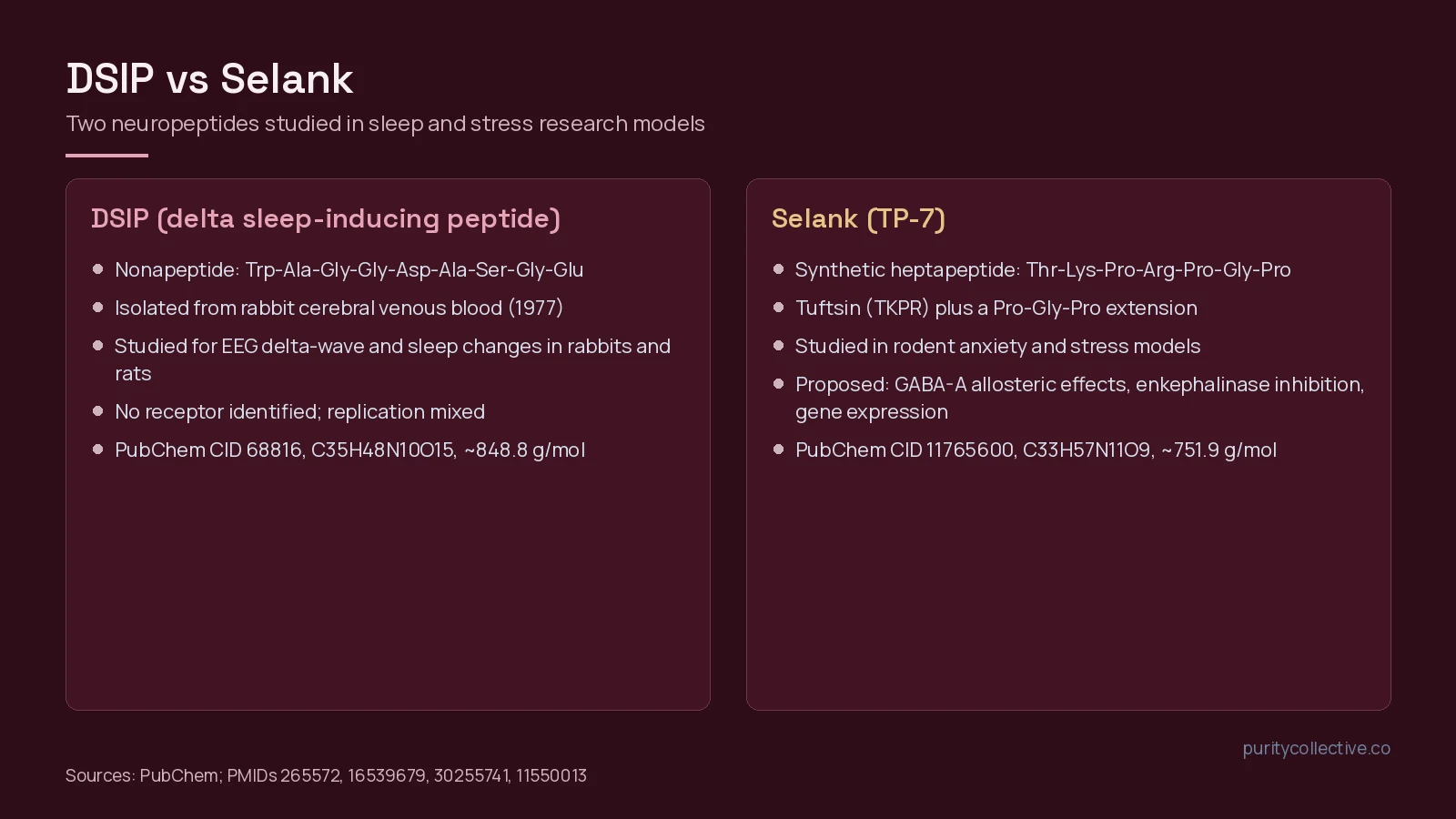
Short answer: DSIP and Selank are both short peptides that come up in sleep and stress research, but they have almost nothing else in common. DSIP (delta sleep-inducing peptide) is a nine-residue peptide first isolated from rabbits in 1977 and named for the slow-wave EEG pattern it enhanced after infusion into the rabbit brain [1]. Decades later its gene, precursor protein and receptor are still unknown, and a 2006 review called the sleep-factor idea “extremely poorly documented” [2]. Selank is a synthetic seven-residue peptide: the immune peptide tuftsin with a Pro-Gly-Pro tail added. It has been studied mainly in rodent anxiety and stress models, with proposed actions on GABA-A receptor binding and on the enzymes that break down enkephalins [3][4]. One is a natural compound whose biology remains unclear; the other is a designed analogue with a short, mostly Russian, literature.
DSIP vs Selank at a glance
| Feature | DSIP | Selank |
|---|---|---|
| Origin | Isolated from cerebral venous blood of rabbits after electrical stimulation of the thalamus [5][2] | Synthetic analogue of tuftsin (Thr-Lys-Pro-Arg) extended with Pro-Gly-Pro [3] |
| Sequence | Trp-Ala-Gly-Gly-Asp-Ala-Ser-Gly-Glu (9 residues) [1] | Thr-Lys-Pro-Arg-Pro-Gly-Pro (7 residues) [3] |
| Known receptor | None identified; no gene or precursor protein isolated [2] | No dedicated receptor; radioligand work describes allosteric effects on [3H]GABA binding [3] |
| Main research question | Does it change EEG sleep patterns, and does it act on stress hormones? [1][6] | Does it change anxiety-like behavior in rodents, and through which systems? [7][8] |
| Main models | Rabbit and rat EEG and sleep recordings, dog and guinea pig transport studies, rat brain mitochondria [9][10][11] | Mouse and rat stress and anxiety tests, rat brain gene-expression panels, a human neuroblastoma cell line [12][13][14] |
| State of the evidence | Mixed: early positive rabbit EEG data, but null results in rats for native DSIP and in small human hormone studies [9][15][16] | Small number of research groups; human work limited to Russian clinical studies; described in a 2021 US review as poorly studied [17] |
Identity of each compound
| Compound | Length | Formula | MW (g/mol) | PubChem CID |
|---|---|---|---|---|
| DSIP | 9 residues | C35H48N10O15 | 848.8 | 68816 |
| Selank (TP-7) | 7 residues | C33H57N11O9 | 751.9 | 11765600 |
The two peptides are close in mass, so a printed molecular weight alone separates them by only about 97 g/mol. The compositions are very different, though. DSIP is rich in glycine and carries two acidic residues (Asp and Glu), while Selank is built around three prolines and two basic residues (Lys and Arg). A mass spectrum that matches the formula in the table is the cleanest way to tell which one is in a vial.
DSIP: a sleep-factor candidate that never found its receptor
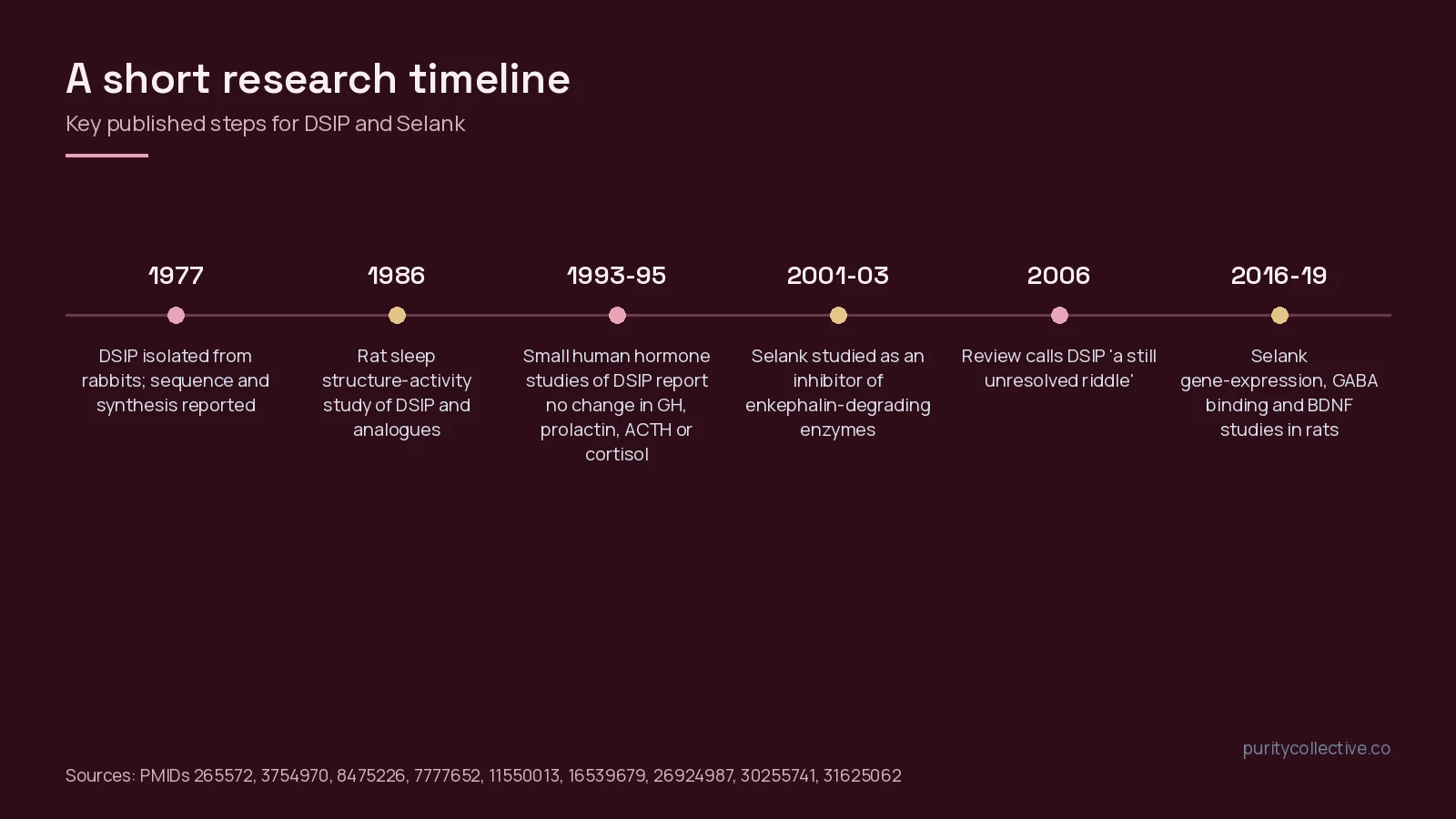
The DSIP story starts in Basel. Researchers collected dialysate from the cerebral venous blood of rabbits given hypnogenic electrical stimulation of the thalamus and isolated a peptide from it [5]. They sequenced it as Trp-Ala-Gly-Gly-Asp-Ala-Ser-Gly-Glu, made it synthetically, and infused it into the brain ventricles of rabbits under double-blind conditions alongside eight related peptides. Across 58 rabbits including controls, only synthetic DSIP gave a specific increase in delta and spindle EEG patterns [1].
Replication was the problem. In a rat study, native DSIP injected into the brain at dark onset did not increase sleep over the following 24 hours. Two D-amino-acid analogues did promote sleep early in the night, and the authors suggested native DSIP was simply degraded too quickly to act [9]. That fits a blood-stability study: DSIP incubated in human or rat blood was broken down, releasing tryptophan-like products, while a phosphorylated analogue lasted longer [18]. The same paper raised the question of whether faster breakdown explained why DSIP results varied between labs.
Transport work went in a different direction. In anesthetized dogs, DSIP given into a vein raised DSIP immunoreactivity in cerebrospinal fluid, and much of it was intact peptide [10]. In a perfused guinea pig brain, uptake of labeled DSIP was partly saturable, which the authors read as binding at specific sites on brain capillaries [19].
DSIP also turned up in endocrine and stress studies. In ovariectomized rats, DSIP injected into the third ventricle raised plasma growth hormone (GH), an effect blocked by a dopamine receptor antagonist; it also raised GH release from cultured rat pituitary cells [20]. In pretreated rats, intravenous DSIP lowered the corticosterone response to corticotropin-releasing factor (CRF) but not to ACTH, which pointed to an action at the pituitary [6]. In isolated rat brain mitochondria, DSIP changed measures of oxidative phosphorylation, including the rate of phosphorylating respiration [11]. More recently, a rat focal stroke study measured infarct volume and motor tests after intranasal DSIP; the infarct difference versus vehicle was not significant, while rotarod scores differed [21].
The 2006 review that called DSIP “a still unresolved riddle” summed up the gap: DSIP-like immunoreactivity sits in hypothalamic neurosecretory nuclei, the peptide shows a wide range of activity in lab studies, yet no DSIP gene, protein or receptor had been found. The authors proposed that one or more still-unknown DSIP-like peptides may explain the findings [2].
Selank: a designed tuftsin analogue
Selank (also coded TP-7) was designed rather than discovered. Its sequence, Thr-Lys-Pro-Arg-Pro-Gly-Pro, is the four-residue peptide tuftsin (Thr-Lys-Pro-Arg) with Pro-Gly-Pro added at the C-terminus [3]. The research on it comes mostly from Russian groups and falls into three lines.
Enkephalin-degrading enzymes. In human plasma in vitro, Selank inhibited the enzymatic breakdown of enkephalin more strongly than the peptidase inhibitors bacitracin and puromycin [4]. In mice, the effect depended on strain: Selank lengthened plasma leu-enkephalin half-life and changed open-field behavior in BALB/c mice but had no effect on either measure in C57Bl/6 mice [12].
GABA-A receptors. In radioligand studies on rat brain membranes, Selank changed [3H]GABA binding in the manner of a positive allosteric modulator, and it blocked the modulating effect of diazepam and olanzapine. The authors suggested its binding site differs from theirs but may partly overlap [3]. In rats, Selank and GABA changed the expression of many of 84 neurotransmission genes in the frontal cortex, with correlated patterns between the two [13]. In human IMR-32 neuroblastoma cells, though, Selank alone produced no change in the mRNA levels of the same gene panel; it only altered the changes caused by GABA or olanzapine [14]. That is a useful null result: the gene effects seen in rat brain did not appear as a direct effect in this cell line.
Behavior and BDNF. Across rats and two mouse strains sorted by emotional reactivity, Selank and ten tuftsin-family peptides were compared in a conflict-based stress model [7]. In an unpredictable chronic mild stress study, rats received Selank, diazepam or both, and anxiety-like behavior was measured in the elevated plus maze; the combination group differed most under chronic stress [8]. In rats given ethanol as their only fluid for 30 weeks, Selank was studied for object-recognition performance and for brain-derived neurotrophic factor (BDNF) content in the hippocampus and frontal cortex [22].
Human data are thin. A 2008 Russian study compared Selank with the benzodiazepine medazepam in 62 patients and measured rating scales and serum enkephalin half-life [23]. A 2021 US review of GABA-acting sedative-hypnotics described Selank as a poorly studied Russian drug sold to US consumers as a dietary supplement [17]. It is not an FDA-approved drug.
For the broader background on Selank and its sister peptide Semax, see our explainer on what Selank and Semax are.
Study table
| Compound | Study | Model | What was reported | Ref |
|---|---|---|---|---|
| DSIP | Isolation and synthesis | Rabbits (intraventricular infusion) | Specific increase in delta and spindle EEG patterns; related peptides inactive | [1] |
| DSIP and analogues | Structure-activity, 24 h sleep recording | Rats | Native DSIP did not increase sleep; two D-amino-acid analogues did early in the night | [9] |
| DSIP | Biostability | Human and rat blood in vitro | Rapid degradation; phosphorylated analogue more persistent | [18] |
| DSIP | Blood-to-CSF passage | Anesthetized dogs | Intact DSIP detected in CSF after intravenous injection | [10] |
| DSIP | GH and prolactin | Healthy women (n=8) | No change in GH or prolactin secretion or their rhythm | [15] |
| DSIP | ACTH and cortisol | Healthy men | CRH- and meal-induced ACTH and cortisol responses matched placebo | [16] |
| Selank | Enkephalinase inhibition | Human plasma in vitro | Inhibited enkephalin hydrolysis more than bacitracin and puromycin | [4] |
| Selank | Strain comparison | BALB/c and C57Bl/6 mice | Effects on behavior and enkephalin half-life in BALB/c only | [12] |
| Selank | Gene expression | Rat frontal cortex | Expression changes in 45 of 84 genes at 1 h, 22 at 3 h | [13] |
| Selank | Gene expression | IMR-32 neuroblastoma cells | No direct change in the same gene panel | [14] |
What the evidence does not show
- No DSIP receptor or gene. More than four decades after isolation, no DSIP gene, precursor or receptor has been identified, so the mechanism behind any DSIP effect is still a hypothesis [2].
- No consistent sleep effect for native DSIP. The rabbit EEG result did not carry over to rats in a 24-hour recording, where only modified analogues changed sleep [1][9].
- No hormone effect in small human studies. The rat GH and corticosterone findings [20][6] were not matched by the human measurements of GH, prolactin, ACTH and cortisol [15][16].
- No independent replication base for Selank. Most Selank studies come from a small cluster of Russian labs, and the one cell-line gene study found no direct effect [14].
- No head-to-head studies. We found no paper that tested DSIP and Selank in the same model. Any comparison here is between separate literatures with different methods.
- No US drug approval. Neither peptide is an FDA-approved drug [17].
Reading the product records for each compound
Both peptides are sold as research materials in two formats: lyophilized vials and ready-made nasal spray solutions. The format changes what a lab has to check, not what the compound is. For a vial, the batch report should confirm identity and purity of the powder. For a solution, the concentration and the lot on the bottle matter as much as the peptide itself.
- DSIP 5mg. Our COA library lists a DSIP 5mg report (batch PCDSIP-5) with identity confirmed by HPLC. Check the batch on your vial against it on the DSIP 5mg listing.
- DSIP Nasal Spray 5mg. A batch COA for this product isn’t posted yet. See the DSIP nasal spray page for an added report.
- Selank 10mg. The posted UPLC/MS report (lot PCCL-240644) names Selank with CAS 129954-34-3, PubChem CID 11765600 and about 751.9 g/mol, which match PubChem. Read the purity and quantity lines on the Selank 10mg listing.
- Selank Nasal Spray 5mg. A batch COA for this product isn’t posted yet. Check the Selank nasal spray page before relying on the vial lot’s report.
Every posted report sits in the COA library, and our guide on how to read a peptide COA walks through each field. When you’re ready to buy research peptides online in the USA, match the lot number on the label to the lot number on the report.
Frequently asked questions
What is the difference between DSIP and Selank?
DSIP is a natural nine-residue peptide (Trp-Ala-Gly-Gly-Asp-Ala-Ser-Gly-Glu) isolated from rabbits in 1977 and studied for EEG sleep patterns (PMID 265572). Selank is a synthetic seven-residue analogue of tuftsin with a Pro-Gly-Pro extension, studied mainly in rodent anxiety and stress models (PMID 30255741).
Does DSIP have a known receptor?
No. A 2006 review notes that no DSIP gene, precursor protein or receptor has been isolated, and calls the sleep-factor hypothesis poorly documented (PMID 16539679).
How is Selank thought to work in lab studies?
Proposed mechanisms include inhibition of enkephalin-degrading enzymes (PMID 11550013) and allosteric modulation of GABA binding in rat brain membranes (PMID 30255741). A cell-line study found no direct effect of Selank on GABA-system gene expression (PMID 28293190).
Were DSIP findings replicated?
Results were mixed. Native DSIP did not increase sleep in a 24-hour rat recording (PMID 3754970), and small human studies found no change in GH, prolactin, ACTH or cortisol (PMIDs 8475226, 7777652).
Are DSIP or Selank FDA-approved?
Neither is an FDA-approved drug. A 2021 US review described Selank as a poorly studied Russian drug sold to US consumers as a dietary supplement (PMID 34396551). Purity Collective supplies both for laboratory research only.
What should a lab check on the COA for each?
Check identity by mass spectrometry against the expected molecular weight (about 848.8 g/mol for DSIP, about 751.9 g/mol for Selank), then the purity line, the lot number and, for nasal spray solutions, whether a batch report is posted for that format.
References
- Schoenenberger GA, Monnier M (1977). Characterization of a delta-electroencephalogram (-sleep)-inducing peptide. Proc Natl Acad Sci U S A. PMID: 265572. doi: 10.1073/pnas.74.3.1282.
- Kovalzon VM, Strekalova TV (2006). Delta sleep-inducing peptide (DSIP): a still unresolved riddle. J Neurochem. PMID: 16539679. doi: 10.1111/j.1471-4159.2006.03693.x.
- Vyunova TV, Andreeva L, Shevchenko K et al. (2018). Peptide-based Anxiolytics: The Molecular Aspects of Heptapeptide Selank Biological Activity. Protein Pept Lett. PMID: 30255741. doi: 10.2174/0929866525666180925144642.
- Zozulya AA, Kost NV, Yu Sokolov O et al. (2001). The inhibitory effect of Selank on enkephalin-degrading enzymes as a possible mechanism of its anxiolytic activity. Bull Exp Biol Med. PMID: 11550013. doi: 10.1023/a:1017979514274.
- Schoenenberger GA, Maier PF, Tobler HJ et al. (1978). The delta EEG (sleep)-inducing peptide (DSIP). XI. Amino-acid analysis, sequence, synthesis and activity of the nonapeptide. Pflugers Arch. PMID: 568769. doi: 10.1007/BF00581575.
- Graf MV, Kastin AJ, Coy DH et al. (1985). Delta-sleep-inducing peptide reduces CRF-induced corticosterone release. Neuroendocrinology. PMID: 2995861. doi: 10.1159/000124200.
- Kozlovskaya MM, Kozlovskii II, Val’dman EA et al. (2003). Selank and short peptides of the tuftsin family in the regulation of adaptive behavior in stress. Neurosci Behav Physiol. PMID: 14969422. doi: 10.1023/a:1025988519919.
- Kasian A, Kolomin T, Andreeva L et al. (2017). Peptide Selank Enhances the Effect of Diazepam in Reducing Anxiety in Unpredictable Chronic Mild Stress Conditions in Rats. Behav Neurol. PMID: 28280289. doi: 10.1155/2017/5091027.
- Obál F Jr, Kovalzon VM, Kalikhevich VN et al. (1986). Structure-activity relationship in the effects of delta-sleep-inducing peptide (DSIP) on rat sleep. Pharmacol Biochem Behav. PMID: 3754970. doi: 10.1016/0091-3057(86)90432-6.
- Banks WA, Kastin AJ, Coy DH (1982). Delta sleep-inducing peptide crosses the blood-brain-barrier in dogs: some correlations with protein binding. Pharmacol Biochem Behav. PMID: 6897451. doi: 10.1016/0091-3057(82)90486-5.
- Khvatova EM, Samartzev VN, Zagoskin PP et al. (2003). Delta sleep inducing peptide (DSIP): effect on respiration activity in rat brain mitochondria and stress protective potency under experimental hypoxia. Peptides. PMID: 12668217. doi: 10.1016/s0196-9781(03)00040-8.
- Sokolov OY, Meshavkin VK, Kost NV et al. (2002). Effects of Selank on behavioral reactions and activities of plasma enkephalin-degrading enzymes in mice with different phenotypes of emotional and stress reactions. Bull Exp Biol Med. PMID: 12432865. doi: 10.1023/a:1015582302311.
- Volkova A, Shadrina M, Kolomin T et al. (2016). Selank Administration Affects the Expression of Some Genes Involved in GABAergic Neurotransmission. Front Pharmacol. PMID: 26924987. doi: 10.3389/fphar.2016.00031.
- Filatova E, Kasian A, Kolomin T et al. (2017). GABA, Selank, and Olanzapine Affect the Expression of Genes Involved in GABAergic Neurotransmission in IMR-32 Cells. Front Pharmacol. PMID: 28293190. doi: 10.3389/fphar.2017.00089.
- Giusti M, Carraro A, Porcella E et al. (1993). Delta sleep-inducing peptide administration does not influence growth hormone and prolactin secretion in normal women. Psychoneuroendocrinology. PMID: 8475226. doi: 10.1016/0306-4530(93)90057-r.
- Späth-Schwalbe E, Schäfer A, Uthgenannt D et al. (1995). Delta-sleep-inducing peptide does not affect CRH and meal-induced ACTH and cortisol secretion. Psychoneuroendocrinology. PMID: 7777652. doi: 10.1016/0306-4530(94)00050-k.
- Doyno CR, White CM (2021). Sedative-Hypnotic Agents That Impact Gamma-Aminobutyric Acid Receptors: Focus on Flunitrazepam, Gamma-Hydroxybutyric Acid, Phenibut, and Selank. J Clin Pharmacol. PMID: 34396551. doi: 10.1002/jcph.1922.
- Graf MV, Saegesser B, Schoenenberger GA (1987). Degradation and aggregation of delta sleep-inducing peptide (DSIP) and two analogs in plasma and serum. Peptides. PMID: 3628078. doi: 10.1016/0196-9781(87)90031-3.
- Zlokovic BV, Susic VT, Davson H et al. (1989). Saturable mechanism for delta sleep-inducing peptide (DSIP) at the blood-brain barrier of the vascularly perfused guinea pig brain. Peptides. PMID: 2547200. doi: 10.1016/0196-9781(89)90026-0.
- Iyer KS, McCann SM (1987). Delta sleep-inducing peptide (DSIP) stimulates growth hormone (GH) release in the rat by hypothalamic and pituitary actions. Peptides. PMID: 3575154. doi: 10.1016/0196-9781(87)90163-x.
- Tukhovskaya EA, Ismailova AM, Shaykhutdinova ER et al. (2021). Delta Sleep-Inducing Peptide Recovers Motor Function in SD Rats after Focal Stroke. Molecules. PMID: 34500605. doi: 10.3390/molecules26175173.
- Kolik LG, Nadorova AV, Antipova TA et al. (2019). Selank, Peptide Analogue of Tuftsin, Protects Against Ethanol-Induced Memory Impairment by Regulating of BDNF Content in the Hippocampus and Prefrontal Cortex in Rats. Bull Exp Biol Med. PMID: 31625062. doi: 10.1007/s10517-019-04588-9.
- Zozulia AA, Neznamov GG, Siuniakov TS et al. (2008). [Efficacy and possible mechanisms of action of a new peptide anxiolytic selank in the therapy of generalized anxiety disorders and neurasthenia]. Zh Nevrol Psikhiatr Im S S Korsakova. PMID: 18454096.