
Your cart is currently empty!.
You may check out all the available products and buy some in the shop.
Continue ShoppingCompound guide · SS-31 (elamipretide)
SS-31 is a four-residue synthetic peptide that concentrates in the inner mitochondrial membrane and binds cardiolipin. Under the name elamipretide it has been through human trials for heart, kidney, muscle and mitochondrial diseases, most of which missed their primary endpoints, and in 2025 it received a narrow FDA accelerated approval for one rare disease. This guide covers its identity checked against PubChem, the laboratory and clinical record including the null trials, and what Purity Collective has and has not documented for its two listings.
For laboratory research only. Not for human or animal use. The research-grade material sold here is not the FDA-approved drug product. This guide gives no dosing, reconstitution, administration or therapeutic advice.


Purity Collective lists SS-31 in two vial sizes. They are the same compound, but they are not equally documented, and that is the most important difference between them.
| Listing | Format | Lot report | What the report covers |
|---|---|---|---|
| SS-31 10mg | Lyophilized vial | None posted | No batch certificate is published for this listing as of October 1, 2026. |
| SS-31 50mg | Lyophilized vial | PCSS31-50 (ILS Laboratories COA-2026-Z9DG6S) | HPLC purity, net peptide content, identity by retention-time match, fentanyl screen. No endotoxin line. |
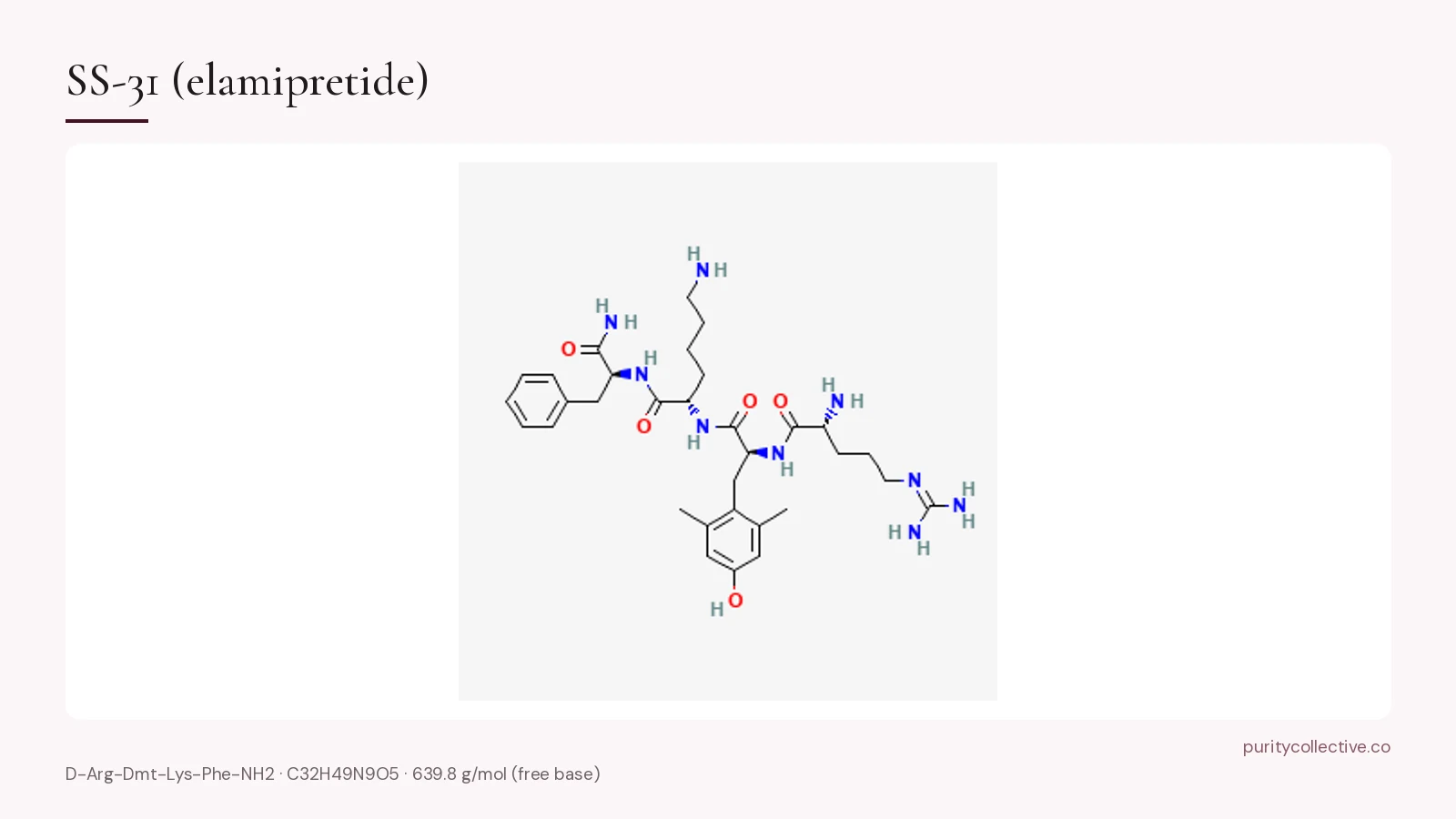
Key facts. SS-31 is D-Arg-Dmt-Lys-Phe-NH2 (Dmt = 2′,6′-dimethyltyrosine), also known as elamipretide, MTP-131 and Bendavia. It was designed to carry an antioxidant residue into mitochondria and was later shown to bind the inner-membrane lipid cardiolipin. In the United States, Forzinity (elamipretide) injection received FDA accelerated approval on September 19, 2025 for Barth syndrome in patients weighing at least 30 kg. Trials in heart attack, heart failure and primary mitochondrial myopathy did not meet their primary endpoints.
SS-31 is one of the Szeto-Schiller peptides, a series designed around alternating aromatic and basic residues. In the 2004 paper that described the series, these peptides were cell-permeable, concentrated about 1000-fold in the inner mitochondrial membrane, reduced reactive oxygen species and cell death in neuronal cells, blocked calcium-induced swelling and cytochrome c release in isolated mitochondria, and improved contractile force in an ex vivo heart model; analogues lacking the dimethyltyrosine did not reduce mitochondrial ROS[15178689].
The explanation shifted over the next decade from “antioxidant” to “cardiolipin binder”. In rats subjected to renal ischemia, SS-31 pretreatment protected mitochondrial cristae, prevented swelling and sped ATP recovery on reperfusion, and the authors traced the effect to an interaction with cardiolipin that protects the heme iron of cytochrome c[23813215]. A 2014 review laid out that cardiolipin-protective model and the compound’s development path[24117165]. The mechanism matters for interpreting the rest of the literature: cardiolipin is exactly what is abnormal in Barth syndrome, the one disease where the clinical picture turned positive.
SS-31 is often listed beside MOTS-c and NAD+ as a mitochondrial compound, but the three have little in common beyond the organelle. SS-31 is a synthetic tetrapeptide that nature never made; it acts from outside the genome by sitting in the inner membrane and binding cardiolipin[24117165]. MOTS-c is a 16-residue peptide encoded in the mitochondrial genome itself, first described in 2015 as a regulator of metabolic homeostasis in mice[25738459] and later shown to move into the nucleus under metabolic stress[29983246]. NAD+ is not a peptide at all but a coenzyme. A result for one of them says nothing about the others, and none of the MOTS-c or NAD+ work involves cardiolipin binding. Purity’s research library has separate records on MOTS-c and NAD+.
Checked against PubChem on October 1, 2026, not copied from a lot report.
| Attribute | Value |
|---|---|
| Names | SS-31, elamipretide, MTP-131, Bendavia, Szeto-Schiller peptide 31 |
| Sequence | D-Arg-Dmt-Lys-Phe-NH2 (Dmt = 2′,6′-dimethyl-L-tyrosine), C-terminal amide |
| Molecular formula | C32H49N9O5 (free base) |
| Molecular weight | 639.8 g/mol (free base; salt forms weigh more) |
| PubChem CID | 11764719 |
| CAS | 736992-21-5 (listed in PubChem for CID 11764719) |
| Target | Cardiolipin on the inner mitochondrial membrane |
| US regulatory status | The drug product Forzinity (elamipretide) injection has FDA accelerated approval for Barth syndrome (September 2025). The research peptide sold here is not that product and is for laboratory use only. |
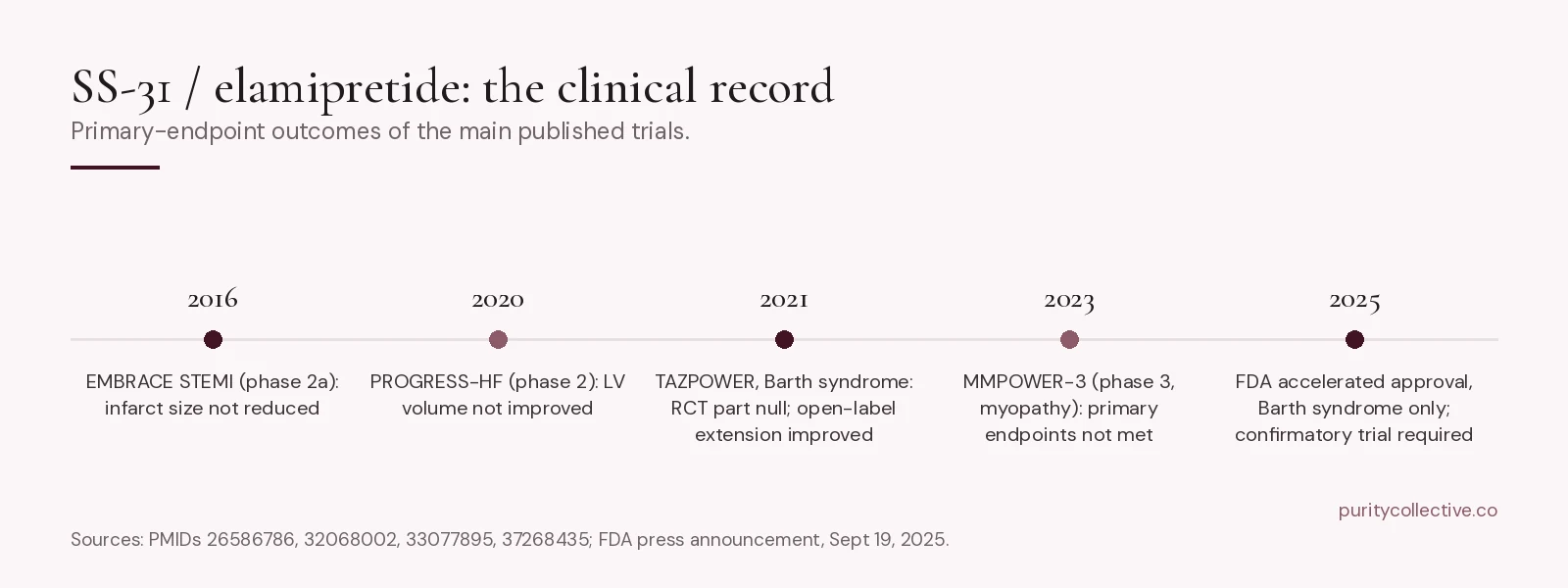
According to the FDA’s announcement, Forzinity (elamipretide) injection was granted accelerated approval on September 19, 2025 as the first treatment for Barth syndrome, in patients weighing at least 30 kg. The approval rests on improved knee-extensor muscle strength, an intermediate endpoint the agency considers reasonably likely to predict benefit, and it requires the manufacturer to run a confirmatory randomized, placebo-controlled trial (FDA press announcement). A 2026 drug profile summarizes the same approval and its basis[41335372], and a second review describes it as the first cardiolipin-directed mitochondrial therapeutic[41260682]. Elamipretide is not approved for any other condition in the United States.
Beyond the founding cell and isolated-mitochondria work[15178689] and the rat kidney ischemia model[23813215], the strongest preclinical thread is aging muscle. In aged mice, a single treatment rapidly improved mitochondrial coupling and the PCr/ATP energy ratio in skeletal muscle, made the muscle more fatigue-resistant an hour later and, after eight days, increased whole-animal endurance; it had no observable effect on young muscle[23692570]. A later aged-mouse study reported restored redox balance and better treadmill endurance without an increase in mitochondrial content[30597195], which points to better function of existing mitochondria rather than more of them.
The clinical record is mostly negative, and it is the part most often left out. In EMBRACE STEMI, a phase 2a trial in patients with a first anterior ST-elevation heart attack, intravenous MTP-131 was safe but did not reduce infarct size or improve imaging, angiographic or clinical outcomes[26586786]. In stable heart failure with reduced ejection fraction, a single infusion was well tolerated and the highest-exposure cohort showed smaller left ventricular volumes[29217757], but the four-week PROGRESS-HF phase 2 trial found no improvement in left ventricular end-systolic volume or ejection fraction versus placebo[32068002]. MMPOWER-3, a phase 3 trial in 218 adults with primary mitochondrial myopathy, did not meet its primary endpoints on the six-minute walk test or fatigue score[37268435].
Barth syndrome is caused by defects in the TAZ gene, which leave cardiolipin abnormal. In the TAZPOWER trial, the randomized crossover part met neither primary endpoint; in the open-label extension, participants showed improvement in six-minute walk distance and a Barth-specific symptom score at 36 weeks[33077895], and a 168-week extension reported those changes were sustained, alongside changes in cardiac volumes and cardiolipin ratios[38602181]. Open-label extensions have no placebo group, which is one reason the FDA approval is an accelerated one with a confirmatory trial attached.
| Model | Design | What was measured | Outcome (direction only) | PMID |
|---|---|---|---|---|
| Neuronal cells; isolated mitochondria; ex vivo heart | Laboratory | ROS, swelling, cytochrome c release, contractile force | Protective; required the Dmt residue | [15178689] |
| Rat renal ischemia | Pretreatment vs control | Cristae, ATP recovery, kidney function | Protective; cardiolipin interaction | [23813215] |
| Aged mice | Acute and 8-day treatment | Muscle energetics, fatigue, endurance | Improved in old, not young, muscle | [23692570] |
| Aged mice | Treatment vs untreated | Redox state, exercise tolerance | Improved without more mitochondria | [30597195] |
| Anterior STEMI patients | Phase 2a RCT | Infarct size (CK-MB AUC) | No reduction vs placebo | [26586786] |
| HFrEF patients | Single-infusion RCT | Safety, LV volumes | Tolerated; volumes smaller at highest exposure | [29217757] |
| HFrEF patients | PROGRESS-HF, phase 2 RCT | LV end-systolic volume at 4 weeks | No improvement vs placebo | [32068002] |
| Primary mitochondrial myopathy (218 adults) | MMPOWER-3, phase 3 RCT | Six-minute walk, fatigue score | Primary endpoints not met | [37268435] |
| Barth syndrome | TAZPOWER RCT + open-label extension | Six-minute walk, symptom score | RCT part null; extension improved | [33077895] |
| Barth syndrome | 168-week open-label extension | Function, cardiac volumes, cardiolipin | Changes sustained (no placebo arm) | [38602181] |
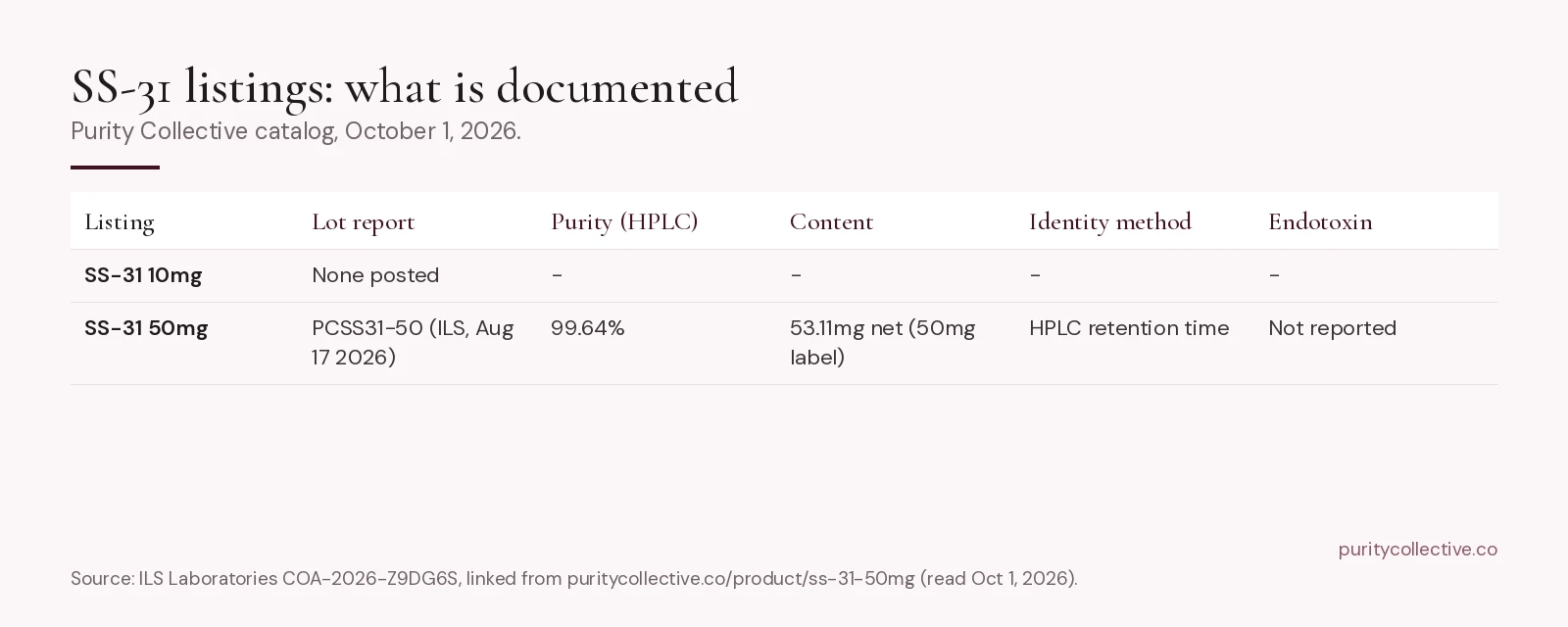
SS-31 50mg, lot PCSS31-50 (ILS Laboratories, San Diego, COA-2026-Z9DG6S, analysis August 17, 2026, HPLC): peptide purity 99.64% against a ≥95.0% specification, net peptide content 53.11mg reported against a 50mg labeled content, identity confirmed as SS-31 (elamipretide) by HPLC retention-time comparison with a reference standard, and fentanyl screen not detected. The certificate has no endotoxin result, and identity is by retention time rather than mass spectrometry. The PDF is linked from the product page and the COA library.
SS-31 10mg: a batch COA for this product isn’t posted yet. The 50mg certificate applies to lot PCSS31-50 only and should not be read as documenting the 10mg vial. Until a 10mg report is posted, a laboratory that needs lot-level identity and purity for the smaller size should request it before ordering or plan its own confirmation.
For what each field on a certificate means, see how to read a peptide COA and HPLC vs mass spectrometry.
Both listings are lyophilized powders. Keep vials cold, dry and away from light until use, and record the lot number with each experiment so results trace back to a certificate. SS-31 is usually supplied as a salt; when comparing a measured mass with the free-base molecular weight above, check which form a certificate refers to. Purity Collective publishes no reconstitution or administration instructions for any product.
Purity Collective lists SS-31 as 10mg and 50mg lyophilized vials, sold to qualified researchers for laboratory use. The 50mg vial has a posted ILS Laboratories lot report; the 10mg vial does not have one yet.
Not yet. As of October 1, 2026 no batch certificate is posted for the 10mg listing. The 50mg report (lot PCSS31-50) covers that lot only and should not be used to document the 10mg vial.
Lot PCSS31-50 showed 99.64% HPLC purity, 53.11mg net peptide content against a 50mg label, identity confirmed by retention-time match, and no fentanyl detected. The report has no endotoxin result.
Yes, SS-31 and elamipretide name the same peptide, D-Arg-Dmt-Lys-Phe-NH2 (PubChem CID 11764719). The FDA-approved product Forzinity is a finished injection; the research peptide sold here is not that product.
Forzinity (elamipretide) injection received FDA accelerated approval on September 19, 2025 for Barth syndrome in patients weighing at least 30 kg, based on knee-extensor strength, with a confirmatory trial required. It is not approved for other conditions.
No. EMBRACE STEMI, PROGRESS-HF and the phase 3 MMPOWER-3 trial all failed to meet their primary endpoints. The positive human data come from Barth syndrome, mostly from open-label extensions.