
Your cart is currently empty!.
You may check out all the available products and buy some in the shop.
Continue ShoppingCompound guide · CJC-1295 + Ipamorelin
CJC-1295 and ipamorelin are two synthetic peptides that reach the same pituitary cell through two different receptors. Purity Collective sells them as a two-component blend in 10mg and 20mg vials and as single-compound vials. This guide covers where each peptide came from, which form of CJC-1295 is in the vial, what has and has not been studied, the identity of both components checked against PubChem, and what Purity’s own lot reports measured.
For laboratory research only. Not for human or animal use. This guide gives no dosing, reconstitution, administration or therapeutic advice.

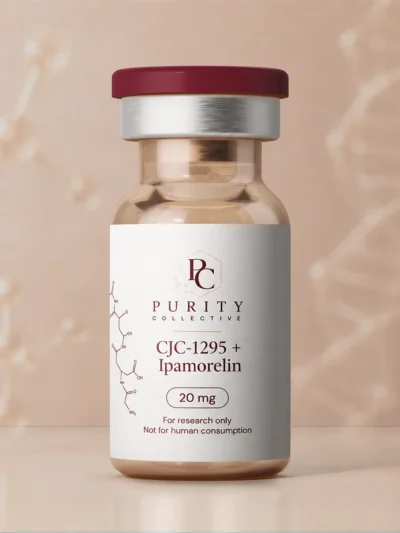

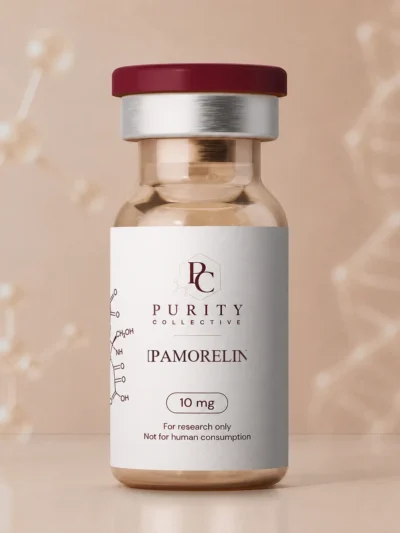
Four listings carry one or both peptides. The two blend vials hold both components in a fixed one-to-one catalog ratio; the single vials let a laboratory run each compound on its own or set its own ratio. Every listing below has a posted lot report, but the two laboratories that wrote them report the blend differently, which matters if you plan to compare lots.
| Listing | Contents (catalog) | Lot on report | Laboratory and method |
|---|---|---|---|
| CJC-1295 + Ipamorelin 10mg | CJC-1295 (no DAC) 5mg + ipamorelin 5mg | PCCL-3437208-P (endotoxin: -E) | Horizon Analytical, UPLC/MS, one result per component |
| CJC-1295 + Ipamorelin 20mg | CJC-1295 (no DAC) 10mg + ipamorelin 10mg | PCCJC-IPA-20 | ILS Laboratories, HPLC blend purity, identity and quantitation |
| CJC-1295 10 mg | CJC-1295 without DAC | DPS-7771773 | Horizon Analytical, UPLC/MS + endotoxin |
| Ipamorelin 10mg | Ipamorelin | DPS-2146000 | Horizon Analytical, UPLC/MS + endotoxin |
Key facts. CJC-1295 is a modified 29-residue fragment of growth hormone-releasing hormone (GHRH); ipamorelin is a five-residue agonist of the ghrelin receptor (GHS-R1a). Purity’s CJC-1295 is the form without DAC, the albumin-binding linker. The published human CJC-1295 studies used the DAC form, so their half-life and hormone results do not describe this material. No study has tested the two peptides together as a blend.
The somatotroph cell of the anterior pituitary releases growth hormone in response to two separate inputs. One is GHRH, which acts on the GHRH receptor. The other is the receptor first characterized in 1996 as the target of the synthetic growth hormone secretagogues, the GHS receptor[8688086], whose natural ligand, ghrelin, was found three years later as an acylated peptide made in the stomach[10604470]. CJC-1295 belongs to the first family and ipamorelin to the second.
The research reason for combining them is older than either compound. In 1990, a study in healthy men found that a synthetic GH-releasing hexapeptide and GHRH given together released more growth hormone than the sum of each alone[2108187], and in 2001 the same synergy was reported for low amounts of ghrelin given with GHRH[11549707]. That body of work concerns the native hormones and older secretagogues. It is the rationale for the blend, not evidence about the blend itself.
Native GHRH has 44 amino acids, but its first 29 carry the activity. Systematic substitution studies of hGHRH(1-29)-NH2 mapped which positions could be changed without losing potency[9513600]. The weakness of the native fragment is speed: plasma dipeptidyl peptidase IV cuts GHRH between residues 2 and 3 within minutes, and substitution of a D-amino acid at position 2 slows that cleavage[2565342]. “Tetrasubstituted GRF(1-29)”, often sold as Mod GRF 1-29, carries four such substitutions (D-Ala2, Gln8, Ala15, Leu27) to resist enzymatic breakdown.
The name CJC-1295 was first given to a version of that tetrasubstituted fragment with one more change: a maleimidopropionamide group on an added C-terminal lysine, the “drug affinity complex” (DAC). In rats the DAC group bonded to serum albumin, and the peptide was still in plasma beyond 72 hours[15817669]. Everything distinctive in the CJC-1295 human literature follows from that albumin bond.
Purity’s CJC-1295 is the version without DAC. Its lot reports print the formula C152H252N44O42 and a molecular weight of about 3367.9, which is the PubChem record “CJC1295 Without DAC” (CID 91976842). The DAC form is a different molecule, C165H269N47O46 at about 3647.2 (PubChem CID 91971820). The two are not interchangeable in any calculation, and a result reported for one says nothing about the other.
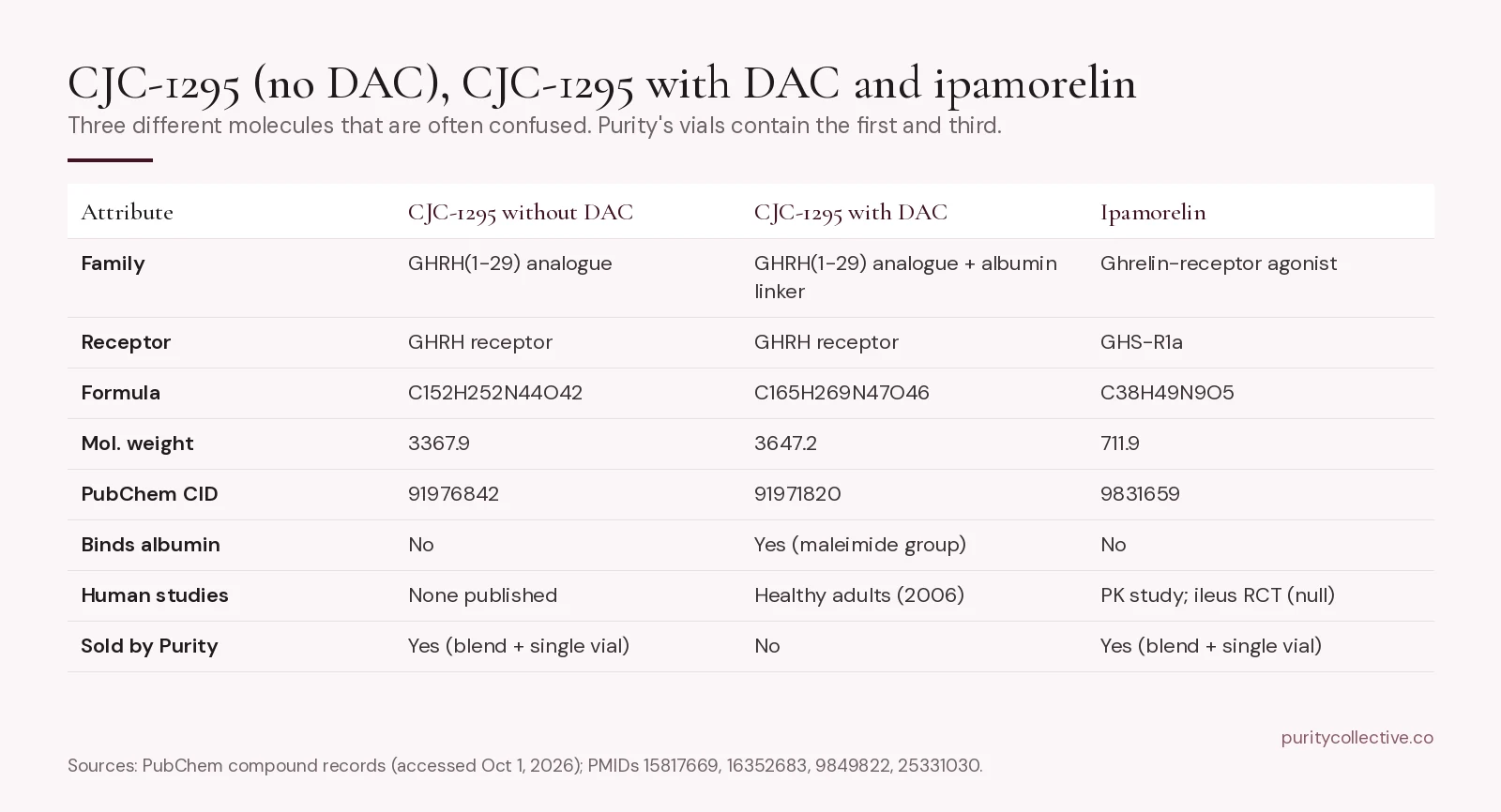
Ipamorelin is the pentapeptide Aib-His-D-2-Nal-D-Phe-Lys-NH2, identified in a medicinal chemistry program that removed the central Ala-Trp dipeptide of GHRP-1[9849822]. In rat pituitary cells it released growth hormone with potency and efficacy similar to GHRP-6, and antagonist studies placed its action on the GHRP (ghrelin) receptor. Its notable property was selectivity: in conscious swine, GHRP-6 and GHRP-2 raised ACTH and cortisol, whereas ipamorelin did not raise them beyond the levels seen with GHRH, even at more than 200 times its ED50 for growth hormone[9849822]. The authors called it the first GHRP-receptor agonist with GHRH-like selectivity.
The one published human pharmacokinetic study, in healthy male volunteers given intravenous infusions, found dose-proportional kinetics, a terminal half-life of about two hours and a single episode of GH release per infusion[10496658]. Ipamorelin was later tested as a gut-motility agent rather than as a growth agent, which is where its clearest negative result comes from (below).
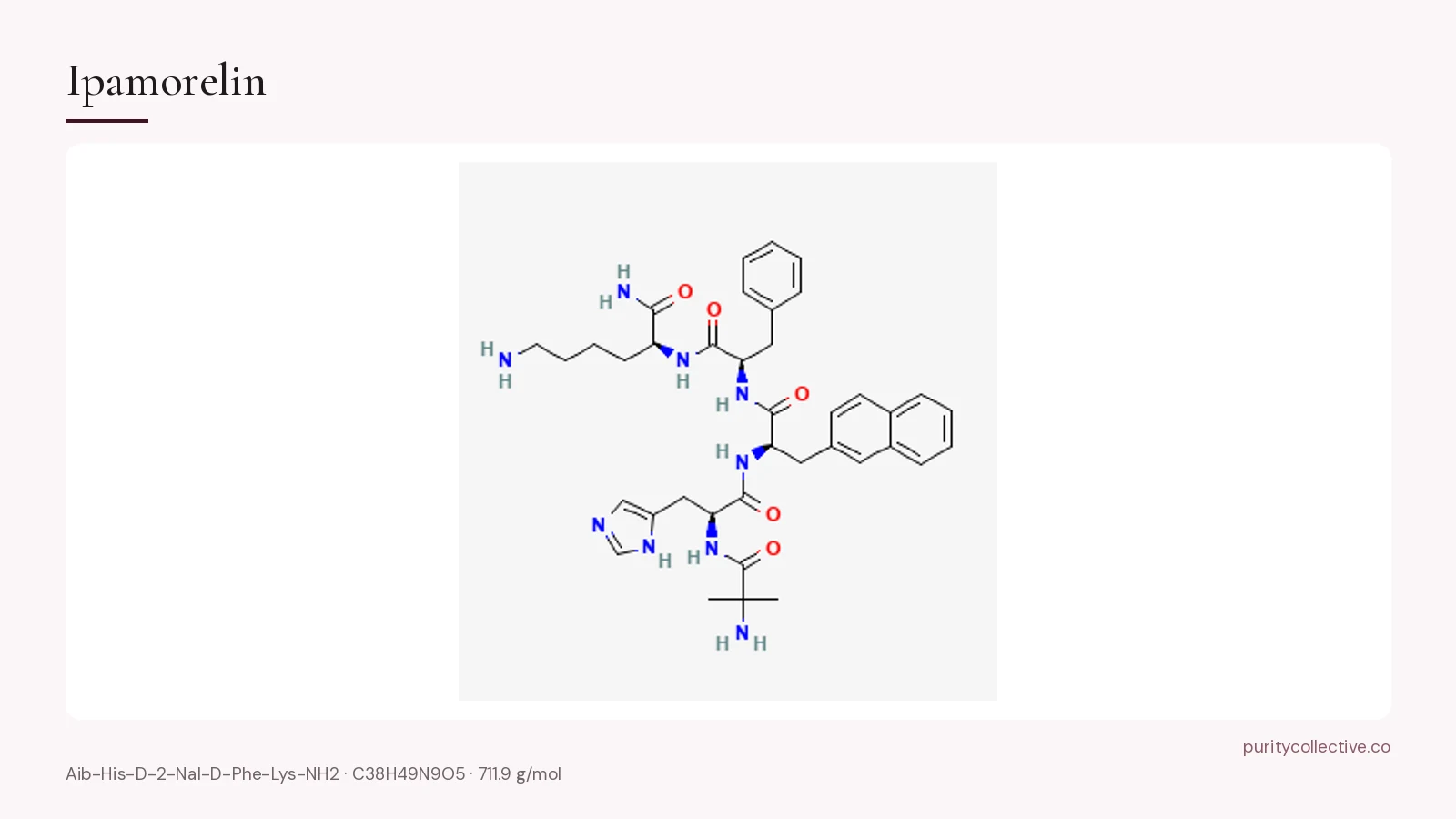
The values below were checked against PubChem on October 1, 2026, not copied from the lot reports.
| Attribute | CJC-1295 (without DAC) | Ipamorelin |
|---|---|---|
| Class | GHRH(1-29) analogue, tetrasubstituted | Growth hormone secretagogue, ghrelin-receptor (GHS-R1a) agonist |
| Length | 29 amino acids, C-terminal amide | 5 residues (Aib-His-D-2-Nal-D-Phe-Lys-NH2) |
| Molecular formula | C152H252N44O42 | C38H49N9O5 |
| Molecular weight | 3367.9 g/mol | 711.9 g/mol |
| PubChem CID | 91976842 | 9831659 |
| CAS (as printed on Purity’s reports) | 446036-97-1 (PubChem maps it to a record with the same formula, CID 56841945) | 170851-70-4 (listed in PubChem for CID 9831659) |
| Not to be confused with | CJC-1295 with DAC, C165H269N47O46, CID 91971820 | GHRP-2, GHRP-6, ghrelin |
| Regulatory status (US) | Neither is an FDA-approved drug. Both are sold here as research reference materials. | |
Identifier note on the CJC-1295 reports. Purity’s Horizon Analytical reports for CJC-1295 (lots PCCL-3437208-P/-E and DPS-7771773) print PubChem CID 91976840 beside the compound. In PubChem, 91976840 is BNP-32 (porcine) trifluoroacetate, an unrelated 32-residue natriuretic peptide (C149H250N52O44S3). The formula and molecular weight printed on the same reports match CJC-1295 without DAC, so this reads as a transcription error in the identifier field, not a different substance. The correct record is CID 91976842. The identity result itself rests on the mass measurement, not on the CID line.
In the rat work that introduced it, the DAC compound produced roughly four times the growth hormone exposure of unmodified hGRF(1-29) over two hours and stayed bound to albumin beyond 24 hours[15817669]. In mice lacking the GHRH gene, CJC-1295 largely normalized growth, which repeated injections of a short-acting GHRH analogue had not achieved[16822960]. In healthy adults, single and repeated doses raised mean growth hormone and IGF-I for days, with an estimated half-life of 5.8 to 8.1 days[16352683]; a second study found that pulsatile secretion persisted, with the rise coming mainly from higher trough levels[17018654]. All of these studies used the DAC form.
In adult female rats, ipamorelin increased longitudinal bone growth rate in a dose-dependent manner over 15 days[10373343]. A three-month study in the same model reported higher total bone mineral content by DXA, but once corrected for the accompanying gain in body weight the ratio did not change, and volumetric bone density was unchanged[10828840]: bigger bones, not denser ones. In rats given a glucocorticoid, adding ipamorelin increased periosteal bone formation and muscle tetanic tension compared with the glucocorticoid alone[11735244]. In GH-deficient and normal mice, ipamorelin also increased fat-pad weight and relative body fat by a route that did not depend on growth hormone[11162489], an effect that cuts against a simple “lean tissue” reading of the secretagogue literature.
In a rat model of postoperative ileus, repeated ipamorelin increased fecal output, food intake and body weight after abdominal surgery[19289567]. The follow-up randomized, placebo-controlled proof-of-concept study in 114 patients after bowel resection found no significant difference from placebo on the key or secondary efficacy endpoints; median time to the first tolerated meal was not significantly shorter[25331030]. It is the largest human study of ipamorelin and the clearest example in this field of an animal finding that did not carry over.
Because both compounds circulate outside clinical channels, much recent CJC-1295 literature comes from doping-control and forensic laboratories. A Norwegian laboratory identified a 29-residue amidated peptide matching CJC-1295 in an unlabeled preparation by high-resolution mass spectrometry[21204297], and a 2021 review summarized LC-MS methods for detecting synthetic GHRH analogues, including the CJC-1295 variants[34665524]. For a buyer of research material, this is the relevant lesson: mass spectrometry, not a label, is what separates the DAC and non-DAC forms.
| Compound and form | Model | What was measured | Finding (direction only) | PMID |
|---|---|---|---|---|
| CJC-1295 with DAC | Rat; rat pituitary cells | GH secretion, plasma persistence, albumin binding | Longer exposure than hGRF(1-29); albumin-bound beyond 24 h | [15817669] |
| CJC-1295 with DAC | GHRH-knockout mice | Growth, body composition | Growth partly normalized | [16822960] |
| CJC-1295 with DAC | Healthy adults | GH, IGF-I, half-life, safety | Sustained GH and IGF-I rise; half-life of days | [16352683] |
| CJC-1295 with DAC | Healthy men | GH pulsatility | Pulses preserved; trough GH raised | [17018654] |
| Ipamorelin | Rat pituitary cells; rats; swine | GH release, ACTH, cortisol | GH release without ACTH or cortisol rise | [9849822] |
| Ipamorelin | Healthy men (IV) | PK/PD | Half-life about 2 h; single GH episode | [10496658] |
| Ipamorelin | Adult female rats | Bone growth rate; bone mineral | Growth rate up; density per volume unchanged | [10373343][10828840] |
| Ipamorelin | Glucocorticoid-treated rats | Bone formation, muscle strength | Partial offset of glucocorticoid effects | [11735244] |
| Ipamorelin | Mice (GH-deficient and normal) | Body fat | Fat mass up, GH-independent | [11162489] |
| Ipamorelin | Rat postoperative ileus | Gut transit, intake | Improved with repeated dosing | [19289567] |
| Ipamorelin | 114 bowel-resection patients, RCT | Time to tolerated meal | No significant difference vs placebo | [25331030] |
All four listings link a lot report, and they come from two laboratories with different formats.
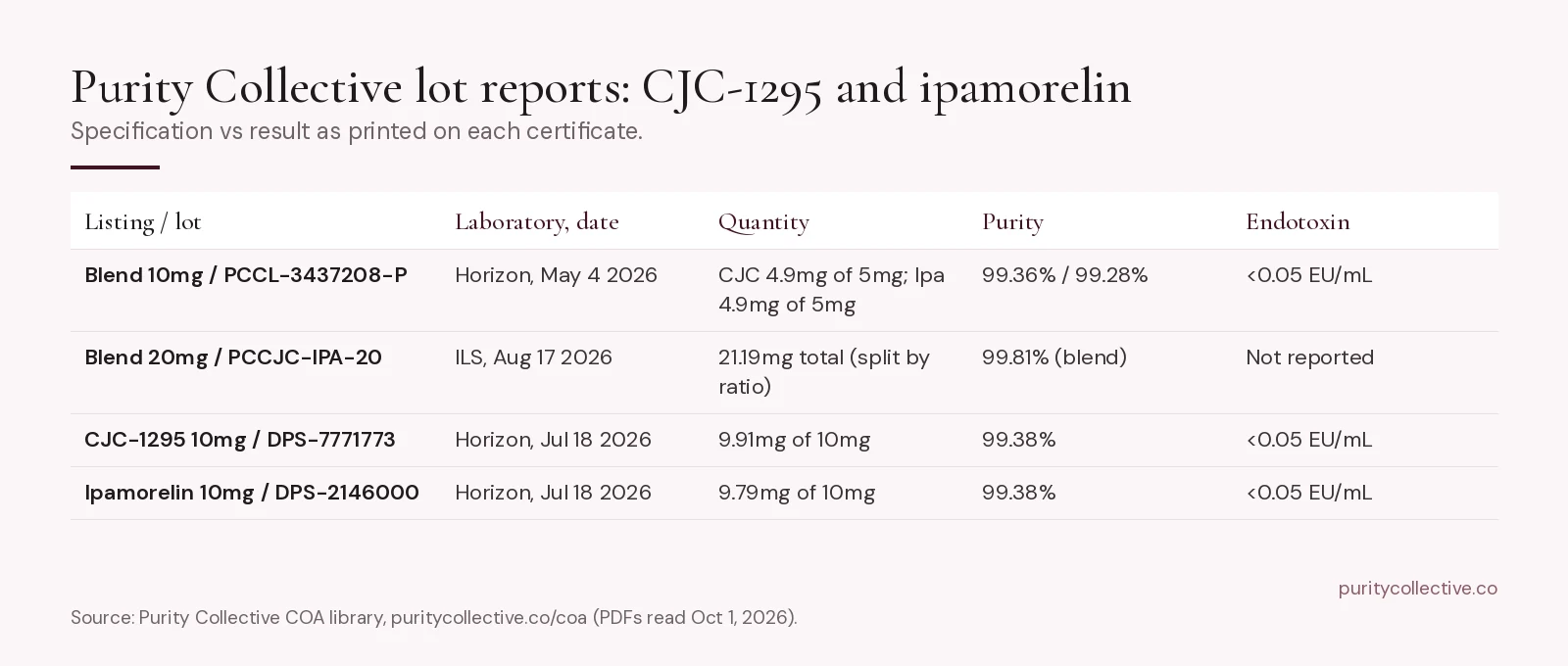
CJC-1295 + Ipamorelin 10mg, lot PCCL-3437208-P (Horizon Analytical, analysis May 4, 2026, UPLC/MS): CJC-1295 no DAC 4.9mg against a 5mg specification at 99.36% purity; ipamorelin 4.9mg against 5mg at 99.28%. The matching endotoxin report, PCCL-3437208-E, reads <0.05 EU/mL. Each component has its own result, which is the most useful format for a blend.
CJC-1295 + Ipamorelin 20mg, lot PCCJC-IPA-20 (ILS Laboratories COA-2026-RJMO_O, analysis August 17, 2026, HPLC): blend purity 99.81%, net blend content 21.19mg, identity confirmed by retention-time match for both peptides, and fentanyl screen not detected. The split shown (CJC-1295 10.38mg, ipamorelin 10.81mg) is calculated from the manufacturer’s stated ratio, as the report itself notes, rather than measured per peak. The report has no endotoxin line.
CJC-1295 10 mg, lot DPS-7771773 (Horizon, July 18, 2026): 9.91mg against 10mg, 99.38% purity; endotoxin <0.05 EU/mL. Ipamorelin 10mg, lot DPS-2146000 (Horizon, July 18, 2026): 9.79mg against 10mg, 99.38%; endotoxin <0.05 EU/mL.
All PDFs are in the COA library and on each product page. For what each field means, see how to read a peptide COA and purity vs endotoxin reports.
All four listings are lyophilized powders. Keep vials cold, dry and away from light until use, and record the lot number with each experiment so a result can be traced to its certificate. Because the 20mg blend report gives a calculated rather than measured component split, laboratories that need per-component quantities should plan their own confirmation. Purity Collective publishes no reconstitution or administration instructions for any product.
Purity Collective lists a CJC-1295 + ipamorelin blend in 10mg and 20mg vials, plus single CJC-1295 10mg and ipamorelin 10mg vials, sold to qualified researchers for laboratory use. Every one of the four listings links a posted lot report.
Without DAC. The reports print C152H252N44O42 and a weight of about 3367.9, which is PubChem CID 91976842. The DAC form is a heavier, different molecule (CID 91971820), and the human CJC-1295 studies used that form.
The Horizon reports print CID 91976840, which in PubChem is porcine BNP-32, an unrelated peptide. The formula and weight on the same page match CJC-1295 without DAC, so the CID line is a transcription error. The correct record is 91976842.
The 10mg lot report gives CJC-1295 and ipamorelin their own quantity and purity results. The 20mg ILS report gives one blend purity and one total content, then splits the content by the stated formulation ratio, so its component figures are calculated rather than measured.
No. Published work covers each peptide separately, mostly in rodents, plus older human studies showing that GHRH and ghrelin-receptor agonists act together. The one randomized ipamorelin trial in patients found no benefit over placebo.
No. Neither is an FDA-approved drug, and both are sold here as research reference materials for laboratory use only. Purity Collective publishes no dosing or administration information.