
For laboratory research only. Not for human or animal use. This article gives no dosing, administration or therapeutic advice.
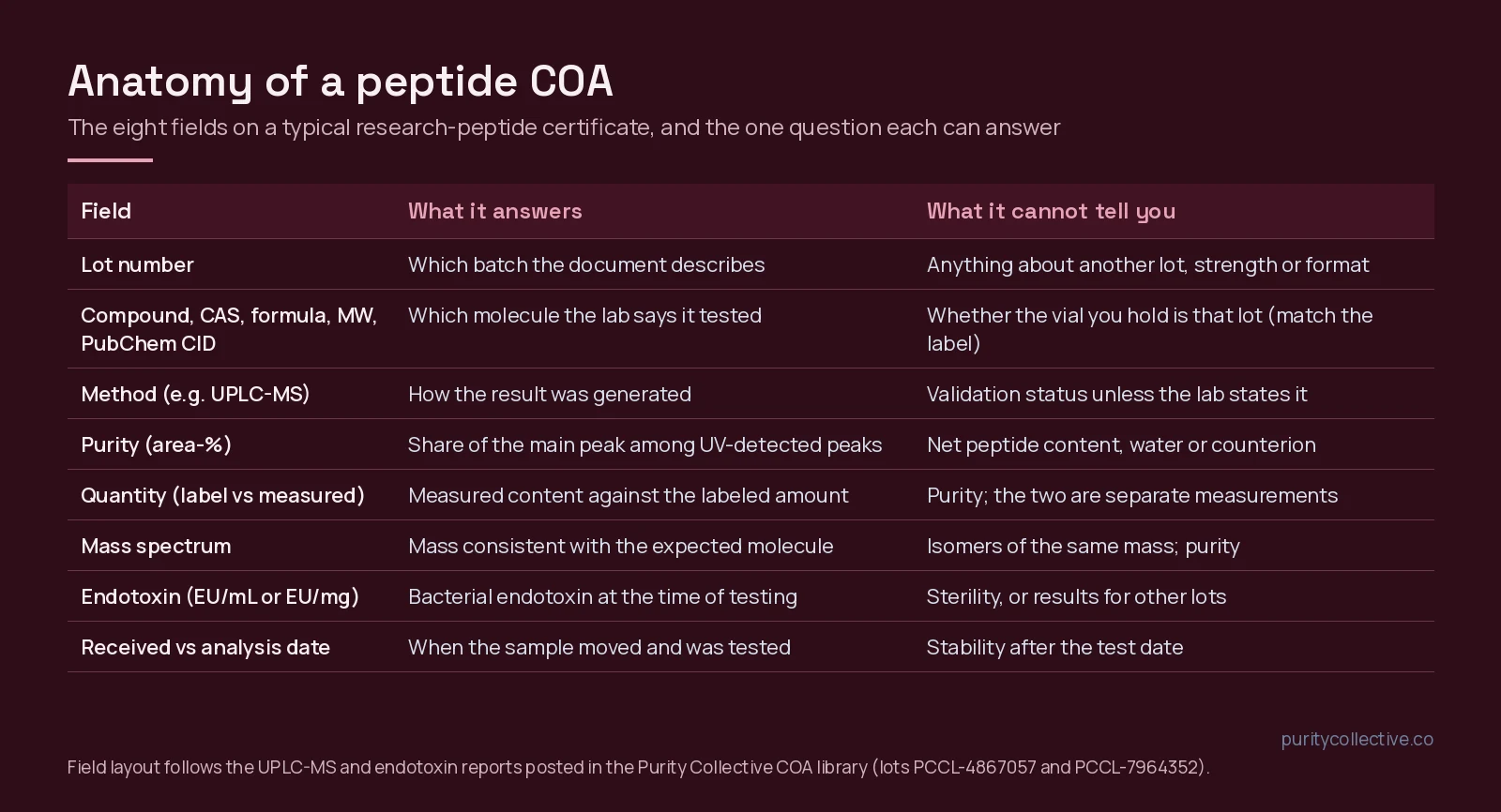
Short answer: a peptide certificate of analysis (COA) is a one-lot record. Read it in this order: lot number, identity block, method, purity, measured quantity, mass spectrum, endotoxin, dates. Each field answers one narrow question, and the most common mistakes come from letting one field answer another; a 99% purity figure says nothing about how many milligrams are in the vial, and an endotoxin result says nothing about sterility.
This guide uses the reports posted in the Purity Collective COA library as worked examples, because those are the documents a US researcher will actually be reading before ordering from us. The same reading order applies to any supplier’s certificate.
1. Start with the lot number, not the headline number
Everything on a certificate is scoped to one lot. On our reports the lot sits in the header (for example PCCL-4867057) and is repeated beside the compound name; the endotoxin document for the same lot carries the suffix -E and the purity document -P. Before reading any result, confirm that the lot on the document matches the lot printed on the vial you have or the product record you are evaluating. A certificate for one lot is not evidence about another lot, another strength, or another format of the same peptide. Our article on what a batch number connects goes through the edge cases.
2. Check the identity block against a public record
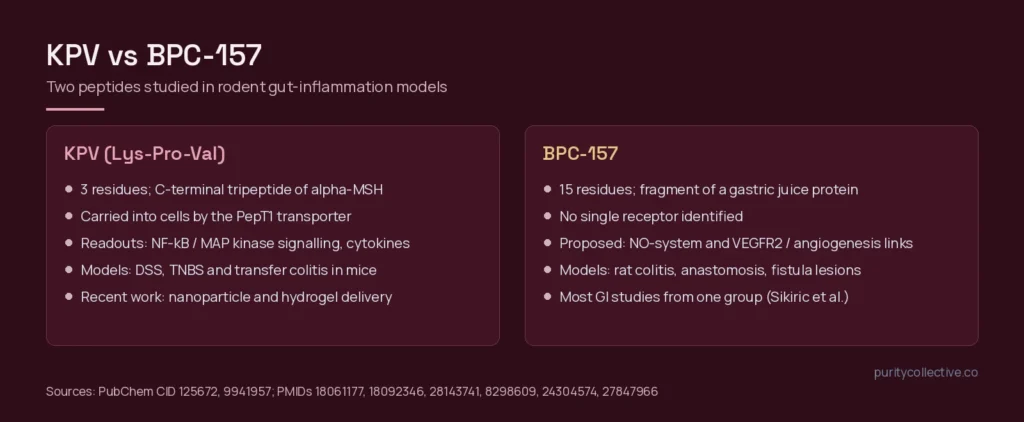
The identity block lists compound name, CAS number, molecular formula, molecular weight and PubChem CID. These are the lab’s statement of what it believes it tested. They are worth thirty seconds against the PubChem entry, because transcription errors happen. One of our own reports is the example: the KLOW 80mg blend report for lot PCCL-7964352 prints a KPV identifier block (CID 9929972, CAS 112965-21-6) that does not correspond to KPV (Lys-Pro-Val, CID 125672, C16H30N4O4). The chromatography and mass data on that page are for the KPV sample, but the identifier lines are wrong, and we have asked the lab for a corrected report. A mismatch like that is a documentation question to raise with the seller, not a reason to ignore the rest of the document, and not something to wave through either.
3. Read the method line before the result
Most research-peptide certificates, including ours, report a reversed-phase UPLC or HPLC separation with UV detection and a mass spectrometry trace. Reversed-phase chromatography is the standard way to separate a synthetic peptide from its process-related impurities (deletion sequences, truncated chains, oxidized or deamidated variants), and reviews of pharmaceutical peptide characterization describe it as the first-line purity method[1][2]. The method line tells you how the number was generated; it does not, by itself, tell you the method was validated for that peptide, the column and gradient used, or the detection wavelength. Reports that state those details answer more questions than reports that do not. Our companion piece on HPLC vs mass spectrometry explains what each instrument contributes.
4. Purity is an area percentage, with known blind spots
The purity result (99.23% on the Tesamorelin 10mg report; 99.18%, 99.13%, 99.45% and 99.05% for the four KLOW components) is the main peak’s share of the total integrated peak area in the UV chromatogram. Three limits follow from how it is calculated:
- It only counts what the detector sees. Water, trifluoroacetate or acetate counterions and inorganic salts are invisible to UV at peptide wavelengths, so they are not in the denominator. Synthetic peptides made by solid-phase synthesis are routinely isolated as trifluoroacetate salts, and a 2025 methods study found the counterion fraction varies with sequence and must be measured separately[5]. This is why purity and net peptide content are different numbers; we cover the arithmetic in what 99% peptide purity means.
- Co-eluting impurities hide inside the main peak. Isomers and closely related sequences can run with the parent peptide. A 2023 two-dimensional LC-MS study was built precisely because compounds with the same mass-to-charge ratio are not resolved by the mass spectrometer and have to be separated chromatographically[3], and a 2025 cyclic-peptide study showed reversed-phase alone gave inaccurate impurity totals until an orthogonal HILIC separation was added[10].
- Area-% is not mass-%. Impurities with different chromophores respond differently. Reference-material work on synthetic C-peptide and oxytocin quantified more than 65 structurally related impurities by high-resolution LC-MS and corrected the purity assignment for them, which is well beyond what a routine COA does[4][11]. A routine certificate gives you a screening number, not a reference value.
Read the chromatogram image when the report includes one. A single dominant peak with a flat baseline and a stated specification (ours print ≥98% or >98%) is what a clean result looks like; a result with no chromatogram, no specification and no method line is a weaker document even if the percentage is high.
5. Quantity is a separate measurement from purity
Our UPLC-MS reports print a quantity row: label 10mg, measured 10.13mg for Tesamorelin lot PCCL-4867057-P; label 10mg, measured 9.75mg for the BPC-157 panel of KLOW lot PCCL-7964352. This is the lab’s measured content against the labeled fill. It is the number that tells you whether a vial is under- or over-filled, and it is independent of purity: a vial can be on-label for quantity and off for purity, or the reverse. Keep the two in separate columns of your notes. A 2024 market-surveillance study of semaglutide vials bought from illegal online sellers is a useful illustration of why: measured content exceeded the labeled amount by 29–39% while measured purity was 7.7–14.4%, and every sample carried detectable endotoxin[9]. A buyer reading only the content row, or only the purity row, would have reached the wrong conclusion.
6. The mass spectrum answers one question: is the mass right?
The MS panel confirms that the main peak’s measured mass is consistent with the expected molecular weight (about 5196 g/mol for tesamorelin, about 1419.5 for BPC-157, 4963 for TB-500). That is identity evidence, and it rules out a wrong compound of a different mass. It does not distinguish isomers of the same mass, and a mass match on the main peak says nothing about purity[3][2]. Our explainer on what “mass consistent with expected” means goes deeper.
7. Read the endotoxin report as its own document
Endotoxin testing detects lipopolysaccharide from Gram-negative bacteria. The compendial method is the Limulus amebocyte lysate (LAL) assay; recombinant factor C (rFC) assays are an accepted alternative that performed at least equivalently to LAL in a four-vaccine comparison and in a 2014–2019 proficiency program[7][6]. Our endotoxin reports (lot suffix -E) print the result as <0.05 EU/mL with no specification line and no method name, so record exactly that: a below-detection result for the lot, by an unnamed endotoxin method. Three reading rules:
- Units matter. EU/mL describes the test solution; EU/mg describes the peptide. They are not interchangeable without knowing how the sample was prepared. The semaglutide surveillance study above reported 2.2–9.0 EU/mg, a per-mass figure[9].
- Low endotoxin recovery is a known artifact. Some protein and peptide matrices mask endotoxin so the assay under-reads it; a 2021 review summarizes the mechanisms and mitigation steps[8]. A very low result is reassuring but is not proof of absence.
- Endotoxin is not sterility. No research-peptide COA we have seen includes a sterility test, and ours do not. Our article on purity vs endotoxin reports keeps the two apart.
8. Dates, scope and the fine print
Our reports print a received date and an analysis date and a one-sentence scope statement that the analysis is for informational and research applications. Read the dates together: they tell you how old the result is relative to the lot’s manufacture and to today. They tell you nothing about stability after the test date, and no research-peptide COA does. If a date sequence looks unusual, ask the seller; the answer is usually a clerical one, and the asking is what distinguishes a reviewed document from a glanced-at one.
9. Result vs specification: a number is not a pass on its own
A specification, sometimes printed as an acceptance criterion, is the condition the lab compared the result against. On our Horizon reports it sits beside the result: “>98%” next to the 99.23% purity figure, “10mg” next to the 10.13mg measured quantity on the Tesamorelin 10mg lot. When both are printed, the document says the result met that stated limit, for that lot, under that method. When no limit is printed, the number is a reported result and nothing more.
Our own endotoxin documents are the example worth remembering. They print a result (<0.05 EU/mL) and no limit, so the accurate reading is “this lot measured below 0.05 EU/mL in the lab’s test”, not “this lot passed an endotoxin specification”. The same caution applies across labs: the ILS report for Tesamorelin 20mg (lot PCTSA-020) prints a purity specification of ≥95% against a 99.91% result, while the Horizon reports print >98%. Each result met its own lab’s limit; the limits are not interchangeable, and neither replaces the acceptance criteria your own lab sets before material is used.
10. Match the report to the exact listing
The lot check in step 1 connects a document to a lot. This step connects the lot to the page you are buying from, and it is where most misreadings happen, because neighboring listings look alike.
- Strength. Each strength is its own listing. Our Retatrutide 10mg, 15mg and 30mg listings each link a different lot report (PCCL-5859103-P, PCCL-5244055-P and PCCL-1857910-P). The 20mg listing has no posted report, and the 10mg report is not evidence for it.
- Format. A pen or spray is a different listing from the vial. Our KLOW, Tesamorelin and Retatrutide pens reference the vial lot’s report (PCCL-7964352, PCCL-4867057-P and PCCL-5859103-P), which describes that lot’s material as tested; read the pen page to see which lot it names.
- Lab and fields. Two strengths of one compound can come with different paperwork. Tesamorelin 10mg has a Horizon UPLC-MS report plus a separate endotoxin document; Tesamorelin 20mg has an ILS HPLC report with net peptide content (20.71mg) and no endotoxin line. Compare field by field, not report by report.
- Name. A listing title and a report heading can use different names for one molecule (a short form, a code name, a blend name). Let the formula, CAS number and PubChem CID settle it, as in step 2. Our guide to research peptide names and identifiers covers the common cases.
- Current page. If a listing has been renamed or moved, the documents linked on the current page are the ones that count, not a copy saved from an older URL.
Worked example: one lot, two documents
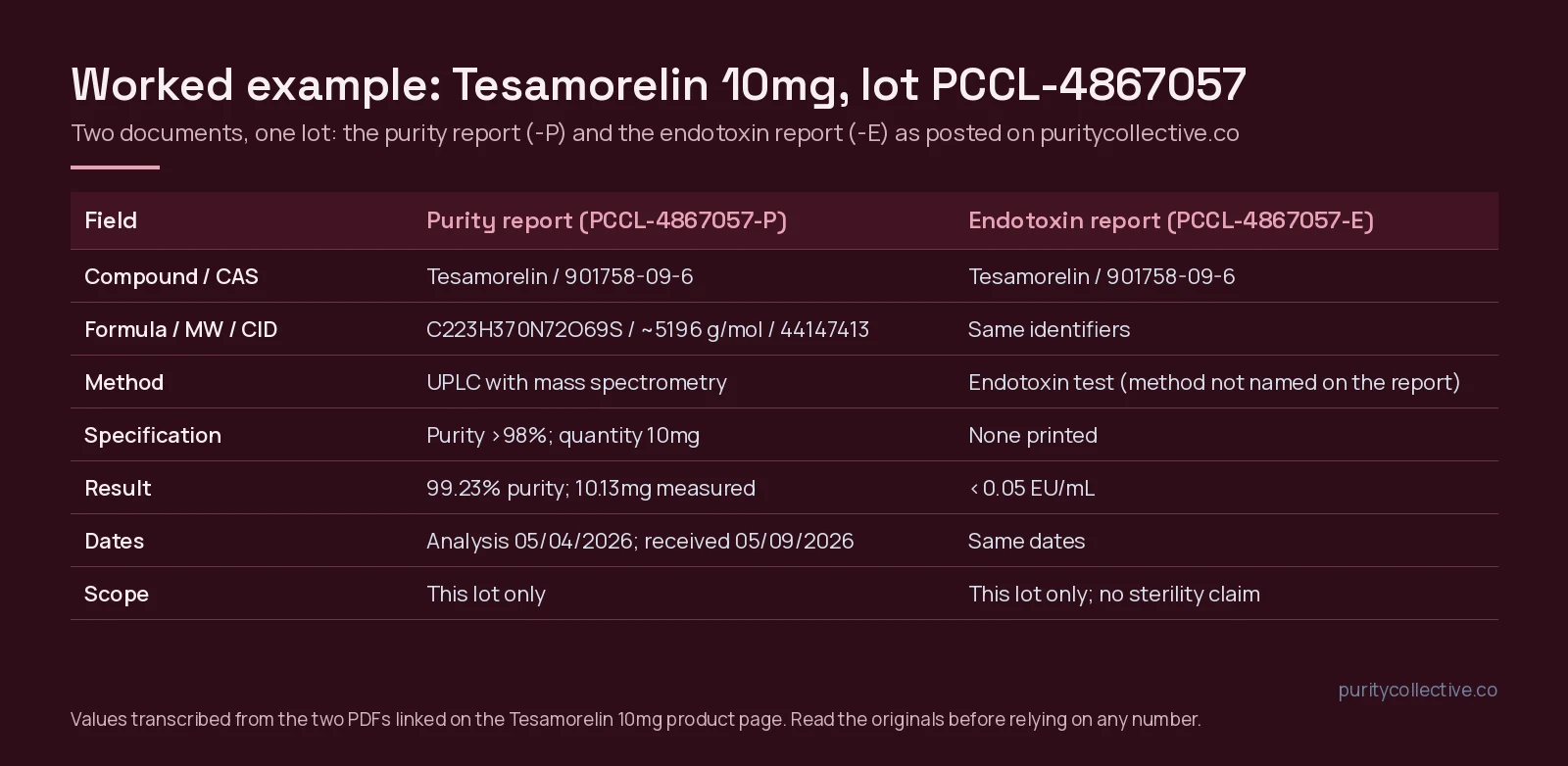
| Field | Purity report PCCL-4867057-P | Endotoxin report PCCL-4867057-E | Question it answers |
|---|---|---|---|
| Compound / CAS | Tesamorelin / 901758-09-6 | Tesamorelin / 901758-09-6 | Which molecule was tested |
| Formula / MW / PubChem CID | C223H370N72O69S / ~5196 g/mol / 44147413 | Same | Identity against the public record |
| Method | UPLC with mass spectrometry | Endotoxin test (method not named) | How the result was generated |
| Specification | Purity >98%; quantity 10mg | None printed | What the lab compared the result against |
| Result | 99.23% purity; 10.13mg measured | <0.05 EU/mL | The lot’s numbers |
| Dates | Analysis 05/04/2026; received 05/09/2026 | Same | How current the record is |
| Scope | This lot, research applications | This lot; no sterility claim | What the document covers |
Blend reports follow the same pattern with one panel per component. The KLOW 80mg report for lot PCCL-7964352 has four UPLC-MS panels (GHK-Cu, BPC-157, TB-500, KPV), each with its own quantity and purity row, plus one endotoxin document for the blend. Read each panel as its own small certificate; a 99.45% result for GHK-Cu is not a result for the blend as a whole. Single-compound vs blend records covers the pitfalls.
What a COA does not show
- Stability or shelf life after the analysis date.
- Sterility, or the absence of microorganisms.
- Net peptide content, unless the report states it separately from area-% purity.
- Anything about other lots, strengths, pens or sprays of the same compound.
- Suitability for any particular protocol. A certificate is a description of material, not an endorsement of a use.
Keep a one-page record for each product
When you are evaluating more than one product, or the same product over several orders, a small written record makes the review repeatable and stops a number drifting from the document it came from. One row per field is enough:
| Record this | Example: Tesamorelin 10mg |
|---|---|
| Listing URL, title, strength and format | /product/tesamorelin-10mg/, 10mg vial |
| Each document: file, lab, lot | Horizon purity report PCCL-4867057-P; endotoxin report PCCL-4867057-E |
| Dates | Analysis 05/04/2026, received 05/09/2026 |
| Identity check against PubChem | Formula, MW and CID 44147413 match |
| Each result with its method, specification and units | Purity 99.23% (UPLC, spec >98%); quantity 10.13mg (label 10mg); endotoxin <0.05 EU/mL (no limit printed) |
| What is missing or unresolved | No endotoxin method named; no net peptide content; no sterility test |
The last row matters most. A record that ends with an open question is more accurate than one that quietly fills the gap with an assumption, and it tells you exactly what to ask the seller.
Checklist before you order
- Find the report for the exact product and strength. On our product pages the PDFs are linked under the description; the full set is in the COA library. If a listing has no posted report, it will say so, and you should treat the product as undocumented until one is posted.
- Match the lot number on the report to the lot on the listing or vial.
- Check CAS, formula, MW and PubChem CID against PubChem.
- Record purity, measured quantity and endotoxin as three separate values with their units.
- Note the method, the specification (if any) and the analysis date.
- Write down what is missing: no chromatogram, no specification, no method name, no sterility test. Missing is information too.
If you are comparing suppliers before you buy research peptides online in the USA, run the same checklist on each seller’s documents rather than on their claims about the documents. The seller-comparison checklist on this site turns the same six steps into a scoring sheet.
Frequently asked questions
Is a 99% purity result the same as 99% peptide in the vial?
No. The purity figure is the main peak’s share of the UV-detected peaks in a chromatogram; it does not count water, counterions such as trifluoroacetate, or salts, which can make up a meaningful fraction of a lyophilized powder’s mass. Net peptide content is a separate measurement, and most research-peptide COAs do not report it.
What is the difference between the quantity result and the purity result?
Quantity compares the measured amount of peptide with the labeled amount (for example 10.13mg measured against a 10mg label). Purity describes how much of the detected peptide material is the main compound. A vial can be close to its labeled quantity and still have a low purity, or the reverse.
Why does a lot sometimes have two separate reports?
Many labs issue the UPLC-MS purity and identity analysis as one document and the endotoxin test as another, often with a suffix on the lot number (for example -P and -E). Both belong to the same lot; neither replaces the other.
Does an endotoxin result below 0.05 EU/mL mean the vial is sterile?
No. An endotoxin test detects bacterial endotoxin, usually with a Limulus amebocyte lysate (LAL) or recombinant factor C assay. Sterility is a different test and is not part of a standard research-peptide COA. Note also whether the unit is EU/mL or EU/mg, which are not interchangeable.
How do I check that a COA belongs to the product I am looking at?
Match four things: the compound name, the strength or labeled quantity, the lot number on the vial, and the identity block (CAS, formula, molecular weight, PubChem CID) against the public PubChem record. If any of these do not line up, treat it as an open question for the seller rather than assuming the document applies.
Can a COA for a 10mg vial be used for the 20mg or pen version of the same peptide?
Only if the seller states that both formats come from the same lot and the lot number matches. A certificate describes one lot. Different strengths and formats are usually different lots, so each should have its own report.
If a COA prints a result but no specification, did the lot pass?
There is nothing printed to pass against. The document shows that the lot produced that result in that test. Record it as a reported result, with its units and method, and compare it with your own lab’s acceptance criteria.
References
- Sharma N, Kukreja D, Giri T et al. (2022). Synthetic pharmaceutical peptides characterization by chromatography principles and method development. J Sep Sci. PMID: 35460196. doi: 10.1002/jssc.202101034.
- Lian Z, Wang N, Tian Y et al. (2021). Characterization of Synthetic Peptide Therapeutics Using Liquid Chromatography-Mass Spectrometry: Challenges, Solutions, Pitfalls, and Future Perspectives. J Am Soc Mass Spectrom. PMID: 34110145. doi: 10.1021/jasms.0c00479.
- Petersson P, Buckenmaier S, Euerby MR et al. (2023). A strategy for assessing peak purity of pharmaceutical peptides in reversed-phase chromatography methods using two-dimensional liquid chromatography coupled to mass spectrometry. Part I: Selection of columns and mobile phases. J Chromatogr A. PMID: 36841023. doi: 10.1016/j.chroma.2023.463874.
- Li M, Josephs RD, Daireaux A et al. (2018). Identification and accurate quantification of structurally related peptide impurities in synthetic human C-peptide by liquid chromatography-high resolution mass spectrometry. Anal Bioanal Chem. PMID: 29862433. doi: 10.1007/s00216-018-1155-y.
- Erckes V, Streuli A, Chamera Rendueles L et al. (2025). Towards a Consensus for the Analysis and Exchange of TFA as a Counterion in Synthetic Peptides and Its Influence on Membrane Permeation. Pharmaceuticals (Basel). PMID: 40872554. doi: 10.3390/ph18081163.
- Piehler M, Roeder R, Blessing S et al. (2020). Comparison of LAL and rFC Assays-Participation in a Proficiency Test Program between 2014 and 2019. Microorganisms. PMID: 32188126. doi: 10.3390/microorganisms8030418.
- Marius M, Vacher F, Bonnevay T (2020). Comparison of Limulus Amoebocyte Lysate and Recombinant Factor C Assays for Endotoxin Detection in Four Human Vaccines with Complex Matrices. PDA J Pharm Sci Technol. PMID: 32179709. doi: 10.5731/pdajpst.2019.010389.
- Cao Y, Zhang Y, Qiu F (2021). Low endotoxin recovery and its impact on endotoxin detection. Biopolymers. PMID: 34407207. doi: 10.1002/bip.23470.
- Ashraf AR, Mackey TK, Vida RG et al. (2024). Multifactor Quality and Safety Analysis of Semaglutide Products Sold by Online Sellers Without a Prescription: Market Surveillance, Content Analysis, and Product Purchase Evaluation Study. J Med Internet Res. PMID: 39509151. doi: 10.2196/65440.
- Yoshida K, Kato S, Nagai K et al. (2025). Impurity profiling of synthetic cyclic peptides based on orthogonality between hydrophilic-interaction and reversed-phase liquid chromatography. J Chromatogr A. PMID: 39922152. doi: 10.1016/j.chroma.2025.465748.
- Li M, Josephs RD, Daireaux A et al. (2021). Structurally related peptide impurity identification and accurate quantification for synthetic oxytocin by liquid chromatography-high-resolution mass spectrometry. Anal Bioanal Chem. PMID: 33479819. doi: 10.1007/s00216-021-03154-5.