For laboratory research only. Not for human or animal use. This article gives no dosing, administration or therapeutic advice.
Short answer: research peptides are synthetic peptides sold as reference materials for laboratory, analytical and in vitro work, not as medicines. Each listing describes one compound or blend at one strength and format, and the useful questions about it are narrow ones: what molecule is it, how much is in the vial, and which lot report, if any, describes it. This guide explains what a peptide is, how research peptides are made, and how to read a listing so that a name, a label amount or a public database entry is never mistaken for evidence about the material in front of you.
What a peptide is
A peptide is a short chain of amino acids joined by amide (peptide) bonds. The line between a peptide and a protein is a convention rather than a rule, usually drawn somewhere around 50 residues. Peptides sit between small-molecule drugs and large biologics, and that middle position is why they matter in research: they can be designed to bind a receptor with high selectivity, yet they are small enough to be made chemically. Since insulin, more than 80 peptide drugs have reached the market, for conditions from diabetes to osteoporosis[1], and reviews of the field describe a steady expansion of synthetic and modified peptides across many research areas[2].
That history is also the reason caution is needed. Several compounds sold as research materials share a name with, or are close relatives of, an approved or investigational medicine. The research material is not that medicine: it is not made, labeled or sold as one, and nothing on a research listing should be read as a statement about use in people.
How research peptides are made
Almost all research peptides are made by solid-phase peptide synthesis (SPPS). The first amino acid is anchored to a resin bead, and the chain is built one residue at a time in repeated cycles of deprotection and coupling; the Fmoc protecting-group chemistry is today’s method of choice, helped by cheap, high-quality building blocks from multiton therapeutic-peptide production[3]. At the end the peptide is cut from the resin, purified by reversed-phase HPLC and freeze-dried into the white powder that arrives in a vial.
Each of those steps leaves a characteristic fingerprint. Incomplete deprotection or coupling gives deletion sequences (a residue missing); excess reagent can give insertions; the chemistry can racemize a residue and create a diastereomer; and storage brings oxidation and deamidation[4]. The cleavage and purification steps rely on trifluoroacetic acid, so peptides are usually obtained as TFA salts, and the counterion is part of the powder’s weight[5]. These are the impurities and non-peptide components that the documents described below are designed to measure, and they explain why a purity figure and a milligram figure are different things.
What “research use only” means on a US listing
A research-use-only label describes the intended setting: controlled laboratory, analytical or in vitro work by people qualified to handle the material. It is not a quality grade and not a loophole. A responsible listing states that boundary plainly, avoids any promise about effects in a body, and gives no use instructions. What it should give instead is the material record: the compound, the strength, the format, the lot documents and their limits. Purity Collective ships within the US, and the listings on this site are sold for research use only.
Listed quantity vs analytical result
The “10mg” in a product title and the “10.13mg” on a lab report are different kinds of statement, and they belong in different columns. The first is a catalog amount: what the listing says a vial contains. The second is a measurement made on a submitted sample from one lot, by one method, on one date. Our Tesamorelin 10mg report (lot PCCL-4867057-P) shows both: a 10mg specification and a 10.13mg measured quantity.
Some reports add a third number. The ILS report for Tesamorelin 20mg (lot PCTSA-020) gives a net peptide content of 20.71mg: the peptide itself, after the water and counterions that make up part of a lyophilized powder’s weight are accounted for. Gross powder weight, labeled amount, measured quantity and net peptide content can all differ, and a result should never be rewritten as a promise about every vial. The COA reading guide walks through each field.
Each strength and format is its own record
Two listings for the same compound are still two records. They can come from different lots, be tested by different labs, and carry different fields. Our CJC-1295 + Ipamorelin listings show how far apart they can be:
| CJC-1295 + Ipamorelin 10mg | CJC-1295 + Ipamorelin 20mg | |
|---|---|---|
| Lot | PCCL-3437208-P | PCCJC-IPA-20 |
| Lab and method | Horizon Analytical, UPLC-MS, one panel per component | ILS Laboratories, HPLC on the blend |
| Results reported | CJC-1295 (no DAC) 4.9mg, 99.36%; Ipamorelin 4.9mg, 99.28% | Blend purity 99.81%; net blend content 21.19mg |
| Endotoxin | Separate report PCCL-3437208-E, <0.05 EU/mL | No endotoxin line on the report |
Neither report says anything about the other listing, and neither says anything about the single-compound CJC-1295 10mg or Ipamorelin 10mg vials, which have their own lot reports. Pens and sprays are separate listings again. The rule is simple: map each document to the exact listing it names, and leave any listing without a document marked as undocumented.
Single compounds vs blends
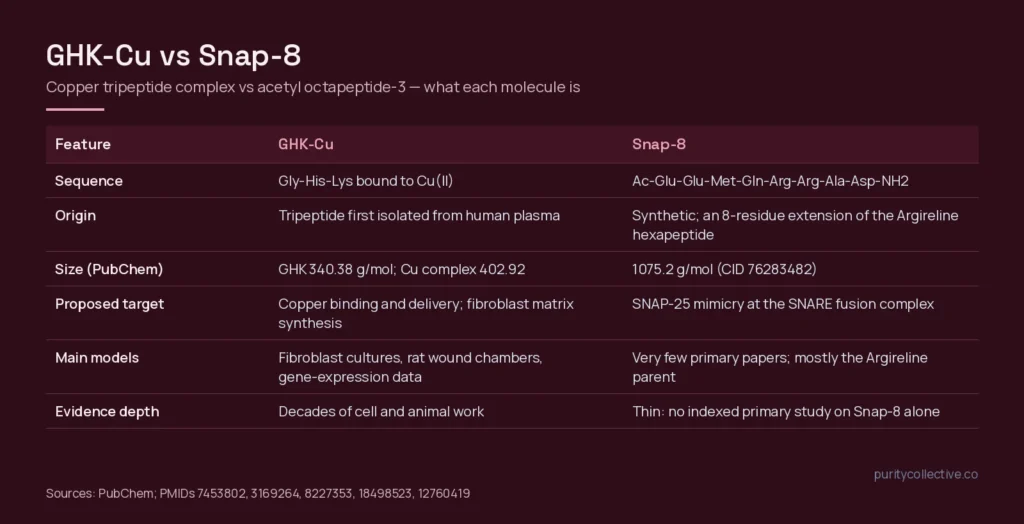
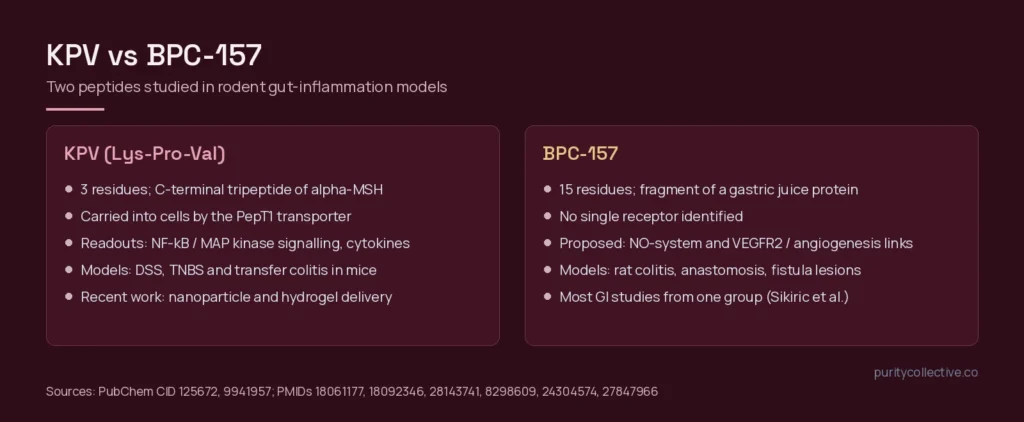
A single-compound listing maps one molecule to one record, which makes it the easier case. A blend needs component-by-component reading. A good blend listing names every component and its amount, and a good blend report gives each component its own panel. Our KLOW 80mg report (lot PCCL-7964352) has four, for GHK-Cu, BPC-157, TB-500 and KPV, each with its own measured quantity and purity, plus one endotoxin document for the blend.
Two transfers are tempting and both are wrong. A component result is not a result for the blend as a whole: the 99.45% on the GHK-Cu panel describes GHK-Cu in that lot, not KLOW. And a component panel inside a blend report is not evidence about the stand-alone listing of the same compound: the KPV panel in the KLOW report says nothing about the KPV 10mg vial, which is a different lot. Our KLOW hub goes through that report panel by panel.
Names, synonyms and code names
Peptide names are messy. The same molecule can travel under a trivial name, a development code, a nonproprietary name and a few spellings, and blend names are trade names rather than chemistry. A few real cases:
- SS-31 is listed in PubChem as elamipretide (CID 11764719), with SS-31 and MTP-131 among its recorded synonyms.
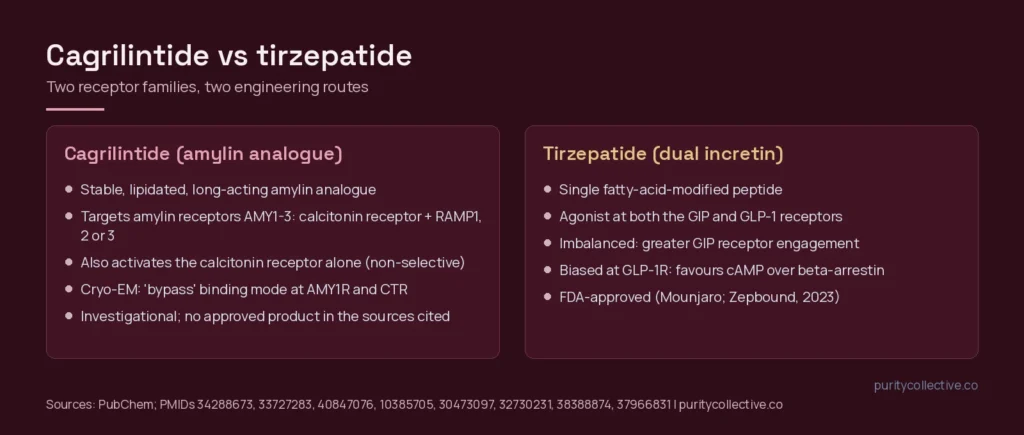
- Retatrutide appeared in the clinical literature first as LY3437943, a single molecule that acts on the GIP, GLP-1 and glucagon receptors[6].
- KPV (Lys-Pro-Val) is titled in PubChem as “Msh (11-13)”, because it is the C-terminal tripeptide of α-MSH.
- CJC-1295 exists with and without a drug affinity complex (DAC). They are different molecules with different formulas, and a listing should say which one it is. Ours is the no-DAC form.
- Hyphens and spacing (BPC-157, BPC 157, BPC157) are search variants of one name. Blend names such as KLOW and GLOW identify a product, not a molecule.
Names are for finding a record. Identity is settled by the formula, the molecular weight, the CAS number and the PubChem CID, checked against each other.
Public identity records vs product records
PubChem is the NIH’s public chemical repository: a Substance database of depositor records, a Compound database of unique standardized structures, and linked bioassay data[7], and its 2023 update alone added data from more than 120 new sources[8]. It is the right place to check what a name, formula or CID refers to. It is the wrong place to look for evidence about a product. A PubChem entry describes a structure; it says nothing about a seller, a lot or a vial.
The two records do meet in the identity block of a COA, and that is where checking pays off. Two of the reports linked on our own listings carry identifier errors that a PubChem lookup catches in seconds. The KLOW report prints CID 9929972 beside KPV, but that CID is H-Leu-Arg-Pro-OH; KPV is CID 125672 (C16H30N4O4). The CJC-1295 + Ipamorelin 10mg report prints CID 91976840 beside CJC-1295, which PubChem lists as porcine BNP-32; CJC-1295 without DAC is CID 91976842 (C152H252N44O42, about 3367.9). In both cases the chromatography and mass data concern the named peptide and the identifier line is a transcription error. Our product and hub pages state the correct identifiers while corrected reports are sought from the lab. We point these out because a reader who checks will find them, and should.
Renamed listings, moved pages and canonical URLs
Catalogs change. Products get renamed, categories get reorganized, and old URLs redirect to new ones. In fall 2026 we renamed our categories for US search (Recovery + Repair became Tissue Research Peptides, Mind became Neuro Research Peptides, Radiance became Dermal Research Peptides), with permanent redirects from the old addresses. Three habits keep the record straight through changes like that:
- Treat the current product page, at its canonical URL, as the source of truth for title, strength, format and linked documents.
- Do not merge evidence between two pages because their slugs or old names look alike. Match on strength, format and lot.
- If you saved a PDF from an older page, check that the current listing still links the same lot before relying on it.
How to use the Purity Collective catalog
Start from the category that fits your work: Metabolic, Weight Loss, Growth Hormone, Tissue, Neuro, Dermal or Skin & Hair. Then open the exact listing and read its documents. Our compound hubs, such as KLOW and Tesamorelin, collect the science and every strength in one place, and the COA library holds every posted report.
Be aware of what is and is not there. At the time of writing, 49 of our 70 listings have a posted batch report; the other 21 do not yet. Some reports include an endotoxin result and some do not. If you are comparing sellers before you buy research peptides online in the USA, ask the same narrow questions of every listing, ours included.
Checklist for any research peptide listing
- Does the title name the compound or every component of the blend, the strength and the format?
- Is a lot report linked for this exact listing, and does its lot match?
- Do the formula, CAS and CID on the report match PubChem?
- Are the label amount and the measured amount shown separately?
- Are purity, quantity and endotoxin recorded as separate results, with methods and any printed limits?
- Does the page stay inside a research-use boundary, with no use instructions or promises?
Frequently asked questions
What are research peptides?
Synthetic peptides sold as reference materials for laboratory, analytical and in vitro research, not as medicines. Each listing describes one compound or blend at one strength and format, ideally with a lot-specific analytical report.
What does “for research use only” mean?
It means the material is intended for controlled laboratory work by qualified people. It is not approved or labeled for human or veterinary use, and a responsible listing gives no use instructions or claims about effects.
Is the amount on the label the same as the amount measured on the COA?
Not necessarily. The label is the catalog amount; the report measures a sample from one lot. Some reports also give net peptide content, which excludes water and counterions. Record each number separately.
Does a blend’s COA cover the single-compound product of the same peptide?
No. A component panel in a blend report describes that component in that blend lot. A stand-alone vial of the same peptide is a different listing and needs its own lot report.
Does every Purity Collective listing have a COA?
No. At the time of writing, 49 of our 70 listings have a posted batch report. Reports are collected in the COA library on this site.
References
- Muttenthaler M, King GF, Adams DJ et al. (2021). Trends in peptide drug discovery. Nat Rev Drug Discov. PMID: 33536635. doi: 10.1038/s41573-020-00135-8.
- Wang L, Wang N, Zhang W et al. (2022). Therapeutic peptides: current applications and future directions. Signal Transduct Target Ther. PMID: 35165272. doi: 10.1038/s41392-022-00904-4.
- Behrendt R, White P, Offer J (2016). Advances in Fmoc solid-phase peptide synthesis. J Pept Sci. PMID: 26785684. doi: 10.1002/psc.2836.
- D’Hondt M, Bracke N, Taevernier L et al. (2014). Related impurities in peptide medicines. J Pharm Biomed Anal. PMID: 25044089. doi: 10.1016/j.jpba.2014.06.012.
- Erckes V, Streuli A, Chamera Rendueles L et al. (2025). Towards a Consensus for the Analysis and Exchange of TFA as a Counterion in Synthetic Peptides and Its Influence on Membrane Permeation. Pharmaceuticals (Basel). PMID: 40872554. doi: 10.3390/ph18081163.
- Jastreboff AM, Kaplan LM, Frías JP et al. (2023). Triple-Hormone-Receptor Agonist Retatrutide for Obesity – A Phase 2 Trial. N Engl J Med. PMID: 37366315. doi: 10.1056/NEJMoa2301972.
- Kim S, Thiessen PA, Bolton EE et al. (2016). PubChem Substance and Compound databases. Nucleic Acids Res. PMID: 26400175. doi: 10.1093/nar/gkv951.
- Kim S, Chen J, Cheng T et al. (2023). PubChem 2023 update. Nucleic Acids Res. PMID: 36305812. doi: 10.1093/nar/gkac956.